Why ZhiWei

Your Reliable Bag Factory — From Sample to Scale

88+ skilled workers, 100% in-house production, zero outsourced steps. Here's why 30+ countries trust us.

MOQ Starting at 300 Pieces Test new products without tying up cash — prove market demand first, then scale as your sales grow.
7-Day Sample Turnaround Get production-accurate samples in 7–10 days — validate fit, materials, and build quality before committing to bulk.
100% Pre-Shipment Inspection Every unit in every order is checked against your approved sample — so bulk always matches what you signed off on.
Full OEM & ODM Customization Structure, materials, color, hardware, printing — every element is customizable to your brand's specification.
BSCI ISO 9001 GRS

Get Your Free Quote

Tell us about your bag project — we'll respond within 24 hours with specific answers, pricing, and a tailored production plan. No sales pressure.

Response within 24 hours · No commitment required

Engineered for Reliability

Application in Outdoor & Tactical Industry

Outdoor gear bag programs are shaped by durability expectations, heavy-load use, replenishment pressure, and the need to balance rugged performance with channel-ready execution.

In this category, stronger bag programs usually depend on clearer material standards, more disciplined structural logic, and production systems that can hold up under field-use expectations without losing commercial control.

Industry Realities

What Buyers Commonly Face in Outdoor & Tactical Bag Programs

In this sector, the difficulty is rarely limited to tactical bag sourcing. The harder problem is building a product line that can survive real use, remain commercially viable, and scale without operational instability.

Risk Control

New SKUs Must Be Tested Carefully

Outdoor and tactical products often enter the market through cautious launch cycles, where low-risk validation matters before inventory is committed at scale.

Profitability

Durability and Cost Must Stay Aligned

Heavy-duty fabrics, reinforced panels, and tactical hardware increase product credibility, but must still fit the target price structure.

Inventory

Replenishment Stability Matters Early

For fast-moving outdoor products, weak replenishment control can interrupt sales momentum before the line has time to mature.

Positioning

Differentiation Must Be Functional

In the tactical segment, design language alone is rarely enough. Buyers increasingly expect compartment logic, modular tactical design, and field-use relevance to be credible.

These pressures are common across tactical bag sourcing.

Review the Common Roadblocks
Common Roadblocks

Why Outdoor & Tactical Bag Projects Commonly Break Down

Many failures in this category begin with weak structural reasoning, loose execution standards, or product positioning that looks tactical without behaving that way.

Tactical Positioning Without Structural Depth

Some products communicate ruggedness visually, but lack the load-bearing structure, stress-point control, and reinforcement logic expected in real use.

Root cause: Appearance-driven development.

Bulk Orders Drift Away from the Approved Standard

Initial samples may pass visual review, but production batches often lose consistency in stitching, hardware, and fabric performance.

Root cause: Weak execution control.

Durability Is Claimed, Not Defined

Terms like heavy-duty or military-grade are often used loosely without a clear specification framework behind them.

Root cause: Unclear material standards.

Replenishment Is Treated as an Afterthought

When outdoor products start moving, unstable lead times and weak capacity planning can interrupt ranking, distribution rhythm, or reorder confidence.

Root cause: Disconnected supply planning.

Execution Lacks End-Use Awareness

Bag programs may follow instructions exactly while still missing the practical expectations of outdoor and tactical buyers.

Root cause: Order-taking without scenario reasoning.

These issues often look small at development stage and become expensive later.

See the Consequences
The Cost of Compromise

How Weak Outdoor & Tactical Execution Usually Spreads Through the Business

In this category, the real cost is rarely the first defect. It is the chain reaction that follows once rugged-use products fail in the wrong channel or at the wrong time.

1

Structural Weakness Appears

Materials, stitching, or hardware fail to support the intended load or use condition.

2

End-User Confidence Drops

Outdoor users quickly notice weak performance because the product category invites practical, repeated stress.

3

Review and Return Pressure Rises

Low durability is exposed faster in tactical and outdoor segments than in casual-use categories.

4

Margin and Growth Weaken

The result is not only after-sale cost, but slower restocks, weaker conversion, and lower confidence in line expansion.

Pro Tip: A low quote is rarely the lowest cost in this category. Field-use reliability and bulk consistency usually determine whether a product line becomes scalable or unstable.
Review a durability-focused outdoor case →
The Right Approach

What Outdoor & Tactical Supply Chains Should Be Built Around

In this category, better sourcing usually begins with stronger scenario reasoning, clearer durability standards, and execution that protects the approved structure at scale.

1. Scenario-First Engineering

Field use, load profile, carry duration, and user movement should be defined before visual features are finalized.

2. Material Systems, Not Isolated Components

Fabric, lining, zipper grade, webbing, and reinforcement points should be selected as one coordinated durability system.

3. Structural Sample Validation

Prototype review should test weight-bearing logic, stress points, and closure performance instead of relying on appearance alone.

4. Repeatable Bulk Standards

The approved structure should translate into production rules that protect consistency from first order through repeat runs.

Common Pattern vs Stronger Standard
Design is approved before real carry scenarios are fully defined.
Use conditions are clarified first, then the structure is built around load, access, and field movement.
Materials are chosen by look or quote pressure.
Material combinations are matched to durability targets, user expectations, and retail positioning.
One strong sample is treated as enough.
Sample performance is used as the baseline for a bulk-executable standard.
Replenishment is discussed after launch.
Capacity and restock rhythm are considered before a successful SKU creates pressure.

Ready to review the ideal execution sequence?

Review the Sourcing Framework
Ideal Framework

What Stronger Outdoor & Tactical Programs Usually Include

The most stable product lines in this sector are usually built through a more disciplined sequence: define use, match materials, validate structure, protect consistency, and scale with planning.

Step 1

Define the Use Scenario First

Clarify mission type, carry profile, storage needs, and expected field conditions before finalizing the bag concept.

Reduces false tactical positioning.
Step 2

Translate Performance into Material Standards

Set realistic expectations for fabric weight, coating, zipper quality, webbing strength, and reinforcement points.

Creates a more credible durability baseline.
Step 3

Validate Structure Before Scale

Review load-bearing logic, stress points, pocket access, and carry balance before wider SKU expansion begins.

Improves field-use reliability.
Step 4

Protect the Bulk Standard Early

Use the approved structure to define bulk controls instead of assuming that production will naturally match the sample.

Improves batch consistency.
Step 5

Build Restock Logic Before Demand Spikes

Plan replenishment rhythm before a winning SKU starts moving fast enough to create operational pressure.

Supports more stable scale-up.

Looking for products that fit this execution sequence?

Explore Recommended Products
Recommended Product Directions

Product Types Commonly Used in Outdoor & Tactical Programs

Different rugged bag development scenarios usually require different product structures. These product pages are the most relevant next step for buyers working in this segment.

Focus: Modular Carry

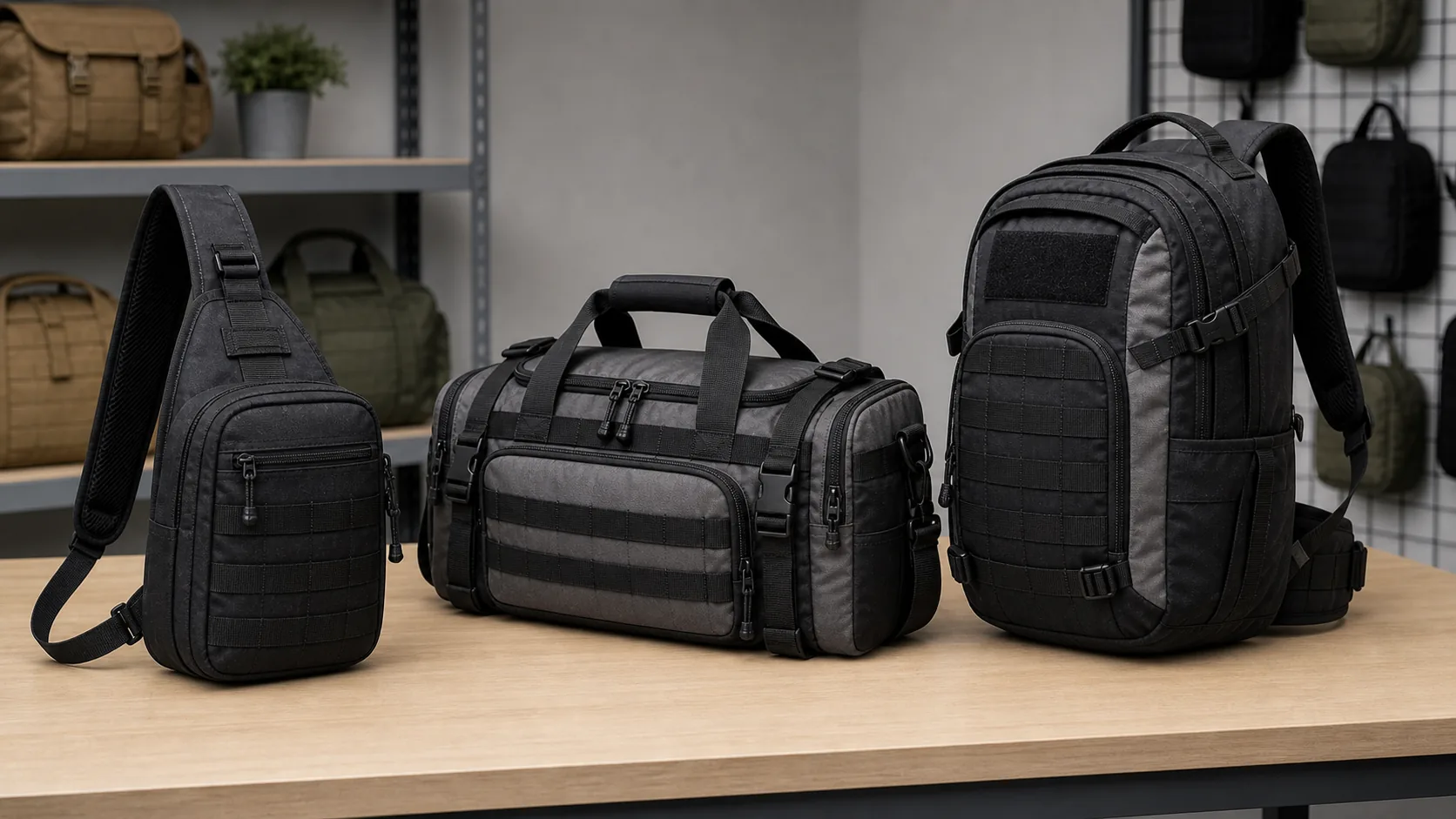
Tactical Backpacks

Relevant where MOLLE layouts, reinforced structure, and rugged load-bearing performance are central to the product brief.

Focus: Utility Mobility

Travel Backpacks

Useful for projects that overlap outdoor utility, travel organization, and heavier daily-carry requirements.

Focus: Structured Protection

EVA Cases

Suitable for products that require shape retention, impact protection, and more controlled organization in field or transport use.

Review how these principles work in practice.

See Related Case Studies
Related Case Studies

How These Outdoor & Tactical Problems Show Up in Real Projects

These case pages show how common sourcing issues in rugged-use categories become real business problems once durability, replenishment, or scale-up pressure begins to appear.

Durability

When Outdoor Bags Fail in Real Use

See how weak structure, unclear material matching, and load-bearing issues can turn into review pressure and delayed scale decisions.

Review the Durability Case
Replenishment

When Fast-Moving SKUs Outgrow the Supply System

See how stock pressure grows when replenishment logic is not built early enough for tactical or rugged-use categories.

Review the Replenishment Case

Avoid common mistakes when sourcing for these categories.

Read the Buyer's Guide
Buyer’s Guide

Common Sourcing Mistakes in Outdoor & Tactical Bag Programs

This category tends to punish shortcuts early. These are the most common sourcing mistakes that weaken rugged-use bag programs before they scale.

What Often Happens

Approving a tactical design based mainly on appearance.

Stronger Priority

Checking whether the structure actually matches the intended field-use load and carry logic.

What Often Happens

Choosing materials by headline claims like heavy-duty or military-grade.

Stronger Priority

Matching fabric, hardware, webbing, and reinforcement to a defined durability standard.

What Often Happens

Treating one approved sample as enough proof for mass production.

Stronger Priority

Using the approved sample as the start of a protected bulk execution standard.

What Often Happens

Waiting until the SKU moves fast before thinking about replenishment.

Stronger Priority

Building a realistic restock path before demand begins to stress the supply system.

Initiate Your Next Product Program

Transition from Concept to Market-Ready Product with Stable Execution

Submit project requirements for review. An execution plan and pricing breakdown will be provided for evaluation.

Sample evaluation — clarify structure before volume
MOQ flexibility — test validation before scale
Dedicated project coordination
OEM/ODM execution with controlled consistency
Quick Response · 24 Hours

Submit Project Details

Provide the project details to receive pricing, MOQ options, and a production timeline — no strings attached.