
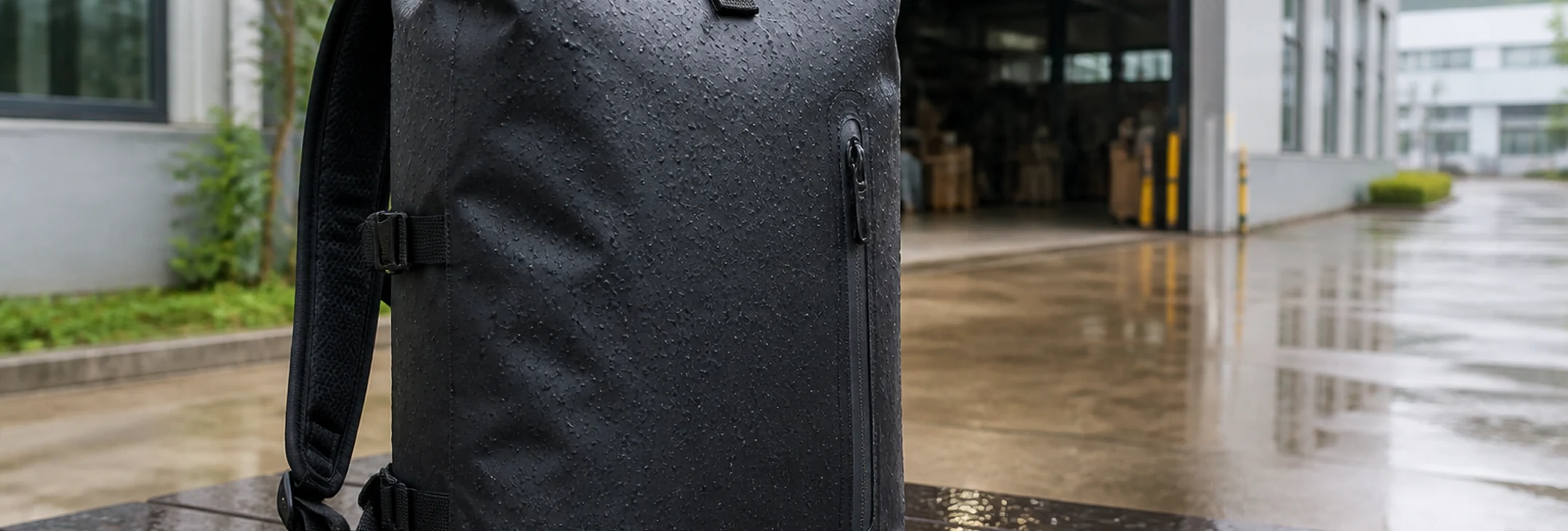
Custom Waterproof Backpack for Travel Brand Programs
Develop a custom waterproof backpack from a defined exposure scenario, complete construction, controlled entry points, and finished-product evidence.
- MOQ from 300 pieces
- Sampling in 7-10 days
- Bulk production in 25-35 days
- Initial response within 12 hours
Travel Backpack Styles for Different Market Needs
Presenting market-ready travel backpack directions for different channels, user needs, and price levels.

Classic Travel Backpack

Hiking Travel Backpack

Mountaineering Travel Backpack

Multi-Compartment Travel Backpack

Outdoor Travel Backpack

Packable Travel Backpack

Shoe Compartment Travel Backpack

Upgraded Hiking Travel Backpack
Define the Water Exposure Scenario
Define the exposure before using "waterproof." Light splash, intermittent rain, sustained rain, wet-ground contact, and immersion require different fabrics, seams, openings, and tests. State the target use and the wording your market expects.
- Water-resistant and waterproof are not interchangeable.
- If the product will mention immersion or safety, plan the design and proof separately.
Choose the Fabric, Coating and Construction Route
The construction route combines base fabric, coating or membrane, lamination, lining, reinforcement, seam method, panel geometry, and compatible hardware. Fabric performance alone does not establish finished-backpack performance.
- Approve the full layer construction.
- Check processing compatibility.
-
Base fabric
The woven or knit substrate that carries the coating and sets the base tear and abrasion behavior.
-
Coating or membrane
The water-managing layer applied to, or laminated with, the base fabric.
-
Lining
The inner face that protects the membrane and separates it from the contents.
-
Reinforcement
Added panels and structure at stress points, bases, and load paths.

Control Water Entry at Zippers, Seams and Openings
Water can enter through zippers, seams, needle holes, openings, pockets, vents, logo penetrations, and panel interfaces. Select zipper protection, seam construction, and flaps around the exposure target. Roll or zip closures and drainage should be reviewed in the same sample.
- Map entry points during prototype review.


Plan Capacity, Compartments and Carrying Comfort
After exposure is defined, plan capacity, item organization, laptop or equipment protection, and access. Back panel, straps, padding, and carrying comfort should be checked with the loaded bag. A backpack still needs to work as a backpack.
- Test the loaded sample as well as water management.
-
Capacity
Total volume mapped to the target trip length and gear list.
-
Laptop or equipment
Dedicated protection for a laptop, tablet, or specialized equipment.
-
Access
Main opening style, pocket layout, and reach while wearing the pack.
-
Back panel and straps
Padding, ventilation, load transfer, and strap geometry for loaded comfort.

Add Branding without Weakening the Construction
Printing, embroidery, badges, rivets, labels, and hardware can penetrate or change a water-managed construction. Place and test branding so it does not contradict the intended performance.
- Use non-penetrating options where the design requires them.
- Validate the finished branded sample.
-
Logo
Print, embroidery, or heat transfer placed where it will not cross a seam or membrane.
-
Badge
Sewn or bonded badges reviewed for needle penetration and edge sealing.
-
Label
Internal or external labels attached without piercing a water-managed layer.
-
Hardware
Zipper pulls, buckles, and fasteners selected for compatibility with the closure system.
Validate Fabric and Finished-Product Performance
Use water-resistance wording only when the proof matches the finished backpack. The record should say what was tested, how it was tested, under what conditions, and what result was achieved. A coated fabric swatch is not the same as a finished bag.
- Do not publish a rating from unrelated material data.
- Match the report to the production version.

-
Subject
State exactly what was tested: a fabric swatch, a seam, or the finished backpack.
-
Method
Name the test standard or procedure used to support the claim.
-
Conditions
Record the conditions, including water volume, pressure, duration, and temperature.
-
Production version
Match the report to the materials and construction that will go into bulk.
Real Waterproof Backpack Project Gallery
Use this gallery to compare waterproof travel backpack directions before choosing the exposure target. Look at fabric direction, seam and zipper control, opening style, compartments, carry system, and branding placement.
The images can help frame the exposure and construction conversation. Actual water-performance wording, test records, customer details, quantities, and pricing are handled inside the project review.


Buyer questions
What is the difference between waterproof and water-resistant?
Water-resistant usually means the bag can handle light moisture or short exposure. Waterproof requires stronger fabric, seam, zipper, opening, and construction control. The exact claim should match the finished product and supporting evidence.
Can a waterproof backpack be fully submerged?
Only some specialized constructions are designed for submersion. Many travel backpacks are built for rain, splash, or wet-ground contact, not immersion. The target exposure should be defined before fabric, seams, closures, and testing are selected.
Where does water usually enter a backpack?
Common entry points include zippers, seams, needle holes, openings, pockets, vents, logo applications, and panel junctions. A coated fabric alone does not control every water path.
What should be tested or reviewed before making water claims?
Review the material, coating or lamination, seams, zippers, openings, loaded sample, and any relevant finished-product test evidence. Public claims should match the tested construction and intended use.
Define the Water-Protection Target for Your Travel Backpack
Share the exposure scenario, closure and seam direction, capacity, carry system, materials, branding, quantity, destination market, and evidence requirements.
Describe Your Waterproof Backpack
We will review the water-entry risks and the construction questions to validate in sampling.