
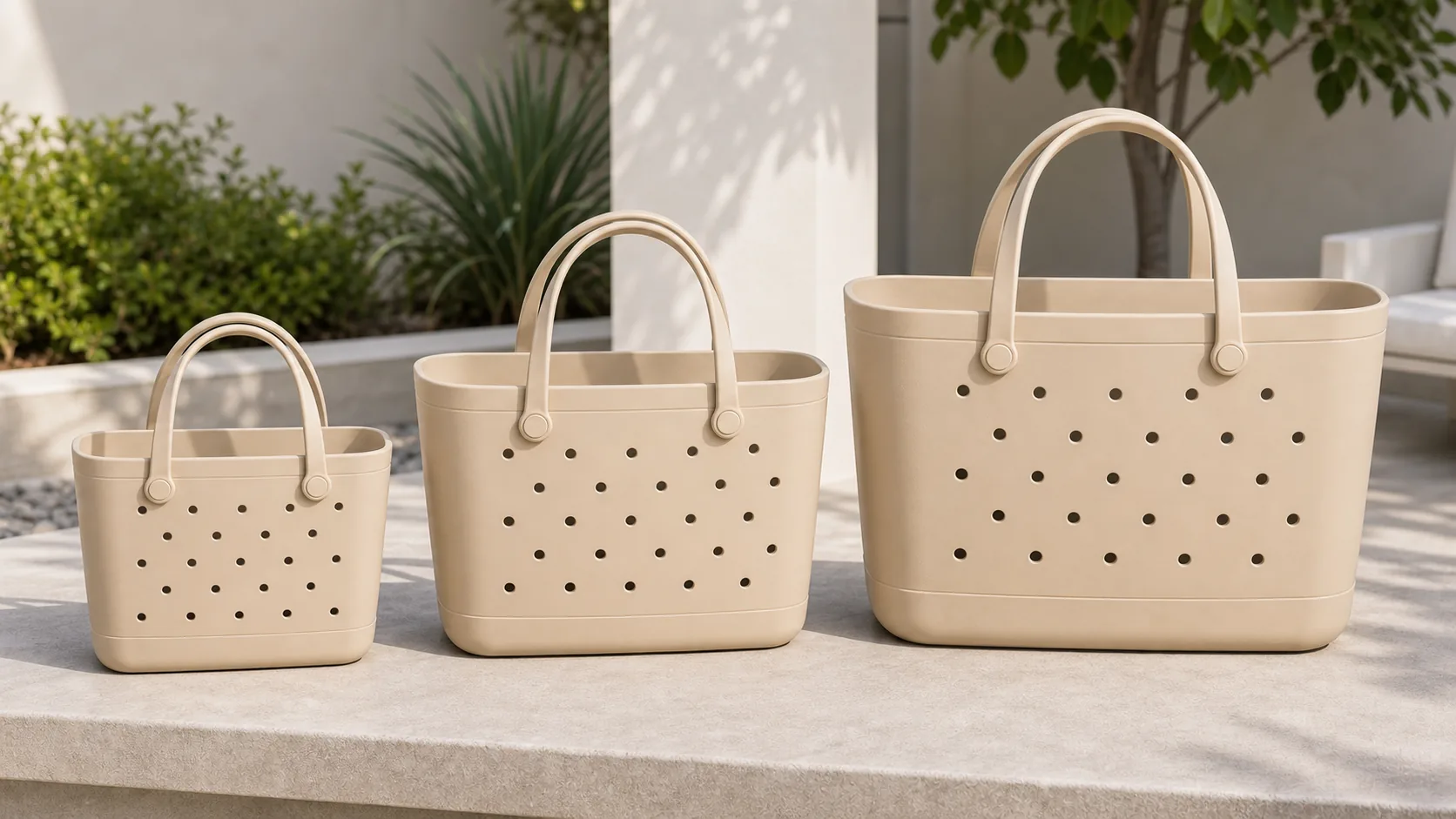
Similar names make Bogg Bag sizes easy to confuse, while small differences in depth and height change carrying and storage more than shoppers expect.
The official support page currently lists the Original at 19 × 15 × 9.5 inches, Baby at 15 × 13 × 5.25 inches, and Bitty at 11 × 8.5 × 4.5 inches. Choose by the actual contents and footprint you need, then verify the current listing.
The comparison below separates published external measurements from usable space, packed behavior, and product-development decisions.
What Are the Current Bogg Bag Sizes?

The official Bogg Bag support page currently lists three named sizes:
| Official size name | Published external dimensions | Practical footprint |
|---|---|---|
| Original | 19 × 15 × 9.5 in | Largest outside envelope of the three |
| Baby | 15 × 13 × 5.25 in | Mid-size footprint with notably less depth |
| Bitty | 11 × 8.5 × 4.5 in | Smallest outside envelope |
The support table was rechecked on September 16, 2026. It also publishes weight guidance, but this article deliberately omits it because the current Bitty product page displays a conflicting number.
Measurement order also needs attention. The support page lists the Bitty as 11 × 8.5 × 4.5 inches, while the current Bitty product page presents the same values as 11 in L × 4.5 in W × 8.5 in H. The physical values align when the axes are identified; the sequence alone is not enough.
These are time-sensitive dimensions for named products, not a universal size standard for molded EVA totes. Check the current official listing before purchasing, packing for a rule-based use, or comparing a physical sample.
How Large Is the Original Bogg Bag?

The Original is the largest of the three published Bogg Bag sizes at 19 × 15 × 9.5 inches. Searchers sometimes describe it as the large or XL Bogg Bag, but the official support page calls it Original.
Its wider and deeper footprint gives bulky contents more room than the Baby or Bitty. That does not establish an exact capacity, packing list, carrying comfort, or maximum load. Wall thickness, base shape, opening, handles, inserts, and accessories still affect usable space.
Before choosing it, check:
- the height and bulk of the largest items;
- whether the open top provides enough clearance;
- how much trunk, shelf, floor, or closet space the tote occupies;
- the loaded distance it must be carried; and
- whether the loaded sample remains stable on the intended surface.
The Original is the capacity-first option in this three-size comparison, with a correspondingly larger storage and carrying footprint.
How Do Baby Bogg Bag Dimensions Compare?

The Baby is currently listed at 15 × 13 × 5.25 inches. Compared with the Original, it is 4 inches shorter in the first listed axis, 2 inches lower in the second, and 4.25 inches shallower in the third.
The reduced depth is especially visible in storage and body clearance. A shallower structured tote occupies less shelf or floor space and projects less from the carrier, but it also provides less room for thick or bulky items.
Baby may suit a smaller personal load when the planned contents fit its opening and interior. Do not assume it fits a laptop, locker, airline space, towel set, or shoe size from the outside measurements alone. Measure the actual contents and inspect the current product.
For wet or fitness-related contents, the separate custom gym bag category shows why item separation, closure, cleaning, and carrying method still matter after the outside size is selected.
What Is the Bitty Bogg Bag Size?

The Bitty is the smallest size, listed by the support page at 11 × 8.5 × 4.5 inches. The current product page identifies those axes as 11 inches long, 4.5 inches wide, and 8.5 inches high.
Its small footprint suits a short list of small contents rather than the packing role of the larger two sizes. Check the interior, opening, and item height before relying on the external measurements.
The support article and current product page disagree on the Bitty weight limit. Because two official pages conflict, no weight or load claim should be used until the brand resolves the discrepancy for the exact current product.
How Do Original, Baby, and Bitty Compare?

The three sizes differ most clearly in outside footprint:
| Decision | Original | Baby | Bitty |
|---|---|---|---|
| Outside envelope | Largest | Middle | Smallest |
| Thick or bulky contents | Most room of the three | More limited by shallower depth | Intended for smaller contents |
| Storage footprint | Requires the most space | Easier to place than Original | Requires the least space |
| Loaded carrying effect | Can become bulky as contents increase | Lower depth can reduce projection | Smallest loaded outline |
This is a relative comparison, not a capacity, comfort, or use guarantee. The right choice depends on the intended contents, how far the tote will be carried, and where it will be stored.
What Fits in Each Bogg Bag Size?
External dimensions provide a screening tool, not a guaranteed packing list. Representative categories can help with planning:
- Original: compare it with bulky towels, bottles, footwear, containers, or multiple pouches when a larger open compartment is needed.
- Baby: compare it with a smaller personal set where reduced depth matters more than maximum bulk.
- Bitty: compare it with small accessories, snacks, keys, compact pouches, or other short item lists.
Place the actual objects together, measure their tallest and widest points, and compare them with the opening and usable interior. A physical fit check is more reliable than converting the outer dimensions into liters.
Accessories also change the result. Inserts, dividers, toppers, beverage holders, and pouches consume clearance or alter how items sit near the opening.
How Do External Dimensions Differ From Usable Space?
External length, width, and height describe a bounding envelope. They do not reveal the internal floor, opening width, usable height, wall thickness, taper, corner radius, handle clearance, or space occupied by accessories.
For a structured tote, record the field that answers the decision:
- widest outside length and width for storage or carton planning;
- base dimensions for stability and item placement;
- opening dimensions for loading bulky objects;
- usable interior height for tall contents;
- handle drop and grip clearance for carrying; and
- accessory clearance for inserts and toppers.
Do not multiply outside dimensions and present the result as usable capacity. A comparable volume needs a stated object, method, loading rule, and endpoint.
How Do Size and Structure Affect Carrying, Storage, and Travel?
Loaded behavior depends on more than the size name. Handle geometry, base projection, stiffness, total load, and walking distance affect how a structured tote carries. Test the intended contents instead of predicting comfort from dimensions.
The rigid footprint also affects shelves, trunks, closets, displays, and cartons because the body does not fold flat like a soft textile tote. Nesting can reduce storage or shipping volume, but only when handles, packaging, accessories, and tolerances permit the samples to fit together.
Dimensions do not prove water protection or airline eligibility. An open-top tote with openings is not a sealed waterproof bag, and a structured product may not compress into a carrier's sizer. If the planned use involves travel, check the operating airline's current rules and measure the actual packed item; the carry-on measurement guide explains that process for soft travel bags.
What Should Brands Specify in a Structured EVA Tote?
Use branded size research as a comparison exercise, not a design to copy. A legally distinct molded EVA tote should start from its own user, contents, channel, and evidence requirements.
Specify:
- outside length, width, height, base dimensions, and measurement points;
- opening dimensions and usable interior height;
- handle drop, grip geometry, attachment, and target carrying method;
- wall thickness, stiffness, base stability, and target empty weight;
- accessory openings, inserts, toppers, and required clearance;
- representative load and finished-sample checks;
- nesting sequence, carton dimensions, packaging, and display footprint;
- cleaning instructions and water-related claim boundary; and
- approved sample identity, tolerances, and change controls.
The molded EVA beach bag category provides the closest commercial development context. When the requirements are controlled, a custom bag manufacturer can quote a legally distinct product rather than infer the design from another brand's size names.
ZWbags is not affiliated with, authorized by, or the manufacturer of Bogg Bag.
Frequently Asked Questions (FAQ)
Which Bogg Bag size is the largest?
The Original. The official support page currently lists it at 19 × 15 × 9.5 inches, the largest external footprint of the three named sizes.
Which Bogg Bag size is the smallest?
The Bitty. The support page lists it at 11 × 8.5 × 4.5 inches; the current product page identifies the same values as length, height, and width in a different displayed order.
Is the Original Bogg Bag the large or XL size?
Original is the official name used by the support page. Searchers may use large or XL informally, but verify the named product and current dimensions instead of relying on an unofficial size label.
How should I choose between Original, Baby, and Bitty?
Choose from the actual contents and available footprint. Compare item height and bulk with the opening and usable interior, then consider carrying distance and storage space.
Do the listed dimensions guarantee that my items will fit?
No. They are outside measurements. Wall thickness, base shape, opening, handles, inserts, and accessories affect usable space, so confirm with the current listing or a physical fit check.
The official dimensions provide a comparison point, not a complete fit decision. Verify the current product, then test the intended contents and footprint before buying or using the numbers in a product-development decision.
For a new structured-tote program, start with your own contents and dimensions rather than another brand's protected product identity.