
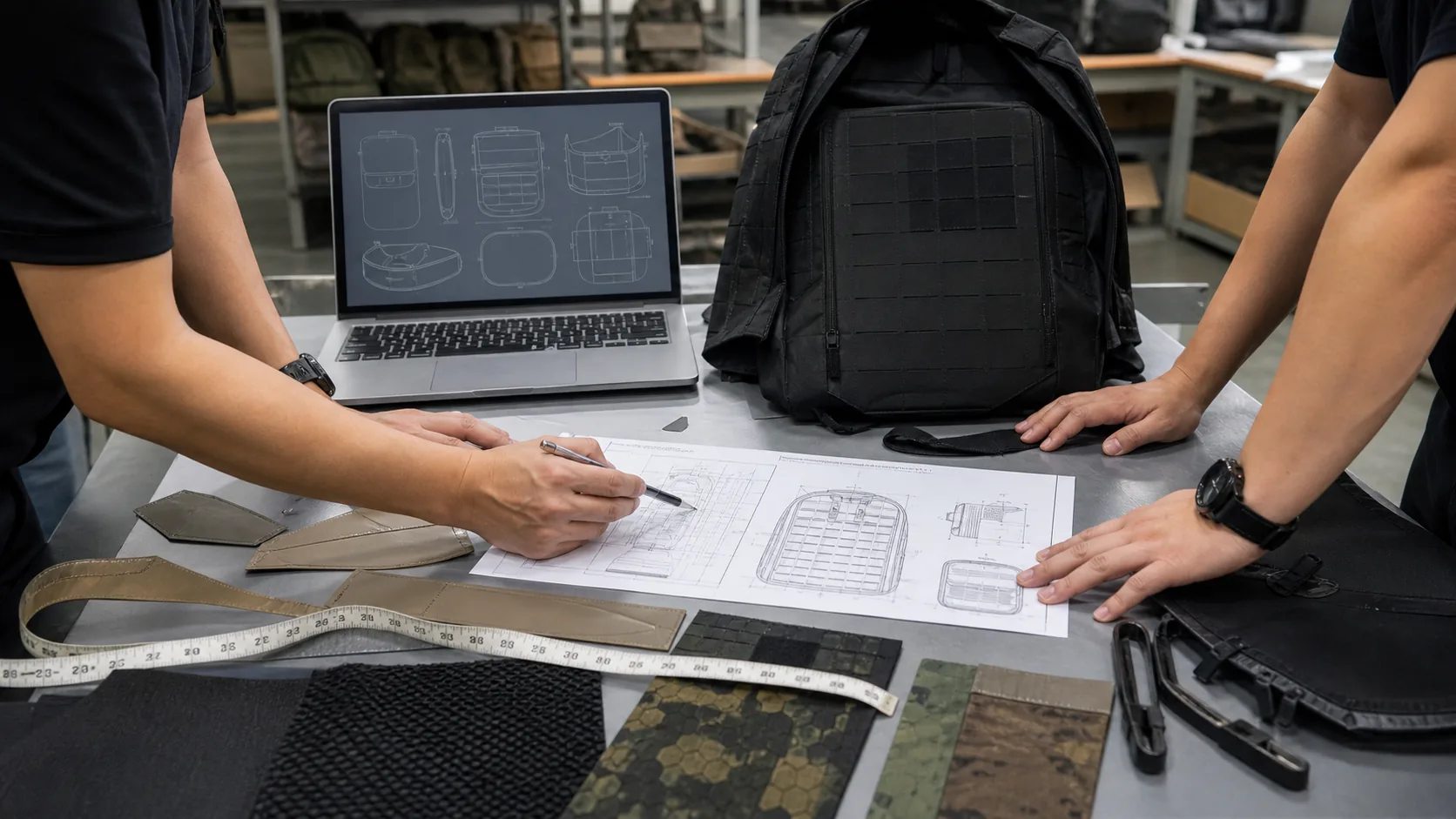
Manufacturing a tactical backpack starts with a validated design file, durable fabrics, reinforced construction, accurate webbing placement, and repeatable quality testing. A rugged appearance is not enough for B2B buyers; the finished pack must carry weight, resist abrasion, organize equipment, and survive repeated use in the field.
For brands, wholesalers, and sourcing teams, the real question is not only how to make a tactical backpack, but how to turn a concept into a consistent production item. The process below follows the practical factory sequence used for custom tactical backpacks, from blueprint development through bulk production.
1. How Do You Create a Tactical Backpack Design Blueprint?

An accurate design blueprint converts a rough product idea into measurable production instructions. It should define capacity, panel shape, pocket layout, zipper paths, strap geometry, hardware positions, and load-bearing zones before sampling begins.
CAD files are especially important when multiple teams handle design, costing, cutting, sewing, and quality inspection. A clear technical pack reduces guessing and helps the factory quote materials, labor, sample time, and tooling needs more accurately.
Establish Reference Dimensions
Start with the intended user and load. A compact everyday tactical pack may need a very different panel structure from a 40L field pack or a heavy-duty outdoor pack.
Useful baseline measurements include:
- Target capacity, such as 25L, 35L, 40L, or 55L
- Main compartment height, width, and depth
- Laptop, hydration, admin, or medical pocket dimensions
- Shoulder strap length, curve, and adjustment range
- PALS or MOLLE placement zones
| Design Component | Typical Specification | Factory Checkpoint |
|---|---|---|
| Main volume | Around 35L to 55L for larger field packs | Confirm usable capacity and panel dimensions |
| Stitch allowance | Often 8 mm to 12 mm, depending on construction | Keep allowances consistent across patterns |
| Webbing spacing | Match intended PALS or MOLLE geometry | Check pouch compatibility on a sample |
A strong blueprint prevents expensive sample revisions later. It also gives procurement teams a common reference when comparing factories, materials, and price levels.
2. Which Materials Are Used to Make a Tactical Backpack?

Material selection shapes durability, weight, appearance, cost, water resistance, and perceived value. Common choices include high-denier nylon, heavy polyester, reinforced bottom fabrics, coated linings, acetal buckles, nylon webbing, foam padding, and heavy-duty zippers.
The best fabric is not always the heaviest one. Buyers should match material performance to the intended product tier, retail price, expected load, and usage environment in the outdoor and tactical industry.
Compare Fabric, Coating, and Thread Together
Many tactical backpacks use 600D polyester, 900D polyester, 1000D nylon, ripstop nylon, or ballistic-style fabrics. Performance depends on yarn quality, weave, coating, backing, colorfastness, and construction method.
Key material decisions include:
- Outer shell fabric for abrasion resistance
- PU or TPU coating for water resistance
- Lining fabric for internal durability and cleaning
- Bonded nylon or polyester thread for seam strength
- EVA or PE foam for shoulder straps and back panels
| Material Option | Main Advantage | Buyer Note |
|---|---|---|
| 1000D nylon | Strong abrasion resistance when properly specified | Higher cost and weight than many polyester options |
| 600D polyester | Balanced cost and structure | Suitable for many commercial tactical-style packs |
| Ripstop nylon | Tear control with lighter weight | Best for selected panels, not every high-wear zone |
Ask for test data on the exact material, not just a fabric name. Abrasion, tear, tensile, hydrostatic pressure, and colorfastness results are more useful than broad claims.
3. How Do You Build the Pattern and Cutting Layout?

Pattern making turns the blueprint into individual panel shapes that can be cut and sewn. Each pattern piece needs grain direction, stitch allowance, notches, fold marks, binding requirements, reinforcement zones, and matching points.
For bulk orders, efficient nesting matters. Placing panels carefully across the fabric width can reduce waste, lower cost, and keep the visual direction of textured fabrics consistent.
Cut Panels with Tight Tolerances
Factories may use digital cutting, laser cutting, die cutting, or manual cutting depending on order size, material, and component shape. The goal is not only speed; it is repeatability.
Pattern controls should include:
- Clear notches for seam alignment
- Separate reinforcement patches for stress zones
- Accurate zipper opening lengths
- Mirrored left and right strap components
- Consistent binding and seam allowances
| Pattern Piece | Typical Quantity | Common Cutting Method |
|---|---|---|
| Front and back panels | 1 each | Digital or laser cutting |
| Shoulder strap shells | 2 pairs | Die cutting or digital cutting |
| Side pockets | 2 | Digital cutting |
| Webbing strips | Multiple lengths | Hot cutting to seal edges |
Small cutting errors become bigger problems during sewing. If panels are inconsistent, the final backpack may twist, pucker, or fail inspection even when the material itself is strong.
4. What Sewing Setup Is Needed for Tactical Backpack Production?

Tactical backpack construction requires industrial sewing machines, trained operators, suitable needles, controlled thread tension, and reinforcement operations at stress points. Domestic machines are not built for repeated layers of coated fabric, webbing, foam, binding, and zipper tape.
Common equipment includes walking-foot sewing machines, bar-tack machines, binding machines, cylinder-bed machines, and hot-cutting tools. The right setup allows a factory to sew dense seams without skipped stitches, broken thread, or distorted panels.
Match Needle, Thread, and Stitch Type
Needle size should match fabric density and thread size. A needle that is too small can break or fray thread; one that is too large can leave unnecessary holes in coated fabric.
Important sewing controls include:
- Stitch length for structural seams
- Bar-tack length and density for webbing points
- Thread tension for multi-layer construction
- Seam binding quality on internal raw edges
- Operator guides for repeatable placement
| Machine Type | Main Use | Quality Risk if Misused |
|---|---|---|
| Walking-foot machine | Main panel and strap seams | Uneven feeding or skipped stitches |
| Bar-tack machine | Handles, loops, and stress points | Weak attachment if density is too low |
| Binding machine | Internal edge finishing | Twisted or uneven binding |
Good sewing setup is one reason a sample can look similar across suppliers but perform very differently under load.
5. How Do You Add MOLLE Webbing and Modular Attachment Points?

MOLLE-style attachment systems depend on accurate spacing, strong webbing, correct stitch placement, and reinforcement behind the panel. If the grid is misaligned, users may struggle to attach pouches or may overload weak points.
Traditional sewn webbing and laser-cut panels can both work. The choice depends on appearance, weight target, cost, repairability, and the type of pouches the buyer expects end users to attach.
Control PALS Grid Placement
For tactical use, pouch compatibility should be checked on the actual production-intent sample. A drawing alone cannot prove that webbing thickness, row spacing, and stitch channels will work with common attachments.
Practical checkpoints include:
- Webbing width and row spacing
- Bar-tack position and length
- Reinforcement backing behind the grid
- Edge finishing on laser-cut slots
- Pull resistance after repeated attachment cycles
| Attachment Material | Typical Use | Buyer Check |
|---|---|---|
| Nylon webbing | Traditional MOLLE grids | Confirm spacing and bar-tack strength |
| Laser-cut laminate | Lower-profile modular panels | Inspect slot edges and laminate strength |
| Tubular webbing | Handles and heavy loops | Test pull strength and stitch security |
For buyers comparing modular designs, a durability-focused backpack project is a useful reminder that construction details matter as much as the visible webbing layout.
6. How Do You Build the Frame Sheet and Back Support?
An internal support system helps the backpack keep its shape and carry load more comfortably. Depending on the design, this may include an HDPE frame sheet, aluminum stays, EVA foam, mesh padding, or a molded back panel.
The support structure should match the load rating. A soft everyday pack may not need the same frame design as a larger pack intended for tools, outdoor equipment, or long walks with heavy gear.
Select the Right Support Components
HDPE sheets can reduce sagging and protect the wearer from hard objects inside the pack. Aluminum stays can add structure and help transfer weight when the pack also has a compatible hip belt.
| Support Component | Common Material | Main Function |
|---|---|---|
| Frame sheet | HDPE | Adds structure and reduces back pressure |
| Stay | Aluminum | Supports load transfer in heavier designs |
| Back padding | EVA foam and mesh | Improves pressure distribution and airflow |
Back support should be tested with the intended load, not judged only by padding thickness. Foam density, panel shape, ventilation channels, and torso fit all affect comfort.
7. How Do You Construct Shoulder Straps and Load Lifters?
Shoulder straps must distribute weight without cutting into the neck, rubbing the arms, or collapsing under repeated use. The strap curve, foam density, edge binding, stitch quality, webbing anchors, and adjustment hardware all matter.
Closed-cell EVA foam is often preferred because it resists moisture absorption better than open-cell foam. Breathable mesh can improve comfort, but it must be durable enough for abrasion and repeated compression.
Reinforce the Anchor Points
Load lifters, sternum straps, lower strap anchors, and handle connections are high-stress zones. These areas usually need box stitching, bar tacks, reinforcement patches, or multiple layers of support.
| Strap Detail | Manufacturing Purpose | Inspection Point |
|---|---|---|
| Curved foam strap | Improves shoulder fit | Check pressure points under load |
| Load lifter | Pulls upper pack closer to the body | Confirm angle and anchor strength |
| Sternum strap | Stabilizes shoulder straps | Check slider movement and retention |
Strap geometry should be reviewed on different body sizes during sample fitting. A pack that fits one model well may still need adjustment for a broader retail customer base.
8. Which Hardware and Closure Details Should Be Installed?
Hardware choices affect usability, durability, noise, repair, and cost. Tactical backpacks commonly use acetal buckles, ladder locks, D-rings, compression straps, cord zipper pulls, hook-and-loop panels, drainage grommets, and heavy-gauge zippers.
Zippers deserve special attention because they are one of the most common failure points. Chain size, slider quality, end stops, sewing alignment, and corner radius all influence long-term performance.
Test Buckles, Zippers, and Pullers
Premium hardware should still be tested in the final backpack. A strong buckle can fail if it is attached to weak webbing, and a good zipper can jam if the opening geometry is too tight.
| Closure Detail | Typical Use | QC Method |
|---|---|---|
| No. 8 or No. 10 zipper | Main compartment | Cycle, pull, and contamination testing |
| Acetal buckle | Compression and shoulder straps | Pull test and impact check |
| Cord puller | Quiet glove-friendly access | Abrasion and knot security check |
Brands preparing retail launches can also study an e-commerce product testing case before finalizing hardware, because small usability issues often become review problems after launch.
9. How Do You Prototype and Test a Tactical Backpack?
Prototype testing verifies whether the design works before bulk production begins. A good sample review covers fit, capacity, seam strength, pocket access, MOLLE compatibility, zipper movement, water resistance, weight, and appearance.
Testing should reflect the expected claim. A school-style tactical backpack, a duty pack, and a large outdoor pack should not use the same pass/fail standard.
Run Practical Stress Checks
Sample testing may include static load, repeated lift tests, seam pull checks, zipper cycle tests, drop tests, abrasion checks, spray testing, and packing trials.
| Test Area | What It Reveals | Practical Standard |
|---|---|---|
| Seam pull | Weak stitching or poor reinforcement | No separation under target load |
| Loaded carry | Strap comfort and frame support | Stable fit during movement |
| Water resistance | Coating, seams, and zipper exposure | Match the advertised product claim |
Record every failure and revise the construction file. Clear change notes help the factory reproduce improvements in the next sample and prevent old mistakes from returning in bulk production.
10. How Do You Scale Tactical Backpack Production?
Bulk production requires a controlled workflow, not just a good sample. The factory must prepare materials, confirm color and hardware, create cutting markers, train sewing stations, inspect inline quality, and pack finished goods according to the buyer’s shipment plan.
Scaling also affects cost. Material yield, sewing complexity, number of pockets, webbing density, hardware grade, logo method, packaging, and order quantity all influence the final unit price. A material optimization case can help buyers think through these trade-offs before locking a specification.
Build a Repeatable Factory Workflow
Production planning should divide work into clear stages: material inspection, cutting, webbing preparation, panel sewing, strap assembly, final joining, cleaning, inspection, packaging, and shipment.
| Production Stage | Factory Goal | Buyer Review Point |
|---|---|---|
| Pre-production sample | Confirm final specification | Approve materials, dimensions, and workmanship |
| Inline inspection | Catch defects early | Review seam, webbing, and zipper consistency |
| Final inspection | Protect shipment quality | Check AQL results, packing, labels, and cartons |
Learning how to make a tactical backpack is ultimately about controlling many small details at once. When the blueprint, materials, sewing setup, modular system, support structure, hardware, testing, and production workflow all align, the finished product is much easier to sell and reorder. To discuss an OEM or private-label build, contact us today with your target capacity, material preference, and intended use case.
FAQ
Can a tactical backpack be made with standard polyester?
Yes, some tactical-style backpacks use polyester successfully, especially in commercial and everyday categories. For heavier field use, buyers should compare abrasion, tear, coating, and seam data instead of choosing by fabric name alone.
What stitch pattern is best for high-stress strap connections?
Box stitching with bar-tack reinforcement is commonly used for handles, strap anchors, and webbing points. The best specification depends on fabric layers, thread, load target, and test results.
How do I know if a prototype is ready for mass production?
A prototype is ready only after the buyer approves fit, capacity, appearance, workmanship, materials, and performance tests. Any change after approval should be documented before bulk cutting starts.
Can the MOLLE layout be customized for a private-label order?
Yes. Factories can adjust webbing position, laser-cut panel shape, pouch zones, and reinforcement areas when the changes are confirmed in the CAD file and prototype.
What is the most common quality risk in tactical backpack production?
Common risks include weak strap anchors, poor zipper alignment, inaccurate MOLLE spacing, inconsistent cutting, and under-reinforced high-stress panels. These risks are easier to fix during sampling than after bulk production.