
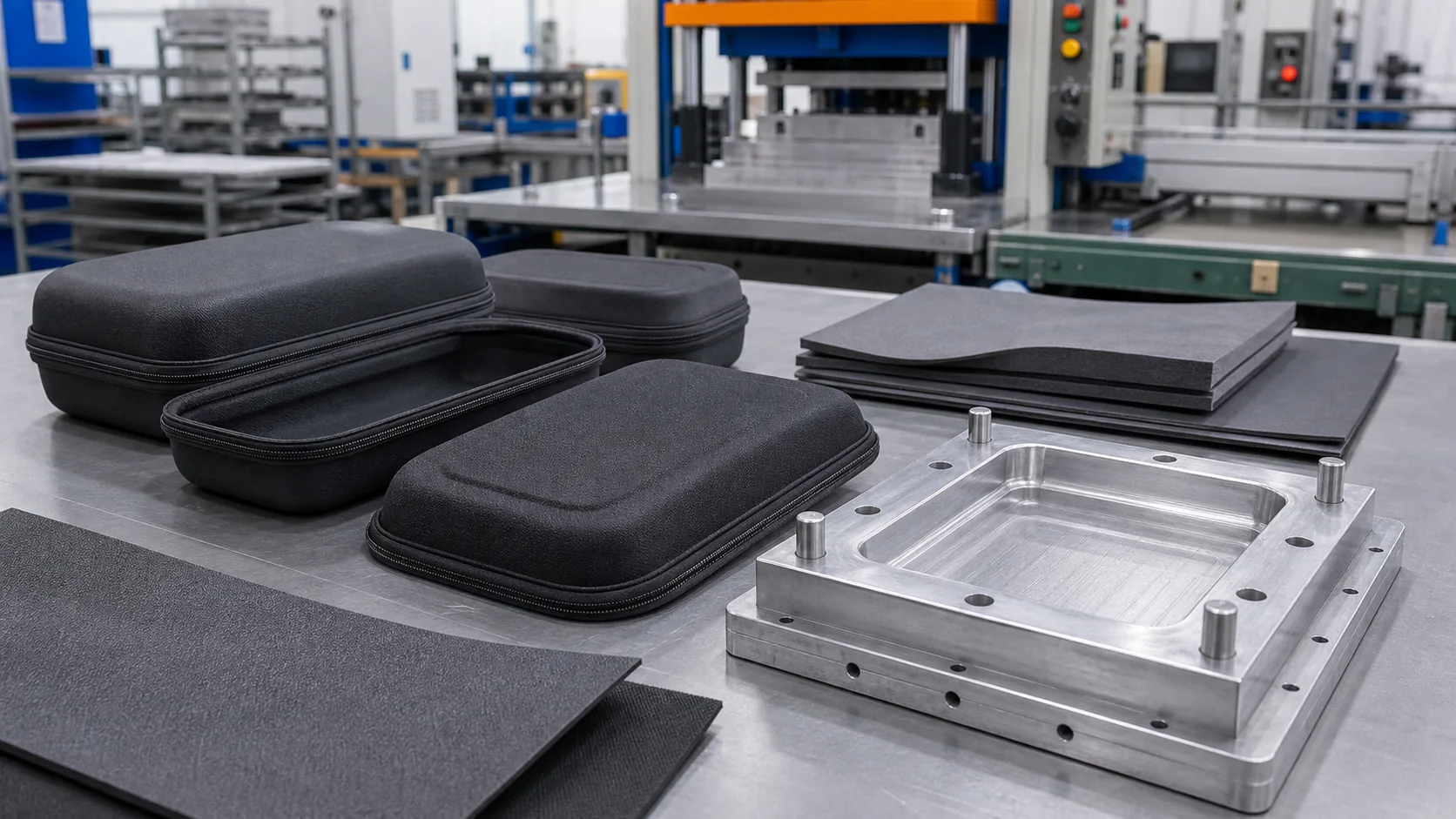
Thermoformed EVA cases are molded protective cases made by heating ethylene-vinyl acetate foam and pressing it into a shaped mold. The result is a lightweight, semi-rigid enclosure that can protect products, organize accessories, and improve how a kit looks when a customer opens it.
For B2B buyers, thermoformed EVA is useful when a product needs more structure than a soft pouch but less weight than a metal or thick plastic case. It is commonly used for electronics, tools, medical accessories, optical equipment, outdoor gear, and branded retail kits that need a tailored fit.
What Are Thermoformed EVA Cases?

Thermoformed EVA cases are protective enclosures made from ethylene-vinyl acetate foam sheets. During production, the material is heated until pliable, pressed over a mold, cooled into shape, trimmed, and assembled with fabric, zippers, linings, inserts, handles, and branding details.
For buyers developing protective packaging or equipment cases, ZWbags can support custom EVA cases with shell structure, molded inserts, logo options, and packaging specifications.
Core Materials Explained
EVA is a copolymer valued for flexibility, cushioning, and shape recovery. In case manufacturing, it is often laminated with nylon, polyester, PU leather, spandex, or other exterior fabrics. The foam provides the molded structure, while the fabric controls appearance, abrasion resistance, and brand presentation.
Key material advantages include:
- Lightweight structure for easier transport
- Cushioning that helps absorb impact
- Moldability for custom shapes and inserts
- Compatibility with fabric lamination and branding
- A semi-rigid feel without the weight of many hard cases
| Process Step | Action Performed | Resulting Characteristic |
|---|---|---|
| Heating | EVA sheet softens | Material becomes moldable |
| Molding | Pressure forms the shell | Case gains shape and depth |
| Cooling | Formed shell stabilizes | Structure holds its geometry |
| Assembly | Zippers, lining, and trims are added | Case becomes usable and brand-ready |
Thermoforming is valuable because it turns flat material into repeatable product geometry that can be matched to specific equipment.
Why Choose Thermoformed EVA for Protection?

Brands choose thermoformed EVA because it can reduce shock, scratches, and internal movement without making the final package overly heavy. The molded shell creates structure, while inserts can hold the product and accessories in fixed positions.
Impact Resistance Features
Closed-cell EVA foam can help dissipate impact energy before it reaches the product inside. The case design can also add protective spacing around fragile corners, buttons, screens, lenses, or sensors. This is especially useful when products move through e-commerce fulfillment, distributor warehouses, sales samples, or field-service environments.
Useful protection features include:
- Molded shell walls that cushion everyday knocks
- Interior inserts that reduce movement
- Soft linings that limit surface scratches
- Reinforced edges or handles for frequent carrying
- Zipper paths designed to avoid pressure on the product
Is Thermoformed EVA Waterproof?
EVA foam itself has good moisture resistance, and coated fabrics or water-resistant zippers can improve surface protection. Still, most standard thermoformed EVA cases should be described as water-resistant, not fully waterproof, unless the complete case has been tested for a specific waterproof standard.
| Feature | Protection Type | Practical Note |
|---|---|---|
| EVA shell | Shock and shape support | Depends on thickness and density |
| Exterior fabric | Scratch and surface protection | Depends on coating and fabric grade |
| Zipper system | Closure and moisture control | Usually the limiting point for water entry |
| Insert layout | Internal stability | Prevents parts from hitting each other |
The strongest protection comes from designing the shell, insert, fabric, and closure together rather than treating the EVA shell as the only protective element.
How Does Thermoformed EVA Support Customization?

Thermoformed EVA supports customization through molded tooling, insert design, fabric choice, color selection, hardware options, and branding methods. A buyer can design the case around the product instead of forcing the product into a generic square box.
Tailored Interior Foam Inserts
The interior can be designed with molded trays, die-cut foam, EVA partitions, mesh pockets, elastic straps, zipper pockets, or removable dividers. These details help separate accessories and reduce internal collisions during shipping or daily use.
Custom interiors can support:
- Main product cavities
- Cable and charger slots
- Spare battery areas
- Finger grooves for easier removal
- Mesh pockets for small accessories
- Separate zones for delicate and heavy parts
For launch testing and sample validation, a pilot order case can help buyers review the fit, packaging volume, and customer response before scaling a new SKU.
Exterior Branding Options
Exterior customization can include embossing, debossing, screen printing, rubber patches, woven labels, custom zipper pulls, colored lining, and fabric selection. The best option depends on target retail price, usage environment, and the desired brand impression.
| Customization Method | Visual Effect | Best Use |
|---|---|---|
| Molded logo | Subtle 3D brand detail | Premium cases |
| Screen printing | Clear graphic mark | Promotional or retail cases |
| Rubber patch | Raised and durable | Outdoor and tool kits |
| Custom zipper pull | Small branded touch | Consumer accessories |
Good customization makes the case feel like part of the product, not just shipping protection.
Is Thermoformed EVA Lightweight and Durable?

Thermoformed EVA is popular because it combines low weight with useful structure. It will not replace a heavy-duty sealed hard case in every application, but it is often a better fit for products where buyers need protection, presentation, and everyday portability at the same time.
Weight Comparison
Metal, wood, and thick hard-plastic cases can add considerable weight. Thermoformed EVA can protect many consumer and professional products with less mass, which may reduce shipping weight, improve user comfort, and make sample kits easier for sales teams to carry.
| Material Type | Relative Weight | Typical Strength |
|---|---|---|
| Aluminum | Heavy | Very high crush resistance |
| Hard plastic | Medium to heavy | High rigidity |
| Thermoformed EVA | Light | Good cushioning and structure |
Long-Term Durability Factors
Durability depends on foam density, shell thickness, exterior fabric, stitching, zipper grade, handle design, and how the case is used. Higher-denier nylon, reinforced handles, strong edge binding, and quality zipper systems can extend service life in demanding use cases.
For field-use categories, outdoor gear applications usually need stronger fabrics and more careful stress-point testing than light indoor retail kits.
Can Thermoformed EVA Improve Organization?

Thermoformed EVA can improve organization by giving each component a dedicated position. A molded or cut insert makes it easier for users to see whether a tool, cable, sensor, or accessory is missing before leaving a job site or packing a shipment.
Custom Compartments
Designers can map the internal layout based on how the product is used. Heavy parts can be separated from fragile screens. Sharp tools can be isolated from cables. Small accessories can sit in mesh pockets or elastic loops instead of falling to the bottom of the case.
| Organization Feature | Primary Benefit | Secondary Benefit |
|---|---|---|
| Molded slots | Reduces internal movement | Improves presentation |
| Mesh pockets | Holds loose items | Keeps contents visible |
| Elastic straps | Secures cables or tools | Allows faster packing |
| Removable dividers | Adds flexibility | Supports multiple kit layouts |
Why Organization Matters
Organization is not only visual. It reduces friction damage, shortens packing time, and helps users keep track of expensive components. For premium kits, it also creates a better opening experience and supports a more professional brand impression.
What Industries Benefit From Thermoformed EVA?
Thermoformed EVA can serve many industries because the same process can be adapted to different products, sizes, and usage environments. The case can be tuned for presentation, field service, protection, retail display, or e-commerce fulfillment.
Common industries include:
- Medical device accessories and portable diagnostic kits
- Photography, drones, and optical equipment
- Automotive diagnostic tools
- Electronics and smart device accessories
- Outdoor, tactical, and field-service gear
- Retail, supermarket, and branded promotional kits
For channel-focused buyers, retail buyer scenarios can require different priorities from industrial field cases, including shelf appeal, carton efficiency, and repeatable packaging appearance.
| Industry | Typical Item Stored | Key Requirement |
|---|---|---|
| Medical accessories | Portable monitors, sensors, tubing | Organization and surface protection |
| Photography | Camera lenses, filters, batteries | Scratch and shock control |
| Automotive | Diagnostic tools and adapters | Durability and layout clarity |
| Electronics | Devices, chargers, cables | Presentation and fit precision |
Buyers should confirm any special compliance, cleaning, anti-static, or material requirements before mass production.
How Does Thermoformed EVA Compare to Hard Plastics?
Thermoformed EVA and hard plastic cases solve different problems. EVA usually offers a softer exterior, lighter weight, and more flexible branding options. Hard plastic can offer stronger rigidity, higher crush resistance, and better performance for some sealed or extreme-duty cases.
Flexibility vs Rigidity
EVA can flex slightly under impact, which helps cushion everyday handling. Rigid plastic resists deformation but may transfer more force to the product unless the internal foam is carefully designed. For many consumer and professional kits, EVA provides a strong balance of protection, weight, and appearance.
Cost-Effectiveness Comparison
Thermoformed EVA tooling can be more accessible than some injection-molded plastic tooling, especially for medium-volume or fast-moving custom projects. That makes it attractive for brands testing new equipment kits, retail bundles, and e-commerce product lines.
| Material Characteristic | Thermoformed EVA | Hard Plastic |
|---|---|---|
| Impact handling | Cushions and flexes | Resists but can transfer force |
| Tooling | Often more accessible | Often higher for custom injection molds |
| Weight | Usually lighter | Usually heavier |
| Branding | Fabric, patches, printing, pulls | Labels, molded marks, printing |
The right choice depends on whether the buyer values lighter weight, softer handling, and retail presentation or maximum rigidity and sealed protection.
Is Thermoformed EVA Safe and More Sustainable?
Thermoformed EVA can be a safe and practical packaging choice when materials are selected and tested correctly. However, buyers should avoid assuming every EVA formulation automatically meets every market requirement. Compliance depends on the actual material, supplier documentation, adhesives, coatings, dyes, and final application.
Material Safety Standards
For projects sold in regulated markets, buyers may request RoHS, REACH, CPSIA, phthalate, heavy-metal, or other relevant test reports when applicable. If the case is used for medical, child-related, food-adjacent, or skin-contact applications, material verification becomes more important.
Reusability Benefits
An EVA case is often reused by the customer, which can make it more valuable than disposable packaging. A durable reusable case can reduce the need for extra storage boxes and may support a stronger sustainability story when paired with responsible sourcing.
Factories may also help reduce waste through:
- Better cutting layouts
- Scrap sorting or regrinding where available
- Recycled exterior fabrics such as RPET
- Water-based adhesives when suitable
- Longer-lasting design that avoids disposable packaging behavior
| Environmental Aspect | Practical Option | Buyer Note |
|---|---|---|
| Reuse | Durable case design | Extends customer value |
| Fabric | RPET or other recycled options | Confirm availability and testing |
| Waste | Better cutting and scrap control | Depends on factory process |
| Claims | Verified documentation | Avoid unsupported green claims |
The safest approach is to treat sustainability as a specification and documentation topic, not just a marketing phrase.
What Design and Maintenance Options Matter?
Design and maintenance affect how customers experience the case after purchase. A strong thermoformed EVA case should look good, carry well, open smoothly, and remain easy to clean under realistic conditions.
Color, Texture, Zippers, and Handles
Designers can select nylon for ruggedness, PU leather for a more premium finish, spandex for a smooth consumer look, or polyester for cost-effective retail cases. Hardware options include standard zippers, reverse coil zippers, rubber handles, shoulder straps, zipper pull branding, and interior mesh pockets.
| Design Element | Material Option | Primary Function |
|---|---|---|
| Outer surface | Nylon, polyester, PU, spandex | Appearance and abrasion resistance |
| Closure | Standard or reverse coil zipper | Secure opening and closing |
| Carrying | Rubber handle or shoulder strap | Easier transport |
| Interior | Lining, mesh, EVA insert | Organization and protection |
Cleaning and Storage
Most fabric-covered EVA cases can be cleaned with a damp cloth and mild soap. Avoid machine washing, soaking, harsh solvents, or high heat unless the supplier confirms the material can tolerate it. Store cases in a dry place away from prolonged direct sunlight and avoid placing heavy loads on top unless the case was designed for stacking.
Routine care helps protect the outer fabric, zipper, and molded shell, especially for cases used in field work or frequent travel.
Thermoformed EVA gives brands a practical way to protect products, organize accessories, and create a reusable packaging experience. The best results come from matching foam density, shell geometry, insert layout, fabric, zipper, branding, and testing to the product’s real use. If you need a custom protective case for an upcoming product launch, contact us today to discuss a practical production path.
FAQ
Can I order thermoformed EVA cases in custom colors?
Yes. Exterior fabrics can often be selected in custom colors, and some projects can match brand color direction through available fabric, lining, zipper, or patch options. Exact Pantone matching should be confirmed during sampling.
What is the best way to clean the foam interior?
Use a damp cloth with mild soap, then let the case air dry fully. Avoid soaking the insert or using aggressive cleaners unless the factory confirms the material specification supports it.
How do I know if thermoformed EVA is right for fragile electronics?
It is a strong option when electronics need cushioning, scratch control, accessory organization, and a lighter case. For high-value electronics, request samples and test the case with the real product before bulk production.
Can I add my company logo to the exterior?
Yes. Common logo options include embossing, debossing, screen printing, rubber patches, woven labels, and custom zipper pulls. The best method depends on fabric type, quantity, budget, and brand style.