
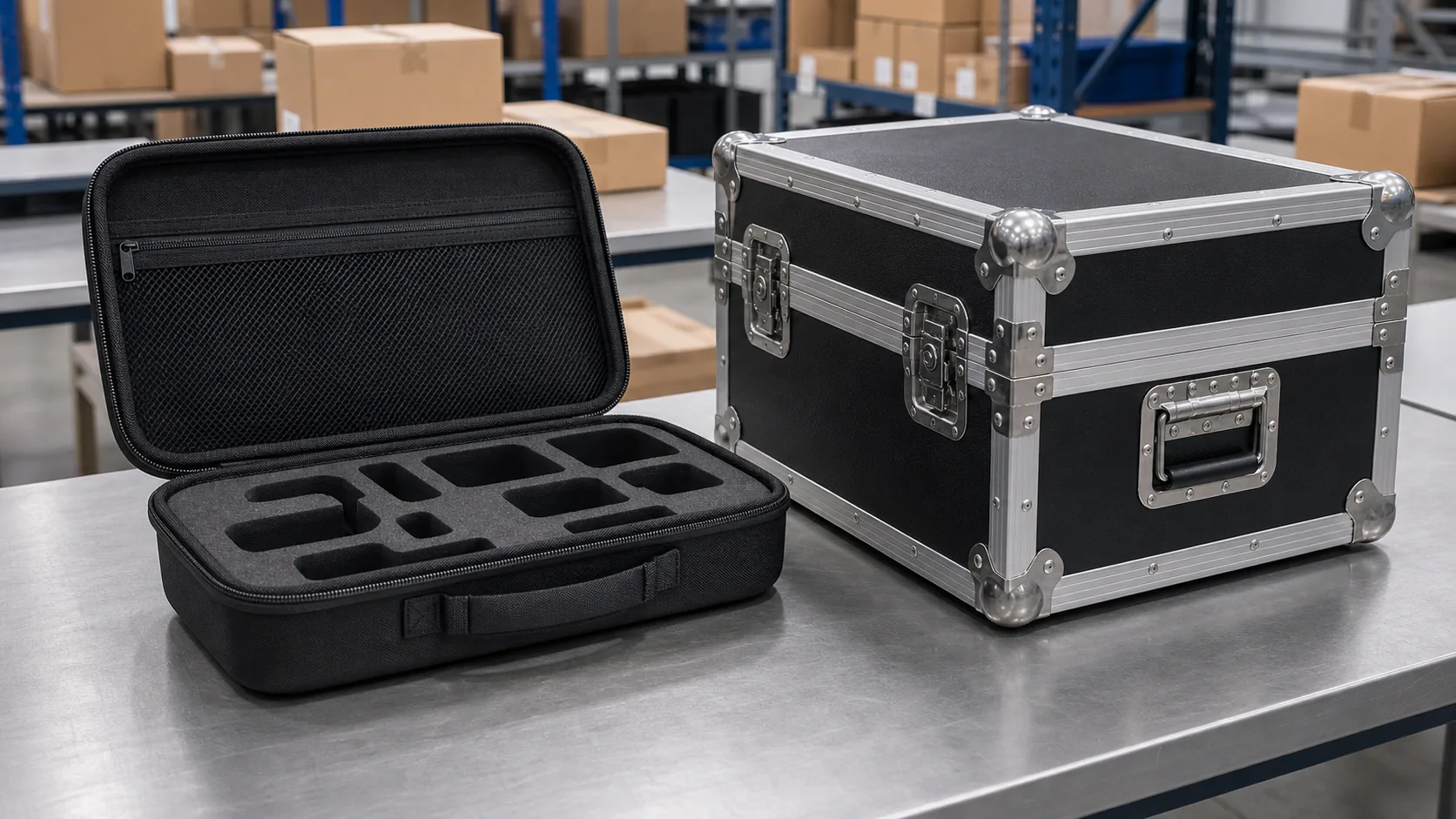
An EVA case is a lightweight molded protective case made from ethylene-vinyl acetate foam, while an ATA case is a heavy-duty transit case usually built with rigid panels, metal hardware, and reinforced corners. The right choice depends on how the product will move: hand-carried sales kits, retail bundles, and daily-use equipment often fit EVA well, while freight shipping and extreme stacking loads may need ATA-style protection.
For B2B buyers, the decision is not simply soft versus hard. It is about weight, impact control, custom inserts, shipping method, cost, repairability, moisture exposure, and brand presentation.
What Makes an EVA Case Different From ATA?

An EVA case uses thermoformed foam to create a semi-rigid shell. An ATA-style case uses a stronger rigid frame, often with hard panels, metal corners, latches, and reinforced edges. EVA is designed for portability, molded fit, and clean presentation. ATA is designed for heavier transit abuse, repeated freight handling, and stronger crush resistance.
For buyers developing protective packaging or retail-ready equipment kits, ZWbags can support custom EVA cases with shell shape, insert layout, material, zipper, logo, and packaging customization.
How Do Core Materials Function?
EVA foam absorbs part of an impact by compressing and recovering. ATA-style panels resist impact through rigidity and external reinforcement. One cushions. The other shields.
- EVA works well for hand-carried products and organized accessory kits.
- ATA works better for freight, touring, and high-stack pressure situations.
- EVA usually gives brands more fabric, color, and soft-touch design options.
- ATA usually gives better hardware repairability and higher crush resistance.
| Specification | EVA Case | ATA-Style Case |
|---|---|---|
| Structure | Semi-rigid molded foam | Rigid framed shell |
| Best transport mode | Hand carry, retail, e-commerce, samples | Freight, touring, heavy transit |
| Weight | Usually lighter | Usually heavier |
| Brand feel | Sleek and product-focused | Industrial and utilitarian |
These differences determine whether the case should support portability, retail presentation, or maximum transit strength.
How Does an EVA Case Handle Heavy Impact?

An EVA case handles impact through foam compression, shell shape, and internal inserts. When the case is designed correctly, the shell cushions external force while the insert prevents the product from moving inside.
Can Foam Withstand Sharp Blows?
High-density EVA and durable exterior fabric can resist many everyday knocks, scratches, and handling impacts. However, a sharp tool, heavy crush load, or severe freight accident can still damage a soft-sided case. ATA-style cases are stronger when puncture resistance and crush protection are the top priorities.
Do Drops Cause Internal Damage?
Drops are less risky when the product sits in a well-fitted insert. Loose space is the real problem. If the item can slide, bounce, or hit accessories inside the case, damage risk increases even if the outer shell looks strong.
| Impact Type | EVA Reaction | ATA Reaction |
|---|---|---|
| Blunt knock | Cushions and compresses | Deflects through rigid frame |
| Sharp edge | Depends on fabric and density | Usually stronger resistance |
| Internal movement | Controlled by insert design | Controlled by foam or mounts |
For field-use and outdoor categories, an outdoor durability case is a useful reference when buyers are thinking about reinforcement, material selection, and return reduction.
Is an EVA Case Lighter Than ATA Alternatives?

Yes, an EVA case is usually much lighter than an ATA-style case of similar size. EVA uses molded foam, fabric, zippers, and lighter hardware. ATA cases use rigid panels, metal edging, latches, handles, and reinforcement.
Does Weight Affect Protection Levels?
Weight affects logistics, not just comfort. A lighter EVA case can reduce shipping weight, make sample kits easier to carry, and help sales teams move products through airports, trade shows, or customer visits. The trade-off is that EVA usually gives up some crush resistance compared with a heavy-duty framed case.
How Much Do Flight Boxes Weigh?
ATA-style flight boxes can be substantially heavier before any equipment is packed inside. That extra mass may be acceptable for freight or touring, but it can become inefficient for e-commerce, retail kits, handheld tools, and daily-use accessories.
| Material Route | Empty Mass | Portability |
|---|---|---|
| EVA molded foam | Low to moderate | High |
| Plywood, plastic, and metal hardware | Moderate to heavy | Lower |
For e-commerce and product-bundle launches, e-commerce bag projects often benefit from packaging that protects the item without making every shipment heavier than necessary.
Why Choose an EVA Case for Custom Inserts?

EVA is well suited for custom inserts because it can be molded, cut, layered, and lined around specific product shapes. This makes it useful for electronics, tools, camera accessories, medical device accessories, and sample kits.
How Are Interiors Customized?
Designers can use product samples, drawings, or 3D files to plan the internal layout. Inserts may be molded, CNC-cut, die-cut, or assembled from layered materials depending on the product and order volume.
Useful insert options include:
- Main product cavities
- Cable and charger slots
- Mesh pockets
- Elastic straps
- Finger grooves for easier removal
- Separate zones for heavy and fragile parts
Do Custom Shapes Last Long?
A well-made insert can last through repeated use, but durability depends on foam density, edge design, lining material, and how aggressively users remove the product. Solid shaped inserts often look cleaner and last longer than low-grade pluck foam.
| Insert Type | Precision | Best Fit |
|---|---|---|
| CNC-cut insert | High | Tools and equipment |
| Molded tray | High | Retail kits and electronics |
| Pluck foam | Moderate | Low-volume flexible layouts |
For early validation, a pilot order case can help buyers test insert fit, packaging volume, and customer response before scaling production.
Can an EVA Case Work for Airline Travel?

An EVA case can work well for airline travel when the case stays with the user as carry-on luggage or fits inside another travel bag. It is less suitable for checked fragile equipment unless the product is low-risk or the case has been designed with extra reinforcement.
What Are Carry-On Benefits?
Carry-on use reduces exposure to baggage sorting, stacking, and rough handling. A compact EVA case can protect sales samples, electronics accessories, camera items, or tools while staying easier to carry than a heavy flight case.
Should I Check Fragile Gear?
Fragile and high-value gear should be evaluated carefully before checked transport. If cargo holds, pallet movement, or heavy stacking are likely, a rigid ATA-style case may be safer. EVA can still be useful inside larger packaging, but it should not be treated as a universal replacement for freight-rated crates.
| Travel Method | Better Fit | Risk Level |
|---|---|---|
| Carry-on or hand carry | EVA case | Lower handling risk |
| Checked luggage | Depends on product and reinforcement | Moderate risk |
| Freight or touring | ATA-style case | Better for heavy handling |
The practical rule is simple: use EVA when portability and fit matter most; use ATA when heavy transit hazards dominate.
Which Costs More: EVA Case or ATA Case?
ATA-style cases often cost more per unit because they require heavier panels, metal hardware, latches, manual assembly, and freight-oriented construction. EVA cases may require tooling, but once the mold and insert plan are approved, volume production can be cost-effective.
Are Tooling Fees Expensive?
Custom EVA molds require upfront investment. The amount depends on case size, shell complexity, insert design, and sampling needs. Larger orders spread that cost across more units, while very small orders may feel the setup cost more sharply.
Do ATA Cases Need Molds?
ATA cases may avoid foam-shell molding, but they still require panel cutting, hardware assembly, and skilled labor. For small quantities, this can make sense. For branded retail or e-commerce products, EVA often offers better balance between presentation, weight, and unit cost.
| Expense Factor | EVA Case | ATA-Style Case |
|---|---|---|
| Setup | Mold and sample development | Panel layout and hardware setup |
| Unit cost at volume | Often efficient | Often higher |
| Shipping cost | Usually lower weight | Usually higher weight |
Cost should be judged against product value, damage risk, and channel requirements, not simply the lowest quote.
How Long Does an EVA Case Last?
An EVA case can last for years in normal daily use, but lifespan depends on fabric grade, zipper quality, stitching, foam density, handle construction, and user behavior. ATA cases can last longer in harsh touring or freight environments because their hardware is easier to replace and their shells tolerate heavier abuse.
What Causes Wear and Tear?
Common EVA case wear points include zippers, pullers, edge binding, handles, fabric abrasion, and overstressed insert cavities. Overpacking can shorten zipper life. Dragging fabric over rough concrete can damage the exterior.
Can Broken Parts Be Fixed?
EVA cases can sometimes be repaired, but they are not as modular as many flight cases. ATA cases may allow latch, hinge, handle, or corner replacement. If repairability is a key requirement, buyers should specify replaceable hardware or choose a case style designed for service.
| Shell Type | Typical Strength | Repairability |
|---|---|---|
| EVA case | Good for daily carry and retail kits | Limited to moderate |
| ATA-style case | Strong for harsh transit | Often higher |
The better choice depends on whether the buyer values lighter day-to-day use or long-term repairability under rough logistics.
What Materials Give an EVA Case Its Shape and Water Resistance?
EVA cases get their shape from heat-molded foam, laminated fabric, edge binding, lining, and stitched assembly. The foam shell creates structure, while the exterior fabric protects the surface and supports the brand look.
Are Different Densities Available?
Yes. Manufacturers can adjust EVA density and thickness based on product weight, shell firmness, and target use. Heavier or sharper items need stronger wall design and better inserts than lightweight retail accessories.
Does an EVA Case Offer Good Water Resistance?
Many EVA cases handle light rain, splashes, or surface moisture when paired with coated fabric and suitable zipper construction. They should not be described as fully waterproof unless the finished case has been tested for that standard. Zippers, seams, stitching holes, and openings are usually the weak points.
| Layer Component | Function | Common Material |
|---|---|---|
| Core shell | Shape and cushioning | EVA foam |
| Outer skin | Abrasion and appearance | Nylon, polyester, PU, spandex |
| Closure | Access and moisture control | Standard or water-resistant zipper |
| Interior | Product fit and scratch control | Lining, foam, mesh, elastic |
For outdoor or tactical use, outdoor gear applications often require stronger fabrics, reinforced seams, and more careful moisture-risk planning.
How Do You Pick Between EVA Case and ATA?
Start by mapping the product’s real logistics path. A case that works beautifully for sales samples may fail in freight. A case that survives freight may be too heavy and expensive for a retail product bundle.
What Questions Should Buyers Ask?
Ask practical questions before choosing:
- Will the product be hand-carried, shipped by parcel, checked on flights, or moved by freight?
- Is crush resistance more important than weight?
- Does the product need a premium unboxing experience?
- Will the customer reuse the case after purchase?
- Are custom pockets or molded inserts required?
- What water, dust, or abrasion risks are realistic?
Which Looks More Professional?
EVA cases often look cleaner for consumer, retail, and sample-kit presentation. ATA cases look stronger and more industrial, which can be an advantage for touring, professional freight, and rental equipment.
| Decision Factor | Choose EVA Case When… | Choose ATA Case When… |
|---|---|---|
| Transport mode | Hand carry, parcel, retail, e-commerce | Freight, touring, heavy stacking |
| Weight | Lower weight matters | Weight is less important |
| Presentation | Sleek branded appearance matters | Industrial protection matters |
| Repairability | Limited repair is acceptable | Replaceable hardware is important |
EVA and ATA are not direct replacements in every situation. They are different tools for different risk profiles.
Evaluating protective shells requires understanding the product, channel, and worst realistic handling conditions. EVA cases deliver strong portability, fit, and branded presentation, while ATA-style cases provide heavier-duty transit protection. If you need a custom protective case for a product launch, sales kit, or e-commerce bundle, contact us today and our team will suggest a practical production path.
FAQ
Can I wash an EVA case?
Most fabric-covered EVA cases can be cleaned with a damp cloth and mild soap. Avoid machine washing, soaking, harsh solvents, or high heat unless the supplier confirms the material can tolerate it.
What makes a good EVA case zipper?
A good zipper opens smoothly, follows the shell shape cleanly, and suits the moisture and usage risk of the product. Water-resistant zipper options can help, but they do not make the whole case waterproof by themselves.
How do I know if I need an ATA case instead?
Choose ATA-style construction when the product will face freight handling, heavy stacking, touring use, or harsh industrial logistics. Choose EVA when portability, product fit, and branded presentation matter more.
Can I order EVA cases in custom colors?
Yes. Buyers can usually choose exterior fabrics, lining colors, zipper colors, patches, and logo methods. Exact color matching should be confirmed during sampling.
How do I design the interior layout?
Start with the product sample, accessory list, and use scenario. The factory can then plan molded inserts, CNC-cut cavities, mesh pockets, elastic straps, and clearance zones around fragile parts.