
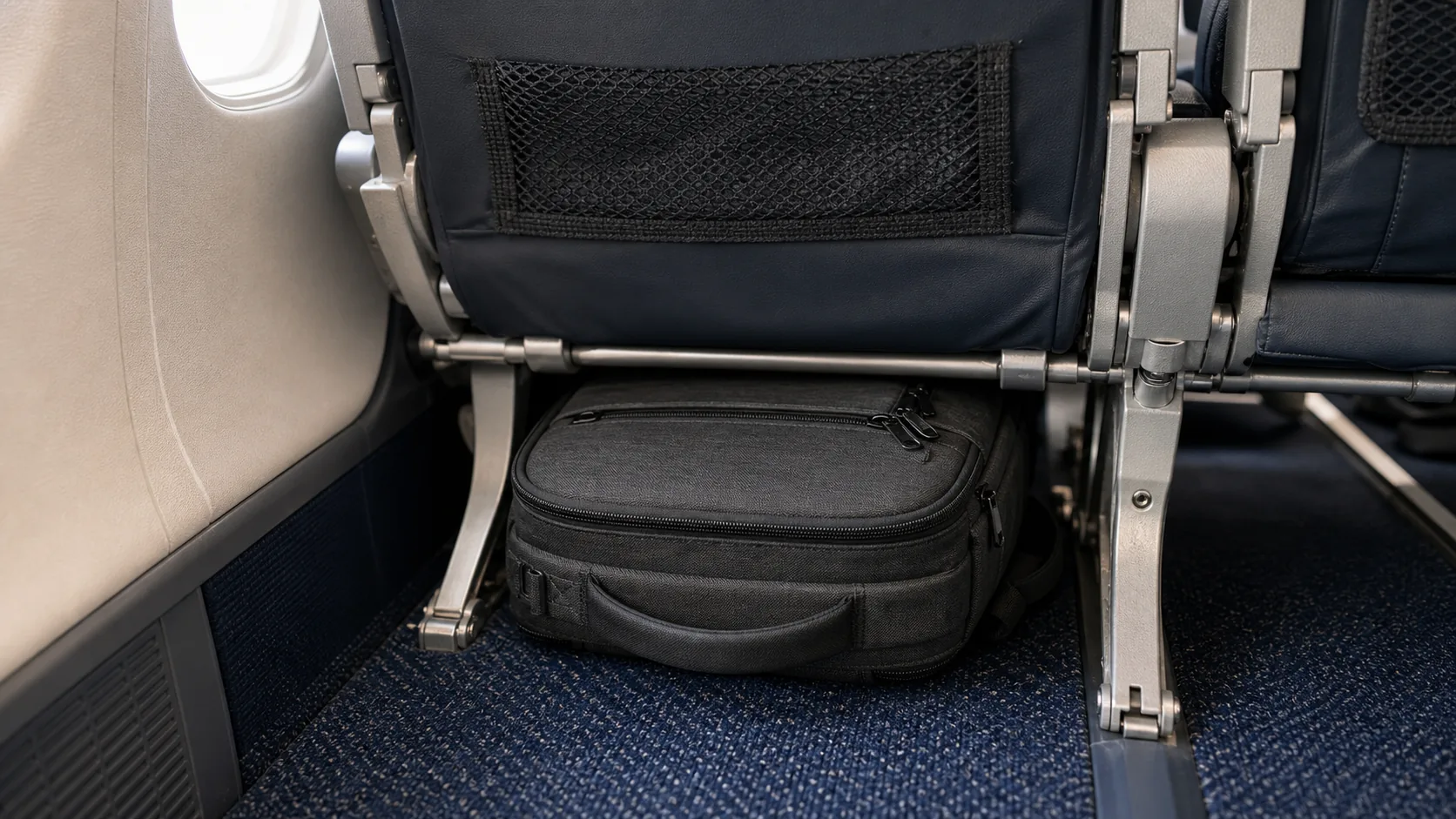
Yes, a backpack counts as a personal item on many airlines when it fits fully under the seat in front of you and stays within that airline’s size rules. The exact answer depends on the carrier, aircraft, fare type, and how full the backpack is. A slim soft-sided backpack usually has a better chance than a rigid or overpacked bag because it can compress into the underseat space.
The question does a backpack count as a personal item matters because a wrong answer at the gate can mean a surprise fee, a forced gate check, or losing easy access to your laptop, documents, medication, and travel essentials. For brands and buyers developing waterproof travel backpacks, personal-item compliance also shapes product dimensions, pocket layout, materials, and packaging claims.
Does a Backpack Count as a Personal Item Under Airline Rules?

A backpack counts as a personal item when it can slide completely under the seat ahead of you. Airlines usually define personal items by placement and size, not by the name of the bag. A purse, tote, briefcase, laptop bag, or backpack can all qualify if the item fits the underseat space and follows the fare rules.
The main difference is location. A personal item goes under the seat. A carry-on goes in the overhead bin. A checked bag goes below deck and is not available during the flight.
What defines a personal item versus a carry-on?
The simplest rule is this:
- Personal item: under the seat, quick access during the flight
- Carry-on: overhead bin, larger capacity, less access after boarding
- Checked bag: cargo hold, available after arrival
Many full-service airlines allow one personal item plus one carry-on, but basic economy and low-cost fare rules can vary.
Why do airline dimensions vary?
Underseat space changes by aircraft, seat layout, and carrier policy. Regional jets may have less room than larger mainline aircraft. Budget carriers may publish tighter limits and enforce them more strictly because baggage fees are part of their pricing model.
| Bag Type | Typical Location | Common Size Limit |
|---|---|---|
| Personal item | Under seat | About 18 x 14 x 8 in |
| Carry-on | Overhead bin | About 22 x 14 x 9 in |
| Checked bag | Cargo hold | Often 62 linear in |
Always check the airline’s current policy before flying, especially if the backpack is close to the limit.
What Size Backpack Usually Counts as a Personal Item?

A backpack around 18 x 14 x 8 inches or smaller is a common personal-item target for US travel, but the safest product spec is slightly smaller. A 17 x 13 x 7 inch backpack gives travelers more breathing room when the bag is packed and the gate uses a sizer.
For custom travel backpacks, the loaded shape matters as much as the empty measurement. A backpack that is compliant when empty can fail when front pockets, bottle holders, and laptop padding bulge outward.
How do you measure a backpack correctly?
Measure the backpack at its widest loaded points:
- Height from base to top panel
- Width across the widest side-to-side point
- Depth from back panel to the fullest front pocket
- Any handles, side pockets, straps, or external loops that protrude
Do not measure only the flat fabric panel. Gate sizers judge the real packed shape.
Does backpack shape affect approval?
Yes. Slim rectangular backpacks slide under seats more easily than boxy front-loaders. Soft fabric, tapered gussets, compression straps, and flatter front pockets help the bag fit without giving up all usable capacity.
| Dimension | Common Limit | Safer Product Target |
|---|---|---|
| Height | 18 in / 45 cm | 17 in / 43 cm |
| Width | 14 in / 35 cm | 13 in / 33 cm |
| Depth | 8 in / 20 cm | 6.5-7 in / 17-18 cm |
Building below the ceiling protects the customer from real-world packing and sizer variation.
Does a Backpack Count as a Personal Item on Delta?

Yes, Delta generally treats a backpack as a personal item when it fits under the seat. Delta’s public guidance focuses on examples such as a purse, briefcase, small backpack, camera bag, or diaper bag rather than a single strict personal-item measurement. That gives travelers some flexibility, but the bag still needs to fit safely under the seat.
For Delta-heavy business travel, a slim laptop backpack is usually a better choice than a thick hiking pack. The goal is a clean profile that does not block foot space or protrude into the aisle.
What backpack styles work best?
Good Delta-friendly styles include:
- Slim laptop backpacks
- Everyday commuter backpacks
- Soft-sided weekender backpacks
- Business backpacks with flat front pockets
Avoid overpacking side pockets or attaching bulky jackets, pillows, or travel accessories to the outside.
What specs should product buyers consider?
Retailers targeting business travelers should prioritize practical underseat proportions, professional fabric, and strong laptop protection. This is where thoughtful e-commerce bag projects can benefit from customer testing before a larger launch.
| Feature | Recommended Direction |
|---|---|
| Volume | 15-20 L |
| Laptop sleeve | Up to 15.6 in or 16 in, depending on layout |
| External profile | Slim and non-boxy |
| Fabric | Durable nylon or polyester |
Delta may be flexible, but a neat underseat shape still matters.
Does a Backpack Count as a Personal Item on American Airlines?

Yes, American Airlines allows a backpack as a personal item when it fits under the seat and stays within the personal item limit of 18 x 14 x 8 inches. That makes American one of the clearer examples for travelers and product teams because the published dimensional target is easy to design around.
American also commonly allows one carry-on plus one personal item, depending on route and fare rules. The backpack should remain the underseat bag, while the carry-on uses the overhead bin.
What if the backpack barely exceeds the limit?
A slightly oversized soft backpack may compress, but travelers should not rely on gate-agent flexibility. Busy flights, full cabins, and stricter boarding checks can turn a small overage into a fee or forced gate check.
Useful packing habits include:
- Emptying side bottle pockets before boarding
- Removing bulky external attachments
- Using compression straps
- Packing flat items against the back panel
What specs support American-friendly designs?
Sourcing teams should treat 18 x 14 x 8 inches as an upper limit, not a design target. A pack that measures just under the limit when loaded is more reliable than one that only meets the spec when empty.
| Spec | American Airlines Limit |
|---|---|
| Personal item | 18 x 14 x 8 in |
| Carry-on | 22 x 14 x 9 in |
| Weight | No common published personal-item weight limit |
Compression features protect travelers when a packed bag starts to bulge.
What About Frontier and Other Budget Airlines?

Frontier and many other budget airlines accept backpacks as personal items only when they fit the published personal-item dimensions and the underseat space. Frontier’s personal item limit is commonly listed as 14 x 18 x 8 inches, including handles, wheels, and straps. Other low-cost airlines may use different limits, and some international budget carriers may also weigh bags.
Older travel content often mentions Spirit together with Frontier. That needs caution now because Spirit’s website states that the airline began winding down operations on May 2, 2026. For current travel planning, check live airline guidance instead of relying on outdated carrier lists.
How strict are sizer boxes?
Budget airlines may use hard-sided sizer boxes. A backpack must drop in cleanly without forcing, squeezing, or pushing. A soft bag helps, but overstuffing can still make it fail.
Travelers should:
- Test the packed backpack before leaving home
- Keep exterior pockets flat
- Remove clip-on accessories
- Pack dense items low and close to the back panel
Why do budget carrier rules matter for sellers?
Budget-airline travelers actively search for guaranteed-fit personal-item backpacks. A product page that claims airline compliance should be based on loaded measurements, not optimistic empty-panel specs.
| Carrier Type | Main Risk | Design Response |
|---|---|---|
| US budget carrier | Sizer-box enforcement | Keep loaded depth below limit |
| European low-cost carrier | Size and weight checks | Use lightweight fabric |
| Regional aircraft | Smaller underseat area | Use slim, flexible shape |
For DTC and marketplace sellers, compliance is a product feature, not just a travel detail.
Does a Backpack Count as a Personal Item on International Flights?
Yes, but international rules vary more than domestic US rules. Some carriers focus on dimensions, some focus on combined cabin weight, and some enforce both. A backpack that works under a seat on one airline may be too tall, too deep, or too heavy on another.
European low-cost carriers can be especially strict. Asian and Middle Eastern carriers may pay closer attention to weight limits. Long-haul airlines may allow a personal item but still expect it to fit safely under the seat without blocking movement.
What should travelers check before international flights?
Before packing, check:
- Personal item dimensions
- Carry-on dimensions
- Combined cabin baggage weight
- Fare-class rules
- Whether laptop bags count separately
- Whether duty-free bags are included in the allowance
How should product teams design for global use?
For global travel backpacks, lightweight fabric and flexible shape matter. Buyers should avoid building right up to one airline’s maximum if the product is marketed as broadly airline-friendly.
| Region | Typical Focus | Enforcement Style |
|---|---|---|
| North America | Dimensions | Moderate to strict |
| Europe low-cost | Dimensions and weight | Strict |
| Asia | Weight and piece count | Often strict |
| Long-haul legacy | Underseat fit and cabin weight | Varies |
International use rewards conservative dimensions and lower empty weight.
Does a Backpack Count as a Personal Item for Business Travelers?
Yes, a backpack can count as a personal item for business travelers if it fits under the seat and still protects work essentials. Business use raises the bar because the bag needs to look professional, hold a laptop safely, and keep documents, chargers, and travel items easy to reach.
A well-built business backpack should stay slim even when loaded. Cheap construction can bulge, sag, or strain at the zipper, making the bag look less professional and less compliant.
What features matter most?
Business travelers usually need:
- Padded laptop sleeve suspended above the base
- Quick-access passport and boarding-pass pocket
- Trolley pass-through strap
- Water-resistant exterior
- Clean front panel with limited bulging pockets
How do materials affect professional appearance?
Durable nylon and premium polyester can look polished without the weight of leather. Reinforced strap anchors, smooth zipper movement, and a stable back panel help the bag keep its shape through repeated trips.
| Feature | Business-Grade Direction |
|---|---|
| Exterior fabric | Durable nylon or polyester |
| Zippers | Reliable reverse coil or similar quality |
| Laptop sleeve | Suspended and padded |
| Trolley strap | Reinforced pass-through |
For corporate channels, underseat fit and professional appearance need to work together.
Does a Backpack Count as a Personal Item If It Holds Sports Gear?
Yes, a sports-focused backpack can count as a personal item if the total packed shape stays within the airline limit. Gym clothes, court gear, shoes, or a compact paddle sleeve do not automatically disqualify the bag. The risk comes from rigid compartments, bulky shoe pockets, or external gear loops that push the bag beyond the allowed size.
For hybrid travel and training products, custom gym bags and backpacks need flexible compartments that collapse when not in use.
What should sports-focused packs prioritize?
Useful features include:
- Ventilated shoe or wet pocket
- Wet/dry divider
- Odor-resistant lining
- Flat front pocket
- Collapsible internal divider
Rigid add-ons should be used carefully because airline sizers measure the outside of the loaded bag.
Can one backpack work for flights and daily use?
Yes, but the best designs avoid wasted volume. A gym-and-travel backpack should carry workout gear during the week and compress flat enough for underseat travel when packed lightly.
| Use Case | Key Feature | Design Priority |
|---|---|---|
| Gym | Wet/dry pocket | Moisture control |
| Court sports | Slim gear sleeve | Low external bulk |
| Travel + gym | Collapsible divider | Flexible volume |
Dual-purpose design works when the structure stays airline-aware.
What Should Wholesale Buyers Know About Personal-Item Backpacks?
Wholesale buyers need to engineer every unit around real loaded measurements, not just sample-room dimensions. If a backpack is sold as personal-item compliant, the finished product should be tested with typical contents, filled pockets, and normal strap placement.
This is especially important for buyers planning a pilot order case before scaling. A small market test can reveal whether customers actually pass gate checks, understand the capacity, and leave positive reviews. For durability-focused travel products, an outdoor durability case can also help frame how fabric, stitching, and strap reinforcement affect long-term performance.
What should buyers ask a manufacturer?
Ask for:
- Loaded-bag measurements
- Empty weight by final material
- Compression behavior when packed
- Zipper and buckle specifications
- Fabric weight and coating details
- Compliance documents when using recycled or certified materials
What about sustainable travel brands?
Sustainable personal-item backpacks can use RPET, recycled nylon, or certified linings, but documentation matters. Claims such as GRS, OEKO-TEX, or recycled-content percentages should be backed by supplier documents and confirmed for the final production materials.
| Sourcing Factor | Buyer Priority |
|---|---|
| Loaded measurement | Confirms real airline fit |
| Sample testing | Reduces returns and bad reviews |
| Material documentation | Supports compliance claims |
| Compression design | Helps users pass sizers |
Final Thoughts
Does a backpack count as a personal item? Yes, when it fits under the seat and follows the airline’s current size and fare rules. For travelers, the safest move is to pack a slim soft-sided backpack below the common 18 x 14 x 8 inch ceiling and check the live policy before departure. For brands and sourcing teams, the better answer is design discipline: loaded measurements, flexible structure, durable materials, and honest product claims. If you are developing airline-friendly travel backpacks for retail or private label programs, contact us today to discuss dimensions, materials, sampling, and production planning.
FAQ
Can I bring a backpack and a carry-on together on the same flight?
On many full-service airlines, yes. The backpack must fit under the seat as the personal item, while the carry-on goes in the overhead bin. Budget fares and low-cost carriers may charge extra, so check the ticket rules.
What is the safest backpack size for personal-item travel?
A backpack around 17 x 13 x 7 inches is a safer target than designing to the full 18 x 14 x 8 inch ceiling. It leaves room for packing bulge and sizer variation.
How do I know if my backpack is too full?
Look for bulging panels, strained zippers, full bottle pockets, and a bag that will not slide under a chair at home. If it cannot compress with light pressure, it may fail a gate check.
Can I use a hiking backpack as a personal item?
Yes, if the loaded pack stays within the airline’s personal-item size rules. Remove external attachments, tighten compression straps, and avoid rigid frames or bulky outside pockets.
What should sellers check before calling a backpack personal-item compliant?
Measure the finished backpack when loaded with realistic contents. Confirm height, width, depth, empty weight, compression behavior, and the airline or region the product claim is meant to support.