
Compare drawstring bag dimensions by finished width and height, measurement state, usable opening, and any base or gusset. Then check the intended contents and closed shape on a sample. A size name or a pair of flat measurements cannot confirm capacity, device fit, or usable print space on its own.
Which Drawstring Bag Dimensions Should You Compare?
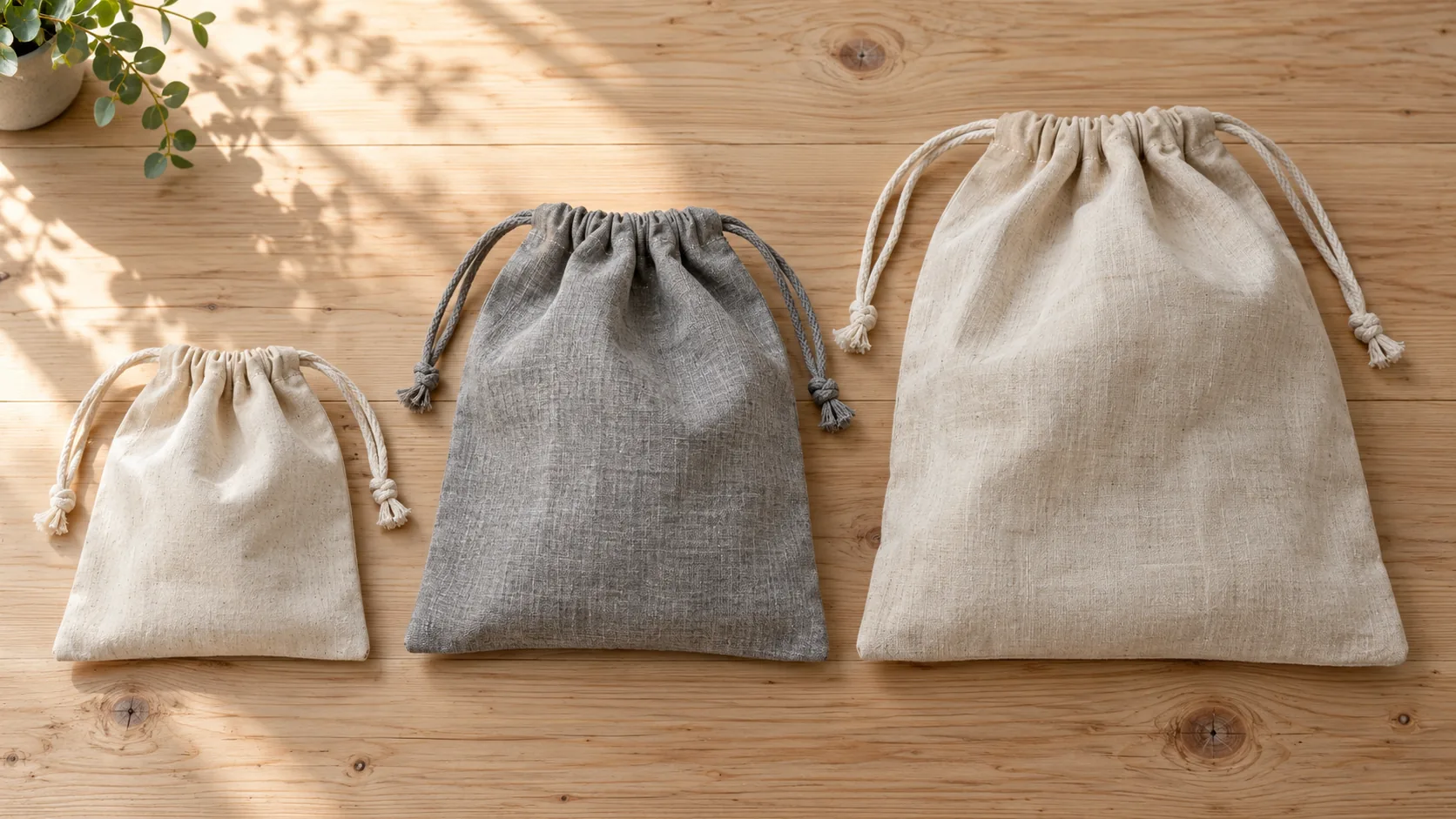
Drawstring bags range from small pouches to backpack-style carryalls. Compare the actual dimensions of the product being offered rather than treating “small,” “medium,” or “standard” as a transferable specification.
A useful size record separates the empty finished body from the space needed by the contents. Width and height describe a flat body only when that measurement state is stated. A gusset adds another construction dimension; the opening and gathered top still need separate attention.
| Dimension or field | What the record should identify |
|---|---|
| Finished width | Measurement endpoints and whether the empty bag is laid flat |
| Finished height | Top and bottom endpoints, including whether the channel is included |
| Base or gusset | Location, measurement state, and how depth is recorded |
| Usable opening | The access path with cords relaxed and any fittings in place |
| Usable closed height | Clearance above the contents when the draw closure is used |
| Packed shape | Contents and arrangement used to show the filled bag |
| Print area | Position and boundaries on the actual panel construction |
If a listing gives only two numbers, confirm their order and meaning before comparing it with another product. If it names a standard, ask for the standard and its relevant scope. This guide does not turn a selection of supplier charts into a claim that no sizing standard exists anywhere.
How Are Finished Drawstring Bag Dimensions Measured?
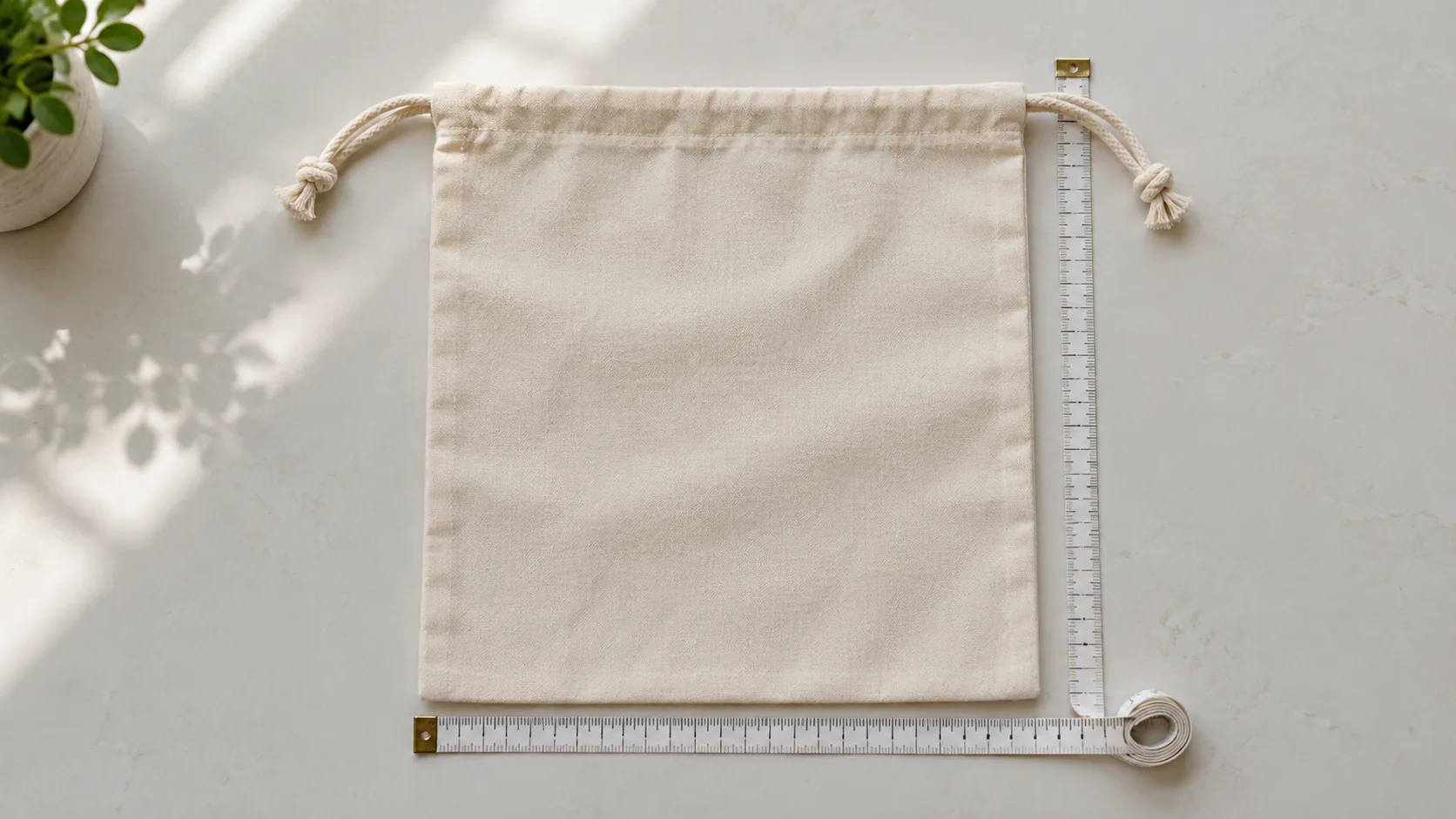
For a flat-size comparison, empty the bag, relax the cords, and lay the body naturally flat without stretching it. Agree on the endpoints before recording a result. One project may measure across the outer body edges; another may use a defined seam line. Keep that choice consistent between the drawing and sample.
Record body height separately from the space available below the channel and gathered closure. The channel occupies part of the top construction when it is included in total height. The affected clearance is usable height, not the bag’s front-to-back depth. Its size and the closing allowance must come from that construction, not a universal deduction of one or two inches.
For a gusseted bag, identify whether the base is measured opened out, folded flat, or in a specified packed state. Cord length, carrying length, opening size, and bag height are different fields. State which cord measurement is needed rather than combining them into one ambiguous “length.”
Finished measurements also differ from cut or pattern measurements. Sewing, folds, seam allowances, and the channel affect the conversion from a pattern to the finished product. This page covers finished fit; it does not prescribe a sewing pattern.
NIST’s unit tables give the exact relationship of one inch to 2.54 centimeters. For example, a hypothetical 12-inch measurement equals 30.48 cm, or 30.5 cm when rounded to one decimal place. That is a conversion example, not a recommended bag size. Keep the original unit and agreed precision in a specification.
Our backpack measurement guide explains the broader distinction between external size, packed shape, and separately assessed capacity. Flat drawstring bodies still need their own explicit measurement state.
Why Can Similar Size Listings Give Different Fit?
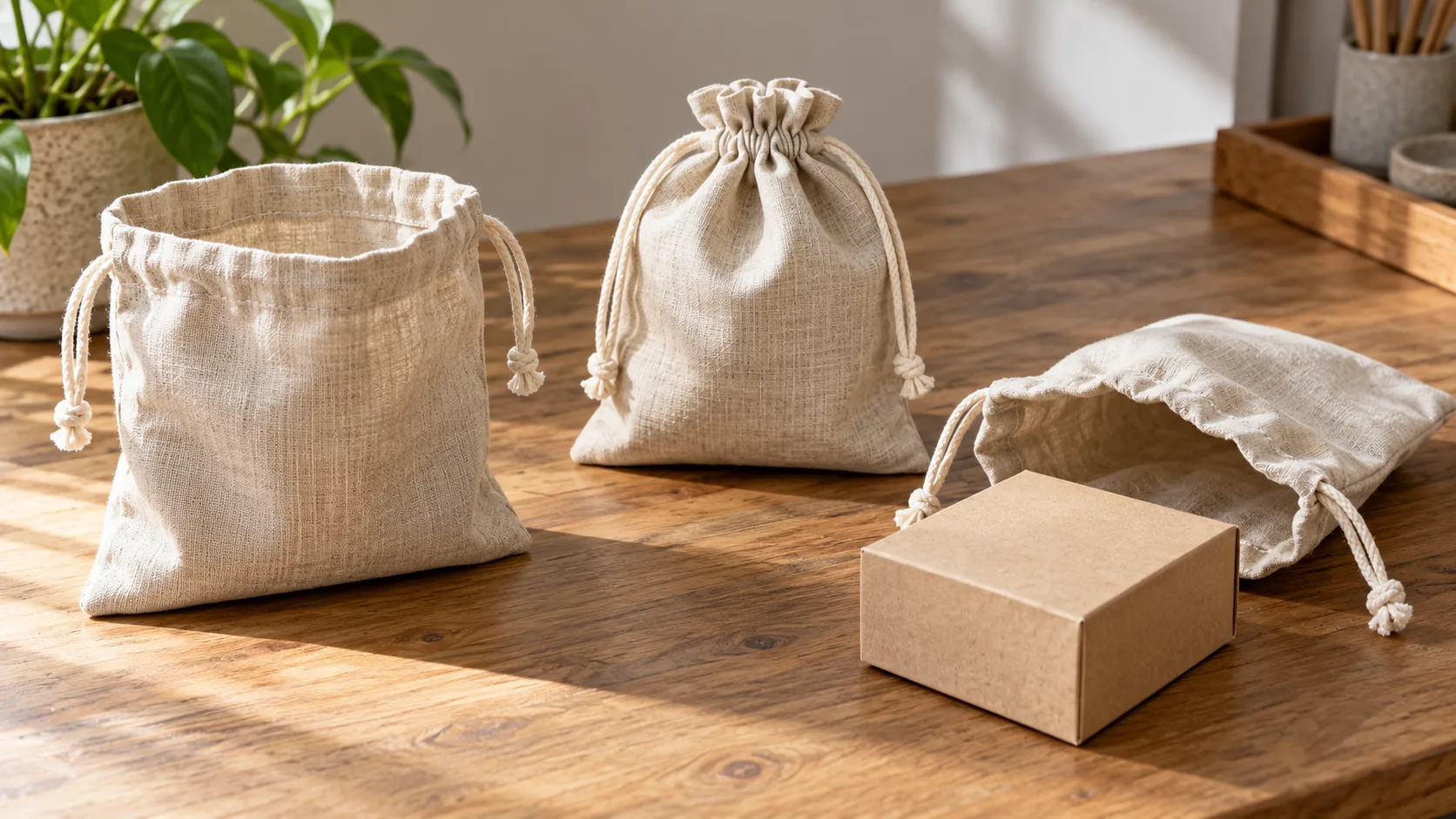
The same nominal width and height leave unanswered questions. Are the figures for the finished bag or a fabric piece? Is the top channel included? Does the bag have a lining, gusset, reinforced exit, or pocket that affects the access path?
Use a comparison sheet that records these differences instead of averaging unlike sizes. A row with an unknown measurement basis is incomplete, even if its numbers look close to a better-documented product.
| Comparison field | Product A | Product B |
|---|---|---|
| Product or sample reference | Record identifier | Record identifier |
| Finished dimension order and unit | Record stated values | Record stated values |
| Empty, flat, open, or packed state | Record method | Record method |
| Channel included in height? | Confirm | Confirm |
| Gusset or separate base? | Describe if present | Describe if present |
| Opening and required item clearance | Check on sample | Check on sample |
| Packed contents and closure state | Record arrangement | Record arrangement |
| Artwork position and construction limits | Confirm template | Confirm template |
This is a blank comparison tool, not an industry size chart. Do not fill its gaps with another vendor’s allowances or assumptions about what “adult size” means. If the products use different measurement conventions, remeasure samples on an agreed basis before treating the values as equivalent.
How Do Flat and Gusseted Drawstring Bags Differ?
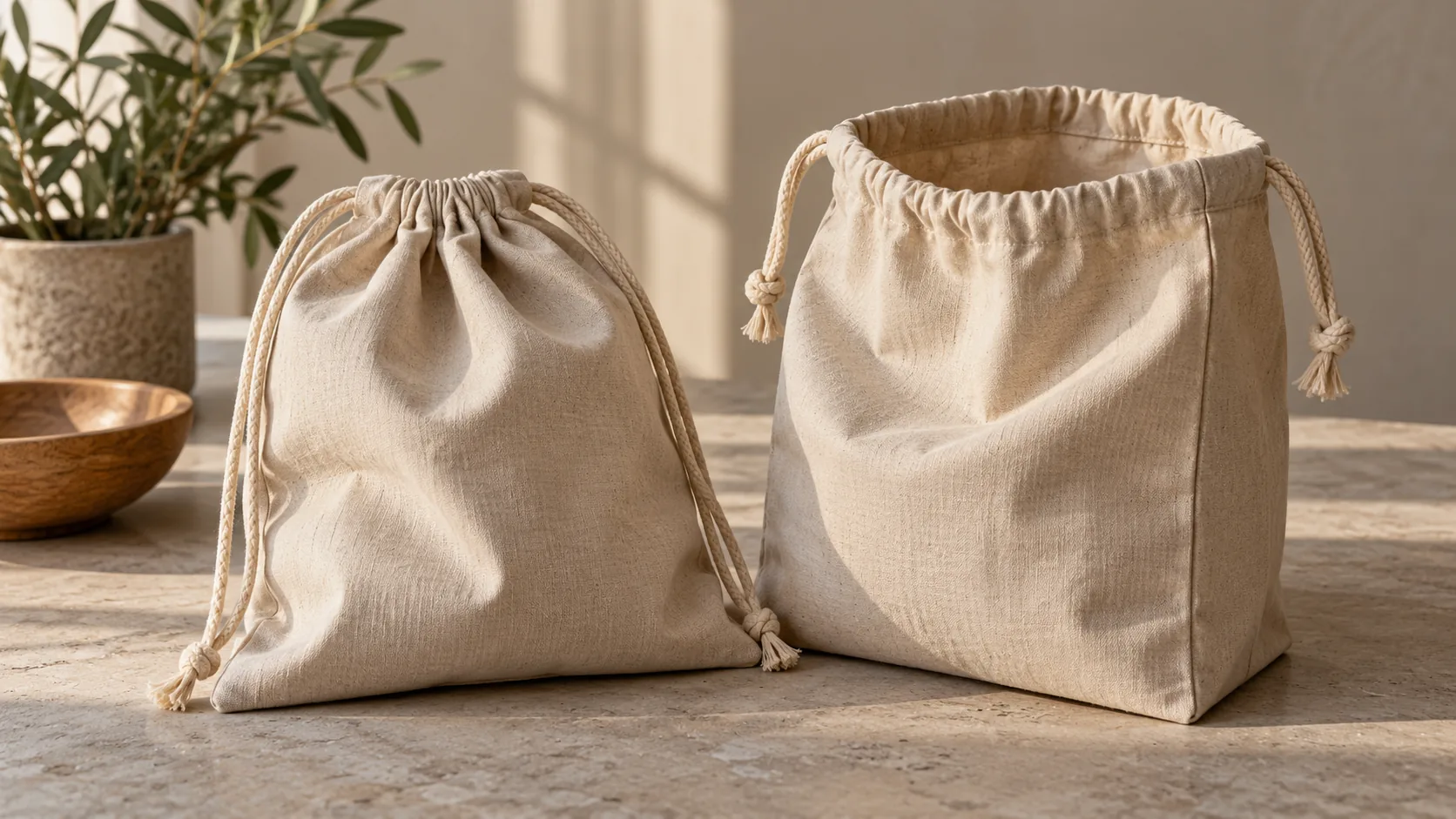
A flat two-panel bag changes shape around a load as its panels bend and move. That does not require the fabric itself to stretch. Fiber name alone does not establish how much a woven, knitted, coated, or laminated fabric will deform.
A gusset or separate base provides additional geometry. It can accommodate a different load shape, but it does not guarantee that a soft bag stands upright, stacks, or has a particular usable capacity. Base stiffness, contents, and support conditions still matter.
Flat width × height gives an area, not a volume. For a gusseted or box-shaped compartment, three stated dimensions may support a geometric estimate under a defined shape assumption; seams, taper, gathering, and internal parts can make that estimate differ from usable packing space. Ask how any listed liter value was assessed and what compartments it includes.
Check the material construction where stiffness or drape affects fit. Our canvas bag material guide gives the fabric and finish details to record rather than treating “canvas” as one fixed behavior.
How Do You Choose Dimensions From the Actual Contents?
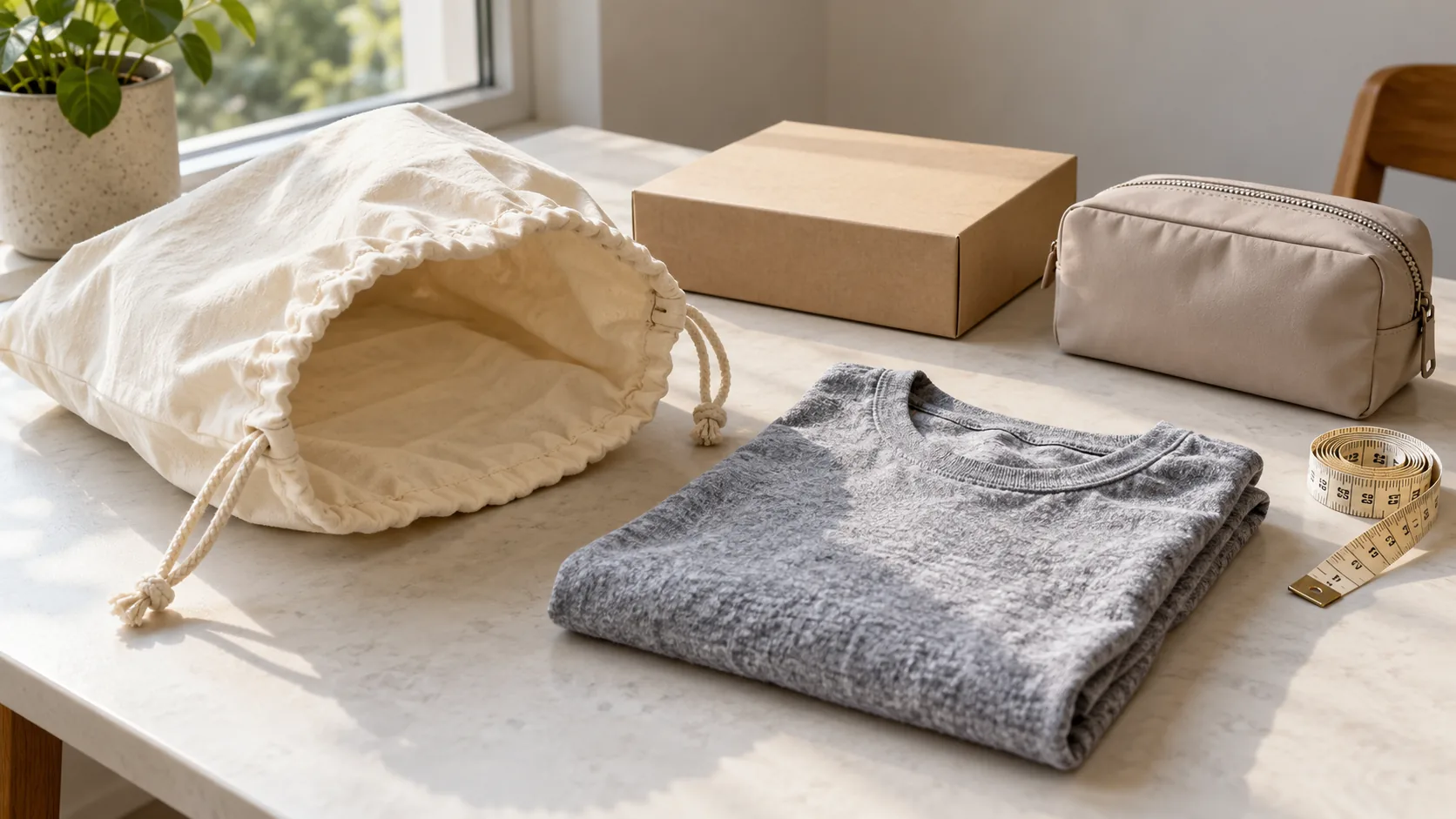
Measure the actual load in its intended arrangement. A pair of shoes placed side by side creates a different outline from the same pair stacked. A folded shirt, box, or device may fit inside the body yet still be difficult to insert through the opening.
Use these inputs to shortlist a finished sample:
| Input | What to record |
|---|---|
| Largest rigid item | Its actual width, height, depth, and insertion orientation |
| Full load | Packed arrangement, including soft-item compression chosen for normal use |
| Opening requirement | Item path with cords relaxed and fittings installed |
| Closure requirement | Space needed to gather the top without forcing it around the load |
| Access requirement | Whether items must be retrieved frequently or packed once |
| Carry mode | Hand-carry pouch, shoulder carry, or backpack-style cord arrangement |
Trial the complete load rather than adding a fixed allowance to each item dimension. A paper or fabric mock-up may help explore an initial shape, but it does not establish how the final fabric, seams, cord system, and lining will behave. Confirm the selected geometry with the finished construction.
For a laptop or tablet, use its body dimensions and any protective sleeve that will be included. Screen diagonal is a different measurement. Confirm insertion, removal, and closure on the actual sample; a size-fit check alone does not demonstrate device protection.
How Should Print Area and Cord Space Be Planned?
A print-safe area depends on the finished panel, decoration process, seams, channel, reinforcement, and access to the application surface. Obtain the template for the exact bag and process instead of assigning a universal percentage of width or height.
Review artwork with the bag empty and filled. Gathering near the top and drape around the contents can change how a logo reads. Keep numerical position and size targets separate from the appearance reference so a favorable photo does not substitute for a measured placement requirement.
Cord length also depends on the route and intended carrying mode. Check that the fitted cord arrangement allows the required opening and closure, and assess the carrying configuration relevant to the project. Do not use a small/medium/large cord-length table as a replacement for these checks.
For backpack-style versions, the backpack parts guide provides broader terminology for the body and attachments. Record the components actually present: cord, channel, exits, any adjustment hardware, sewn anchors, reinforcement, and supporting fabric. A cord specification alone does not establish the strength of that assembled load path.
What Should Buyers Check on the Finished Sample?
Keep the target dimensions, measurement method, tolerance, and approved appearance reference distinct. The target records design intent; a tolerance belongs to defined endpoints and a stated sample condition. An approved sample can show the agreed look and assembly, while dimensions and performance still need their own records.
| Sample check | Acceptance question |
|---|---|
| Finished dimensions | Do results match the project’s stated endpoints, condition, and tolerance? |
| Opening and removal | Can the intended items pass through without an unplanned workaround? |
| Closure | Does the fitted cord system close and reopen as intended with the planned load? |
| Artwork | Are position, size, and appearance checked by their respective criteria? |
| Packed shape | Does the chosen flat or gusseted body suit the recorded load arrangement? |
| Cord exits and anchors | Are the actual components and interfaces identified for the relevant assessment? |
When strength testing is needed, specify the relevant assembly and method. SATRA’s luggage catalogue lists static handle loading, repeated lifting, and fittings attachment as distinct assessments. That distinction does not prescribe one test for every drawstring bag. Select an applicable method or controlled project assessment and retain its relevant load, configuration, conditions, endpoint, and result.
Record a sample’s identifier, date, version, agreed purpose, and open items. Approval creates a comparison reference, not a guarantee that future production has identical measured performance. No industry-wide tolerance or sample-signature rule is assumed here.
Once fit, closure, and artwork are confirmed, custom bag development can use that defined size brief rather than an unexplained catalog label.
Frequently Asked Questions
What is the standard drawstring bag size?
Use the specific product’s finished dimensions and measurement convention. A “standard” size label does not establish a shared specification unless the supplier identifies its basis and scope. This guide does not prescribe one universal pouch or backpack size.
Are dimensions listed width by height?
Confirm the order rather than assuming it. Also check whether the figures describe an empty flat body, finished edges, seam lines, a pattern piece, or a packed bag.
How much height does the cord channel take up?
Measure the channel and closure arrangement on that construction. If total height includes the channel, the space available below it differs from total body height; the difference is not a universal one- or two-inch deduction.
Can flat dimensions be converted into liters?
Width × height describes area. Usable volume requires a third-dimensional shape and an assessment method. For a soft bag, ask how the capacity was determined instead of supplying an assumed depth.
What size fits shoes or a device?
Measure the actual item or pair in the intended packing orientation, including any sleeve or pouch. Check the opening, interior arrangement, and closure on the sample. A generic size name or screen diagonal cannot establish fit.