
Gift bag sizes are not universal. Two suppliers can use the same “medium” label for bags with different dimensions, measurement orders, and constructions. The reliable way to choose a bag is to measure the packed gift, confirm how the supplier lists its dimensions, and compare usable space rather than size names.
This guide explains how to read a gift bag size chart, measure the item that must fit, choose between paper and sewn constructions, and write a clear specification for a custom order.
Are Gift Bag Sizes Standard?
No. Small, medium, and large are catalog labels rather than shared industry sizes.
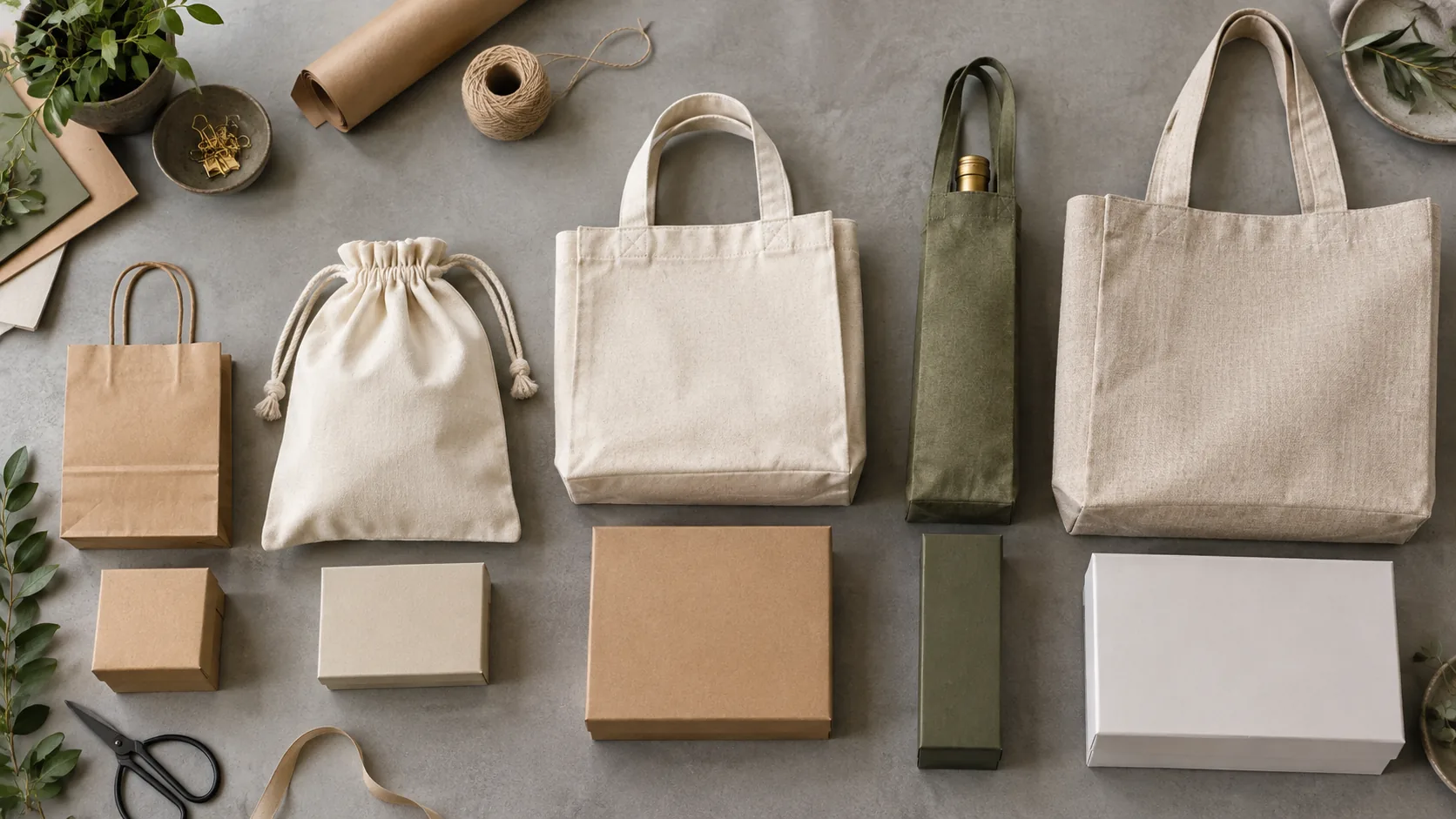
Current supplier guides show the difference. UPrinting lists a medium paper gift bag at 7 × 4.5 × 10 inches, while Gentle Bags gives a medium range of 7-10 × 4-5 × 9-12 inches. Gather and Knot lists its medium flat fabric gift bag at 12 × 16 inches. These figures are useful within each supplier’s catalog, but they are not directly interchangeable.
The construction also changes what a dimension means. A folded paper bag, a flat sewn pouch, and a gusseted fabric bag may all carry the same size label while offering different openings, base shapes, and usable internal space.
Before comparing two charts, align the product type, size name, measurement points, dimension order, units, product state, source date, and what the dimensions include. If those details are unclear, the figures are not yet comparable.
Treat a size label as a starting point. The stated dimensions and the packed-item test determine whether the bag fits.
How Are Gift Bag Dimensions Measured?
Many suppliers use width × depth × height, but the order is not universal. Some use width × height × gusset, while flat fabric pouches may list only width × height. Confirm the order before comparing or ordering.
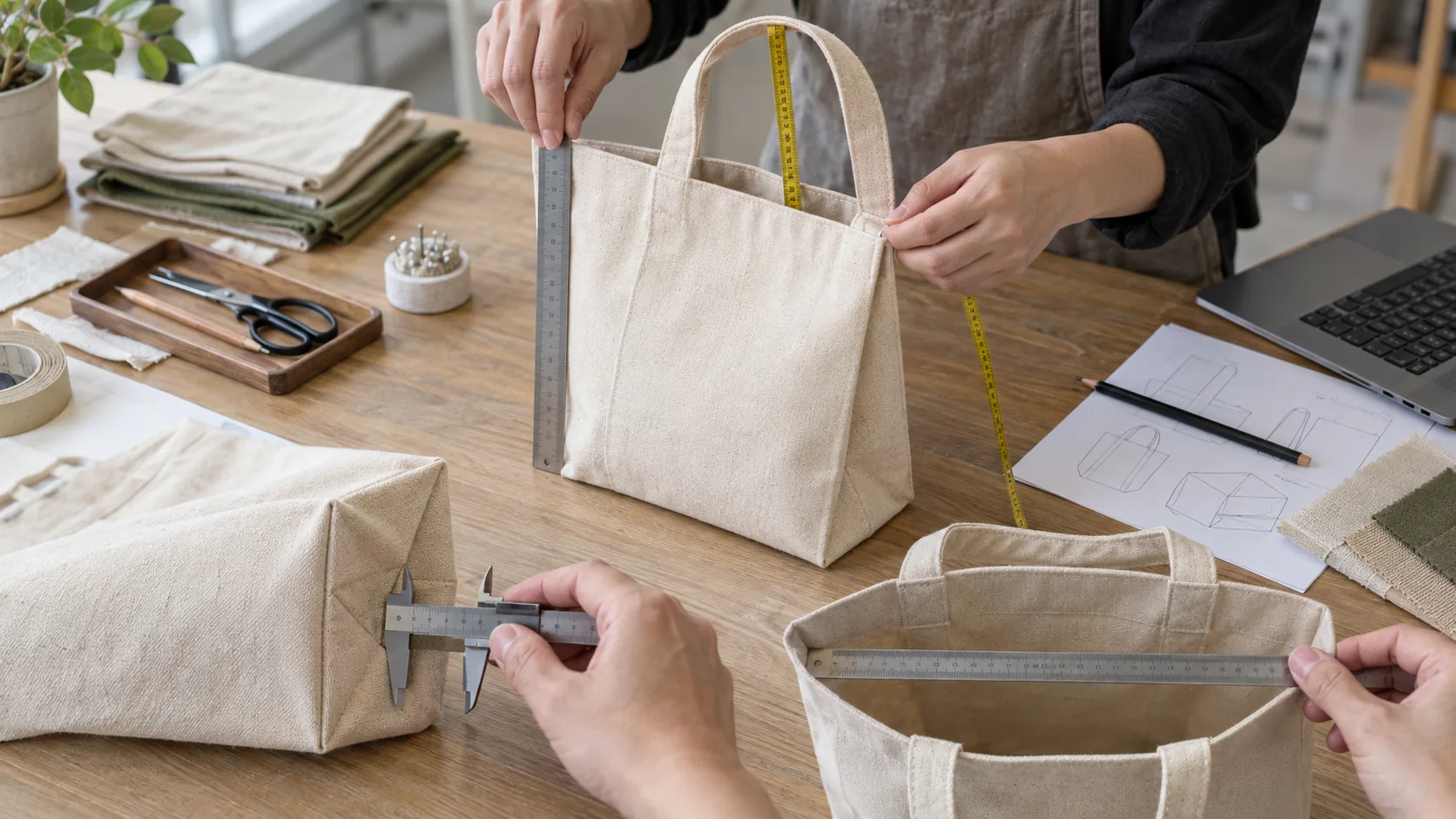
The useful measurements are:
- Width: the horizontal front-panel measurement, usually taken across the opening or widest stated point.
- Depth or gusset: the side or bottom dimension that creates room for a thicker item.
- Height: the body measurement from the base to the top edge, normally excluding the handles unless the supplier says otherwise.
- Clear opening: the space through which the packed gift must pass.
- Usable internal height: the body space left after allowing for seams, a glued base, a fold-over top, or a drawstring channel.
- Handle drop: the distance from the top edge of the bag to the top of the handle on constructions where this measurement applies.
Outside size, opening, usable base, usable height, and handle drop answer different fit questions. A single external width × depth × height line cannot confirm all of them.
External dimensions are also a bounding box, not a capacity measurement. Seams, folds, tapered sides, top channels, and base construction can reduce usable space. Do not multiply three outside dimensions and present the result as a verified bag capacity unless the loading method and endpoint are defined.
How Should You Measure the Gift or Product Pack?
Measure the gift after its retail box, protective wrap, tissue, bow, or other packing has been added. Record the widest, deepest, and tallest points in the orientation that will enter the bag.
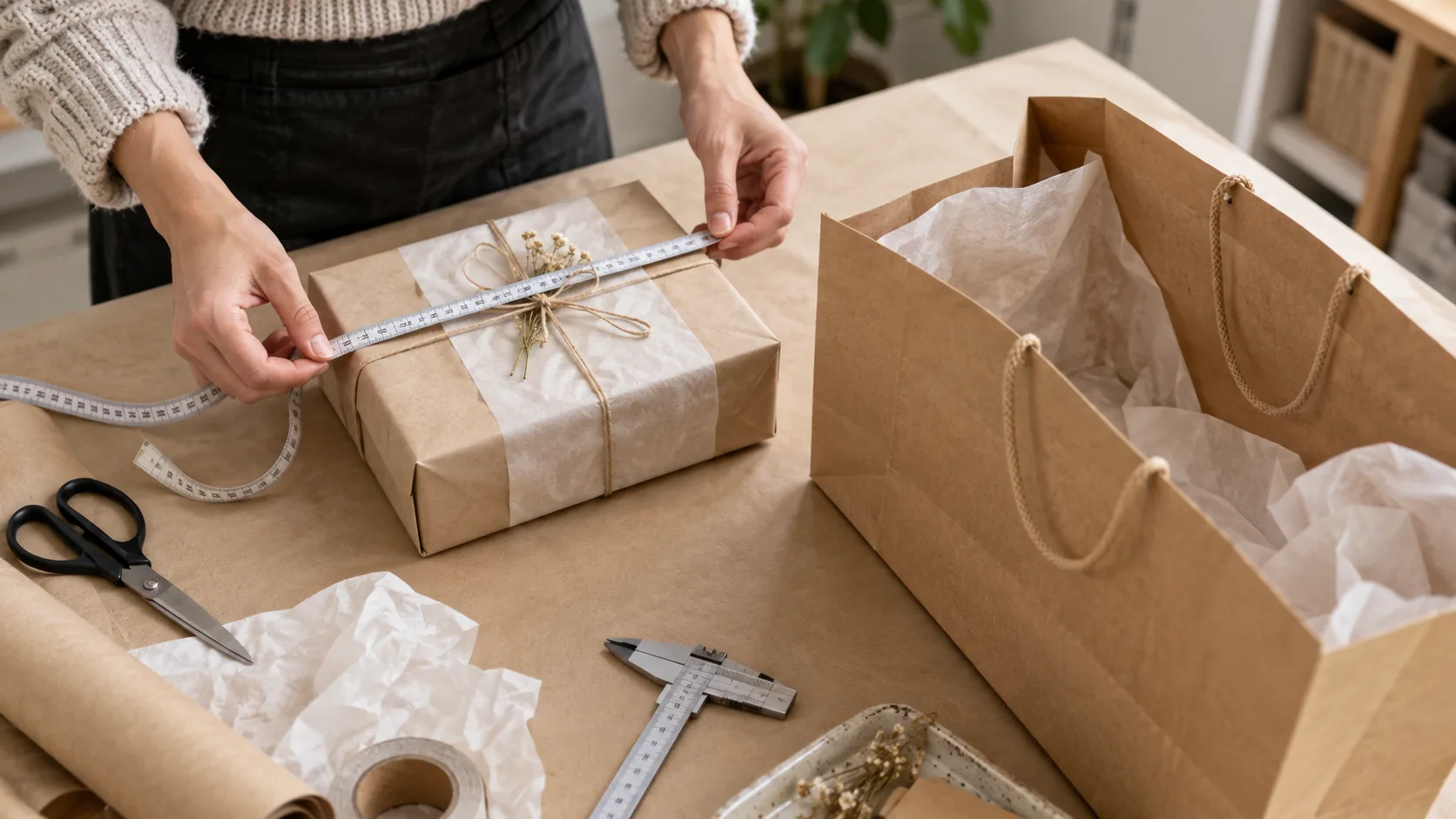
Use this sequence:
- Measure the packed item. Record its maximum width, depth, and height rather than the bare product dimensions.
- Choose the insertion orientation. The face entering first must pass through the clear opening.
- Account for the closure. A fold-over top, ribbon, or drawstring needs space above the item.
- Check the base. A box may fit through the opening but still sit poorly on a narrow or tapered floor.
- Test a physical sample. The sample should use the actual packed item and intended closure, not an empty-bag appearance alone.
There is no universal clearance allowance for every construction. One supplier’s rule of thumb may be useful for an initial shortlist, but paper, cotton, canvas, drawstring, and structured formats do not consume space in the same way. A test fit is the practical final check.
Use this worksheet before requesting a quote:
| Field | What to record | Why it matters |
|---|---|---|
| Packed width | Widest point with wrapping included | Minimum usable width and opening |
| Packed depth | Thickest point with wrapping included | Minimum gusset or base depth |
| Packed height | Tallest point, including protrusions | Minimum usable body height |
| Insertion face | Which face enters first | Clear-opening requirement |
| Closure | Open top, fold-over, ribbon, or drawstring | Extra space and top construction |
| Base requirement | Flat, soft, or able to stand when loaded | Construction choice |
| Fit result | Pass, tight, or fail with the real packed item | Sample decision |
Which Gift Bag Construction Fits the Item?
Choose the construction after you know the item’s shape, weight, presentation, and reuse requirement.
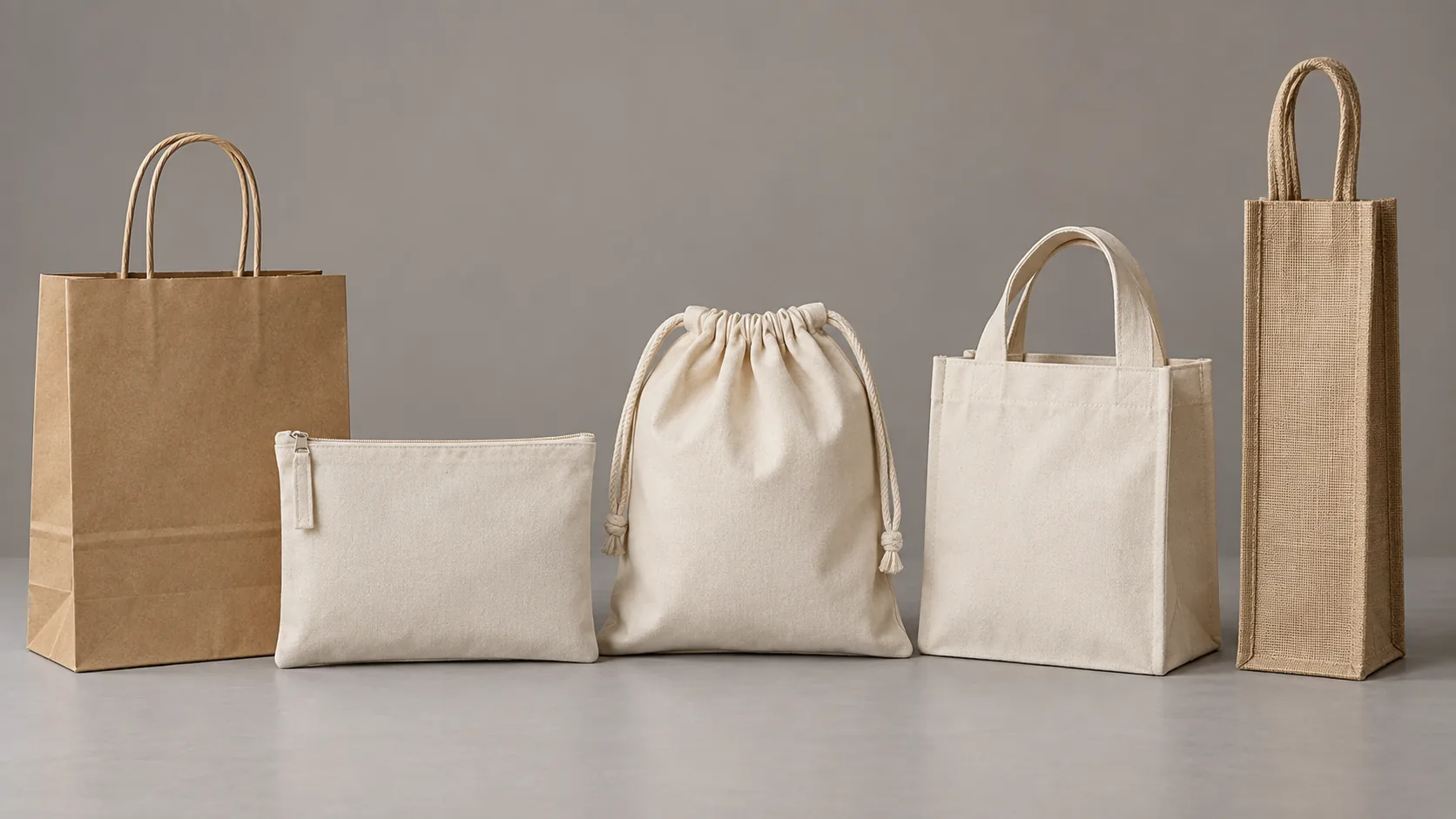
- Paper retail bag: suited to boxed merchandise and counter presentation. Its folded gussets and glued base create the shape, but the usable interior can be smaller than the outside dimensions.
- Flat fabric pouch: a sewn width × height format without a standing base. It works for soft, flat, or foldable contents.
- Drawstring fabric bag: a soft pouch with a cord channel. The channel and closure consume part of the listed body height.
- Gusseted or flat-bottom fabric bag: a sewn side or bottom panel creates depth for boxed or bulky contents. It does not, by itself, guarantee a rigid or self-standing bag.
- Bottle bag: a narrow format for tall contents. Bottle shapes still vary, so check the widest body and base rather than relying on the category name.
- Tote-style gift bag: an open-top sewn bag with two handles, available in flat or gusseted formats. A broader overview of bag types and their structures can help when the final format is still open.
Paper and sewn bags are different production systems. Paper bags are printed, folded, glued, and fitted with handles; fabric bags are cut and sewn from panels, seams, channels, and straps. Even when their listed dimensions match, they may not load or close in the same way.
For reusable sewn programs, material choice also affects hand feel, washability, print compatibility, and structure. Cotton bag material is one common starting point, but the final fabric and construction should be sampled together.
What Does a Gift Bag Size Chart Actually Show?
A gift bag size chart shows one supplier’s product range in that supplier’s units, order, and construction. It does not create a universal definition of small, medium, or large.
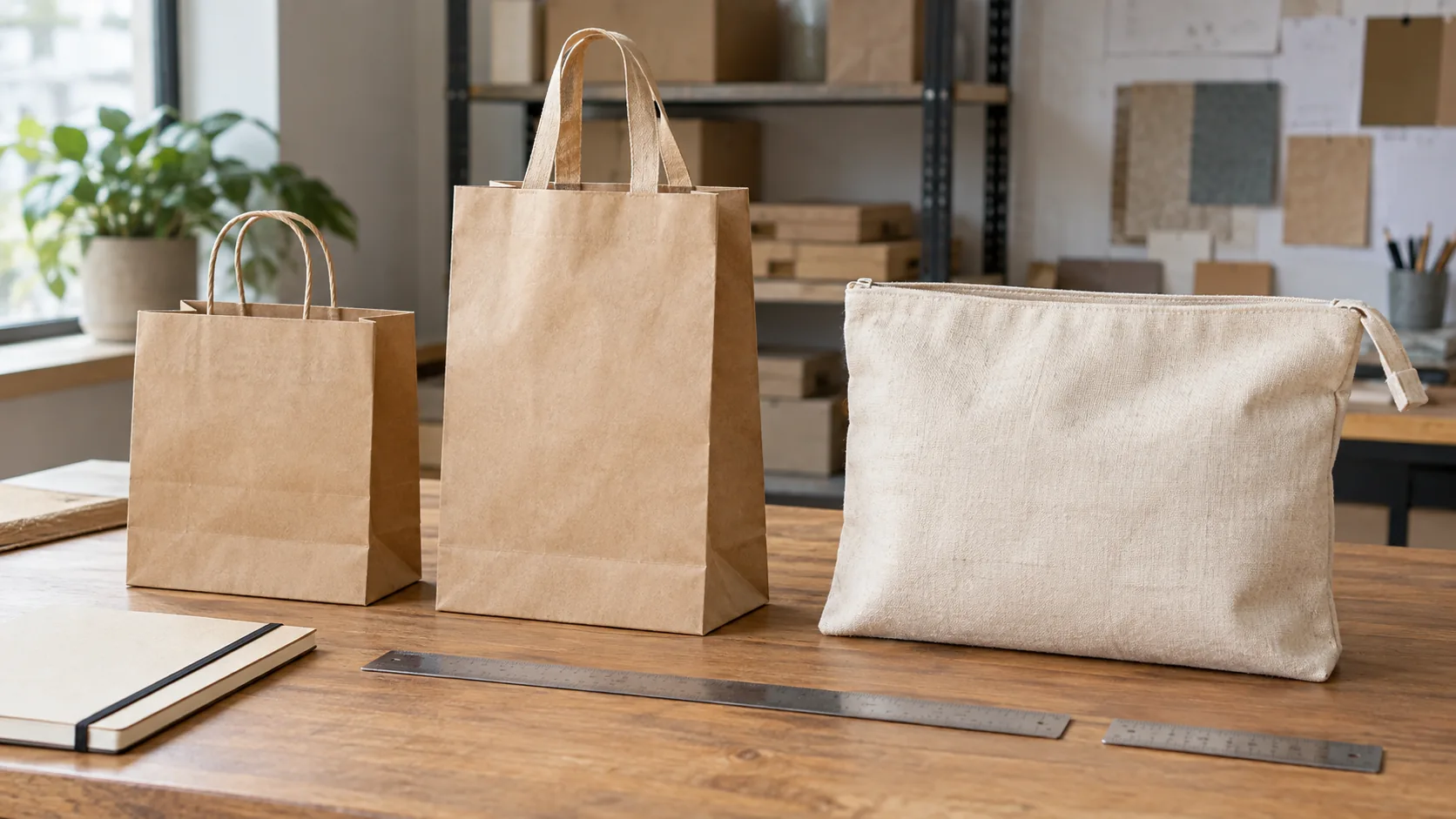
The following examples were rechecked on September 29, 2026. They are presented in each source’s own terms rather than as standard sizes.
| Supplier guide | Stated or apparent order | Small example | Medium example | What to note |
|---|---|---|---|---|
| UPrinting | Width × depth × height | 5 × 3 × 8.5 in | 7 × 4.5 × 10 in | Paper retail bags; dimensions are single catalog sizes |
| Gentle Bags | Width × depth × height, with a warning that other orders exist | 5-6 × 3-4 × 7-9 in | 7-10 × 4-5 × 9-12 in | Uses ranges rather than one fixed size |
| Lipack | Width × depth × height | 15 × 8 × 21 cm | 21 × 11 × 27 cm | Paper-bag examples stated in centimeters |
| Gather and Knot | Width × height for flat styles | 9 × 12 in | 12 × 16 in | Reusable flat fabric bags; flat-bottom styles add a base dimension |
The listed heights of the UPrinting medium paper bag and the Gather and Knot medium flat fabric bag differ by six inches, but that is not a like-for-like product comparison. Their materials, construction, dimension counts, and intended use differ. The comparison shows why the word “medium” is insufficient on its own.
When using a chart, confirm four things before moving on: the dimension order, external versus internal measurement, construction state, and whether handles or closures are included.
How Do Gussets, Openings, and Handles Change the Fit?
The gusset creates depth, but it also changes the relationship between the opening, base, and loaded shape.
A flat pouch behaves like a sleeve. A sewn bottom panel or paper gusset creates room for a box, yet the nominal depth does not guarantee that the entire internal floor has that measurement. Tapered sides, corner folds, seams, and a narrower base can change the usable footprint.
The opening is a separate constraint. Side seams, folded tops, and drawstring channels can make the clear opening smaller than the listed width. If a box only just matches the nominal width, it may not pass through the top.
Handles should be specified separately where their length and attachment affect use. Record the relevant handle drop or strap length, attachment position, and reinforcement rather than adding the handles to the bag’s body height. For paper and sewn bags, those attachment methods are different and should not be treated as one construction detail.
What Should Buyers Specify for a Custom Gift Bag?
A custom gift bag brief should remove ambiguity from the dimensions, packed contents, construction, artwork, and approval process.
Write the measurement order in words-for example, “finished external width × gusset × height”-and give every critical dimension its own measurement point, product state, and project-specific tolerance. A nominal target, an allowed tolerance, and an approved physical sample are different controls; none replaces the others.
Include these fields:
| Specification field | What to state |
|---|---|
| Measurement order | Written out in full, with units |
| Bag dimensions | External or usable internal; measurement points and state |
| Project tolerance | Agreed per critical field; do not assume a universal bag tolerance |
| Packed contents | Maximum dimensions, insertion orientation, and a physical item if available |
| Construction | Flat, side-gusset, bottom-gusset, or structured base |
| Opening and closure | Clear opening plus open top, ribbon, fold-over, zip, or drawstring details |
| Handles or drawcord | Length or drop, placement, attachment, and reinforcement |
| Material | Paper grade or fabric construction, color, and finish |
| Artwork | Method, size, position, colors, and artwork file version |
| Packaging | Folding, individual packing, carton orientation, and labeling |
| Sample control | Purpose, version, date, approval status, and retained reference |
A decoration sample, a complete-bag fit sample, and a final retained sample answer different questions. Define what each stage must close. A retained or “golden” sample can provide an appearance and assembly reference, but written dimensions, tolerances, material fields, and test requirements still need their own records.
For a sewn tote-style gift program, a custom tote bag manufacturer is the relevant production route. For other sewn shapes, start with a custom bag manufacturer and send the packed-item worksheet with the inquiry. Paper retail bags use different machinery and should be sourced from a supplier with paper-packaging production.
Frequently Asked Questions
Is there a standard medium gift bag size?
No. “Medium” describes a position within one supplier’s range. Compare the stated dimensions, order, construction, and usable space instead of matching size labels.
Which number is the height in gift bag dimensions?
It depends on the supplier’s order. Width × depth × height is common, but other orders exist. The chart or supplier should label the order explicitly.
What size gift bag do I need for a boxed gift?
Measure the packed box at its widest, deepest, and tallest points. Check the insertion face against the clear opening, confirm the base can support the footprint, leave room for the closure, and test the actual pack in a sample.
Are fabric gift bag sizes the same as paper gift bag sizes?
No. Flat fabric pouches may be listed as width × height, while paper bags often include a depth or gusset. Seams, drawstring channels, folds, and glued bases also reduce usable space differently.
How should I order a custom gift bag size?
State the dimension order, units, measurement points, external or internal basis, product state, and project tolerance. Include the packed item’s dimensions and approve the fit with a physical sample before bulk production.
Conclusion
Gift bag sizes become manageable once size labels are separated from measurable fit. Start with the packed item, confirm the supplier’s dimension order, compare usable opening and internal space, and choose a construction that suits the contents.
For a custom sewn bag, send the supplier a field-by-field specification and a representative packed item. That gives the sample a clear job: proving that the bag can be loaded, closed, carried, and presented as intended.