
This guide explains how to design custom tote bags for production. Start with the bag’s contents and construction, then define materials, artwork, and sample approval.
A production-ready custom tote bag design defines the physical product first: what the bag carries, its dimensions, gusset, handles, material, and construction. Artwork comes next, matched to a compatible decoration method and approved on a representative sample before bulk production.
The process below follows the order a factory needs. It gives each supplier the same product definition, so the quotations and samples refer to the same bag.
What Should a Tote Bag Design Brief Define First?
A useful tote design brief defines the bag’s job before its appearance. A supplier needs to know the contents, carry method, distribution channel, packed weight, and acceptance criteria before it can quote the construction.
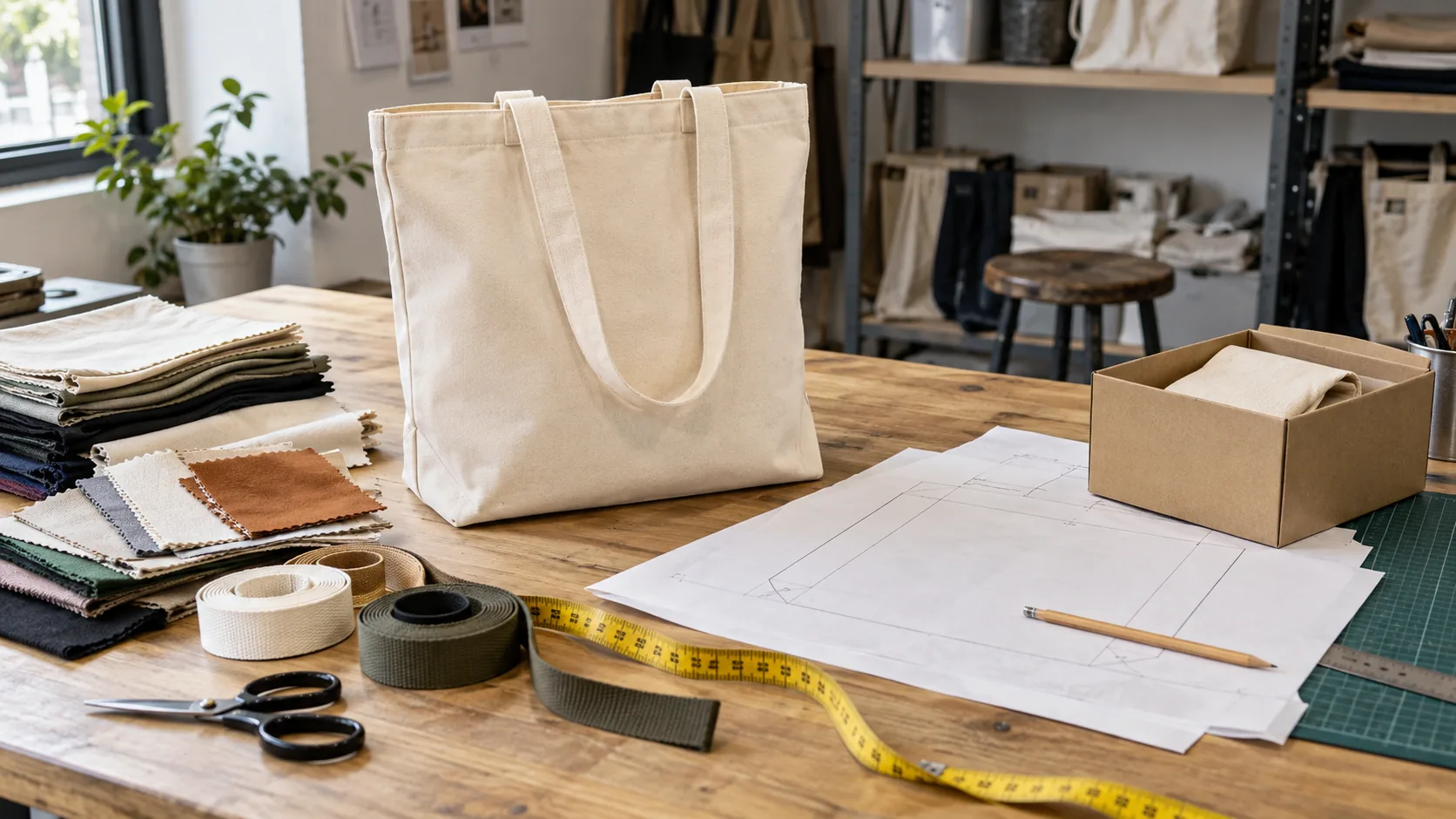
Start with the use and user: what goes inside, how it is carried, where it will be distributed or sold, and what the finished bag must withstand. Those answers guide the format, dimensions, material, decoration, and price.
Record these five inputs before discussing artwork:
- Contents. The largest item the bag must hold, such as a laptop, folder set, product box, or bottle. Contents set minimum dimensions.
- Carry method. Hand-carried, shoulder-carried, or carried inside another bag. Carry method sets handle length and reinforcement.
- Channel. Retail sale, event giveaway, packaging for a product, or internal use. Channel sets finish level: a retail tote and a trade-show tote tolerate very different constructions.
- Packed weight. How much the bag holds when full. Weight drives fabric weight, handle attachment, and whether the base needs reinforcement.
- Success conditions. Measurable acceptance criteria, such as a target load, critical dimensions, an agreed appearance standard, or a defined wash test where laundering is relevant.
Use one revision-controlled worksheet for every supplier. If dimensions live in a sketch, print size in an email, and material details in chat, different suppliers may quote different products.
Tote design brief worksheet (a supplier can quote from this):
| Field | What to record | What it locks |
|---|---|---|
| Primary use and contents | Largest item and total contents | Format, minimum dimensions, base construction |
| User and carry method | Hand carry, shoulder carry, over-shoulder | Handle length and drop, attachment type |
| Distribution channel | Retail, event, product packaging, internal | Finish level, lining, closures, label setup |
| Packed weight | Target load when full | Material, handle reinforcement, sample checks |
| External dimensions | Width × height × depth, with tolerance to agree | Cutting, price, packing ratio |
| Gusset depth | Flat base or boxed gusset | Capacity and structure |
| Handle specification | Length, drop, width, material, attachment stitch | Comfort, load rating, cost |
| Material and weight | Fiber, construction, weight unit, finish or coating | Decoration compatibility, drape, care |
| Construction extras | Lining, zipper or closure, pockets, base insert | Assembly steps and price |
| Decoration method(s) | Chosen per artwork and substrate, with backup | Artwork preparation route |
| Color references | Physical or named references for fabric and print | Color approval basis |
| Labels and packaging | Care label, brand label, hangtag, poly or boxed | Landed presentation |
| Acceptance criteria | Agreed load, dimension, wash, and appearance checks | The standard used to review the sample and bulk |
Which Tote Format Fits the Intended Use?
Choose the tote format from its contents and use, not from the silhouette alone.
A flat tote, a gusseted tote, and a lined zip-top tote require different patterns, components, and assembly steps. The right option is the one that fits the contents, carry method, and sales channel.
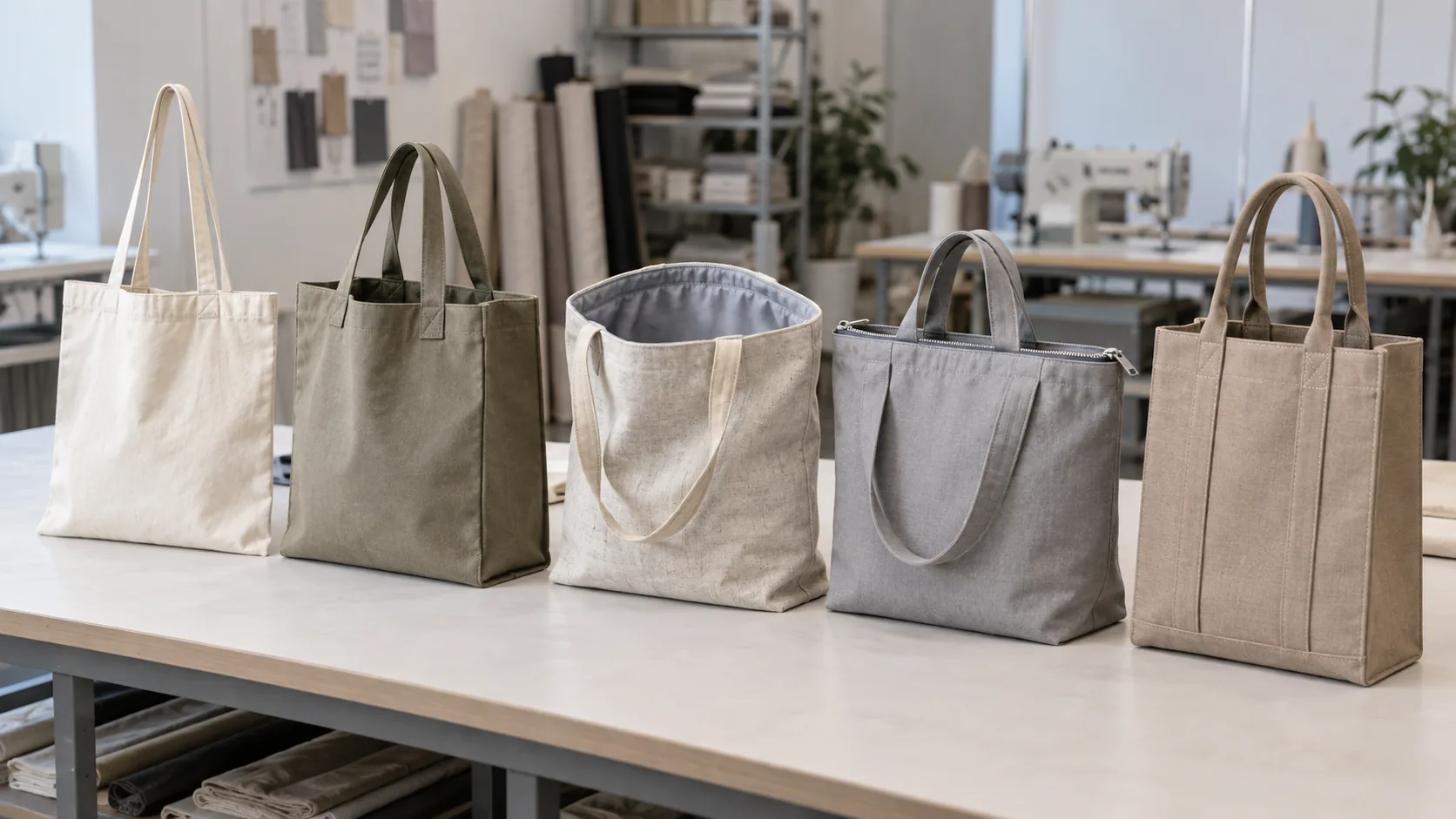
Compare the directions by what each construction actually gives you:
- Flat open tote. A simple panel construction for light, relatively flat contents. Its capacity and structure are limited unless the specification adds depth or reinforcement.
- Gusseted tote. A side or bottom gusset adds depth for boxed or shaped contents. Whether the bag stands depends on the base construction, material, and load.
- Lined tote. An inner lining can hide seams, separate materials, and change the bag’s structure. It also adds material and assembly steps.
- Zip-top tote. A closure changes the bag from open-carrier to secure-carrier. Zippers introduce hardware, tape quality, and stitching requirements that a factory must quote.
- Structured tote. Interfacing, base inserts, and firmer handles help the bag retain a defined shape. These additions require their own material and attachment specifications.
- Work or utility tote. Heavy webbing, reinforced attachments, and sometimes interior organization. Format follows load: this direction exists because of packed weight, not aesthetics.
The promotional-to-retail spectrum matters more than style labels. A giveaway tote that carries a brochure is a different specification from a retail tote that carries a laptop daily, even when the external silhouettes look identical.
How Do Dimensions, Gussets, and Handles Work Together?
One number, such as “a 15-inch tote,” does not explain whether the contents will pass through the opening or sit correctly in the finished bag.
Treat dimensions as a set of related measurements: external size, usable opening, gusset depth, and handle drop must work together against the representative load. Derive them from the contents, not from a catalog convention.
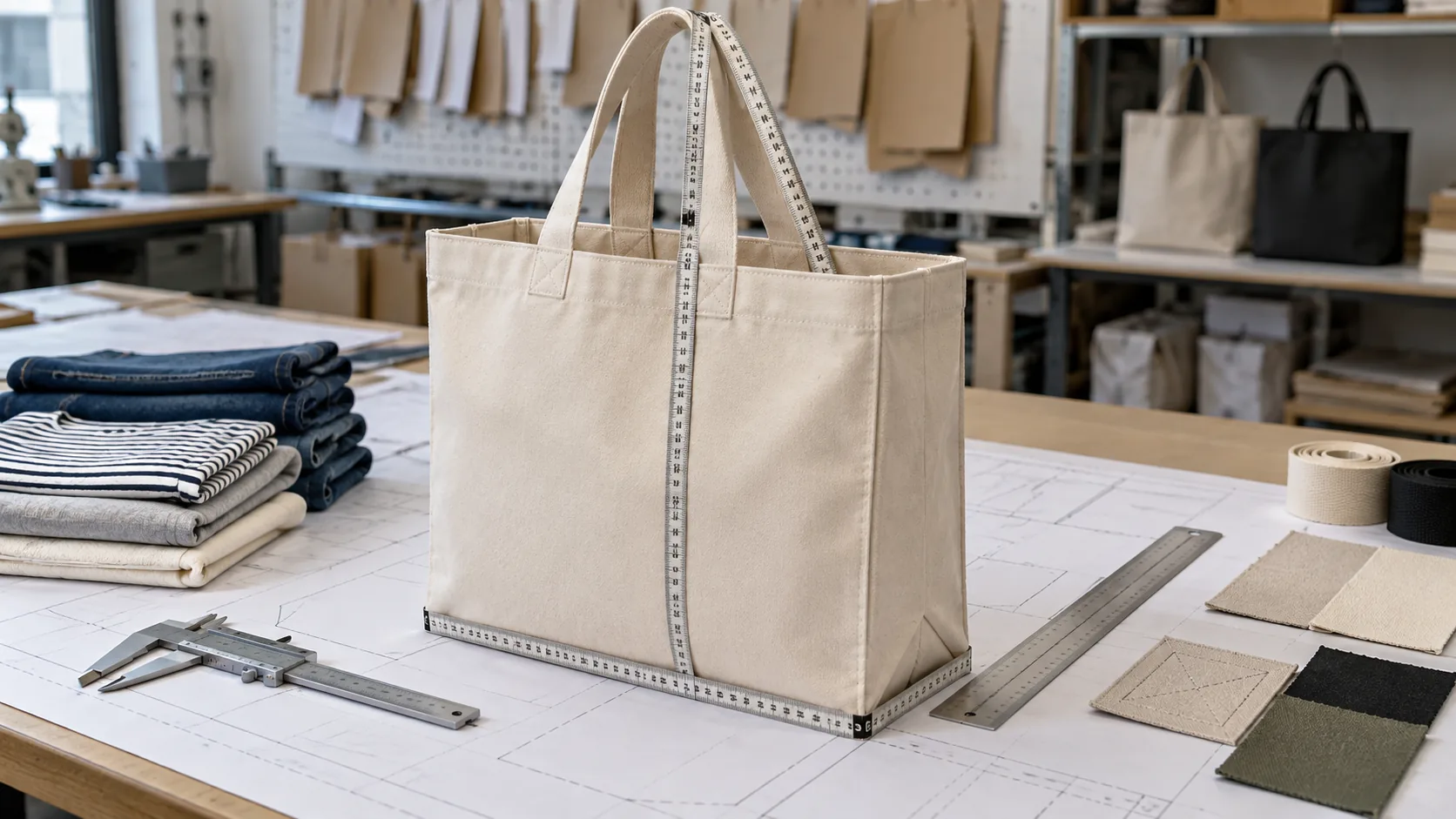
There is no universally correct tote size. Derive the measurements from the contents and carry method:
- External dimensions come from the actual contents plus clearance. For a laptop, measure its physical width, height, and thickness; the advertised screen size is a diagonal measurement and is not a bag dimension.
- Usable opening is smaller than external height once seams, hems, and handle attachments are accounted for. Specify the opening the user actually needs.
- Gusset depth converts a flat sheet into a volume. Deep gussets carry more but change how the bag drapes and how the base wears; a flat base suits soft contents, a boxed base suits structured loads.
- Handle drop is the distance from the top edge of the bag to the top of the handle in use. Specify drop as well as total handle length, and check it against the intended carry method and clothing conditions.
- Representative load ties the measurements together. A dimension set that looks right when empty may behave differently when packed. Specify the handle attachment method and inspect it under the target load.
Put the representative load in the brief so the supplier can review the dimensions, fabric, base, handles, and attachment method as one system.
How Should You Choose Tote Bag Materials?
There is no useful answer to “the best fabric” until the contents, load, care expectations, and decoration method are defined.
Specify material as four separate decisions: fiber, fabric construction, weight, and finish. Each affects price and decoration compatibility differently, and each trades drape, durability, cost, and printability.
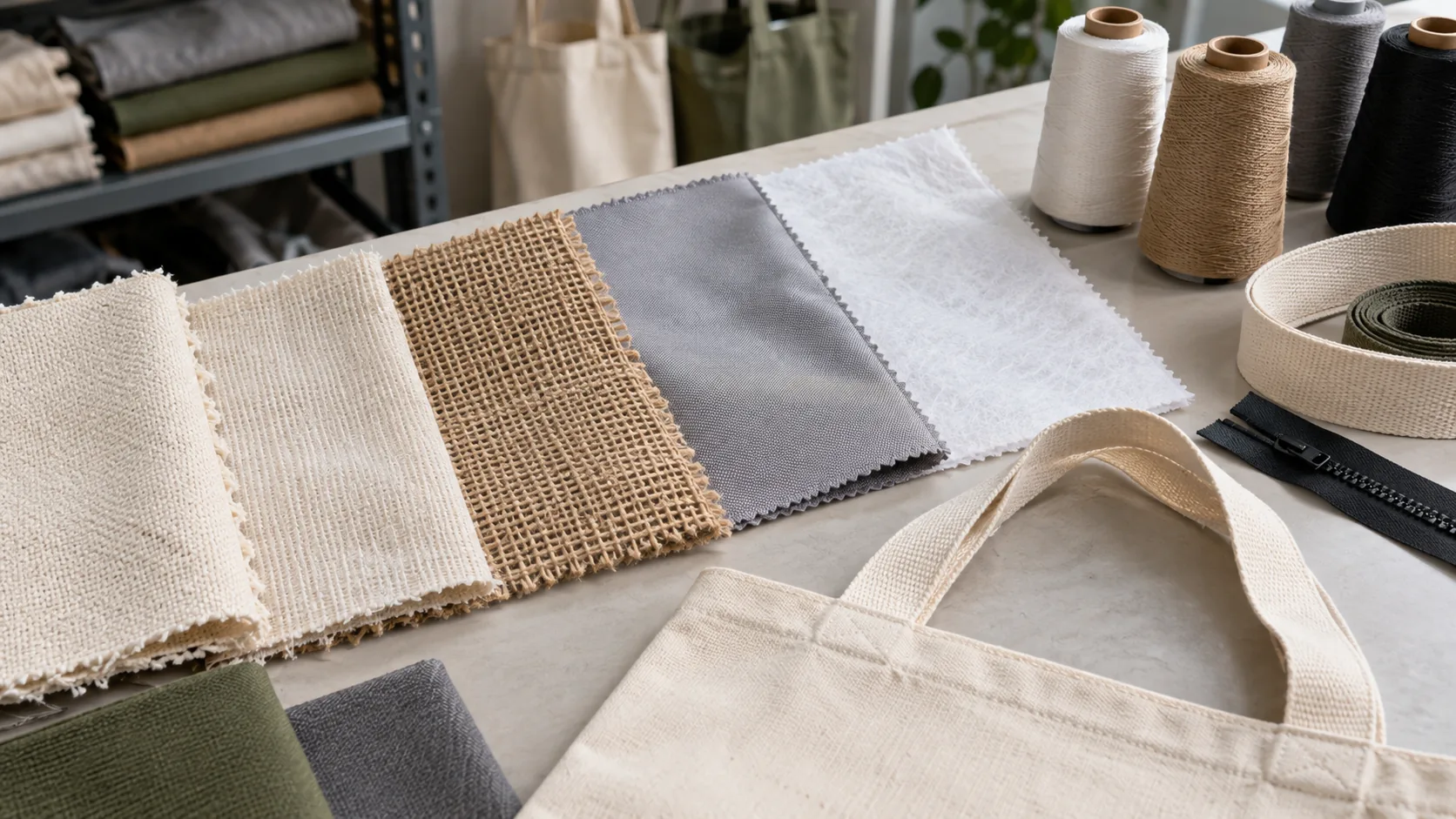
Separate fiber from construction. Cotton is a fiber; canvas is a construction. Canvas can be woven from cotton, and cotton can be woven into non-canvas constructions, so a useful specification names both. Our canvas bag material guide covers construction and weight in more detail, while our cotton bag material guide separates the fiber decision from the fabric decision.
Work through the material decisions in this order:
- Fiber. Cotton, cotton-polyester blends, jute, or synthetics. Fiber influences feel, care behavior, and process compatibility.
- Weave and construction. Plain weave, canvas, or nonwoven. Construction influences strength, drape, and surface texture at a given weight.
- Weight. Fabric weight is quoted in ounces per square yard or grams per square meter. A heavier fabric is not automatically better; it changes drape, cost, and print behavior. Set weight against the packed weight in the brief.
- Finish, coating, and color. Dyeing, coatings, laminates, and surface treatments can change adhesion, heat tolerance, and color appearance. Confirm decoration compatibility on the specified material rather than on a generic swatch.
Decoration compatibility is a material decision, not just an artwork decision. The same logo can print cleanly on one fabric and fail on a coated or deeply textured alternative. Select the material before locking the decoration method.
Which Printing or Branding Method Fits the Artwork?
Choose a decoration method only after the artwork, substrate, order size, surface feel, and durability checks are clear.
No decoration method is universally best. Match the method to artwork detail, color count, fabric content and coating, texture, order size, and turnaround. Require proof on the actual fabric before committing.
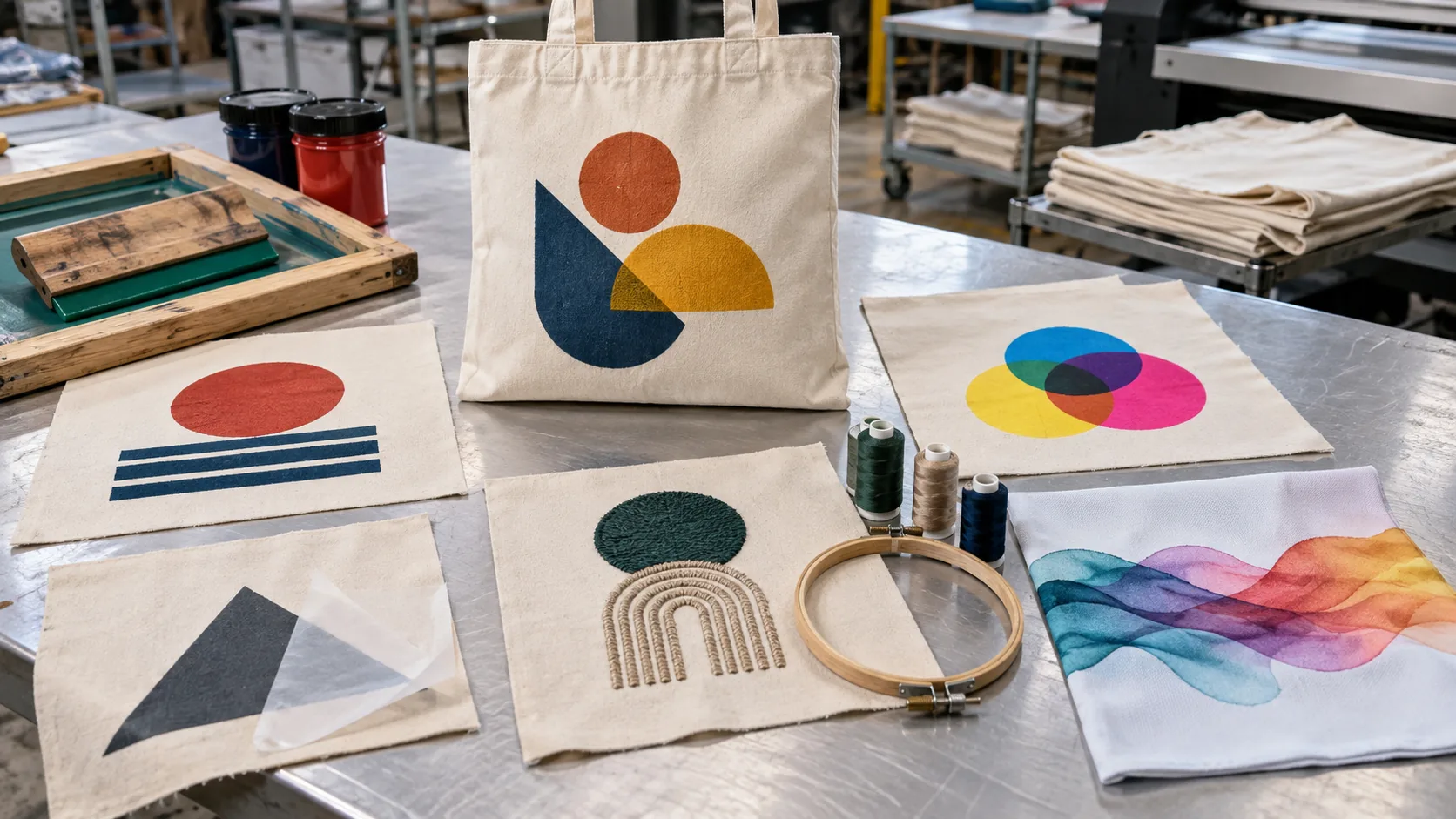
Artwork-to-method decision matrix:
| If your artwork is… | And the substrate is… | Methods to ask about | What to confirm before approving |
|---|---|---|---|
| A simple logo with a few solid colors | A compatible woven fabric, usually at repeat volume | Screen printing | Screen count and setup; ink system; cure settings; wash result on the specified fabric |
| Photographic, gradient, or full-color artwork | A fabric supported by the supplier’s equipment and ink system | DTG or another digital print route | Fiber and color limits; pretreatment if required; a sample on the actual fabric |
| Full-color artwork for a shorter run | A surface that tolerates the transfer temperature and pressure | DTF or another applied transfer | Adhesion, edge quality, hand-feel, heat effect, and wash result |
| Edge-to-edge or all-over color | Polyester textile or a suitable polymer-coated substrate | Dye sublimation | Exact fiber or coating specification; color result and heat effect on the sample |
| A compact mark with limited fine detail | Fabric and panel construction that can support the stitch density | Embroidery | Digitizing, backing, puckering, and smallest readable detail at the intended size |
| Names or small-run personalization | A substrate proven compatible with the selected transfer system | Heat-applied lettering or transfer | Heat tolerance, surface feel, adhesion, and durability on the specified material |
Check the method against run size, curing, and substrate compatibility:
- Run size changes the economics. Screen printing has more setup, while DTG avoids screens and supports frequent artwork changes. Kornit’s current comparison describes screen printing as efficient for long repeat runs and DTG as flexible for one-offs, short runs, and changing designs (Kornit Digital).
- Cure settings belong to the ink system. The complete ink layer must reach the required cure condition. Process guidance from ScreenPrinting.com recommends confirming cure with appropriate stretch and wash checks rather than relying only on surface temperature (ScreenPrinting.com). Ask the printer to document the ink, fabric, equipment, and verification method used for your sample.
- Fabric content and surface treatment affect compatibility. Do not approve DTG, DTF, or another transfer from a method name alone. Confirm the printer’s supported substrate range and test the actual fabric. Conventional sublimation requires polyester textile or a suitable polymer coating, according to Sawgrass.
Use the matrix to create a shortlist, then ask the supplier to confirm the method against the actual fabric. Record the approved method in the specification because changing it after sampling can invalidate the color, surface-feel, and durability approvals.
What Files and Color References Should the Buyer Provide?
Artwork review slows down when the supplied file cannot be resized, separated, or checked at production dimensions.
Provide editable artwork at the intended print size, plus placement and color references, and let the chosen decoration method and your supplier dictate the exact technical settings. File requirements come from the process, so there is no universally correct file setup to publish here.
What to hand over, regardless of method:
- Editable artwork. Provide vector source files for line art and logos when available. Supply linked assets and either outline the fonts or include the approved font files.
- Physical print dimensions and placement. Width and height of the print, measured position from defined bag landmarks (top edge, side seam), stated for every print location.
- Color references. A physical swatch or a named color standard, such as a Pantone reference, for every artwork color. Include a physical reference for the intended fabric color as well.
- A production-size proof. Approve the design at the intended size, then review a physical decoration sample on the production material.
Two color issues affect physical approval:
- A screen is not a proof. Monitors create color by emitting red, green, and blue light, while print uses inks and reflected light. These are different physical systems, so screen color is only indicative (X-Rite). Approve against the physical sample, not the PDF.
- Light changes matches. Two samples can match under one light source and mismatch under another. X-Rite describes this phenomenon as metamerism, so agree on the light source used for color evaluation, especially for near-neutral and dark brand colors (X-Rite).
How Should the Tote Sample Be Approved Before Bulk?
A sample photo cannot replace agreed measurements, material references, and a physical decoration review.
Approve in sequence: artwork check, decoration sample, complete bag sample, and written pre-production approval. Keep visual approval separate from measurable construction approval. A custom tote bag manufacturer can then quote and sample against the same locked specification.
For a structured tote, “size” is not one number. Keep the outside envelope, clear opening, usable base, usable height, and handle drop as separate fields, and bind each critical dimension to a measurement point, product state, and agreed tolerance. The same discipline applies to decoration: heat-based methods should be checked on the actual dyed polyester or coated substrate, while embroidery backing, fabric stability, and machine tension should be approved as separate variables. A physical sample answers only the question it was made to answer, so a decoration strike-off does not replace a complete-bag sample or the written specification.
The sequence:
- Digital artwork check. Dimensions, placement, spelling, color references confirmed on screen. Fast to fix here, expensive later.
- Production-size decoration sample. Your artwork on the actual fabric, made with the actual method. Judge color, surface feel, and edge quality against the physical reference under the agreed light.
- Complete bag sample. The whole construction: fabric, handles, stitching, lining, closures, labels. Judge construction with measurements, not photos.
- Written pre-production approval. The sample plus the specification sheet, confirmed in writing as the standard the bulk order will be judged against.
- Retained reference. Keep one approved sample on each side, identified by the same revision. Use it with the written specification when reviewing bulk production.
Sample approval checklist:
| Checkpoint | Visual approval (eyes) | Construction approval (measure) |
|---|---|---|
| Decoration | Color matches physical reference under agreed light; edges clean; no registration errors | Print size and placement match the specification sheet |
| Fabric | Hand-feel, color, surface as expected | Weight and construction match the material specification |
| Handles and stitching | Attachment looks clean, no loose threads | Handle drop and length as specified; attachment stitch pattern and count as specified |
| Structure | Bag stands/drapes as intended | Dimensions within the tolerance agreed with the supplier |
| Durability | No visible defects after handling the sample | Define the relevant load, abrasion, or wash checks. For washable textiles, AATCC TM61 is an accelerated colorfastness-to-laundering method; AATCC says one 45-minute test roughly approximates the color loss and surface change from five typical hand or home launderings under the method’s stated conditions (AATCC) |
| Labels and packaging | Care label, brand label, and packaging as briefed | Label content and placement match the specification |
Visual approval without construction approval is how bulk orders arrive with the right logo on the wrong bag. Sign off both columns.
What Should Change Control Cover After Approval?
Approval locks a defined revision; it does not make later changes harmless. If the material article, fabric weight, coating, color, decoration process, handle webbing, hardware, pattern, or packaging changes, record what changed, why it changed, who approved it, when it takes effect, and which samples or production lots are affected.
Then reopen only the checks the change can affect. A new coated fabric may require decoration and seam review; a handle-webbing change may require attachment and load checks. Do not carry an old approval onto a different construction simply because the supplier calls it an “equivalent” material.
Frequently Asked Questions
How do I start a tote bag design for production?
Start with the physical product, not the artwork. Define contents, carry method, and where the bag will be used or sold; those inputs determine format, dimensions, and material. Once the bag works as an object, artwork decisions follow from the fabric and decoration method you have chosen.
What size should a custom tote bag be?
There is no universally correct size. Measure the largest item the bag must hold, including its actual width, height, and thickness, then add the clearance needed for the opening, seams, and closure. Market conventions are references, not specifications.
Which material is best for custom tote bags?
No single material is best. A canvas construction may use cotton or a blend, and performance changes with weave, weight, finish, and reinforcement. Match the complete material specification to the contents, care expectations, and proposed decoration process.
What is the best way to put a logo on a tote bag?
It depends on the artwork, fabric, finish, quantity, and required surface feel. Use those inputs to shortlist a process, then approve the result on the actual production material. Do not accept a method change after sampling without reviewing a new sample.
How can I make sure printed colors match my brand colors?
Do not rely on a screen. Monitors emit RGB light while prints use ink on fabric, so a screen image is only indicative. Supply a physical or named color reference, agree on the evaluation light source, and approve a production-size proof on the actual fabric before bulk.
Conclusion
Complete the brief before requesting a quote, and judge the sample against written measurements and references rather than memory. When those inputs are ready, send the same specification to ZWbags or another custom bag manufacturer and keep that revision with the approved sample.