
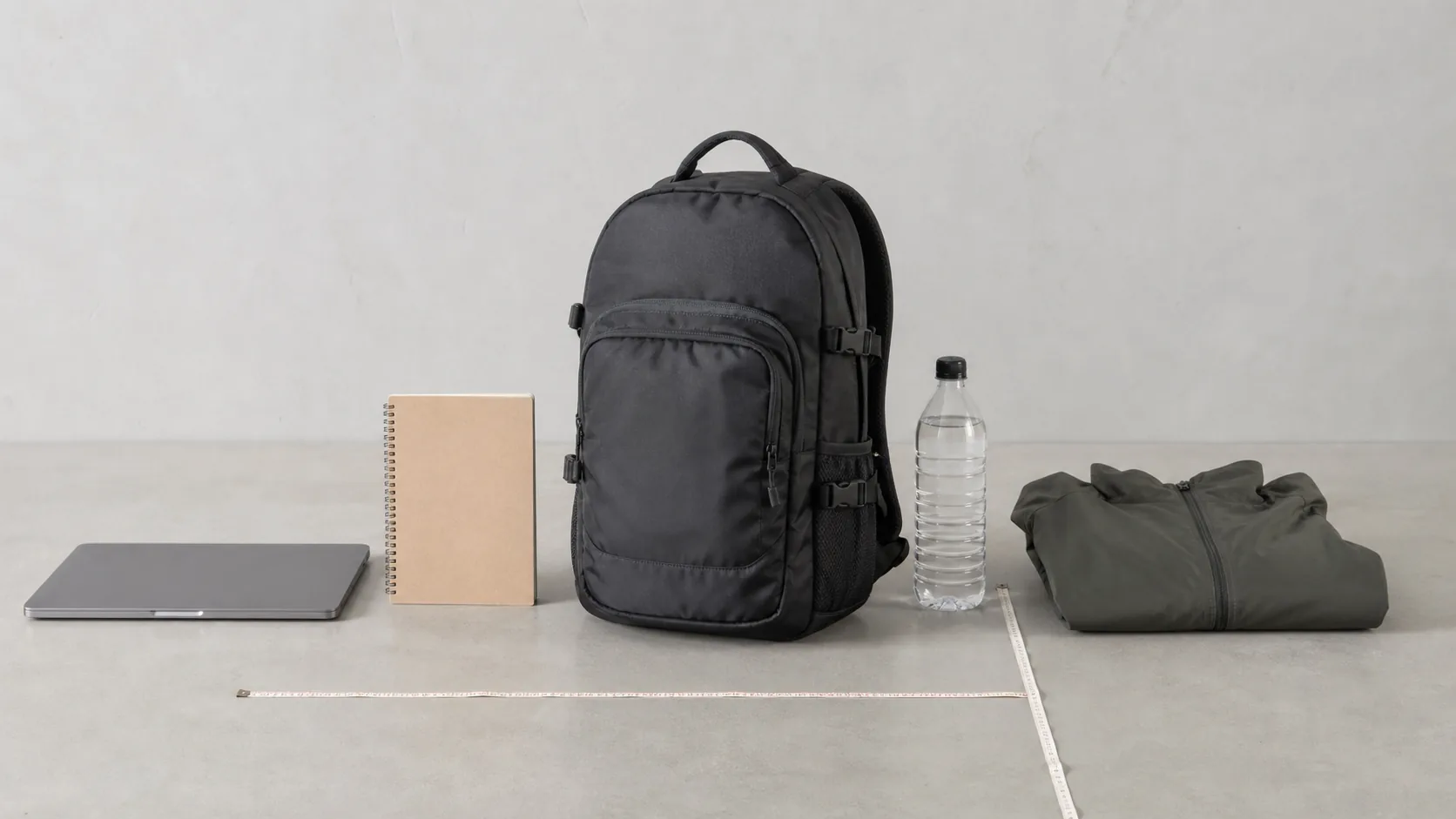
A 20-liter backpack is a compact everyday size that often measures about 17 to 19 inches tall, 11 to 12 inches wide, and 5 to 7 inches deep. Those dimensions vary because 20 liters describes internal volume, not one fixed shape. A slim laptop pack, rounded school bag, and outdoor daypack can all hold 20 liters while looking and fitting differently.
In practical terms, a 20L backpack can carry a laptop, notebooks, lunch, a light layer, and small accessories, or a minimalist weekend clothing kit. It is generally too small for conventional overnight camping equipment or gear-heavy sports. This guide shows how the capacity translates into physical dimensions and real packing scenarios.
How Big Is a 20L Backpack in Physical Dimensions?
A typical 20L backpack has external measurements around 17 to 19 inches high, 11 to 12 inches wide, and 5 to 7 inches deep. Treat these as a common range rather than a standard because padding, pocket shape, back-panel structure, and measurement method all affect the result.

Two bags with the same external dimensions may not provide the same usable capacity. Thick laptop padding and a curved ventilated back panel reduce the main compartment, while stretch pockets can add practical storage outside the measured interior.
What Are the Average External Measurements?
External dimensions describe the fully loaded silhouette and help users judge body fit, locker compatibility, and transport limits.
- Height: approximately 17 to 19 inches (43 to 48 cm)
- Width: approximately 11 to 12 inches (28 to 30 cm)
- Depth: approximately 5 to 7 inches (13 to 18 cm)
- Empty weight: commonly around 1.2 to 2.5 pounds, depending on structure and materials
Measure the pack at its widest usable points and state whether the figures include filled exterior pockets. For product listings, brands should use a consistent method and avoid presenting nominal capacity as though it guarantees one set of dimensions.
What Are the Internal Compartment Dimensions?
The usable interior is normally smaller than the exterior because fabric layers, foam, frames, dividers, and seams consume space. A common 20L main compartment may fall within the following range, but the product’s actual measurements remain authoritative.
| Dimension Type | Imperial Range | Metric Range |
|---|---|---|
| Internal height | 16-18 in | 40-45 cm |
| Internal width | 10-11 in | 25-28 cm |
| Internal depth | 4.5-5.5 in | 11-14 cm |
Measure the thickest item before purchasing. It should pass through the opening and sit inside without forcing the zipper, roll top, or back panel out of shape.
How Is 20-Liter Capacity Measured?
Twenty liters equals about 1,220 cubic inches. Manufacturers may calculate volume from pattern geometry, internal measurements, or a fill method, and the result can differ if exterior pockets are included. Buyers comparing products should ask whether the capacity covers only the closed main compartment or every usable pocket.
For online sellers, clear diagrams and real-item loading photographs are often more useful than the liter number alone. A small-batch product testing example can also help validate whether users interpret the stated dimensions and capacity as intended.
How Big Is a 20L Backpack for Airline Travel?
A soft-sided 20L backpack can fit under many airline seats, but capacity alone does not make it an approved personal item. Airlines use external length, width, and depth limits, and a fully packed 20L bag can exceed a rule even if an empty version compresses.

Check the operating airline’s current allowance before every trip, especially on budget carriers and codeshare itineraries. Measure the packed bag, including handles and filled exterior pockets, rather than relying on the manufacturer’s liter rating.
Does It Comply With Budget-Airline Personal-Item Rules?
It often can, provided the actual dimensions fit the airline’s sizer. A flexible pack has an advantage because it may compress when not filled to the limit, but do not count on squeezing rigid laptop padding or a full bottle pocket into a smaller space.
Useful checks include:
- Compare the packed external measurements with the airline’s current published limit
- Leave enough empty space for the bag to compress without damaging electronics
- Keep bottles and bulky accessories inside while using the sizer
- Confirm weight limits where the airline applies them
- Recheck the operating carrier when another airline sold the ticket
A product such as a waterproof travel backpack may use the same compact capacity while adding laptop protection and travel organization. Those features can increase external depth, so capacity and dimensions must still be checked separately.
Can It Replace a Standard Carry-On Suitcase?
A 20L bag can replace a roller for a minimalist short trip, but it offers roughly half the nominal volume of many 40-45L carry-on suitcases. It works best with lightweight clothing, compact toiletries, and one pair of shoes worn during transit.
| Baggage Type | Typical Nominal Volume | Likely Storage Position |
|---|---|---|
| 20L backpack | 20 L | Often under-seat when dimensions comply |
| Carry-on suitcase | About 40-45 L | Usually overhead bin |
The backpack keeps both hands free and avoids wheels in stairs or crowded streets. The trade-off is stricter packing and less room for cold-weather layers, extra shoes, or souvenirs.
How Big Is a 20L Backpack When Packing Clothes?
A 20L backpack can hold about two to three days of lightweight clothing and basic toiletries for many travelers. Fabric thickness, clothing size, weather, shoes, and the space reserved for electronics can change that estimate substantially.

Heavy winter clothing can consume the entire main compartment quickly. For a short warm-weather trip, choose versatile layers and avoid packing duplicate items that serve the same purpose.
Can You Pack Clothing for a Weekend Getaway?
A minimalist weekend kit may include:
- Three lightweight T-shirts
- One pair of travel pants or shorts
- Three pairs of underwear and socks
- One compact sleep or base layer
- One small toiletry pouch
- A packable rain shell if the weather requires it
This list assumes bulky footwear and the heaviest outer layer are worn rather than packed. Larger garment sizes or a second pair of shoes may require removing other items.
How Do Packing Cubes Affect Usable Space?
Packing cubes organize outfits and keep soft items from spreading across the compartment. Compression cubes may reduce the bulk of compressible clothing, but they do not create additional physical volume and do little for dense or rigid items.
| Packing Method | Practical Capacity | Organization |
|---|---|---|
| Flat folding | Light one- or two-day kit | Items may shift |
| Rolling | Flexible use of narrow gaps | Moderate |
| Standard packing cubes | Similar volume with clearer groups | High |
| Compression cubes | More compact soft clothing | High, but can create dense blocks |
Do not compress the bag until its zipper is under tension. A slightly looser pack protects the closure and leaves room to retrieve items without unpacking everything.
What Should Stay Outside the Clothing Cube?
Keep liquids in a sealed toiletry pouch, place chargers where they cannot press into a laptop, and isolate damp clothing. A rain jacket is often most useful near the top or in an exterior stretch pocket rather than at the bottom of a cube.
How Big Is a 20L Backpack for School and a Laptop?
A 20L school or commuter backpack can carry a laptop, notebooks, stationery, lunch, and small personal items when its compartment shape matches the load. It may feel tight for several thick textbooks, large binders, athletic shoes, and a lunch box at the same time.

The liter rating does not determine laptop compatibility. Sleeve width, height, opening shape, padding thickness, and the computer’s actual dimensions matter more than diagonal screen size.
Can It Fit Textbooks and Binders?
A possible school load is:
- One medium binder
- One or two standard textbooks
- One thin notebook
- A tablet or laptop in a protected sleeve
- A compact lunch container
- Small stationery in the organizer pocket
Place dense books flat against the back panel and avoid loading more weight than the student can carry comfortably. A compact bag limits excess volume, but it does not automatically create healthy carrying habits; total weight and fit still need attention.
Does It Organize Stationery and Accessories?
A front organizer can keep pens, calculators, cards, charging cables, and keys out of the main compartment. Look for pockets that match the actual items rather than a large number of tiny slots.
| School Item | Typical Fit in 20L | Check Before Buying |
|---|---|---|
| Tablet or compact laptop | Usually practical | Sleeve dimensions and padding |
| 15-inch laptop | Often possible | Actual chassis size and opening |
| Thick binder | Possible but space-consuming | Spine width and compartment depth |
| Multiple hardback textbooks | Can become tight and heavy | Total load and back-panel support |
Can a 15-Inch Laptop Fit?
Many 20L backpacks accept a slim 15-inch laptop, but some do not. A 16-inch computer with narrow bezels may fit a sleeve labeled for 15 inches, while a thick 15-inch workstation may not. Measure the computer’s length, width, and thickness and compare those figures with the sleeve’s usable dimensions.
What Should a Padded Tech Sleeve Include?
Useful protection features include:
- Foam around the sides and back
- A suspended or padded false bottom
- A lining that does not scratch the device
- A closure that prevents the laptop from lifting out
- Enough clearance that chargers do not press into the screen
| Laptop Class | Likely Compatibility | Best Verification |
|---|---|---|
| 13-14 inch | Commonly fits | Compare chassis dimensions |
| Slim 15 inch | Often fits | Measure sleeve width and opening |
| 15-16 inch performance laptop | Model-dependent | Test thickness and corner clearance |
Bulky chargers and over-ear headphones can make the back panel bulge. Place them in a separate pouch and keep hard edges away from the laptop lid.
How Big Is a 20L Backpack Compared With a 30L Bag?
A 20L backpack is one-third smaller by nominal volume than a 30L bag. The extra 10 liters can hold bulky shoes, winter layers, camera gear, or an additional packing cube, but it also produces a larger silhouette and can encourage unnecessary loading.

The visual difference depends on how designers distribute the volume. A tall narrow 30L model may not look dramatically wider than a 20L commuter pack, while a deep travel bag can appear much bulkier.
What Is the Physical Volume Difference?
- 20 liters: approximately 1,220 cubic inches
- 30 liters: approximately 1,830 cubic inches
- Difference: approximately 610 cubic inches, or 10 liters
That difference is meaningful, but it does not guarantee a specific item will fit. Openings, dividers, padding, and compartment geometry can make a smaller simple bag more usable for one large object than a larger highly divided bag.
When Should You Upgrade to 30 Liters?
Choose 30L when the normal load repeatedly includes a change of clothes, bulky shoes, a laptop, lunch, cold-weather layers, or specialized equipment. Do not upgrade only for occasional overflow if compression straps or a different packing layout solve the problem.
| Capacity | Best Everyday Use | Main Trade-Off |
|---|---|---|
| 20 L | Work, school, light day hiking | Limited room for bulky extras |
| 30 L | Travel, winter layers, gym plus work | Larger profile and higher loaded weight |
Test both sizes with the same gear. The smallest pack that closes comfortably and carries the load securely is usually the more efficient choice.
6. How Big Is a 20L Backpack for Day Hiking?
A 20L backpack is a practical size for many single-day hikes, holding water, food, a rain shell, insulation, navigation, and small safety items. Hot weather, remote routes, winter conditions, or family equipment can require more capacity.
Outdoor models in this volume often prioritize ventilation, secure bottle storage, hydration compatibility, compression, and movement close to the body. Design choices should match the route rather than the liter number alone.
Can It Store Hydration and Trail Food?
An outdoor 20L pack may carry:
- A reservoir up to the sleeve’s stated capacity
- One or two bottles in secure side pockets
- Lunch and energy food
- A compact first-aid kit
- A packable rain jacket and light insulation
- Trekking poles on dedicated attachment points
A two-liter reservoir consumes about 10% of a 20L nominal capacity before accounting for the sleeve and hose. Keep the water close to the back panel and confirm that a full reservoir does not crowd the laptop or other rigid items.
Is It Comfortable for Several Hours?
Comfort depends on torso fit, shoulder-strap shape, back-panel structure, load distribution, and total weight. Compact dimensions can reduce sway, but a poorly fitted 20L bag can still be uncomfortable.
| Trail Item | Priority | Packing Position |
|---|---|---|
| Water reservoir or bottles | Essential | Close to the back panel or secure side pockets |
| Packable rain jacket | Route-dependent | Top of main compartment or quick-access pocket |
| Food | Essential | Centered near the back |
| First-aid and navigation | Essential | Accessible protected pocket |
For brands designing this category, outdoor bag applications show why volume, harness structure, materials, and attachment points must be tested together.
How Big Is a 20L Backpack on a Tall Person?
A 20L backpack can work well on a tall person, but it may look compact and may not fit every torso. Capacity describes storage, while back-panel length and harness geometry determine body fit.
How Does the Pack Fit Torso Length?
Measure torso length from the C7 vertebra at the base of the neck to the level of the top of the hip bones. Compare that measurement with the manufacturer’s fit range. Do not assume every 20L backpack is optimized for one universal 15-19 inch torso range.
Useful fit checks include:
- Shoulder straps follow the shoulders without a large gap
- Strap anchors do not pull sharply against the neck
- The pack sits high enough to avoid interfering with the hips
- The sternum strap can be positioned comfortably
- Shoulder webbing has adjustment room remaining
Will a Small Backpack Look Disproportionate?
It may look smaller on a broad or tall frame, but visual scale matters less than comfort and access. A compact pack can improve movement in doorways, transit, and crowded paths. If the shoulder straps are too short or the panel ends in an uncomfortable position, select a longer harness design rather than increasing capacity only for appearance.
| Fit Variable | What to Check | Why It Matters |
|---|---|---|
| Torso length | Back-panel and strap-anchor range | Controls vertical position |
| Shoulder width | Strap contour and spacing | Prevents neck or edge pressure |
| Strap length | Adjustment with normal clothing | Supports different body sizes |
| Sternum strap | Height and usable range | Keeps straps positioned |
How Big Is a 20L Backpack for Daily Work Commutes?
A 20L backpack is well suited to daily commuting because it can hold a laptop, documents, lunch, water, and a light layer while staying relatively close to the body. Its usefulness depends on pocket layout and loaded depth rather than capacity alone.
Can You Navigate Crowded Trains and Buses?
A slim profile is easier to manage in tight spaces. Commuter-friendly details include:
- A depth that remains controlled when the front pocket is full
- A top handle for hand carrying
- Secure bottle pockets that do not protrude
- Zippers that are easy to operate without opening the whole bag
- A laptop compartment that can be reached without removing loose items
The bag may fit on a lap or beneath a seat, but transport clearance varies. Remove it from the shoulders in crowded vehicles when local etiquette or safety requires it.
Does It Work With Professional Clothing?
Many 20L commuter packs use restrained colors, clean panels, and hidden organization that pair with business-casual clothing. Professional appearance remains subjective, so brands should match materials, hardware finish, and logo placement to the target market.
| Commute Type | Useful Profile | Priority Feature |
|---|---|---|
| Subway or bus | Narrow and controlled depth | Top handle and secure pockets |
| Walking | Balanced close to the back | Comfortable harness |
| Cycling | Stable with limited sway | Sternum strap and visibility details |
| Business travel | Compact and organized | Laptop protection and luggage pass-through |
For brands selling online, e-commerce bag projects benefit from listings that show loaded side views, internal measurements, and the exact laptop sleeve rather than relying on a generic 20L label.
How Big Is a 20L Backpack for Gym Gear?
A 20L backpack can function as a compact, locker-friendly gym bag for training clothes, a small towel, water, and some shoes. It becomes tight when the load includes large footwear, a lifting belt, boxing gloves, a ball, or wet swim equipment.
Can It Fit Athletic Shoes and a Towel?
A typical light gym load may include:
- One pair of compact running or training shoes
- A microfiber towel
- Workout shorts and a performance shirt
- A shaker bottle or water bottle
- Small toiletries
Shoe size alone does not guarantee fit because sole width, heel structure, and compartment opening vary. Test the actual footwear and keep hard or dirty soles away from electronics.
How Do You Separate Dirty Activewear?
Use a lightweight washable pouch or dry bag to isolate damp clothing. A ventilated shoe compartment can help, but it also uses interior volume and may allow odor or moisture to reach adjacent items if it is not designed carefully.
| Athletic Load | Likely 20L Fit | Packing Method |
|---|---|---|
| Shoes plus light clothing | Often practical | Shoe bag and rolled apparel |
| Clothing, towel, and bottle | Comfortable for many users | Separate wet pouch |
| Ball plus shoes | Usually too bulky | Larger bag or dedicated ball storage |
| Boxing or protective gear | Often exceeds capacity | Larger sport-specific bag |
Do not hang heavy shoes from a decorative loop. Use only load-rated attachment points, secure the item at more than one point where needed, and consider snagging or hygiene before carrying wet gear outside.
For product teams, the 20L category succeeds when dimensions, usable volume, laptop protection, harness fit, and pocket layout match a clearly defined user. Prototype the actual school, travel, hiking, commute, or gym load rather than designing around a liter number alone. Contact ZWbags to discuss customized materials, padding, compartments, and sample testing for a market-specific backpack line.
FAQ
Can I use a 20L backpack for camping?
A 20L pack is generally too small for a conventional overnight camping kit with a shelter, sleeping bag, insulation, cookware, food, and water. It can work for a highly compact setup when bulky equipment is shared or carried elsewhere, but the complete safety and weather load must fit without overstuffing.
What is the best way to clean a 20L backpack?
Follow the care label because coatings, frames, foam, leather trim, and adhesives respond differently. Hand washing with mild soap and cool or lukewarm water is a common method. Avoid machine washing or heat drying unless the manufacturer explicitly permits it, then air-dry the bag completely.
How do I know whether my laptop will fit?
Measure the laptop’s actual length, width, and thickness and compare them with the sleeve’s usable dimensions and opening. Do not rely only on diagonal screen size because bezel, hinge, and chassis designs vary.
Can I pack a pair of shoes inside?
Often, but the result depends on shoe size, shape, and what else is packed. Shoes can consume a large part of the compartment. Use a shoe bag, position them where they do not press into electronics, and fill safe empty spaces with soft items.
What fabric is best for water resistance?
There is no single best fabric. Coated nylon, polyester, laminated technical fabrics, and other constructions can provide strong water resistance when seams, zippers, and closures are designed accordingly. Compare hydrostatic or spray-test requirements, abrasion performance, seam construction, and the accuracy of the finished-product claim.