
Golf bag weight depends on the model and on what is included in the reading. In the 15 official product pages checked on October 3, 2026, carry/stand models list 3.4-6.2 lb and cart models list 6-7.6 lb. These are observed specifications, not industry averages or the weight of your packed equipment.
Start by separating three figures: the empty bag in a defined configuration, the bag with clubs only, and the complete load you intend to transport. A shoulder strap, rain hood or travel case can change the comparison. The table below gives current model examples; the worksheet helps you measure your own setup without counting the same part twice.
How Much Does an Empty Golf Bag Weigh?
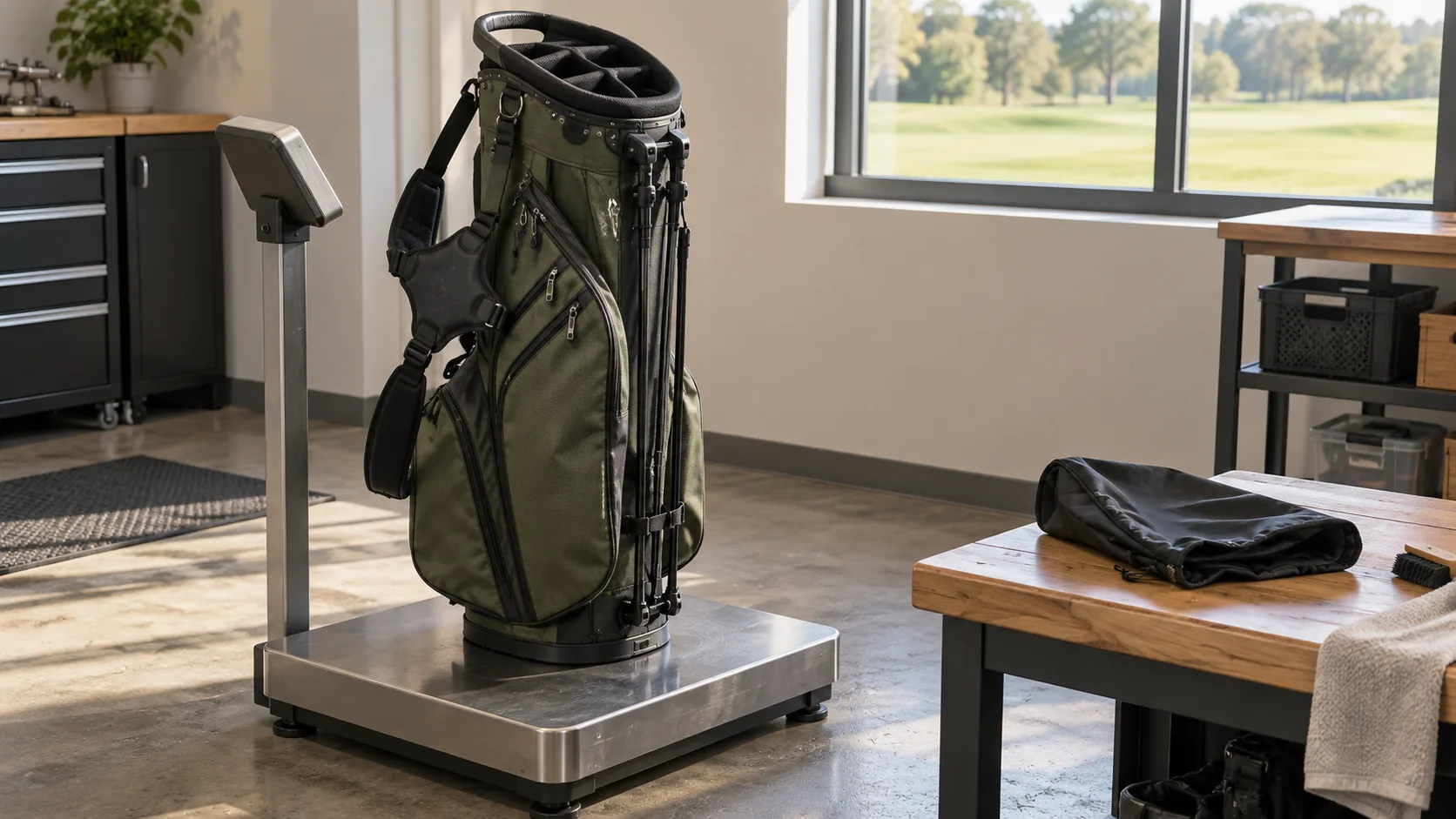
An empty-weight figure needs an inclusion list. Does it cover the bag body alone, or also the shoulder harness and rain hood? A page that lists an included accessory does not necessarily say that the accessory was included in its weight measurement.
The following figures were checked on the brands’ official product pages on October 3, 2026. Each model name links to its source. Kilograms are calculated from the published pounds using the NIST exact conversion factor, 1 lb = 0.45359237 kg, and rounded to two decimal places. Converted values are not separate measurements.
| Format | Model and official source | Published weight | Converted kg | Scope to check |
|---|---|---|---|---|
| Sunday/pencil | Sunday Golf Loma | 1.95 lb | 0.88 | One weight field; confirm included parts |
| Sunday/pencil | Sun Mountain x Victus pencil stand bag | 4.9 lb | 2.22 | Stand-equipped pencil format; confirm included parts |
| Carry/stand | Sunday Golf Loma XL | 3.4 lb | 1.54 | One weight field; confirm included parts |
| Carry/stand | Sun Mountain Phenom | 3.55 lb | 1.61 | Bag-weight field; confirm included parts |
| Carry/stand | Sunday Golf El Camino | 3.9 lb | 1.77 | Rain hood listed as included; weighing state not defined by that alone |
| Carry/stand | Sunday Golf Ryder | 4.9 lb | 2.22 | Confirm the configuration behind the weight field |
| Carry/stand | PING Hoofer Lite | 5 lb | 2.27 | Carry-bag specification; confirm included parts |
| Carry/stand | PING Hoofer | 5.5 lb | 2.49 | Carry-bag specification; confirm included parts |
| Carry/stand | Sun Mountain Eclipse E-4.5 VLO | 5.8 lb | 2.63 | Weight field for this exact model |
| Carry/stand | PING Hoofer Tour | 6.2 lb | 2.81 | Sold as a carry bag, not a staff bag |
| Cart | PING Traverse | 6 lb | 2.72 | Cart-bag weight; confirm included parts |
| Cart | Sunday Golf The Big Rig | 7 lb | 3.18 | Rain hood listed as included; confirm weighing state |
| Cart | Sun Mountain C-Series C-130 | 7.6 lb | 3.45 | Bag-weight field for this exact model |
| Staff | Vessel Prime 2.0 Staff | 9.52 lb, body only | 4.32 | Strap and rain hood each listed separately at 0.82 lb |
| Staff | PING Tour Staff | 10.6 lb | 4.81 | Staff-bag specification; confirm included parts |
Vessel’s breakdown makes the distinction concrete: adding its listed body, strap and rain hood gives 11.16 lb (5.06 kg). That total is arithmetic from the three published components, not a new measurement. It should not be compared with another model’s body-only figure as though the states were identical.
Keep these examples model-specific. A new colorway, revision or replacement model needs its own specification check; the date on this table is not a promise about future listings.
How Does Weight Differ by Golf Bag Type?
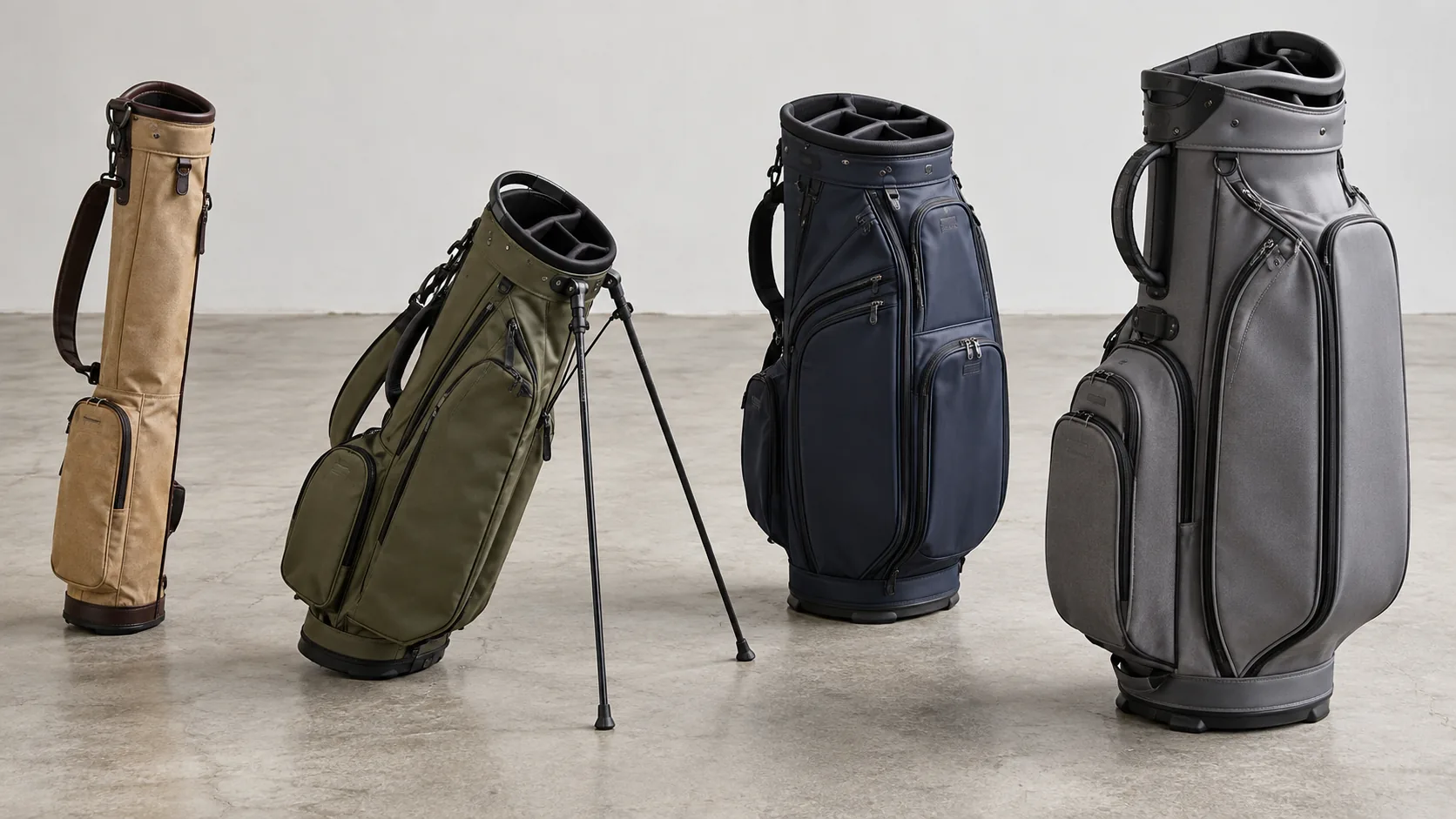
Within this sample, the two Sunday/pencil entries list 1.95 and 4.9 lb, carry/stand entries run from 3.4 to 6.2 lb, and cart entries from 6 to 7.6 lb. The staff entries need separate treatment because Vessel explicitly reports body-only mass. There is no consistently defined staff-weight range here.
The names also overlap. The 4.9 lb Victus pencil stand bag has a higher published figure than the 3.4 lb Loma XL carry bag. PING’s Hoofer Tour is a carry model at 6.2 lb; its Tour Staff is a different format at 10.6 lb. The word “tour” does not define the carrying system.
Pocket count, dividers and dimensions describe other aspects of the product. They do not let you calculate its mass, and this small sample does not establish which construction detail caused a difference. Use the bag type comparison to identify formats, then compare the exact weight fields and included parts.
How Much Does a Golf Bag Weigh With Clubs?
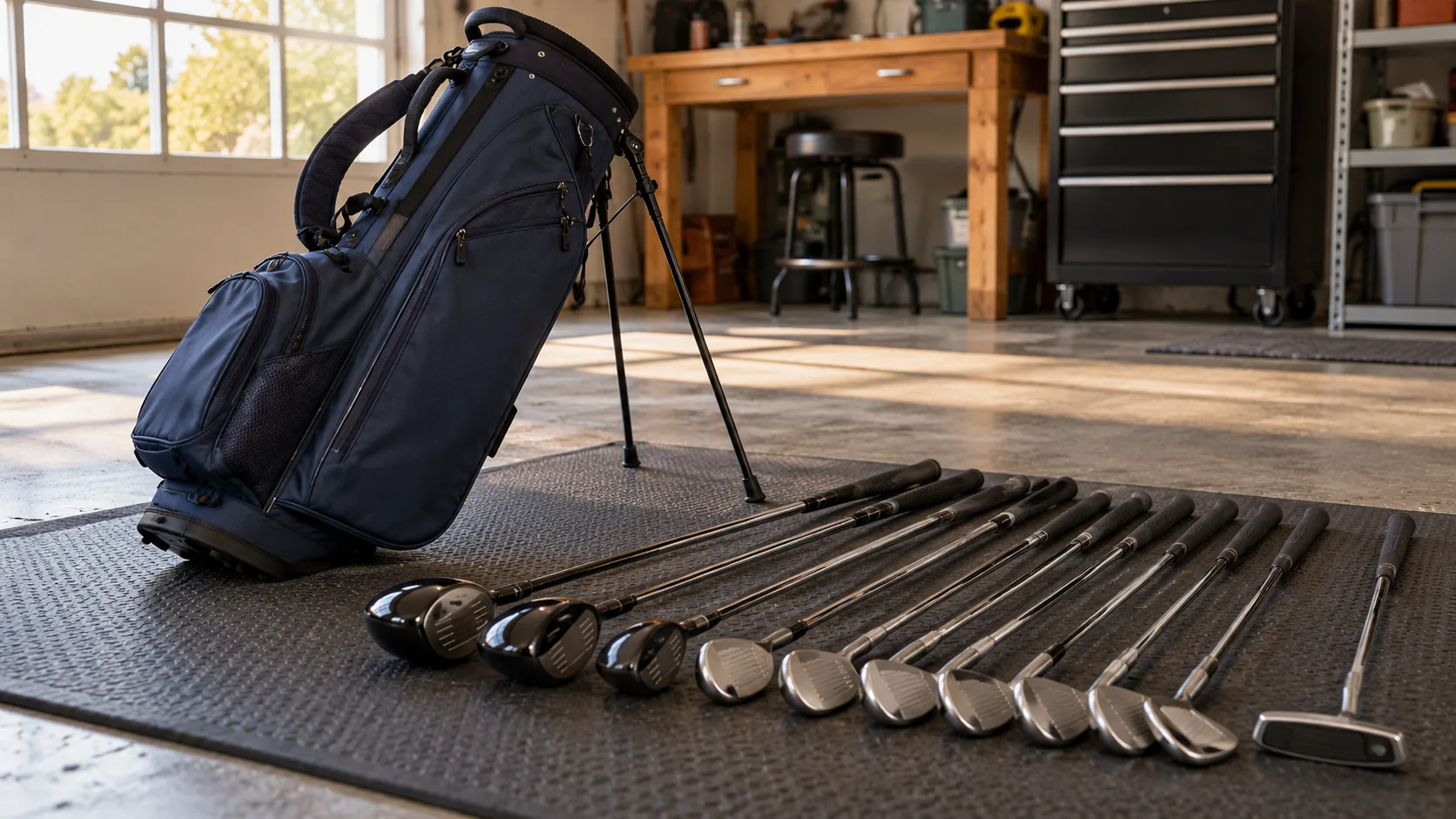
For your setup, use the measured empty bag plus your actual clubs. For the fully packed figure, include balls, drinks, clothing and accessories too. Those are different totals.
R&A Rule 4.1b sets a 14-club limit under the Rules of Golf. It does not assign a standard mass to that set. A published bag specification therefore cannot tell you what your clubs and packed equipment weigh.
To isolate club mass, first weigh the empty bag with a recorded strap-and-hood configuration. Add only the clubs, then weigh again without changing that configuration. Subtract the first reading from the second. If balls, a water bottle or other gear were added too, the difference covers all of those additions-not just the clubs.
You can also weigh the clubs separately on suitable equipment. Either method is more useful than subtracting an “empty bag average” from an unrelated “loaded bag average.” Those two averages may describe different products and packing lists.
Which Contents Add the Most Weight?
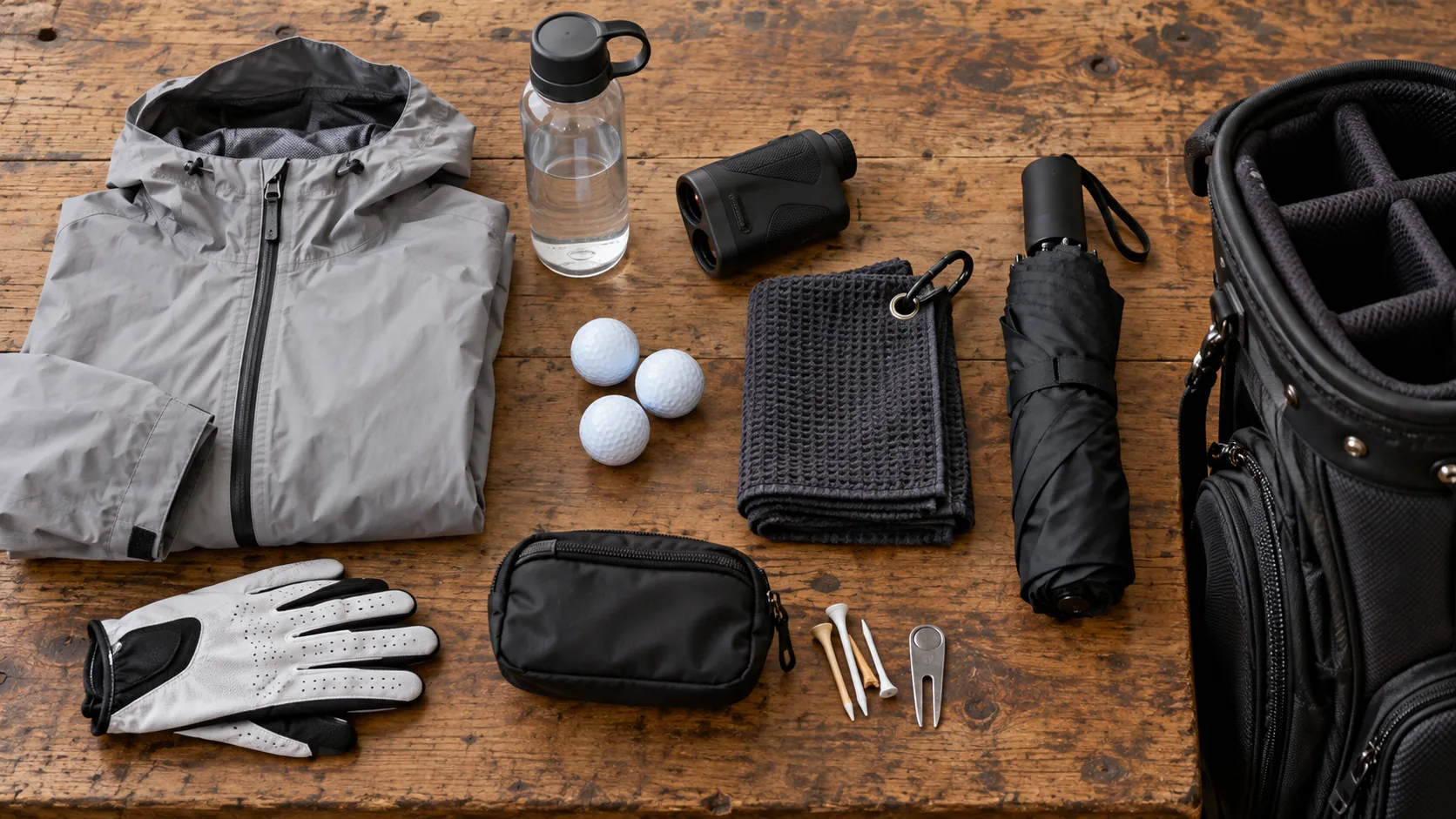
The largest addition depends on your packing list. Check these groups rather than assuming a universal ranking:
- Clubs: record the actual set used for the check, not just the club count.
- Balls and small supplies: include the spares already left in pockets.
- Water and drinks: weigh the filled containers you intend to take.
- Clothing and rain gear: include the packed jacket or rain suit.
- Accessories: account for the rangefinder, umbrella, towel and pouches.
- Removable bag parts: note whether the harness or rain hood is already in the empty-bag reading.
A strap counted in the baseline must not be added again as an accessory. Conversely, a rain hood absent from the first reading belongs in the additions if you pack it later. For a before-and-after comparison, record what changed; do not attribute a difference to the bag fabric when the contents also changed.
There is no need to remove useful equipment just to reach a number from a guide. Measure the complete intended load first, then decide what you can leave out or transport another way.
How Can You Weigh Your Golf Bag Accurately?
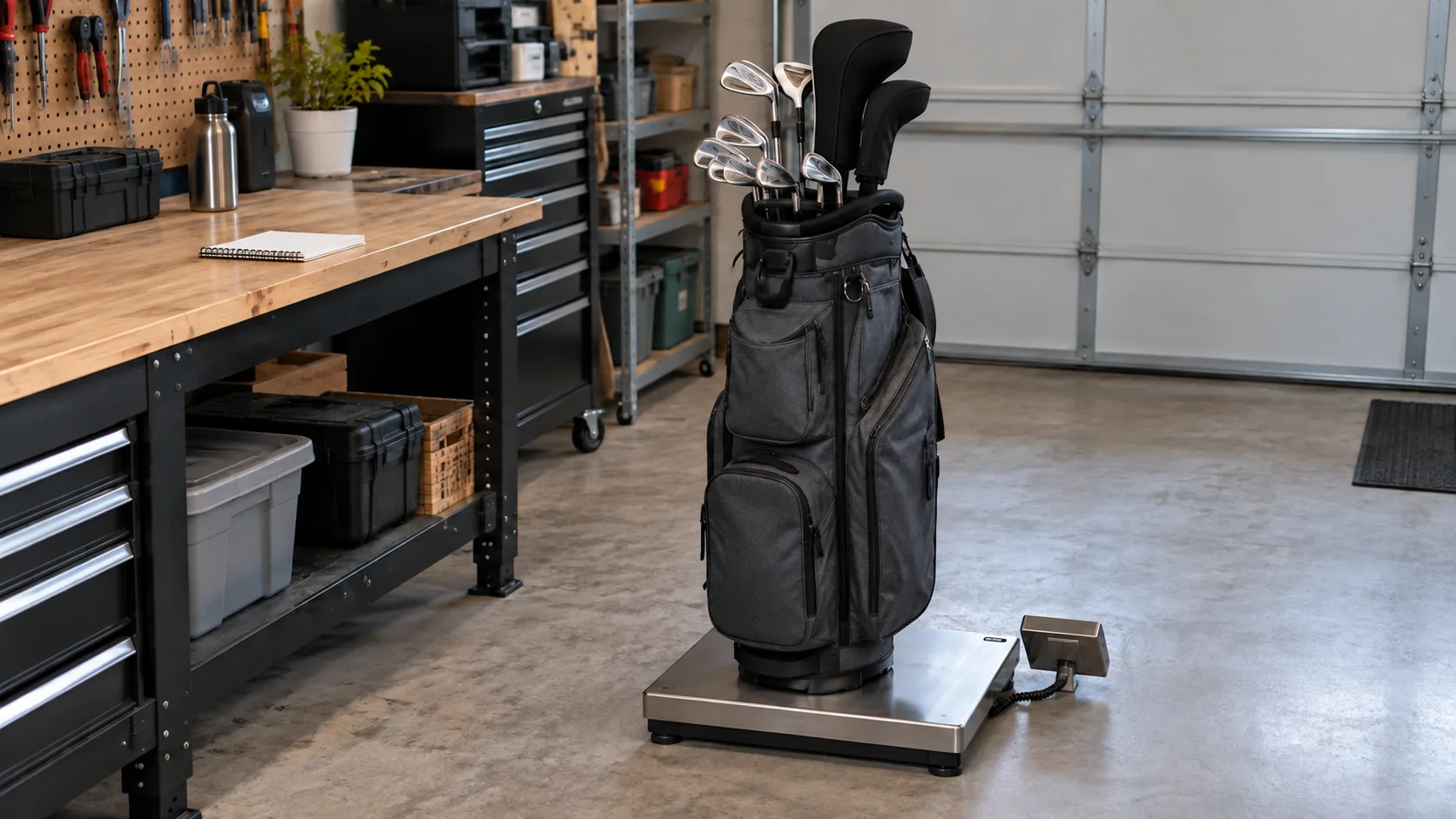
Use a scale with suitable capacity and support for the bag. Follow its instructions for placement, zero or tare, and units. Keep the load stable and fully supported by the weighing surface or the scale’s intended suspension arrangement, without contact with nearby furniture or the floor. Do not exceed the scale’s capacity.
A direct reading is preferable when the scale can accommodate the bag. With a bathroom scale that cannot register the bag alone, the difference between a person-only reading and a person-plus-bag reading can give a rough estimate, provided the person can hold it comfortably and the scale’s capacity is not exceeded. Both readings carry the scale’s resolution and repeatability limits; subtraction does not make this a precise approval method. Use suitable direct weighing equipment for a product specification or a close baggage-limit decision.
Record the date, scale, units, configuration and displayed result. If a reading is unstable, check the setup and the scale instructions rather than guessing the cause. Recheck after changing the load.
| Reading | State | What to record |
|---|---|---|
| A | Empty bag | Strap/hood included or excluded; no loose contents |
| B | Same bag plus clubs only | Same bag configuration; identify the club set |
| B minus A | Derived club mass | A difference, not a separate scale reading |
| C | Additional contents | Items absent from A and B; no double counting |
| D | Complete intended load | Direct reweigh after packing |
Use D as the transport reading. Compare it with your component notes; discrepancies are a reason to check missing items, changed configurations, rounding or the weighing setup, not proof that one component record is false.
Keep product mass separate from shipping mass, which may include packaging. Ask what a listing’s field covers before comparing it. Likewise, dimensions and capacity cannot substitute for weight. The backpack measurement guide explains a related recording discipline for size and volume; it is not a source of golf-bag mass values.
How Should Weight Affect Carry, Cart, and Travel Decisions?
The loaded figure is one input, alongside strap fit, handling, the bag’s intended transport and your needs. This article does not prescribe a universal safe carrying weight or promise that a lighter specification will prevent discomfort.
For walking, evaluate the actual packed bag and its carrying system. For a push cart or riding cart, check the bag’s fit, retention and supported base; a mass figure alone does not show compatibility. A staff or cart format should not be treated as a walking bag just because it has a lifting strap.
For a flight, weigh the complete travel arrangement, including the travel cover or case and everything inside it. Check the chosen airline’s current golf-equipment rules, weight limits and handling requirements before travel. No airline allowance is assumed here.
If you are deciding between buying a lighter bag and changing what you pack, use the component readings to see the contribution of each. A new bag changes the bag component; it does not remove the mass of the equipment you transfer into it.
What Should Brands Specify and Approve for Golf-Bag Weight?
For a sourcing brief, distinguish a design target, an acceptable tolerance and the measured approval sample. They are not interchangeable. Define the tolerance and weighing method for the project; an appearance sample alone does not settle the numerical requirement.
Keep these fields together:
| Field | Decision or record needed |
|---|---|
| Product identity | Model/SKU, drawing or specification version, sample ID and date |
| Bag configuration | Body, harness, hood and detachable components included in the reading |
| Weight requirement | Primary unit, target and agreed acceptance tolerance |
| Method | Equipment, support arrangement, zero/tare instructions and state of the bag |
| Sample evidence | Actual result tied to the approved sample and its configuration |
| Production evidence | Defined check and results for the identified production version or lot |
| Change control | What changed, who approved it, new version and which orders/lots it affects |
Record component identity separately from the finished-bag total. If a hood, harness or hardware version changes, update the relevant specification and inclusion list before comparing the next reading with the reference.
An approved sample provides a reference; it does not prove that every production unit meets the weight requirement. Decide how production results will be checked and attached to their lot. A report should identify the product, version, method and tested configuration, but complete fields alone do not prove the report is authentic or applicable to your order. These are useful questions when reviewing a supplier’s factory information.
For custom bag development, send the intended transport, contents, component list and weight requirement together. This gives the sample discussion a defined starting point without inventing a supplier capability or promising a result before the design has been assessed.
Frequently Asked Questions
How much does an empty golf bag weigh?
The checked carry/stand models list 3.4-6.2 lb and cart models 6-7.6 lb as of October 3, 2026. These are small, dated samples. Check the exact model and what the figure includes; a body-only staff-bag value is not a complete assembled-bag value.
How much does a golf bag weigh with clubs and everything in it?
Weigh your fully packed setup. The result includes the bag, clubs and everything else you transport. To find club mass alone, compare the same empty-bag configuration with that bag plus clubs only.
Which type of golf bag weighs the least?
The Loma has the lowest published figure in this sample at 1.95 lb. That does not establish a rule for all Sunday or pencil bags: the sampled Victus pencil stand bag lists 4.9 lb. Compare models, not category names alone.
How much does a professional tour bag weigh?
The two staff-model pages give 9.52 lb for the Vessel Prime 2.0 body and 10.6 lb for the PING Tour Staff specification. Vessel’s listed body, strap and hood sum to 11.16 lb. None of these figures establishes an individual professional’s packed tour load.
Can I use a bathroom scale to weigh my golf bag?
If suitable for the load, use a direct stable reading. A person-plus-bag subtraction can provide a rough estimate, not a precise specification check. Observe the scale’s instructions and capacity, and use appropriate equipment if holding the bag or obtaining a stable reading is difficult.