
If a golf bag rotates, slips, or catches your legs, stop and check the load and strap setup before continuing.
How to carry a golf bag depends on its format and harness. Pack it for the intended trip, check its balance in the actual carrying position, fit the single or dual straps using the model’s instructions, and lift with control. For a cart-oriented bag, assess cart or trolley transport instead.
Which Golf Bag and Strap System Are You Carrying?
Identify the bag, then identify what each strap and handle is for. A shoulder harness, a lifting handle, and a cart-retention channel perform different jobs.
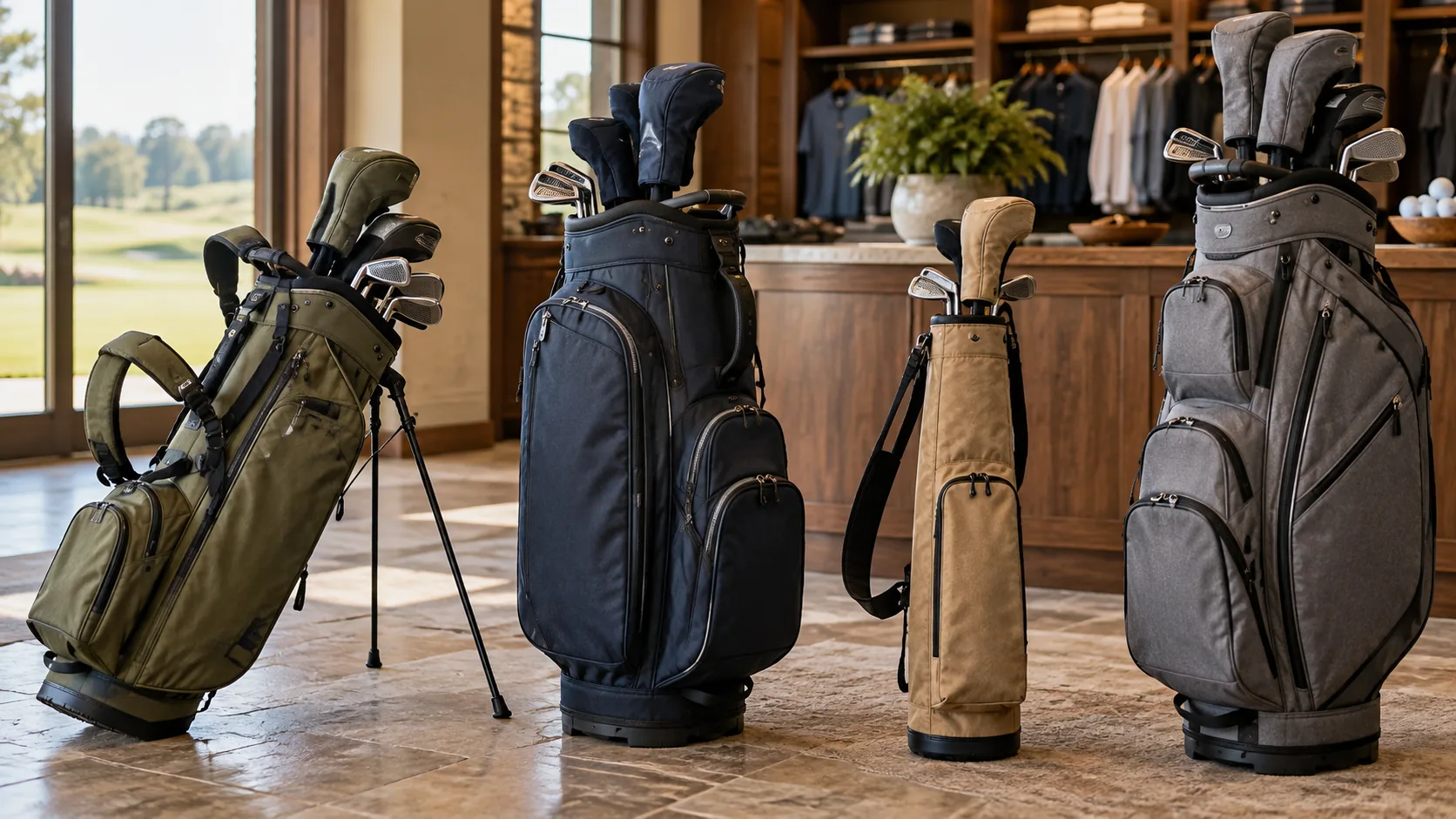
| Format | Features to identify | Transport decision |
|---|---|---|
| Carry or stand bag | Single or dual shoulder harness; stand legs if fitted; lifting handles | Check its walking setup and any stated push-cart compatibility |
| Cart bag | Carry handles or a handling strap, cart-retention path, base and pocket layout | Designed around cart use; a handling strap does not establish suitability for walking a round |
| Sunday or pencil bag | Compact body, smaller packing space, single or dual straps depending on model | Check the intended club set and carrying arrangement rather than relying on the name |
| Staff or tour bag | Larger equipment-storage format and model-specific handles or strap | Check caddie/cart use and compatibility; do not assume it shares a stand bag’s self-carry setup |
Sun Mountain’s stand-versus-cart guide distinguishes walking-oriented stand bags from cart-oriented storage and bases. That is a useful format distinction, not a rule that every product has the same hardware.
The broader types of bags guide explains why carry method and intended contents matter more than a category name. For installation or rethreading, use instructions for the exact harness: Sun Mountain’s how-to library lists separate E-Z Fit/Auto-Fit and X-Strap procedures. Do not copy another system’s routing.
How Should a Golf Bag Be Balanced Before You Lift It?
Pack the contents you intend to take, not an empty demonstration bag. Then check how the loaded bag behaves when supported and worn through its intended carrying system.
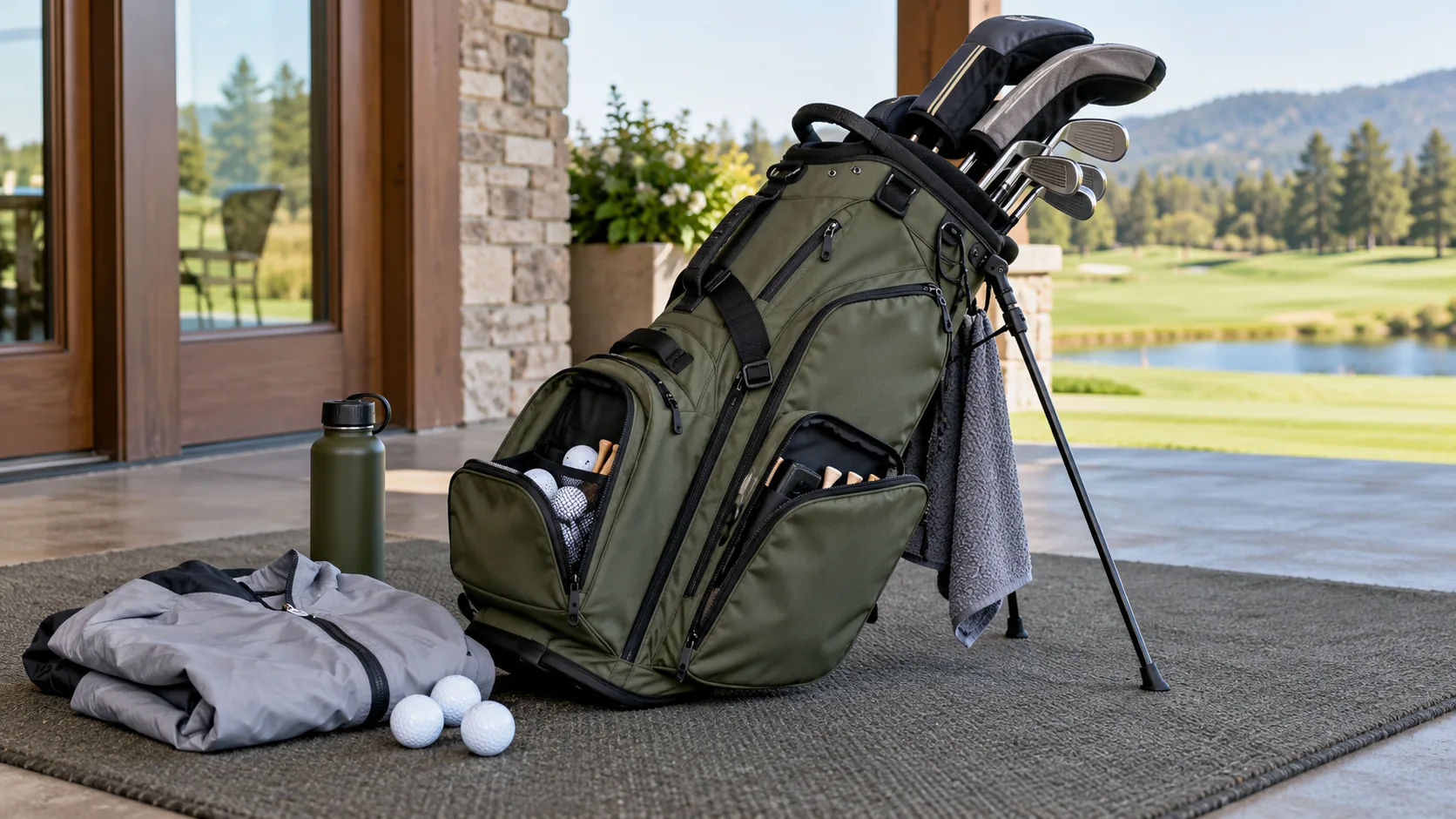
- Place the clubs in the model’s dividers and secure loose accessories.
- Check the side pockets, including bottles, balls, and clothing. Avoid concentrating removable contents on one side without checking the effect.
- Close the pockets, inspect the straps and attachments, and lift using the designated handle while supporting the load.
- In the actual carry position, check for rotation, an excessively dipping club end, or a base that interferes with movement.
- Set the bag down and change the packing or strap setting one item at a time. Recheck with the same contents.
Sun Mountain’s organization advice cautions against overpacking side pockets on a stand bag when that makes it feel lopsided. It also distinguishes access on a stand from access after securing a bag to a cart.
Do not require a bag lifted from its top handle to hang horizontally. The handle’s location is not the shoulder harness’s support arrangement. Carry angle depends on the loaded bag and its design; check that clubs remain retained and the bag clears your stride. Measure the complete loaded weight if it will inform your transport choice, without treating a catalog’s empty figure as that total.
How Do You Carry a Golf Bag With One Strap?
Use a single strap only in the arrangement intended for that model. Fit it so you can put the bag on and remove it without forcing the motion, while keeping the bag controlled at your side.

- Inspect the strap, pad, adjuster, and both attachments before lifting.
- Set the initial length with the bag supported. Lift through the designated handle and steady it as the strap takes the load.
- Position the pad on the shoulder as intended. Check the bag’s resting angle and leg clearance rather than copying a fixed height from another person.
- If it rotates, slides, or needs continuous bracing, set it down and reassess packing, pad position, and strap length.
- If the system permits changing shoulders, refit and check control on the other side. There is no interval prescribed here.
For lifting, Cal/OSHA’s manual-handling guidance recommends a secure grip, smooth movement, a load close to the body, and stepping to turn rather than twisting. Stanford’s safe-lifting advice also recommends assessing the load and using help or equipment when it is too heavy or bulky to handle. These are general handling principles, not an injury-prevention guarantee for golf.
When setting the bag down, keep control until its base or correctly deployed stand supports it on suitable ground. Do not release it while still shifting a strap off your shoulder.
How Do You Carry a Golf Bag With Two Straps?
Wear the harness through both intended shoulder paths. Do not turn a dual system into a single sling unless the manufacturer provides for that mode.

- With the load supported, put one arm through the appropriate strap, then the other, following the model’s orientation.
- Let the harness take the weight gradually and check the contact of both pads.
- Adjust in small increments until the bag sits in its intended carrying position. Assess contact, rotation, club retention, and clearance; equal free-tail lengths are not a universal requirement.
- Move on a clear surface and observe the loaded setup. Set the bag down before correcting routing or an attachment problem.
- Recheck after changing the contents or if the position changes during use. There is no prescribed number of steps or holes.
Sunday Golf’s single-versus-double-strap guide describes the two-arm wearing method and notes that attachments differ by brand. A model’s manual still controls the route and available adjustments.
Sun Mountain’s carrying FAQ positions its hip pad at the lower back around hip height and calls for snug straps. Treat that as its fitting guidance, not a universal body measurement for every golf bag. Auto-balancing, independently adjusted, and convertible systems should be assessed within their own instructions.
Can You Carry a Cart Bag or Tour Bag?
A carry handle or strap can allow handling without making a bag a good choice for self-carry over a round. Check the model’s purpose, actual contents, strap arrangement, and transport equipment.
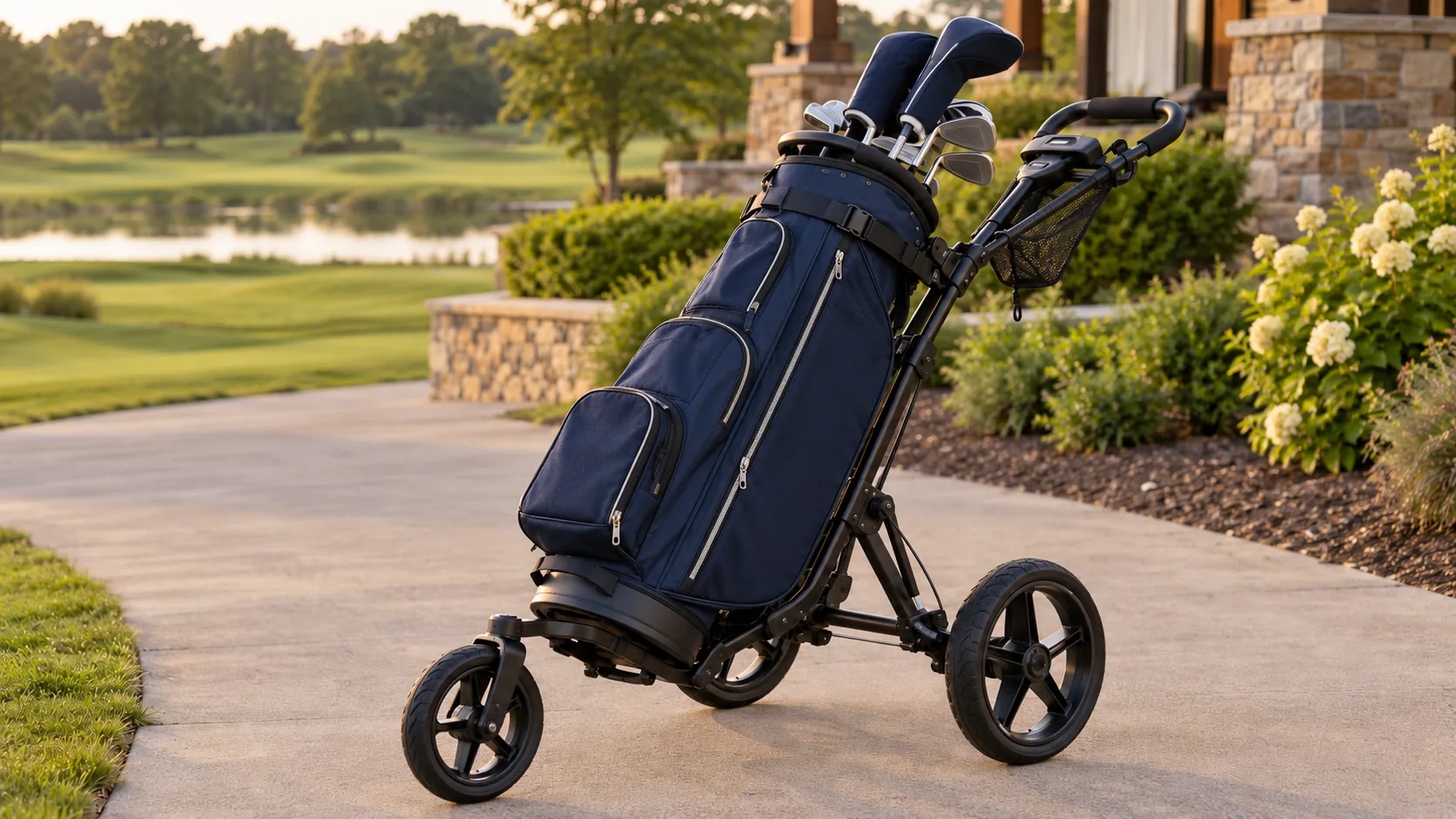
For a cart-oriented bag, use the designated handles or handling strap for moves you can control, then secure it to a compatible cart as instructed. Check the base support, retention path, and pocket access. Do not assume that any stand bag fits any trolley, or that any cart strap can bear a shoulder-carry load.
Staff bags are a separate format, not an absolute prohibition on carrying. Stitch’s staff-bag guide describes caddie use and notes that cart fit can vary. Its description does not establish suitability for every golfer to self-carry a particular loaded bag.
Choose a trolley, riding cart, assistance, or a different bag when the planned handling cannot be controlled comfortably. Check equipment compatibility and the course’s current restrictions before relying on that option. No universal kilogram limit or carrying duration is assigned here.
What Problems Mean the Setup Needs Rechecking?
These observations identify checks, not proven causes. Change one variable at a time so you can tell what altered the setup.
| Observation | Checks to make | Stop boundary |
|---|---|---|
| Club end dips or base hangs too low | Packing, intended orientation, strap range, and club retention | Do not continue with clubs at risk of falling or a bag that catches the ground |
| Bag rotates while walking | Side-pocket load, pad contact, adjustment paths, and intended support points | Set it down if continuous hand bracing is needed |
| Pad slides off a shoulder | Pad position, model orientation, strap setting, and visible wear | Do not keep shortening the strap if it restricts movement or will not stay controlled |
| Pressure at a strap edge | Pad contact, load, clothing, and harness setting | Stop carrying if it is uncomfortable; do not treat symptoms as proof of one mechanical cause |
| Webbing moves through a slider | Specified routing, compatible webbing/hardware, and damage | Do not rely on an adjuster that will not retain its setting |
| Stand legs catch clothing or the stride | Retraction, mechanism operation, strap path, and loose accessories | Clear the interference or seek service rather than forcing the legs |
Cracked fittings, torn anchors, or persistent adjuster movement require inspection or service guidance. Rethreading does not automatically restore a load rating, and the place where damage appears does not prove its root cause.
What Should Brands Check in a Golf-Bag Carry System?
Define the intended transport method before approving a sample. A walking trial, a handle-load check, and cart compatibility answer different questions; a tester’s comfort comment is not structural proof.
| Approval item | Record for the actual sample |
|---|---|
| Contents and carry mode | Club set, accessories, load distribution, single/dual/cart arrangement, and sample revision |
| Wearer range | Intended users, clothing, checked settings, reach and clearance observations |
| Load path | Straps, adjusters, clips, anchors, reinforcement, handles and their installed interfaces |
| Hardware compatibility | Supplier codes, webbing width, thickness and finish, mating geometry, and approved routing |
| Padding and tails | Contact position, pad retention and tail management within the checked range |
| Stand/cart interaction | Leg clearance and retraction, cart base support, retention and pocket access as applicable |
| Verification conditions | Defined load, distribution, movement or fixture, duration/cycles, endpoint and agreed acceptance criteria |
| Instructions | Model-specific setup, release motions, installation limits and drawings matching the sample |
Keep component construction, finish, color, quantity, and placement in a controlled record; drawing callouts can reference the relevant row. Match any test report to its sample or batch, method/revision, date, conditions and result. Complete fields improve traceability but do not prove the report’s authenticity or applicability.
Record visible movement or damage separately from the investigation into its cause. Do not infer complete-system performance from a buckle’s standalone result. These checks are a project planning aid, not a claimed ZWbags test service or a universal golf-bag standard.
For a component-record example, the backpack parts and accessories guide separates hardware, mating parts, routing, and attachments; it is not a golf-harness installation guide. In a factory capability review, ask which component and installed-assembly evidence is available for the proposed design. Send the intended carry mode, contents, wearer range, and sample criteria to a custom bag manufacturer for feasibility discussion before finalizing the project.
Frequently Asked Questions
Is one strap or two straps better for carrying a golf bag?
Use the system intended for the bag and load. A dual harness provides two shoulder paths; a single sling has a different support arrangement. Neither strap count alone establishes fit, compatibility, comfort, or a safe load.
How tight should golf bag straps be?
Set them within the model’s range so the bag remains controlled without restricting movement or making removal difficult. Assess pad contact and the actual carrying position, not a universal strap length or identical tails.
Can I switch shoulders with a single-strap golf bag?
If the design permits it, refit the pad and check the bag’s orientation and control on the other shoulder. There is no fixed interval or handedness rule in this guide.
What should I do if the strap keeps slipping?
Set the bag down. Check packing, pad position, model orientation, routing, and visible damage. Distinguish a pad slipping off the shoulder from webbing creeping through hardware. Persistent hardware movement requires inspection or service, not repeated tightening.
When should I use a trolley instead of carrying?
Consider it when the bag is designed around cart use or the loaded setup cannot be handled comfortably and under control. Check the bag/cart interface and course restrictions. A carrying strap does not by itself establish suitability for a full round.