
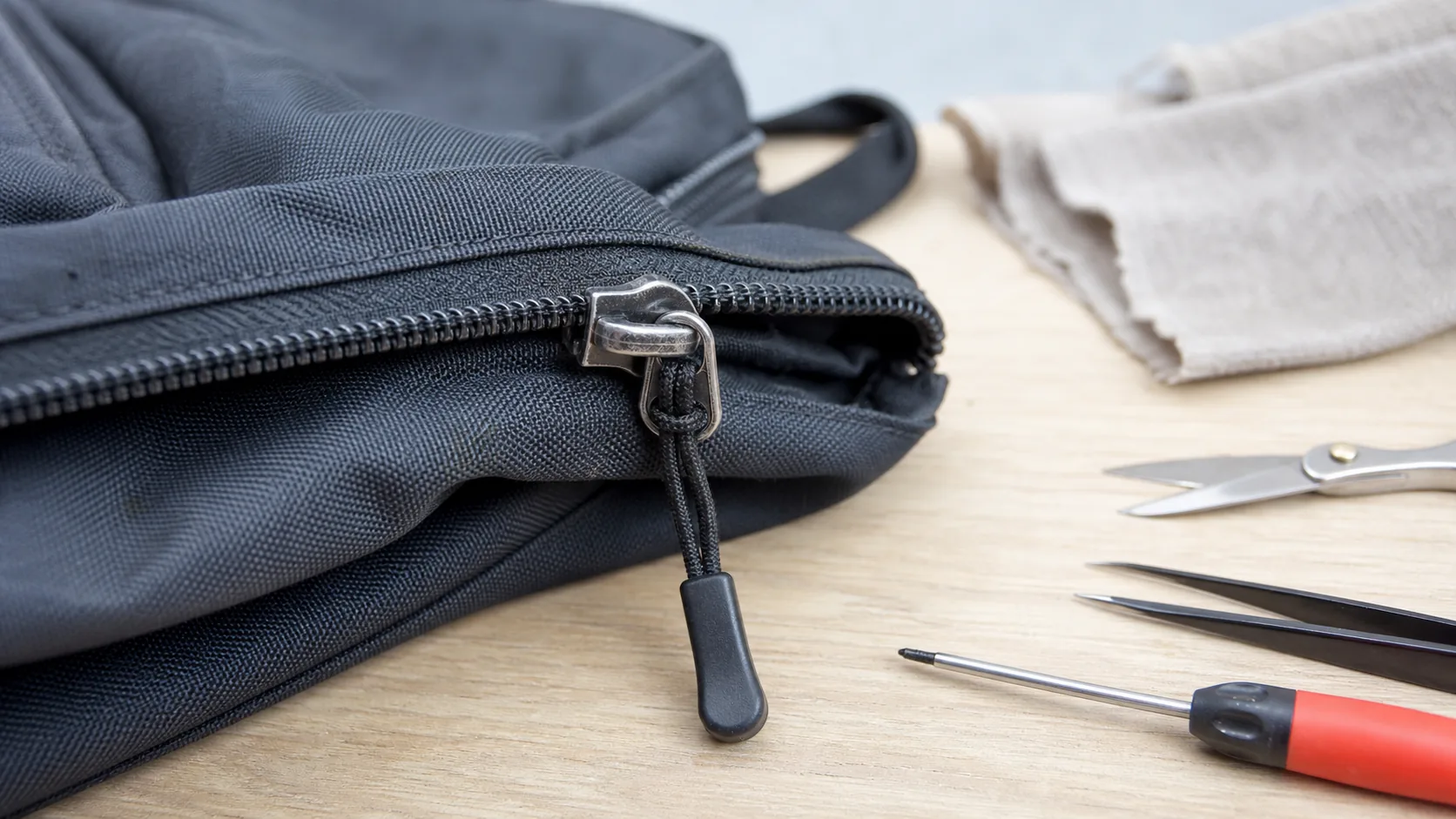
A jammed or splitting zipper can make an otherwise sound backpack unusable, and the wrong first move can turn a small fault into permanent damage.
Many backpack zipper problems are repairable when the chain and tape are intact. The right fix depends on the symptom, zipper construction, damage location, and whether the slider, chain, stop, pull, or tape is actually failing.
Start with diagnosis, use the least destructive repair, and stop when the damaged part needs sewing or replacement.
What Should You Check Before Fixing a Backpack Zipper?

Empty the backpack and place it on a clear, well-lit surface. A loaded pocket can pull the zipper apart and can hide whether the repair works. Keep your fingers clear of pliers and sharp elements, and do not cut healthy tape or teeth to create access.
Next, identify what you are working on:
- A closed-end zipper, used on many backpack compartments, stays joined at the end.
- A separating zipper opens completely and uses a box-and-pin assembly. If that assembly is cracked or distorted, rethreading the slider will not solve the problem.
- Coil, molded plastic, and metal zippers use different chain profiles. YKK's zipper overview distinguishes these construction types.
- A size designation describes a chain category, not a universal quality grade or a guarantee that parts from different suppliers will fit.
A zipper symptom is a starting point, not a diagnosis. The same split or jam can come from the slider, chain, stops, tape, trapped material, installation, or pocket load. Record where the fault occurs and whether the bag is empty or loaded before choosing a repair.
| Symptom | First inspection | Possible repair | Stop or escalate when |
|---|---|---|---|
| Zipper opens behind the slider | Slider, chain alignment, pocket load | Clean, reduce tension, carefully adjust or replace the slider | The chain still separates or the slider is cracked |
| Slider came off one side | Stops, tape, zipper type | Rethread only when the construction allows it, then restore a secure stop | Tape, box, pin, or end construction is damaged |
| Slider will not move | Trapped fabric, dirt, bent elements | Release fabric, clean, and follow compatible care guidance | More force would damage the tape or elements |
| Pull tab broke | Slider body and pull hole | Fit a temporary or compatible replacement pull | The slider body is also damaged |
| Teeth or coil are missing | Damage location and tape condition | Limit travel only when end damage can be isolated by a secure stop | Damage is mid-track, widespread, or the tape is torn |
| Tape or seam is torn | Tape, seam, surrounding fabric | Sew the damaged area or replace the zipper | Structural fabric, warranty, or technical construction is involved |
This table narrows the repair path. It does not guarantee that a particular repair suits every zipper construction.
Why Is the Backpack Zipper Stuck or Splitting?

A stuck zipper and a splitting zipper are different faults. A stuck slider will not travel. A splitting zipper moves, but the chain opens again behind it.
For a stuck slider, inspect the mouth of the slider for lining, loose thread, or grit. For a zipper that splits, test it with the compartment empty. If it closes empty but separates when packed, the load or pocket geometry is pulling the chain apart. Tightening the slider will not remove that tension.
If it splits both empty and loaded, inspect the slider for wear, distortion, or a crack. Also look along the full chain for bent or missing elements. Do not assign a single cause from appearance alone.
This distinction matters on heavily loaded designs such as custom tactical backpacks, where zipper gauge, curve geometry, stops, and compartment load must work as a system.
How Do You Tighten or Replace a Loose Slider?

If an intact chain separates immediately behind the slider, a loose or worn slider is one possible cause. Clean the chain first, empty the bag, and make only a tiny adjustment with needle-nose pliers.
- Move the slider to an accessible straight section.
- Protect your fingers and grip one side of the slider body.
- Apply a very small squeeze.
- Test the full zipper run with the bag empty.
- Adjust the other side only if needed.
- Stop as soon as the chain closes smoothly.
iFixit's slider repair guide shows this careful adjustment and warns that over-tightening can make the slider difficult to move. One hard squeeze can deform the slider or damage the chain.
Replace the slider when it is cracked, visibly distorted, or still allows the chain to separate after careful adjustment. The replacement must match the chain profile, size, direction, and required function. A slider is a functional component, not a generic spare. A matching size number alone does not prove that two suppliers' parts are interchangeable.
iFixit's slider replacement guide is a useful example, but damaged teeth or tape still require a different repair.
How Do You Put a Backpack Zipper Back on Track?

A slider that has come off one side can sometimes be rethreaded, but only when the tape and end construction are sound. First determine how the slider escaped. A missing top stop, damaged end, or torn tape must be addressed or the slider will come off again.
The general sequence is simple:
- Move to an accessible end of the chain.
- Feed both sides into the slider evenly.
- Pull slowly and check that the elements mesh at the same point.
- Restore a secure stop before using the bag.
A strong sewn stop through sound tape or a compatible metal stop may work on a closed-end pocket zipper. iFixit's backpack zipper realignment guide demonstrates one construction, not a universal method.
Do not remove healthy elements simply because one guide does so. Stop if access would require cutting structural tape, if the end is torn, or if a separating zipper has a damaged box or pin.
Can You Fix Missing Teeth, a Broken Pull, or Torn Tape?

These failures look related but need different repairs.
Broken pull tab
If the slider body and pull hole are sound, fit a compatible replacement pull. A small keyring, cord loop, or purpose-made pull can work. Choose a shape that lets you pull along the chain rather than twisting the slider sideways, and remove any sharp ends.
Missing teeth or damaged coil
End damage can sometimes be isolated by placing a secure new stop before the gap. This shortens the usable zipper path. Missing elements in the middle of the track, widespread coil damage, or a slider that must cross the damaged area usually means zipper replacement.
Torn tape or seam
Slider adjustment cannot repair torn tape. A tailor, cobbler, luggage repair shop, or the manufacturer may be able to resew the tape or replace the zipper. Do not promise that the repair will restore the original strength, appearance, water resistance, or warranty coverage.
The same boundary applies to a cracked separating box or bent pin. Those parts control alignment at the start of the zipper and are not repaired by forcing the slider back on.
How Do You Unstick a Backpack Zipper?
Start with the visible obstruction. If lining or thread is caught, hold it close to the slider and ease it backward while moving the slider gently in the opposite direction. Do not yank either part.
If no fabric is trapped, brush away dirt and inspect for bent elements. Run the slider only as far as it moves without force.
There is no lubricant that is safe for every fabric, coating, color, or zipper. Follow the product or zipper maker's care guidance, and test any compatible care product on a hidden area first. Stop if it leaves residue, transfers color, or increases binding. Avoid heat, solvents, cooking oil, petroleum jelly, and greasy sprays unless the relevant care instructions specifically allow them.
For coated or water-resistant packs, the zipper, seams, and surrounding coating form one protection system. A repair to one part does not by itself restore the original finished-bag claim. A custom waterproof backpack therefore needs closure and seam decisions reviewed together during development.
When Should You Replace the Whole Backpack Zipper?
Choose replacement or professional repair when:
- the tape is torn, frayed beside the chain, or pulling away from the bag;
- elements are missing or crushed in the middle of the track;
- a separating box or pin is damaged;
- a matched replacement slider still derails or the chain repeatedly splits;
- the zipper is part of a technical coated construction that you cannot repair without affecting the surrounding material;
- the zipper sits in a structural seam, the bag carries valuable equipment, or a warranty may apply.
Professional replacement may cost more than a low-priced bag, but it can be sensible when the backpack body, straps, and panels remain sound. Check the manufacturer's warranty terms before making an irreversible cut.
What Should Brands Check Before Bulk Bag Production?
Repair reports are most useful when they record the symptom, location, load state, inspected parts, and result. A complaint that says only "the zipper broke" does not identify whether the chain, slider, stop, tape, installation, or use condition failed.
For sample approval, check:
- zipper construction and size against the intended compartment load;
- slider function, direction, count, supplier code, and mating geometry;
- smooth travel around curves on the sewn sample;
- end stops and reinforcement at high-stress points;
- pull shape and the direction in which a user applies force;
- operation with the pocket loaded as intended;
- repeated full-length test pulls, without inventing a universal cycle count.
For a custom gym bag, the review should reflect loaded pockets, curved openings, and the way users grip the pulls. During custom bag manufacturing, field symptoms can then be translated into specific component, geometry, and approval checks instead of a vague request for a "stronger zipper."
Frequently Asked Questions
Why does my backpack zipper split behind the slider?
It may be a loose or worn slider, misaligned chain, damaged elements, or load tension. Test the zipper with the bag empty. If it still splits and the chain is intact, a careful slider adjustment or matched replacement is the next step.
Can I put a backpack zipper back on after the slider comes off?
Sometimes. Rethreading can work on a closed-end zipper when the tape and chain ends are sound and you can restore a secure stop. Stop if the tape, end stop, separating box, or pin is damaged.
How do I unstick a backpack zipper without breaking it?
Free trapped fabric first, then remove visible dirt. Move the slider gently and follow the maker's care guidance before applying any product. If it still binds, inspect for bent elements or tape damage instead of forcing it.
Can a backpack zipper with missing teeth be fixed?
Only in limited cases. End damage may be isolated with a secure new stop, which shortens the travel. Mid-track or widespread missing elements generally require zipper replacement.
Is replacing the whole zipper better than replacing the slider?
Only when the chain, tape, end hardware, or surrounding seam is damaged. If those parts are sound and only the slider has failed, a correctly matched slider is the smaller repair.
Conclusion
Inspect before you squeeze, cut, or buy parts. Repair the pull or matched slider when the chain and tape are sound; use professional help when tape, mid-track elements, separating hardware, coated construction, structural seams, or warranty coverage are involved.