
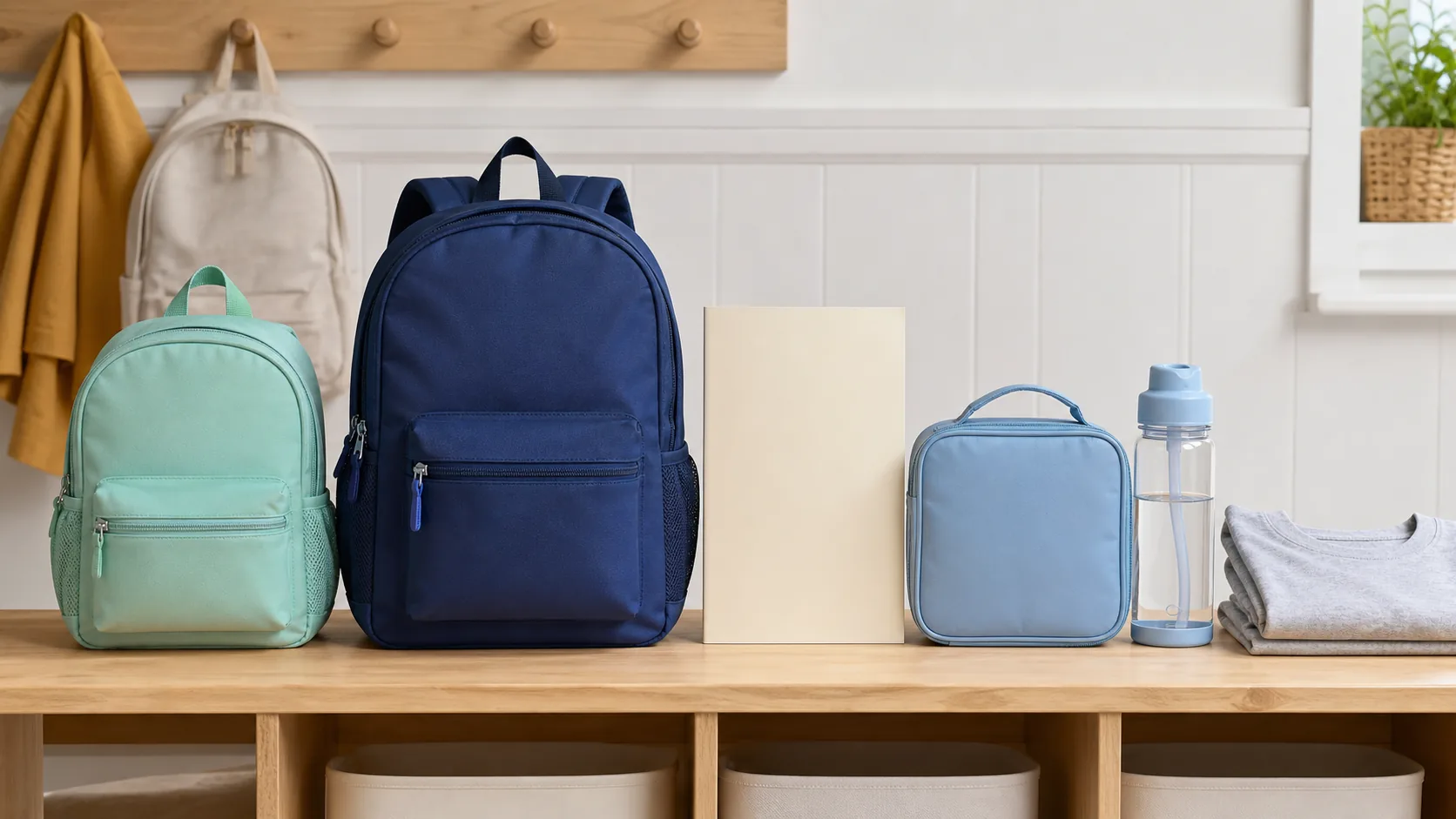
For most kindergarten students, a backpack around 12 to 15 inches high, 9 to 11 inches wide, and 4 to 5.5 inches deep is a practical starting range. The final choice should fit the child’s torso and the school’s supply list. A compact model may suit a child carrying only snacks and spare clothes, while a 14- or 15-inch school backpack is more likely to hold a standard folder without bending it.
Many retail brands and wholesale buyers procure school bags that are either too small for basic folders or so oversized that they hang below a child’s waist. The result is frustrated parents, poor daily use, and avoidable retail returns. Understanding what size backpack for kindergarten students actually need helps B2B buyers balance child fit, classroom capacity, and a product range that parents can understand.
What Size Backpack for Kindergarten Is Usually Best?

The usual range is about 12 to 15 inches high, but there is no single perfect height for every five-year-old. A child who is small for their age and carries very little may be better served by an 11- or 12-inch bag. A student who must carry a 9-by-12-inch folder, lunch box, water bottle, and spare clothing usually needs a taller full-size model.
What Dimensions Work for Young Students?
Selecting appropriate dimensions is crucial for a comfortable and functional carry experience. Height should be checked against the child’s back, width should stay close to the torso rather than extending far beyond it, and depth should provide capacity without pulling the load away from the body.
- Typical height: 12 to 15 inches
- Typical width: 9 to 11 inches
- Typical depth: 4 to 5.5 inches
These are product-development starting points, not biometric guarantees. Brands should test samples on children across the intended age and size range.
How Do Mini and Full-Size Bags Differ?
Mini backpacks and full-size school packs serve different purposes in the classroom. A mini bag is useful for light snacks, a small toy, or a short day out, but it often cannot hold a standard homework folder. A full-size model provides room for folders and a lunch box, although extra capacity also makes overpacking easier.
High-quality manufacturers can develop both formats so retail brands can serve different school requirements without pretending one size fits every child.
| Backpack Category | Height | Width | Depth | Primary Suitability |
|---|---|---|---|---|
| Mini backpack | 9.5 to 11 inches | About 9 inches | About 4 inches | Preschool, snacks, and short trips |
| Compact school backpack | 12 to 13 inches | 9 to 10 inches | 4 to 5 inches | Smaller kindergarten students with light supply lists |
| Full-size kids backpack | 14 to 15 inches | 10 to 11 inches | 5 to 5.5 inches | Folders, lunch boxes, and spare clothing |
The best assortment starts with the actual school supply list and then checks whether each size stays within the child’s back.
Why Does Kindergarten Backpack Size Matter?

Kindergarten backpack size matters because a bag that is too long, wide, or deep is harder for a young child to control. Size also affects what parents can pack. The right model has enough room for required supplies without becoming an invitation to carry everything in the house.
How Does Excess Weight Affect a Child?
A heavy or poorly positioned bag can make a child lean forward or raise the shoulders while walking. Backpack fit is not a diagnosis of spinal health, but obvious discomfort, strap marks, tingling, or a need to change posture are signs that parents should reduce the load and recheck the fit.
The American Academy of Pediatrics’ parent guidance says a loaded backpack should not exceed 15% of a child’s body weight. That is a ceiling, not a target. Kindergarten students often need far less than that for an ordinary school day.
- Use both shoulder straps.
- Pack heavier items close to the back panel.
- Remove unnecessary items each week.
- Recheck the loaded weight, not just the empty bag weight.
What Is the Business Impact of Poor Sizing?
Parents judge a children’s backpack the moment they see it on the child. If it hangs below the hips, swallows narrow shoulders, or cannot close around the required folder, the product feels wrong even if the stitching is excellent.
That mismatch can lead to negative reviews, returns, and weak repeat orders. Retail buyers need clear dimensions, realistic product photos, and a simple fit guide. In retail buyer scenarios, a truthful size chart does more work than broad claims such as “fits ages three to eight.”
| Product-Page Practice | Likely Customer Experience | B2B Impact |
|---|---|---|
| Exact exterior and interior dimensions | Parents can compare the bag with school supplies | Fewer size surprises |
| Child-height claim without measurements | Fit depends on an unverified age assumption | More confused purchases |
| Loaded and empty product photos | Capacity is easier to judge | Better listing clarity |
| Simple back-fit diagram | Parents can check top, bottom, and width | Stronger product confidence |
For a retailer, good sizing is not decorative information. It protects the product promise.
How Do You Measure a Child for a Kindergarten Backpack?

Measure the child’s torso before choosing the backpack. Find the prominent C7 vertebra at the base of the neck, locate the top of the hip bones, and measure the curved distance between those landmarks with a flexible tape. Then compare the child’s back with the actual backpack dimensions.
What Is the Step-by-Step Torso Method?
- Ask the child to stand naturally in a thin shirt.
- Tilt the head slightly forward and locate the prominent bone at the base of the neck.
- Place both hands on the top of the hip bones and imagine a level line across the back.
- Measure from the neck landmark down the curve of the back to that hip line.
- Repeat the measurement before selecting a model.
This takes only a few minutes and gives product developers or parents a better anchor than age alone. The backpack should sit mainly between the shoulder line and the lower-back or hip area rather than extending down over the seat.
Should Backpack Width Match the Child’s Torso?
The bag should stay close to the child’s torso width and should not extend far beyond the shoulders. An oversized shell can shift from side to side, while widely spaced straps may slip off narrow shoulders.
- Check the child’s shoulder width and the bag’s finished width.
- Check the distance between the shoulder-strap attachment points.
- Keep the loaded bag centered rather than pulling to one side.
- Test freedom of arm movement while the child walks.
| Fit Check | Good Starting Sign | Warning Sign |
|---|---|---|
| Top edge | At or below the shoulder line | Rising behind the head |
| Bottom edge | Around the lower back | Hanging over the seat |
| Side width | Close to the torso width | Extending well beyond both sides |
| Shoulder straps | Stay on both shoulders | Slide outward or pinch the neck |
Width alignment matters as much as height because it keeps the load stable instead of asking a small child to control a bag built on adult proportions.
What Backpack Size Fits Kindergarten Supplies?

A full-size 14- or 15-inch kids backpack is usually the safer choice when the school requires a standard 9-by-12-inch folder, a lunch box, a water bottle, and a change of clothes. A smaller bag can work when folders stay at school or the child carries only a few soft items.
Can It Hold a Folder and Lunch Box?
Kindergarteners can carry a surprising amount of daily cargo. A folder needs enough internal height and width to slide in without curling at the zipper. The exterior height alone does not guarantee this because seams, padding, zipper curves, and a rounded top reduce usable interior space.
- Test the actual folder, not only its listed dimensions.
- Check whether the lunch box fits without pressing into the folder.
- Keep the water bottle in a secure external pocket when possible.
- Leave enough zipper clearance for a child to close the bag independently.
How Can Brands Improve Interior Volume?
Adding depth is the easiest way to create volume, but too much depth moves the load away from the body and encourages clutter. A controlled depth with a structured main compartment gives children useful capacity without creating a bag that sags backward.
Interior pockets can organize crayons, permission slips, tissues, and small items that otherwise disappear at the bottom. For school-day combinations that include separate food storage, brands may also coordinate backpack dimensions with insulated lunch bag formats.
| Common Item | Approximate Size | Mini Bag | 14-15 Inch School Bag |
|---|---|---|---|
| Standard folder | 9 x 12 inches | Often bends or does not fit | Usually fits if internal opening is tested |
| Compact lunch box | Varies by style | May use most of the main compartment | More likely to fit beside spare clothing |
| Water bottle | About 2.5 to 3 inches diameter | Often placed inside | Better in a secure side pocket |
| Spare clothes | Soft and compressible | Fits only with a light supply list | Usually fits with folder and lunch |
Capacity should be demonstrated with the real items used in the target school market. A number on a specification sheet cannot show whether a child can operate the zipper.
Which Features Make a Kindergarten Backpack Ergonomic?

No backpack becomes ergonomic simply because it is 15 inches high or has thick padding. Fit comes from the relationship among bag dimensions, loaded weight, strap placement, back-panel shape, and the individual child.
What Is the Role of Padding and Chest Straps?
Moderate padding helps spread pressure across the shoulders, while adjustable straps bring the bag closer to the back. More foam is not automatically better: very thick straps can be stiff on a small body and may crowd the neck.
A sternum strap can help keep shoulder straps from sliding outward, especially during active movement. It should stabilize the harness without pulling the shoulder straps tightly into the child’s neck.
- Soft-edged adjustable shoulder straps
- Child-operable buckles without sharp edges
- Optional sternum strap with useful height adjustment
- Breathable back panel where climate and price point justify it
Do Curved Shoulder Straps Improve Fit?
Curved or S-shaped straps can follow the neck and shoulder line more naturally than poorly spaced straight straps, but the pattern still needs wear testing. The curve, foam density, binding, strap spacing, and attachment angle work as one system.
| Strap Feature | What to Evaluate During Sampling |
|---|---|
| Strap curve | Neck clearance and shoulder contact |
| Foam thickness | Comfort without excessive stiffness |
| Strap spacing | Stability on narrow shoulders |
| Sternum strap | Easy adjustment and safe buckle operation |
| Lower webbing | Enough range without long loose tails |
For B2B brands, the useful claim is not “certified premium ergonomics.” It is that the finished sample has been wear-tested on the intended user range and revised from real fit observations.
Which Size Mix Works Best for Wholesale Buyers?
A two-size range is often more useful than forcing every kindergarten and preschool customer into one model. An 11- to 12-inch compact bag can serve preschool, travel, gifting, and light-carry use; a 14- to 15-inch model can serve kindergarten and early primary students who need folders and lunch storage.
How Should Buyers Compare Compact and Full-Size Models?
Compare each model by usable interior dimensions, finished weight, strap spacing, and the supplies it can carry. Do not copy another retailer’s exterior measurements and assume the same pattern will perform identically. Seams, padding, zipper construction, and pocket layout change usable capacity.
- Compact model: lighter and visually proportional for smaller children
- Full-size model: better folder and lunch capacity
- Shared styling: lets families recognize both products as one range
- Separate fit photography: prevents the compact and full-size products from looking interchangeable online
How Do Wholesalers Select an Inventory Ratio?
The original 70/30 inventory idea is a useful planning hypothesis, not a universal demand rule. A retailer serving kindergarten supply lists may lean toward the full-size model, while a gift-led shop may sell more mini bags. Start with channel data, school requirements, and customer feedback.
For online brands, a small-batch product testing example can help frame a pilot order before the buyer commits to a fixed ratio.
| Sizing Model | Primary Audience | Demand Driver | Inventory Question |
|---|---|---|---|
| 11-12 inch compact | Preschool and smaller children | Snacks, gifting, short trips | Are folders required? |
| 14-15 inch full-size | Kindergarten and early grades | School supplies and lunch | Does it fit the local folder format? |
Stocking both sizes can widen the customer base, but the ratio should be earned through sales data rather than presented as a guaranteed formula.
Which Materials Make Kindergarten Backpacks Durable?
Backpack size does not determine durability. Fabric denier, weave, coating, seam construction, zipper quality, binding, and reinforcement all matter. A 600D polyester can be a practical school-bag material, while heavier 900D fabrics may add abrasion resistance but also add weight and stiffness.
How Should Buyers Compare 600D and 900D Polyester?
Kindergarteners are tough on school gear: bags are dragged, dropped, stuffed into cubbies, and exposed to playground surfaces. The fabric therefore needs appropriate abrasion and tear performance, but denier alone does not prove quality.
- Request material test reports for the exact production fabric.
- Test bar-tack and seam strength at shoulder-strap attachments.
- Check whether coatings crack after flexing.
- Balance durability against empty bag weight.
Why Does a Wipe-Clean Lining Matter?
Spilled drinks and sticky lunch boxes are part of the kindergarten experience. A water-resistant, wipe-clean lining helps parents remove everyday messes, provided seams and zipper openings are not advertised as fully waterproof without testing.
Recycled polyester can support a sustainability program when its content and chain-of-custody claims are documented. Buyers should verify the applicable certification scope instead of assuming every RPET fabric carries the same proof.
| Material Choice | Strength | Tradeoff | Verification Needed |
|---|---|---|---|
| 600D polyester | Practical balance for daily school use | Performance varies by weave and coating | Fabric and seam tests |
| 900D polyester | Higher material weight and potential abrasion resistance | Can feel stiff or heavy on a small bag | Finished bag weight and wear tests |
| Lightweight nylon/polyester | Lower empty weight | May need targeted reinforcement | Tear and abrasion data |
| Wipe-clean lining | Easier maintenance | Does not make the whole bag waterproof | Coating and colorfastness tests |
The most durable option is the tested construction, not simply the largest denier printed on a quotation.
Can the Right Backpack Size Support Better Posture?
A correctly fitted backpack helps a child carry the load closer to the body without leaning forward or hiking the shoulders. It cannot guarantee perfect posture or prevent every ache, but it removes obvious sizing problems that make the load harder to manage.
How Does the 15% Weight Limit Help?
The American Academy of Pediatrics advises that a loaded backpack should not exceed 15% of a child’s body weight. An oversized bag does not automatically cause overloading, but extra volume makes it easier to pack unnecessary items.
- Weigh the backpack after it is packed.
- Place the heaviest items close to the child’s back.
- Use both shoulder straps.
- Reduce the load if the child leans forward or reports discomfort.
Brands can include this guidance on hangtags or product pages without turning it into a medical promise.
Where Should the Backpack Sit?
The top should sit around or below the shoulder line, and the bottom should rest around the lower back rather than sagging over the pelvis or seat. The shoulder straps should hold the bag close without pinching the neck.
| Fit Metric | Better Placement | Warning Sign |
|---|---|---|
| Top edge | At or below shoulder level | Rising behind the head |
| Bottom edge | Around the lower back | Hanging over the seat |
| Back panel | Close to the torso | Large gap or backward sag |
| Shoulder straps | Even contact on both sides | One strap slipping or concentrated pressure |
Good placement reduces unnecessary leverage. The child should still be able to walk, turn, and move both arms naturally.
How Should Brands Manufacture Kindergarten Backpacks?
Brands should manufacture kindergarten backpacks from verified dimensions, a defined supply list, target-user measurements, and wear-tested samples. CAD pattern work is useful, but the sample still needs to be packed, worn, opened, and closed by the intended age group.
How Do OEM Factories Optimize Proportions?
Direct manufacturers can adjust height, width, depth, strap spacing, pocket layout, and zipper access as one pattern system. That work is strongest when the buyer supplies a target market and use case instead of asking for a generic “five-year-old backpack.”
- Draft patterns around exact finished dimensions.
- Build capacity around real folders and lunch formats.
- Reinforce strap joints without making the bag unnecessarily heavy.
- Test zipper access and buckle operation with young users.
- Confirm applicable children’s-product requirements for each sales market.
For U.S. sales, a backpack designed primarily for children 12 or younger may be treated as a children’s product. Buyers should determine applicable CPSC rules, testing, tracking-label, and Children’s Product Certificate obligations for the exact materials and design. Requirements for other markets, including REACH-related chemical restrictions in the EU, must be assessed separately.
How Can Pilot Production Reduce Sourcing Risk?
Launching a new school-bag line is risky without consumer testing. A pilot order lets the buyer validate colors, fit, storage, listing response, and price before committing to a larger seasonal inventory position.
MOQ, sample timing, certifications, and inspection scope depend on the confirmed design and order. Treat figures such as 300 pieces or seven-day sampling as commercial items requiring written verification, not universal promises.
| Sourcing Stage | Buyer Check | Evidence to Request |
|---|---|---|
| Pattern development | Dimensions and usable opening | Approved specification sheet |
| Material selection | Weight, abrasion, chemicals, colorfastness | Relevant material reports |
| Sample review | Child fit, folder capacity, buckle use | Wear-test notes and sample approval |
| Pilot production | Consistency and defect categories | Inspection plan and report |
| Bulk order | Lead time and quality criteria | Signed purchase specification |
Direct factory access can simplify communication and revisions, but the advantage comes from clear specifications and documented controls, not from promising zero risk.
FAQ About Kindergarten Backpack Size
Can I Buy an Adult Backpack for a Kindergartener?
Usually no. Adult backpacks are generally too long, wide, and widely spaced at the shoulder straps. Choose a children’s model that stays within the child’s back and can be adjusted securely.
What Backpack Height Fits a School Folder?
A 14- or 15-inch exterior height commonly provides enough room for a 9-by-12-inch folder, but check the usable interior opening. Rounded tops, seams, and zipper curves can reduce the available height.
How Do I Know Whether the Backpack Fits?
The top should sit around or below the shoulders, the bottom should stay around the lower back, and the sides should not extend far beyond the torso. Load the bag with normal school items and watch the child walk before deciding.
Can Buyers Customize Interior Pockets?
Yes. OEM development can adjust divider pockets, name-label areas, lunch storage, bottle pockets, and organization for local supply lists. Each addition should be checked for weight, usable volume, cost, and child access.
How Can Buyers Verify Material Safety?
Define the destination market and the exact regulatory requirements first, then use appropriate laboratory testing and product certification. Do not rely only on a generic statement that the fabric is “SGS tested”; confirm the tested components, methods, limits, report date, and production-material match.
We understand the frustration of unstable bulk quality, missed shipment dates, and minimum orders that lock up cash. The practical answer is disciplined product development: agree on the child’s fit range, test the real school supplies, approve production materials, and document inspection criteria. For a kindergarten backpack project built around those controls, contact us today with your target market, dimensions, and expected order quantity. ZhiWei’s role is to turn a clear product brief into a repeatable bag, not to hide uncertainty behind a one-size-fits-all claim.