
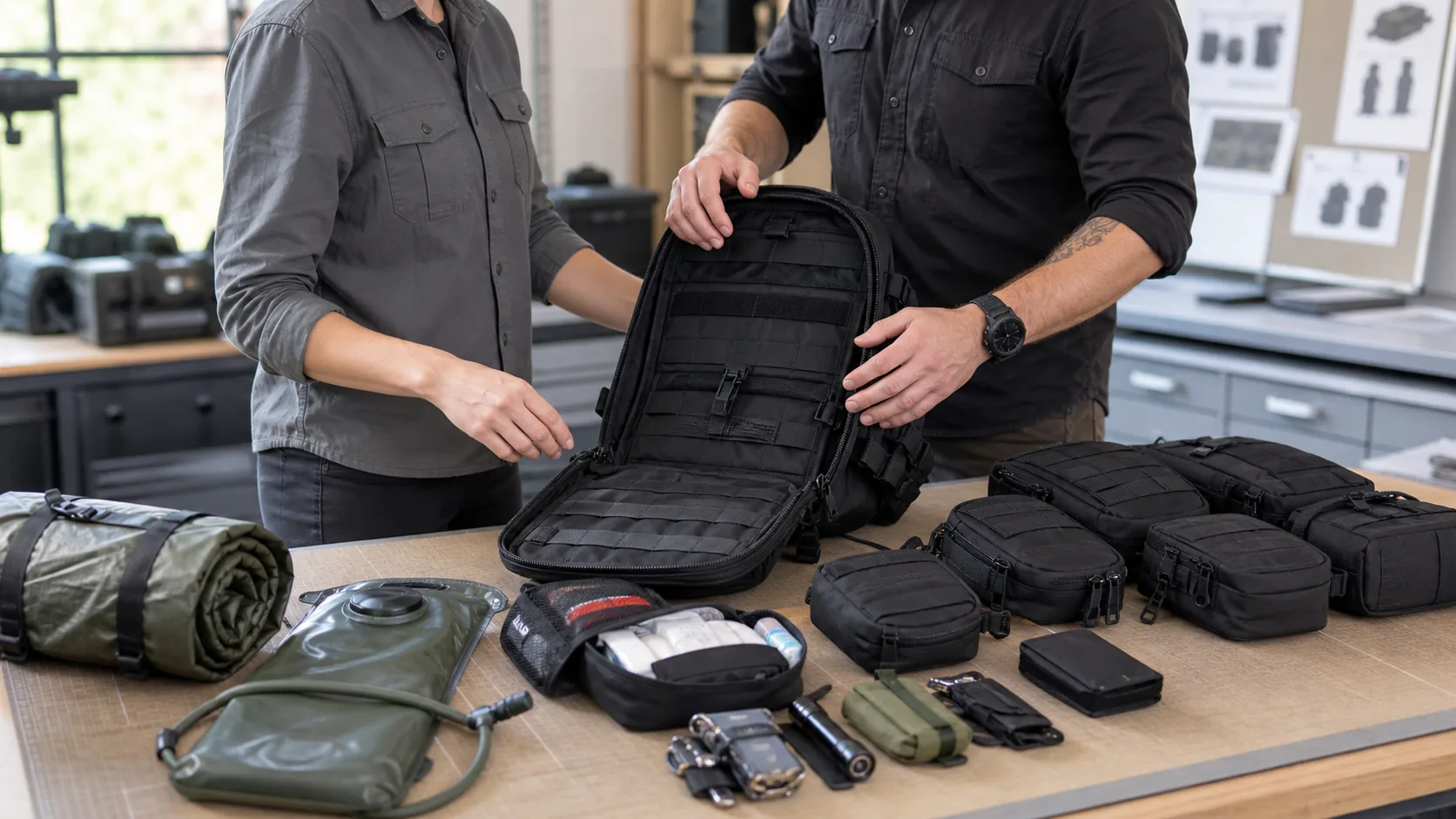
Properly packing a tactical backpack requires a layout that keeps dense items close to the spine, bulky low-frequency gear at the bottom, and priority equipment within easy reach. An unbalanced or shifting load increases fatigue and makes important items harder to find. A structured tactical backpack setup improves stability by combining a gear audit, predictable zones, secure modules, and a loaded carry test. These principles apply to outdoor users as well as B2B teams evaluating compartment layouts and suspension under realistic loads.
Why plan your tactical backpack setup before packing?
Planning gives each item a defined location before field use. It also reveals duplicate equipment, excess weight, poor access, and whether the pack volume matches the actual load.
Lay every item out before it enters the bag. Check its condition, remove duplicate tools and unnecessary packaging, weigh the complete load, and sort it into immediate-use, occasional-use, and camp-use groups. This audit turns a vague packing list into a location plan and reveals whether the selected backpack has the right capacity.

What is the survival mindset?
Start with the likely route, duration, weather, water access, communication coverage, and emergency plan. Pack for those conditions instead of an undefined worst-case scenario.
Medical, navigation, and communication items should have consistent locations that can be reached without unpacking the main compartment.
- Map out your gear based on immediate field demands.
- Prioritize emergency communications and medical response gear.
- Group related survival items together into modular kits.
This approach improves access and makes the loadout easier to check before departure.
How to differentiate wants from needs?
Distinguishing between actual needs and simple comforts helps prevent back fatigue and exhaustion.
Every optional item adds weight. Compare its purpose with the route and remove heavy, single-use items that do not address a defined need.
- Needs: Critical hydration, medical trauma gear, and simple shelters.
- Wants: Bulky cookware, extra electronics, and comfort clothing.
Filtering your equipment prevents unnecessary weight from slowing down your pace.
Key Takeaway: Prioritizing core gear and organizing it around likely scenarios reduces physical fatigue and supports fast access under pressure.
| Category | Primary Item Example | Weight Profile | Priority Level |
|---|---|---|---|
| Needs | Water filtration, medical kits, basic shelter | Heavy to Medium | Priority tier |
| Wants | Extra power banks, comfort cooking tools | Light to Medium | Optional tier |
Limiting optional gear reduces strain on both the carrier and the pack's load-bearing points.
What is inside a custom tactical backpack setup?
A custom tactical backpack setup consists of priority survival items, modular storage pouches, and personal utility gear. The right mixture of hydration, medical supplies, and shelter supports users through harsh conditions. B2B distributors should understand these cargo categories when developing packs for outdoor and tactical applications. Organizing each module properly can separate reliable field performance from equipment failure.
Use labeled pouches or lightweight packing cubes to keep related items together, but avoid filling every compartment simply because it exists. Modules should reduce search time and prevent gear migration without adding unnecessary weight. Waterproof pouches belong around moisture-sensitive items even when the backpack fabric is described as water resistant.

Why do food and water belong in the core loadout?
Food and water requirements depend on trip duration, conditions, available water sources, and the user's needs.
Use compact food packaging and place dense water close to the back panel. Follow local guidance for treatment and carry capacity rather than relying on one fixed quantity.
- Pack lightweight, dehydrated meal pouches.
- Use heavy-duty, BPA-free water bladders.
- Carry portable water purification tablets.
Secure these supplies against leakage and movement, and verify access during the loaded carry test.
How to prepare medical and hygiene supplies?
Carry medical and hygiene supplies appropriate to the activity, training level, group plan, and local guidance.
Place the medical kit where the intended user can identify and retrieve it quickly.
- Store sterile bandages and tourniquets in waterproof bags.
- Include antiseptic wipes and compact wound dressings.
- Keep medical scissors and medical tape in easy-to-reach pockets.
Taking these precautions supports a faster response to sudden field injuries.
What emergency tools and shelter are needed?
Shelter, lighting, and tools should match the planned conditions and the user's skills.
Keep rain protection accessible and protect dry insulation from leakage. Store sharp tools in fitted sheaths where they cannot contact the liner or the user.
- Store heavy tactical knives in rigid, secure sheaths.
- Use compact, lightweight emergency bivvy bags.
- Keep reliable LED flashlights and spare batteries handy.
Review local rules and remove any tool that has no defined purpose in the plan.
Key Takeaway: Consolidating shelter and tool modules supports fast deployment under adverse weather conditions.
| Gear Sub-Type | Ideal Pack Location | Access Frequency | Protective Layering |
|---|---|---|---|
| Trauma Kits | Top Compartment / Outer Pocket | Immediate | Water-tight dry bag |
| Shelter & Tents | Bottom Compartment / External | Low (End of Day) | Reinforced heavy-duty liner |
Aligning access frequency with compartment placement avoids tearing delicate liners with sharp tool edges.
How to balance weight in a tactical backpack setup?
You balance weight in your tactical backpack setup by placing the heaviest items closest to your spine at mid-back level. This configuration centers the load over your natural center of gravity and prevents the pack from pulling you backward. Keeping lighter items near the outer boundaries reduces lateral swaying on rugged terrain. These weight-distribution principles can reduce muscle strain over long-distance movement.

Why does load distribution matter?
Load distribution affects balance, posture, and pressure on the harness.
Weight carried far from the back creates more leverage and can pull the torso backward. Position dense items close to the back panel, then confirm comfort while walking, turning, and climbing.
- Reduces pressure on your lower lumbar spine.
- Keeps your shoulders from pulling back excessively.
- Improves your stability on steep climbs.
This arrangement can reduce load movement, but fit and total weight still determine comfort.
How to use compression straps effectively?
Compression straps stabilize your gear and reduce the pack's physical profile.
Loose gear can shift the center of mass. Tighten compression straps evenly without deforming fragile items or overstressing zippers.
- Cinch side straps evenly to prevent lopsided loads.
- Use bottom straps to compress sleeping bags.
- Tighten internal compression bands before closing the main zipper.
Keeping your load compressed improves your mobility through narrow spaces.
Side pockets need the same discipline as the main compartment. Balance bottles or other dense items from left to right, keep them close to the pack body, and confirm that they remain retained while bending. A single heavy side pocket can create lateral sway even when the center compartment is packed correctly.
Key Takeaway: Tightening compression straps prevents load shifts, stabilizing your balance over uneven terrain.
| Strap Location | Functionality | Adjusting Method | Balance Impact |
|---|---|---|---|
| Side Compression | Minimizes pack profile | Pull tight after interior loading | High / Prevents lateral sway |
| Sternum Strap | Distributes shoulder load | Fasten snugly across chest | Medium / Relieves shoulder strain |
Regular strap checks during movement prevent muscle strain caused by shifts in your gear.
What goes at the bottom of a tactical backpack setup?
The bottom of a tactical backpack setup is reserved for bulky, lightweight items that you will not need until camp. This group typically includes sleeping bags, spare footwear, and extra clothing layers that serve as a shock-absorbing base. Placing soft, compressible gear here cushions the contents above whenever the pack is set down. It also prevents heavy, rigid tools from pressing into your lower back.

Should sleeping gear go at the very bottom?
Bulky, low-frequency items such as sleeping gear often fit at the base when they are not needed during the day.
Soft goods at the bottom fill the pack shape and keep camp-only equipment out of the access path. Protect sleeping insulation in a suitable dry bag.
- Compress sleeping bags using waterproof sacks.
- Place soft camp pillows around the bag's edges.
- Pack compact ground pads next to the sleeping bag.
This structural base protects heavier items from crashing into the ground.
How to pack bulky clothing and extra boots?
Storing heavy spare clothing and footwear at the base helps fill empty pockets and stabilizes your load.
Rolled clothing can fill gaps around other equipment. Electronics still need fitted protection and should not rely on clothing alone for impact resistance.
- Roll uniforms tightly using the military ranger-roll method.
- Place extra boots flat against the bottom panel.
- Fill empty spaces with clean, rolled socks.
This packing technique maintains a smooth, flat surface against your lower back.
Key Takeaway: Placing soft, bulky gear at the bottom creates a sturdy base that protects fragile items stored higher up.
| Item Description | Weight Class | Frequency of Use | Packing State |
|---|---|---|---|
| Sleeping Bag | Medium to Heavy | Single Use (Nightly) | Vacuum compressed or rolled |
| Spare Footwear | Heavy | Emergency only | Packed flat on the very bottom |
Utilizing the bottom section for soft, compressible items cushions the pack when dropped onto hard ground.
Where does heavy gear fit in a tactical backpack setup?
Heavy gear fits directly against your spine in the middle section of your tactical backpack setup to improve balance. Positioning dense items like cooksets and full water reservoirs close to your body uses natural skeletal support. This layout reduces backward pulling force on your shoulders during extended field use. Stowing heavy items elsewhere can create instability on steep or slick surfaces.

Why place heavy items close to the spine?
Storing heavy gear close to your spine keeps the pack's center of gravity aligned with your body.
Heavy objects near the outer face increase leverage and may cause a forward lean. Move them closer to the back panel and reassess the fit under load.
- Reduces fatigue in your lower back muscles.
- Improves your agility and lateral stability.
- Prevents painful shoulder-strap digging.
A compatible frame, torso fit, and adjusted hip belt can transfer part of the load to the pelvis.
How to secure heavy tools and water bladders?
Heavy tools, cooksets, and water bladders must be anchored securely in the mid-back area so they do not shift.
A supported reservoir sleeve can hold water close to the back panel. Check that the filled reservoir does not sag, leak toward electronics, or create a pressure point.
- Slide water reservoirs into the integrated back sleeve.
- Surround hard metal stoves with soft fleece clothing.
- Secure ammunition containers in the center-most pockets.
This buffering technique protects your spine from hard, sharp edges.
Key Takeaway: Store dense gear close to the back panel and restrain it, then verify balance on a controlled walking test.
| Heavy Item | Recommended Position | Contact Barrier | Stability Factor |
|---|---|---|---|
| Water Reservoir | Dedicated sleeve adjacent to spine | Supported, leak-aware liner | Close to the back panel |
| Ammo / Cookset | Centered mid-back | Soft fleece or extra uniform roll | High / Prevents shifting and poking |
Placing a soft buffer between heavy gear and your spine prevents painful pressure points on long hikes.
How to organize daily rations and extra layers?
Placing your daily food rations and lightweight weather jackets in the middle layer saves valuable time.
A windbreaker or rain shell should remain reachable without removing dense equipment. The exact position depends on the opening layout.
- Store rain jackets on top of your middle-layer gear.
- Keep energy bars and trail mix in side compartments.
- Pack fleece jackets directly above your heavy tools.
This simple organization helps you adapt quickly when conditions change.
Key Takeaway: Packing your mid-layer with medium-weight items lets you quickly access snacks or layers without unpacking your entire bag.
| Middle Layer Item | Weight Class | Protection Layer | Priority Level |
|---|---|---|---|
| Daily Rations | Medium | Tear-resistant zip bag | High (Mid-day access) |
| Rain Shell | Light | Waterproof outer casing | High (Sudden storm access) |
Placing waterproof layers right above your heavy gear lets you respond quickly when weather changes.
What goes on top of your tactical backpack setup?
The top of your tactical backpack setup should hold high-priority survival gear, emergency medical kits, and navigation tools. Keeping these items at the peak of your pack allows rapid deployment without unpacking your entire load. Items like trauma dressings, GPS units, and rain jackets should remain immediately within reach. This quick-access strategy supports faster action during sudden environmental shifts or emergencies.
Where should navigation and communication gear go?
Navigation and communication tools need a consistent, protected, quick-access location; this may be a top pocket, hip-belt pocket, or secured shoulder attachment.
Keep these devices restrained, protected from water, and separate from hard objects that could damage them.
- Place GPS units in padded, waterproof cases.
- Keep physical maps in transparent zip-top bags.
- Secure satellite messengers in easy-access loops.
Their location supports access, but safe navigation also depends on planning, power, coverage, backups, and user skill.
How to secure emergency medical kits?
Stashing medical and trauma kits at the very top of your pack is a sound field rule.
Keep this in mind: rapid access matters when stopping bleeding or treating injuries. Placing your individual medical kit right under the main lid supports immediate retrieval.
- Use bright red or labeled pouches for your IFAK.
- Place tourniquets in dedicated, unzipped outer sleeves.
- Keep sterile gauze and shears in the top pocket.
This layout reduces retrieval time when the pouch remains visible and unobstructed.
Key Takeaway: Keeping medical and communication gear at the top of your pack supports fast access during an emergency.
| Item Type | Emergency Frequency | Moisture Threat | Extraction Target |
|---|---|---|---|
| Tourniquet / IFAK | High / Instant | High (Needs dry casing) | Immediate reach |
| GPS / Satellite | Use-dependent | Protect from water and impact | Rapid reach |
Dedicating your top pockets to emergency gear prevents wasted time digging through your pack.
How to use webbing on a tactical backpack setup?
You use the external webbing on your tactical backpack setup to attach lightweight pouches, backup tools, and quick-access utility gear. Modular webbing loops keep main compartments uncluttered while placing key gear at your fingertips. Limit the weight of external attachments to maintain lateral balance and prevent snagging. When used properly, external webbing expands carrying versatility without destabilizing the load.
How to use external webbing efficiently?
Using the external modular webbing allows you to customize your pack's capacity with specialized pouches.
External webbing can hold canteen pouches, flashlight sheaths, or small utility pouches. Every attachment should be restrained and checked for snagging and balance.
- Weave straps securely through every single webbing row.
- Use locking plastic clips for lightweight items.
- Keep attachments symmetrical to maintain lateral balance.
Proper attachment techniques keep your gear stable over rough terrain.
Can you attach heavy items to the exterior?
No, you should avoid hanging heavy tools on the exterior webbing of your pack.
Heavy exterior items can swing, alter balance, stress the webbing, and snag on obstacles. Place them inside when possible or use a purpose-built sheath with secondary retention.
- Store heavy tactical axes inside the main compartment.
- Keep heavy metal tools close to your spine.
- Limit external attachments to lightweight gear.
Following these rules keeps your pack balanced, quiet, and streamlined.
Key Takeaway: Using external webbing for lightweight gear leaves main compartments open for heavier items while keeping frequently used tools within reach.
| Attached Accessory | Weight Class | Secure Method | Snag Threat Level |
|---|---|---|---|
| Utility Pouch | Light | Double-button webbing strap | Low / Sleek fit |
| Tactical Axe / Tool | Heavy | Locking utility sheath | High / Needs strap tie-downs |
Secure all external items tightly against the pack body to prevent swaying and snagging in dense brush.
How do you test a loaded tactical backpack setup?
You test a loaded tactical backpack setup by wearing it during a trial run that involves walking, bending, and controlled movement. This check helps you identify painful hot spots, unbalanced weight shifts, or loose straps before field use. Adjust the load based on physical feedback and stop if pain develops. Skipping this diagnostic step can lead to muscle fatigue and gear failure on the trail.
How to test ergonomics with a trial run?
A loaded trial run helps verify placement, fit, access, noise, and load movement.
Load the pack fully and walk, turn, bend, and climb in a controlled area. Stop and adjust if the load shifts, hard items create pressure, or pain develops.
- Check for sharp items poking through the back panel.
- Listen for clanging metal tools that need buffering.
- Confirm that the hip belt carries most of the load comfortably.
Adjusting your pack now supports a smoother field experience.
How do you adjust straps for a stable fit?
Adjusting your harness straps in the correct order supports stable weight distribution.
Set the hip belt before fine-tuning the shoulder harness so a compatible suspension can transfer part of the load to the pelvis.
- Fasten and tighten your hip belt over your pelvic bones.
- Pull the shoulder straps snug and adjust your load lifters.
- Clip the sternum strap across your chest to prevent slippage.
Properly adjusted straps keep your load stable and close to your body.
Key Takeaway: Test and adjust before departure; reduce the load if fit changes do not resolve pain or instability.
| Adjusting Step | Strap Name | Tightness Level | Desired Dynamic Result |
|---|---|---|---|
| Stage A | Hip/Waist Belt | Firm (Rests on hip bones) | Transfers load through the pelvis |
| Stage B | Shoulder Harness | Snug (Comfortable contour) | Pulls load close to upper torso |
Fine-tune your load lifters until the pack stays close without creating pressure on your collarbones.
How does quality impact a tactical backpack setup?
Manufacturing quality affects how the backpack carries its stated load. Fabric, seam allowance, stitch construction, reinforcement, zippers, webbing, buckles, and frame components should be specified and tested as a system.
Why do fabric and seam strength matter?
High-density fabrics and reinforced bar-tack stitching help prevent pack blowouts under heavy loads.
Materials and seams can fail when the actual load exceeds the design or concentrates stress at anchors. Use a project-specific specification and loaded tests for abrasion, pull, and repeated carry.
- Look for double-stitched seams and heavy-duty nylon thread.
- Select bags made with abrasion-resistant 900D polyester.
- Confirm that load-bearing stress points feature reinforced bar-tack stitching.
Construction reduces failure risk but does not replace appropriate packing, load limits, and inspection.
How to select the right custom manufacturer?
An OEM partner should be evaluated against the project's documented materials, sample process, tests, inspection plan, and delivery requirements.
Review audit documents, equipment, test records, defect handling, and approved-sample controls rather than relying on a general quality claim.
- Request proof of ISO 9001 and BSCI compliance.
- Inquire about their in-house materials stress testing.
- Ask for customizable fabric options like 900D nylon.
A qualified manufacturer and a clear inspection plan reduce production risk; neither guarantees market results.
Key Takeaway: Working directly with a certified manufacturer helps tactical gear meet the quality and performance standards your customers expect.
| Technical Specification | Sourcing Minimum | Testing Standard | Performance Impact |
|---|---|---|---|
| Shell Material | Project-defined woven fabric | Agreed abrasion test | Supports puncture and tear resistance |
| Seam Strength | Bar-tack reinforced sewing | Tension load test | Helps prevent strap blowouts under load |
Specifying double-stitched stress points protects your inventory against failures under heavy loads in the field.
Organization cannot make an excessive load safe, but it can improve balance, access, and consistency. Keep dense items close, restrain modules, protect priority equipment, and reduce weight when the loaded carry test reveals pain or instability.
For B2B buyers, distributors, and outdoor brands, the development brief should include real loadouts, user range, access priorities, materials, construction details, and acceptance tests. To discuss an OEM/ODM sample against those requirements, contact us.
What are FAQs about a tactical backpack setup?
These tactical backpack setup answers address common questions about cleaning, load limits, external storage, and weather-resistant materials. Each answer gives a direct judgment followed by practical reasoning for field users and product teams.
1. Can I wash my tactical backpack in a standard washing machine?
Follow the care label. Machine washing may damage coatings, foam, webbing, frames, and hardware, so structured or coated packs are commonly spot-cleaned or hand-washed with mild soap and then air-dried in shade.
2. What's the best weight distribution for a tactical backpack setup?
The best approach is to place the heaviest items closest to your spine at mid-back level. This configuration centers the load over your pelvis, keeping the pack's weight from pulling you backward. Always pack lighter, bulkier gear at the bottom and quick-access survival tools at the top.
3. How do I know if my tactical backpack setup is too heavy?
There is no universal percentage that suits every user. If you lean forward excessively, lose balance, or feel sharp pain in your neck and collarbones, reduce the load and reassess the fit before continuing.
4. Can I attach sleeping bags to the outside using MOLLE webbing?
Yes, you can securely attach sleeping bags and foam pads to the external webbing of your pack. To do this safely, use heavy-duty utility compression straps threaded directly through the reinforced webbing loops. Make sure the sleeping bag is centered and pulled tight against the pack frame to keep it from swaying.
5. What's the best weather-resistant tactical backpack material?
The right material depends on the product brief, but coated high-density polyester or nylon can provide strong abrasion resistance and water repellency. For demanding wet-weather use, specify sealed seams, covered zippers, and a separate waterproof liner. A standard tactical pack should not be treated as submersible unless it was designed and tested for that purpose.