
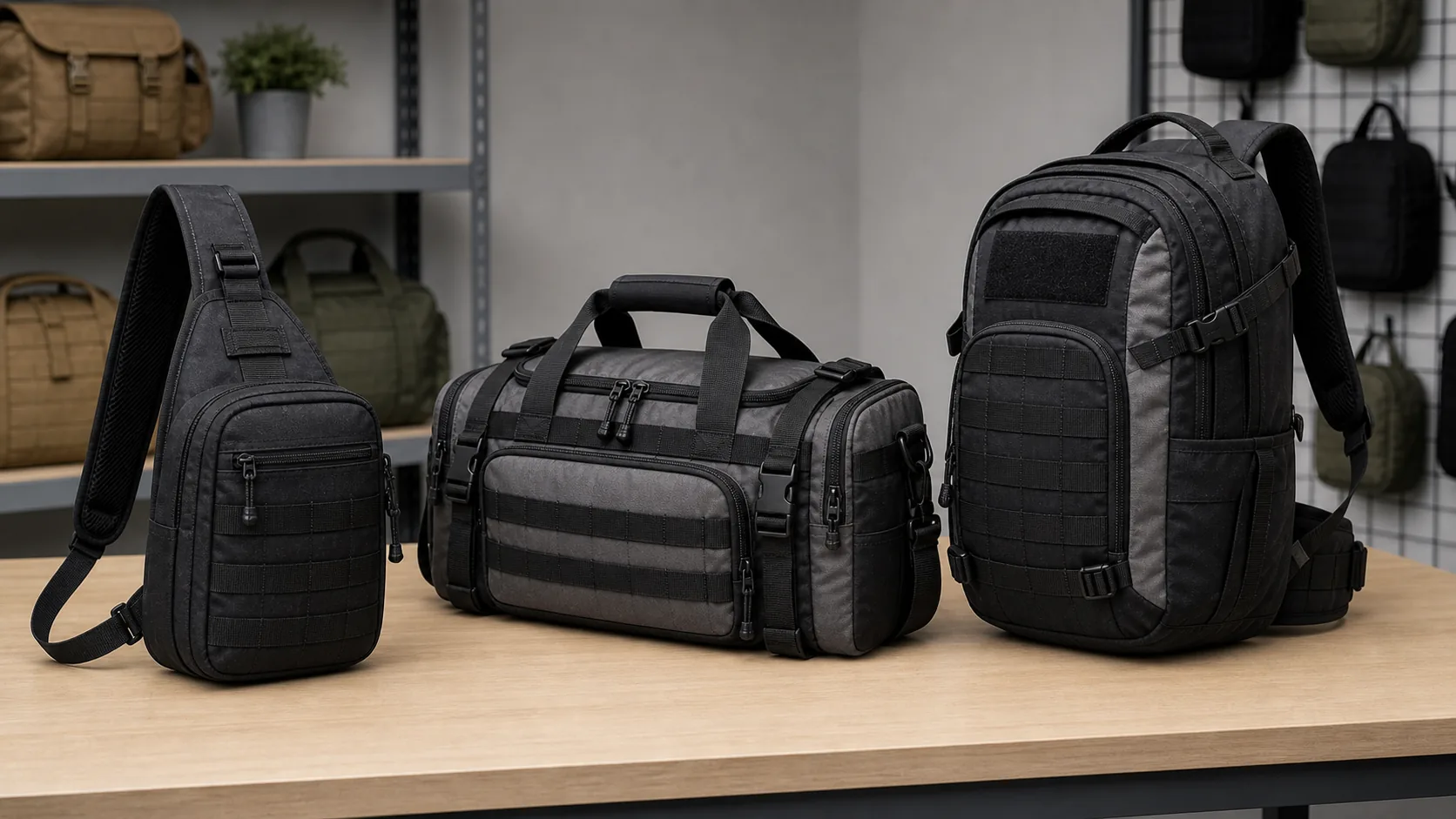
Choosing between tactical bags and tactical backpacks depends on carry style, access speed, load weight, capacity, and the environment where the product will be used. A compact tactical bag is usually better for fast access and short-duration carry, while a tactical backpack is better for balanced weight support and larger gear volume. For brands sourcing tactical backpacks, the right answer is not simply “which one is stronger.” It is which structure best matches the customer, the load, and the expected daily use.
What differs in tactical bags vs tactical backpacks?

The main difference is carry format. Tactical bags often include sling bags, messenger-style bags, compact duffels, waist packs, or shoulder bags. Tactical backpacks use two shoulder straps and usually add a back panel, sternum strap, hip belt, or frame sheet for better load control.
How should buyers compare the structure?
Start with the carry point. A shoulder bag keeps the product close to the user’s side and can rotate forward quickly. A backpack spreads weight across both shoulders and can support longer wear. That makes the backpack better for heavier loads, but it may take slightly longer to access items in the main compartment.
Key structural differences:
- Tactical bags focus on access, compact shape, and short carry time.
- Tactical backpacks focus on load balance, capacity, and longer wear.
- Sling and messenger styles are easier to rotate to the front.
- Dual-strap backpacks keep larger loads more stable.
| Carry Type | Main Strength | Best Limitation to Watch |
|---|---|---|
| Sling or messenger bag | Fast access | Uneven shoulder loading |
| Tactical duffel | Open storage volume | Less hands-free carry |
| Tactical backpack | Balanced support | Slower front access |
For sourcing, this first decision shapes the pattern, padding, hardware, pocket layout, and target price.
How is the design unique in tactical bags vs tactical backpacks?

Design differences come from how the product sits on the body. Tactical bags usually prioritize one-shoulder or hand-carry access. Tactical backpacks prioritize a stable rear carry system. This affects strap width, zipper direction, panel stiffness, pocket placement, and how much structure the bag needs.
What does the carry system change?
A single-strap tactical bag needs a comfortable shoulder pad, an adjustable strap, and a shape that does not swing too much when the user moves. A tactical backpack needs a more complete harness: padded shoulder straps, breathable back panel, sternum strap, and sometimes a hip belt.
Design points to compare:
- Shoulder pad position on sling or messenger designs
- S-curve or padded straps on backpacks
- Back-panel foam and airflow channels
- Strap anchor reinforcement
- Zipper direction for front or rear access
| Design Feature | Tactical Bag Use | Tactical Backpack Use |
|---|---|---|
| Strap system | One shoulder or hand carry | Two-shoulder harness |
| Back panel | Light structure | Padded support zone |
| Zipper access | Side or top entry | Front, top, or clamshell |
If the product needs to carry meaningful weight, the backpack design usually gives more room for ergonomic support.
Which organizes gear better: tactical bags vs tactical backpacks?

Organization depends on whether the user needs fast access to a few items or structured storage for many items. Tactical bags are strong when the user carries a smaller set of tools, documents, tech accessories, or daily items. Tactical backpacks are stronger when the user needs multiple compartments, laptop protection, outdoor gear, and separated storage zones.
Which pocket layout works best?
A compact tactical bag should avoid too many tiny pockets because it has limited interior volume. A backpack can support more layered organization: admin panels, mesh pockets, padded sleeves, side pockets, and larger main compartments. For online retail, clean pocket logic is especially important in e-commerce bag projects because buyers quickly judge whether a bag solves a real packing problem.
Useful organization choices:
- Admin panel for pens, cards, and small tools
- Padded sleeve for laptop or tablet protection
- Mesh pocket for cables and loose accessories
- Clamshell opening for easy inspection
- Side pocket for water bottle or umbrella
| Organization Need | Better Fit | Why |
|---|---|---|
| Fast small-item access | Tactical bag | Easier front rotation |
| Multi-compartment sorting | Tactical backpack | More panel area |
| Tech and outdoor crossover | Tactical backpack | Better sleeve and main volume |
The best layout is the one users can understand immediately without digging through repeated pockets.
What scenarios fit tactical bags vs tactical backpacks best?

Scenario fit depends on movement distance, carried volume, and how often the user needs to open the bag. Tactical bags suit short trips, vehicle carry, commuting, light work kits, event staff, range accessories, or compact tool carry. Tactical backpacks suit outdoor use, longer walking time, heavier daily loads, travel, and field-oriented product lines for the outdoor and tactical industry.
When is a compact tactical bag better?
A tactical bag is better when the load is light and access speed matters. It can sit beside the body, rotate forward, and open quickly. This is useful for documents, electronics, medical pouches, inspection tools, camera accessories, or daily personal items.
When is a backpack better?
A backpack is better when the user carries heavier or bulkier items. The two-strap harness keeps the load closer to the body and reduces uneven shoulder pressure. It also gives the designer more space for structured compartments.
| Scenario | Better Choice | Key Feature |
|---|---|---|
| Short urban carry | Tactical bag | Fast front access |
| Outdoor day trip | Tactical backpack | Balanced support |
| Work and travel crossover | Tactical backpack | Laptop and gear zones |
Buyers should define the primary use case before choosing the silhouette.
How should buyers choose size in tactical bags vs tactical backpacks?

Size should follow the actual load, not the largest possible capacity. Oversized tactical bags encourage overpacking, while undersized bags force users to attach items externally. Tactical backpacks can carry more volume, but too much capacity can make the product heavy, wide, and harder to sell to everyday users.
What capacity range makes sense?
For tactical bags, 5-15 liters is common for compact carry. For tactical backpacks, 20-40 liters covers many daily, outdoor, and work scenarios. Larger packs can be useful, but only when the target customer truly needs extended packing space.
Capacity planning guide:
- 5-15L for compact sling, waist, or shoulder bags
- 15-25L for light everyday backpacks
- 25-40L for daily duty, outdoor, work, and travel crossover
- 40L+ for extended outdoor or heavy gear carry
| Volume Range | Best Application | Mobility |
|---|---|---|
| 5-15L | Compact tactical bags | Very high |
| 20-40L | General tactical backpacks | Balanced |
| 40L+ | Extended carry packs | More restricted |
For a retail line, a medium-capacity backpack often has the widest audience, while compact bags can serve a more specific niche.
Does weight matter in tactical bags vs tactical backpacks?
Weight matters because carry imbalance changes the user experience quickly. A tactical bag may feel convenient at first, but a heavy one-shoulder load can become tiring. A tactical backpack spreads weight more evenly and can use a sternum strap, hip belt, and frame sheet to keep the product stable.
How should brands control carry fatigue?
Control fatigue through structure, not only padding. Thick padding can help, but it also adds bulk and cost. Better design uses balanced pocket placement, reinforced strap anchors, supportive back panels, and compression straps that keep the load close.
Weight-control details:
- Keep dense items close to the body
- Avoid heavy pockets placed far from the back panel
- Use sternum straps for stability on backpacks
- Add waist support only when the target load justifies it
- Keep compact bags light enough for one-shoulder carry
| Loading Style | Comfort Risk | Design Response |
|---|---|---|
| One-shoulder carry | Uneven strain | Keep volume compact |
| Two-strap carry | Heat and bulk | Use breathable panels |
| Hip-supported carry | Added cost | Use only for heavier loads |
This is also where sample testing matters. A product that looks good empty may feel very different when packed.
Can materials decide tactical bags vs tactical backpacks?
Materials strongly affect durability, weight, and price. A tactical bag may not need the same fabric weight as a large backpack because the load is lighter. A tactical backpack often needs stronger fabric, reinforced stress points, and better zipper support because it carries more weight over longer periods. ZWbags’ outdoor durability case is a useful reference for thinking about abrasion, reinforcement, and field-use expectations.
Which material specs deserve attention?
Buyers should review fabric denier, coating, lining, zipper type, buckle quality, webbing strength, and stitching density. Do not choose the heaviest fabric automatically. A 1000D fabric can be very rugged, but it may be too stiff or heavy for a compact everyday bag.
Material review points:
- 500D or 600D fabric for balanced weight and durability
- Heavier fabric on the bottom panel or stress zones
- PU or other water-resistant coating when needed
- Bartacks at handles, strap anchors, and compression points
- Zippers sized for the pocket load and opening style
| Material Choice | Strength | Tradeoff |
|---|---|---|
| 500D/600D fabric | Balanced daily durability | Less rugged than heavier fabric |
| 1000D fabric | Strong abrasion resistance | More weight and stiffness |
| Reinforced bottom | Better wear resistance | Higher cost |
The correct material package should match the use case and the buyer’s target price.
How do MOLLE and modular panels help tactical bags vs tactical backpacks?
MOLLE and modular panels add flexibility, but they should not be used only for appearance. On tactical bags, webbing can support small pouches or accessories without making the product too large. On tactical backpacks, MOLLE or laser-cut panels can expand carrying options while keeping the main compartment organized.
When should buyers choose laser-cut panels?
Laser-cut panels create a cleaner surface and can reduce bulk compared with traditional sewn webbing. Traditional webbing can still be better when the design needs a more rugged tactical look or heavier attachment points. For retail products, the decision often depends on whether the target customer wants a technical appearance or a cleaner everyday profile.
Modular design choices:
- Traditional MOLLE for visible tactical styling
- Laser-cut panels for a lighter modern look
- Hook-and-loop panels for patches or identification
- Compression straps for profile control
- Removable pouches only when they add real value
| Modular Option | Best Product Fit | Buyer Note |
|---|---|---|
| Traditional MOLLE | Technical outdoor packs | Strong visual identity |
| Laser-cut MOLLE | Modern tactical backpacks | Cleaner surface |
| Minimal webbing | Low-profile bags | Broader retail appeal |
Too many external attachments can make a product look busy and increase production complexity.
Which option is better for B2B sourcing?
For B2B sourcing, tactical backpacks usually have broader market appeal because they cover work, travel, outdoor, EDC, and tactical-inspired retail needs. Tactical bags can still be profitable when the target niche is clear. The best product line may include both: one compact tactical bag for fast access and one structured backpack for heavier daily use.
What should procurement teams verify?
Procurement teams should compare sample comfort, fabric consistency, zipper function, stitching quality, packaging needs, and target retail price. They should also confirm whether the supplier can repeat the approved sample in bulk production. For seasonal replenishment or online inventory planning, a fast replenishment project can be a useful model.
Sourcing checklist:
- Define the target user and main carry scenario
- Confirm capacity and load range
- Test zipper pulls, buckles, and strap anchors
- Review fabric, lining, webbing, and coating specs
- Check whether the sample stands, opens, and packs as expected
- Confirm logo placement, colorways, packaging, and QC standards
| Business Goal | Better Product Direction | Reason |
|---|---|---|
| Broad retail appeal | Tactical backpack | More use cases |
| Compact niche product | Tactical bag | Specific carry need |
| Custom brand line | Both options | Wider assortment |
To develop a custom tactical bag or backpack line, buyers can contact us today with capacity, material, color, pocket, and branding requirements.
FAQ About Tactical Bags vs Tactical Backpacks
Are tactical bags better than tactical backpacks?
Not always. Tactical bags are better for compact loads and fast access. Tactical backpacks are better for heavier loads, longer carry time, and more structured organization.
Which option is better for outdoor use?
A tactical backpack is usually better for outdoor use because it offers more balanced support, more capacity, and better room for hydration, clothing, and gear.
What size should a tactical backpack be?
For many daily and outdoor crossover uses, 20-40 liters is practical. Smaller sizes work for light EDC, while larger sizes should be chosen only when the user needs extended packing space.
Should tactical bags use MOLLE?
They can, but MOLLE should serve a real attachment need. For low-profile retail products, minimal webbing or laser-cut panels may be cleaner.
What should B2B buyers test before bulk orders?
Buyers should test loaded comfort, zipper movement, strap strength, pocket logic, fabric consistency, stitching at stress points, and whether bulk samples match the approved prototype.