
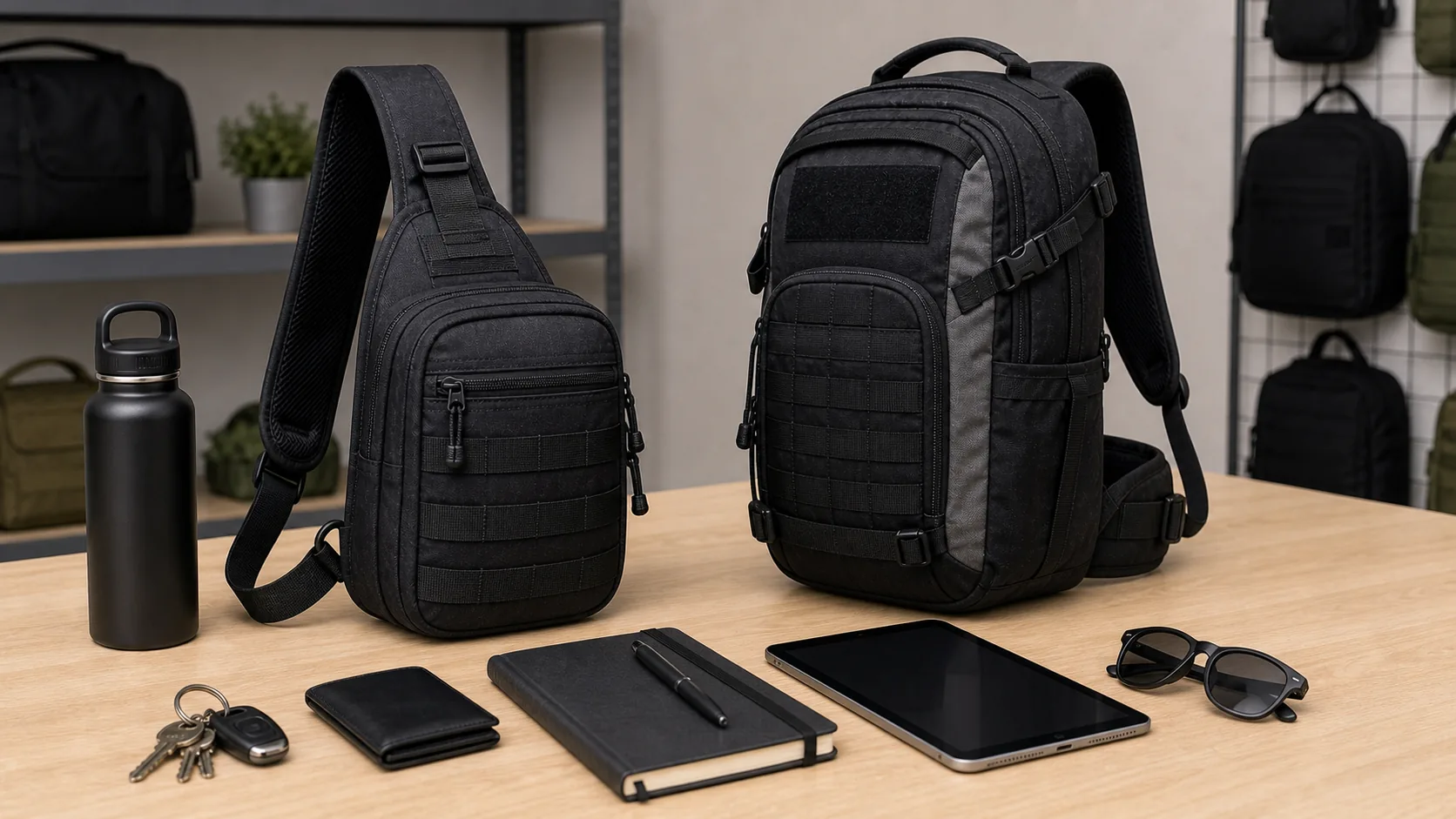
A tactical bag is a durable, organized carry product designed for heavier daily use, fast access, and flexible storage. It can be a backpack, sling bag, duffel, waist pack, or shoulder bag, but the shared idea is the same: stronger materials, structured compartments, reinforced stress points, and practical attachment options. For brands developing tactical backpacks, understanding what is a tactical bag helps define the right size, pocket layout, fabric, and target user before sampling begins.
Need to know what is a tactical bag for daily tasks?

A tactical bag for daily tasks is a practical organizer with stronger construction than a basic fashion backpack. It should carry laptops, documents, tools, water bottles, small accessories, and personal items without becoming messy or uncomfortable. The goal is not to make the bag look aggressive. The goal is to make the product more reliable, more organized, and easier to use every day.
What makes the core structure different?
The core structure usually includes tougher fabric, more reinforcement, and a pocket system that gives each item a clear place. Good design helps the user find items quickly and keeps the bag stable when it is packed.
Daily-use features to review:
- Reinforced seams at handles and strap anchors
- Durable fabric for abrasion resistance
- Padded shoulder straps or carry handles
- Admin pockets for small tools and accessories
- A main compartment sized for the target load
| Feature | Daily Benefit | Buyer Note |
|---|---|---|
| Reinforced seams | Better load support | Check bartacks and stress points |
| Durable fabric | Longer product life | Match denier to use case |
| Smart pockets | Faster access | Avoid overcomplicated layouts |
For sourcing, the first question is simple: what does the user need to carry every day, and how quickly must they access it?
Why should buyers define a tactical bag for travel?

Travel is one of the easiest ways to understand the value of a tactical bag. A travel-ready design should protect documents, electronics, clothing, chargers, and daily essentials while staying easy to open during transit. The best versions use clamshell openings, padded sleeves, quick-grab pockets, and streamlined exterior profiles.
Which travel features matter most?
Travel users often care about access and comfort more than extreme ruggedness. A bag that opens wide, fits under a seat, protects a laptop, and keeps small items visible can be more useful than a heavier pack with too many external attachments.
Travel-friendly details include:
- Clamshell or wide-opening main compartment
- Padded laptop or tablet sleeve
- Hidden or secure pocket for documents
- Smooth exterior that avoids snagging
- Comfortable grab handles and shoulder straps
| Travel Challenge | Tactical Bag Feature | Result |
|---|---|---|
| Security checks | Wide opening | Easier inspection |
| Small-item loss | Admin panel | Better sorting |
| Long walking time | Balanced straps | Less fatigue |
For brands, travel positioning works best when the design looks clean enough for commuting but still has tactical-style organization.
What is a tactical bag made of for strength?

A tactical bag is usually made from woven synthetic fabrics such as nylon or polyester, with reinforced stitching, reliable zippers, webbing, buckles, and sometimes water-resistant coatings. The best material package depends on the product’s target use. A compact everyday bag does not always need the same heavy fabric as an outdoor gear pack.
How do fabric and hardware choices work?
Fabric denier affects strength, weight, hand feel, and price. Hardware affects reliability and the user’s first impression. A good sample should show smooth zipper movement, stable buckles, clean seam alignment, and solid webbing at stress points.
Material details to verify:
- 500D, 600D, or 1000D fabric depending on target load
- PU or other water-resistant coating when needed
- Reinforced bottom panel for abrasion zones
- Durable zipper size matched to compartment load
- Strong webbing and clean bartack stitching
| Material Component | Function | Sourcing Note |
|---|---|---|
| Main fabric | Abrasion resistance | Balance strength and weight |
| Zipper | Access and closure | Test repeated opening |
| Webbing | Strap and MOLLE support | Check tensile requirement |
Any claimed fabric brand, denier, coating, zipper brand, or certification should be verified against the product brief before quoting customers.
What can a tactical bag organize?

A tactical bag can organize electronics, work tools, documents, clothing, water bottles, outdoor accessories, emergency items, and small personal gear. The value comes from separating items logically instead of placing everything in one large compartment. This is especially important for e-commerce bag projects, where buyers need product photos and reviews to show clear everyday function.
How should internal storage be planned?
Start with the most common items, then design pockets around them. A laptop sleeve needs padding and a false bottom. Cables need mesh or elastic loops. Wet clothing needs separation. Small valuables need a secure pocket that is easy for the owner to reach.
Useful organization zones:
- Padded sleeve for laptop or tablet
- Admin panel for pens, cards, and cables
- Mesh pockets for small accessories
- Main compartment for clothing or tools
- Side pocket for bottle or umbrella
| Storage Zone | Intended Cargo | Design Priority |
|---|---|---|
| Admin panel | Pens, cards, cables | Fast access |
| Main compartment | Clothing or gear | Open volume |
| Secure pocket | Valuables | Protection and placement |
The best pocket layout feels obvious to the user within the first few seconds.
How does a tactical bag protect laptops?

A tactical bag protects laptops by combining padding, sleeve placement, back-panel structure, and controlled movement inside the compartment. The laptop should not sit directly against the bottom edge of the bag. A raised or false-bottom sleeve helps reduce impact when the bag is placed on the ground.
Why does sleeve construction matter?
Laptop protection is not only about thick foam. The sleeve must fit the intended device size, hold the device securely, and prevent bending. A rigid or semi-structured back panel can also help stop pressure from other items inside the bag.
Laptop-protection details:
- False-bottom sleeve raised above the bag base
- EVA foam or similar padding around the device
- Strap or elastic closure to reduce bouncing
- Back-panel structure to reduce flexing
- Water-resistant fabric or zipper flap when needed
| Protection Feature | Risk Reduced | Buyer Check |
|---|---|---|
| False bottom | Ground impact | Measure sleeve position |
| Foam padding | Surface pressure | Check density and coverage |
| Structured panel | Screen flex | Test packed sample |
For work, school, travel, and commuter markets, laptop protection is often one of the most important selling points.
What does a tactical bag offer for work?
For work, a tactical bag offers a mobile office with stronger structure and more useful organization than a basic daypack. It can support laptops, notebooks, chargers, tools, samples, documents, and gym or commute items in one product. A low-profile design can also fit office and field environments without looking too technical.
How can it stay professional?
Professional styling depends on color, silhouette, hardware, and exterior panel layout. Black, gray, navy, olive, or other muted colors can make the bag easier to use in business settings. Minimal webbing and clean zipper lines make the product feel more retail-friendly.
Work-focused features:
- Upright base for office use
- Separate tech and clothing zones
- Low-profile exterior styling
- Comfortable handles for briefcase-style carry
- Clean logo placement for private-label branding
| Design Element | Work Benefit | Best Use |
|---|---|---|
| Monochrome color | Professional look | Office and travel |
| Upright base | Desk convenience | Meetings and commuting |
| Separate pockets | Better sorting | Work and gym crossover |
This is where tactical-inspired design can move beyond outdoor use and become a practical everyday product.
Can a tactical bag support emergency prep?
A tactical bag can support emergency prep when it provides clear storage for first aid items, water, flashlight, power bank, jacket, and other essentials. This does not mean every bag needs to be a large survival pack. It means the layout should allow users to find important items quickly and keep them separated from daily clutter.
What makes it useful for preparedness?
Preparedness depends on access, visibility, and load balance. Bright lining, clamshell openings, mesh dividers, and exterior attachment points can all help. For heavier kits, a backpack format is usually better than a one-shoulder bag because it distributes weight more evenly.
Emergency-prep features:
- Clamshell opening for fast overview
- Mesh pockets for first aid and small items
- Light-colored lining for visibility
- Compression straps for load control
- Backpack harness for heavier kits
| Prep Need | Useful Feature | Practical Benefit |
|---|---|---|
| Fast access | Wide opening | Better visibility |
| Item separation | Mesh pockets | Less searching |
| Heavier load | Backpack harness | Better balance |
Brands should avoid overstating survival claims unless the product is actually tested and specified for that purpose.
Can you define a tactical bag for outdoor use?
For outdoor use, a tactical bag is a rugged carry product built for weather exposure, abrasion, uneven terrain, and longer wear. It may include hydration routing, compression straps, reinforced bottom panels, breathable back padding, and external attachment points. The outdoor and tactical industry often needs this balance of durability, comfort, and modular storage.
Which outdoor details matter most?
Outdoor users need a bag that stays comfortable while loaded and resists wear from rocks, branches, wet ground, and repeated packing. Materials should be chosen carefully because heavier fabric can improve durability but also increase fatigue. See this outdoor durability case for related sourcing priorities.
Outdoor design details:
- Reinforced bottom panel
- Water-resistant coating
- Hydration routing if needed
- Compression straps for load stability
- Breathable back panel for longer wear
| Outdoor Need | Bag Feature | Trail Benefit |
|---|---|---|
| Water access | Hydration routing | Easier drinking |
| Load stability | Compression straps | Less shifting |
| Abrasion defense | Reinforced base | Longer wear life |
Outdoor versions should be sample-tested with realistic loads before bulk production.
How do you choose the right tactical bag?
Choosing the right tactical bag starts with the target user, not the feature list. Buyers should define the primary use case, expected load, capacity range, carry style, material level, pocket layout, and target retail price. A compact sling, a daily backpack, and an outdoor pack can all be tactical bags, but they should not share the exact same specification.
What should buyers check before production?
Lay out the user’s real items first. Then compare that load against capacity, pocket placement, strap comfort, zipper access, and sample structure. If the bag is for online retail, also consider how clearly the features can be shown in product images and descriptions.
Pre-production checks:
- Confirm capacity and target load
- Test loaded comfort and strap placement
- Inspect zipper movement and buckle strength
- Review fabric, lining, coating, and stitching
- Confirm logo placement and color options
- Record sample changes before bulk approval
| Capacity | Best Application | Mobility |
|---|---|---|
| Under 20L | Compact daily carry | High |
| 20L to 35L | Work, school, travel | Balanced |
| Over 35L | Outdoor or extended carry | More restricted |
To develop a tactical bag line for your market, buyers can contact us today with capacity, material, pocket, color, and branding requirements.
FAQ About Tactical Bags
Can a tactical bag be used for school or office?
Yes. A low-profile tactical bag can work well for school, office, commuting, and travel if the exterior is clean and the interior organization fits daily items.
What is the best way to clean a tactical bag?
Hand cleaning with mild soap, water, and a soft brush is usually safest. Machine washing may damage coatings, padding, frames, or hardware depending on the construction.
Do I need a 20L or 40L tactical bag?
Choose based on actual load. A 20L bag suits light daily carry, while 35L or 40L is better for travel, outdoor use, or bulkier gear.
Can a tactical bag protect a laptop?
Yes, if it has a padded sleeve, secure fit, structured back panel, and false-bottom design. Buyers should test the actual device size before approving the sample.
Can extra pouches attach to a tactical bag?
Yes, when the bag includes MOLLE, laser-cut panels, or other attachment webbing. These features should be used only when they match the target user’s real needs.