
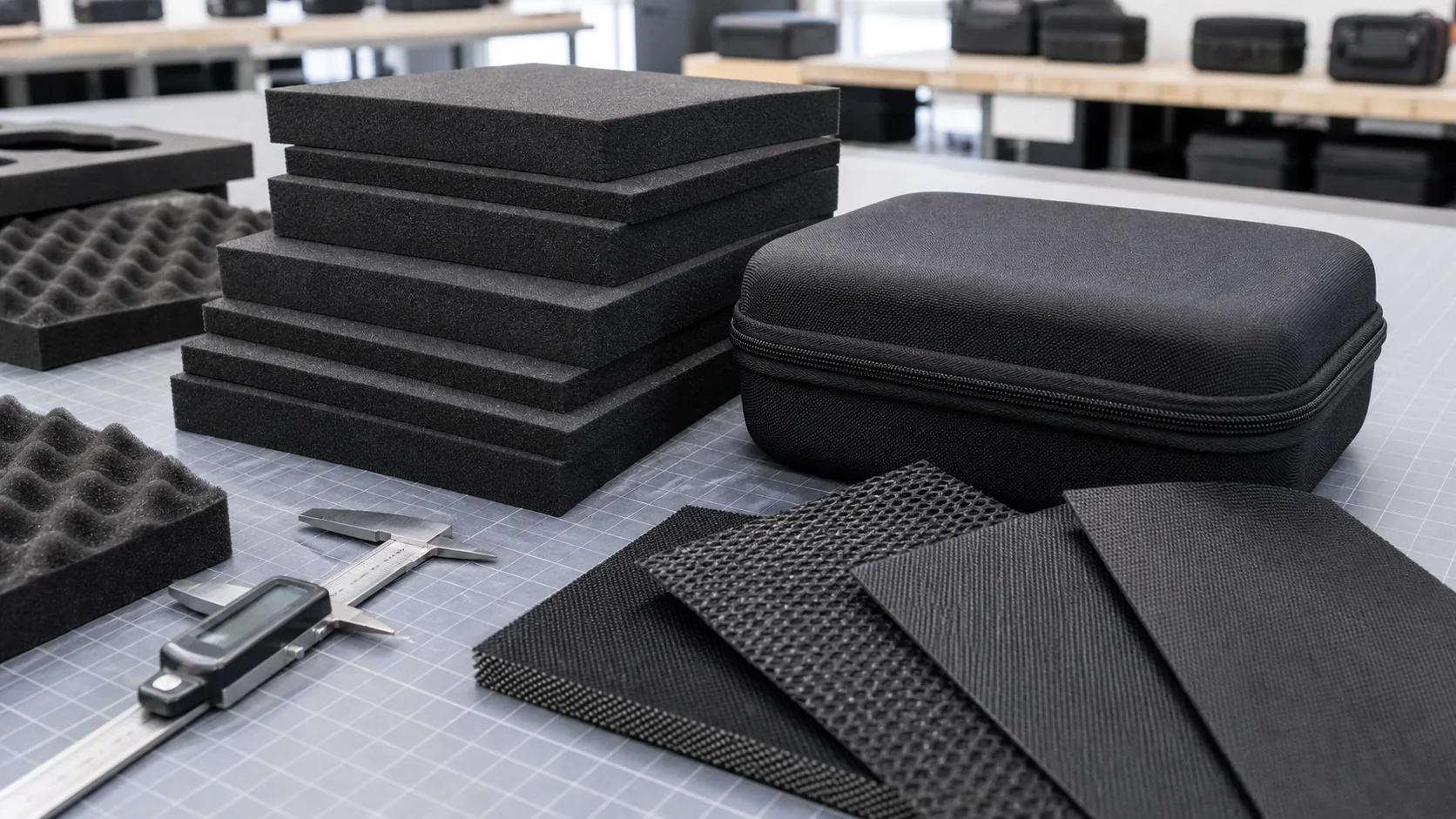
What is EVA case? It is a semi-rigid protective case built around ethylene-vinyl acetate foam, usually molded with heat and pressure to create a lightweight shell around fragile or high-value products. The finished case is normally a system rather than bare foam: exterior fabric, laminated EVA, lining, zipper, and an insert work together. For B2B buyers, an EVA case sits between a soft pouch and a heavy hard box: it offers better structure than a basic fabric bag while staying lighter and more brandable than many rigid plastic cases.
Companies use EVA cases when products need protection, organization, and a defined presentation in one package. Electronics, tools, medical accessories, optical gear, outdoor equipment, and retail kits can benefit when the case is designed around the actual product dimensions.
What Is EVA Case Material?

EVA stands for ethylene-vinyl acetate, an elastomeric polymer known for its flexibility, cushioning, and shape recovery. In case manufacturing, EVA is usually produced as foam sheets, laminated with exterior fabric, then thermoformed into a semi-rigid shell.
This material is popular because it can absorb impact without making the finished case excessively heavy. EVA also works well with stitched fabric, zipper systems, molded interiors, printed logos, patches, linings, and accessory compartments.
The protective result depends on the complete layer stack. Exterior fabric manages appearance and abrasion, the molded EVA shell provides shape and cushioning, the lining protects the product surface, and the insert controls movement. Increasing foam density without improving fit or stress-point construction can add weight without solving the real risk.
For buyers building protective packaging around electronics, tools, or equipment, ZWbags can support molded EVA cases with material, structure, insert, and branding customization.
How Does Foam Density Work?
Foam density affects how firm, light, and protective the case feels. Higher-density EVA can create stronger shell support, while lower-density EVA keeps weight down for lighter consumer products. The best choice depends on the product weight, fragility, usage environment, and target price.
- Higher-density EVA can support tougher industrial or outdoor applications.
- Medium-density EVA is often suitable for electronics and accessory kits.
- Lower-density EVA can work for lightweight cosmetic, gift, or promotional packaging.
| Density Direction | Best Application | Buyer Consideration |
|---|---|---|
| Lower density | Light accessories and cosmetics | Lower weight, softer feel |
| Medium density | Electronics and retail kits | Balanced protection and cost |
| Higher density | Tools and equipment | Better structure, more weight |
The right density prevents overbuilding the case while still giving the product meaningful protection.
What Is EVA Case Used For?

Companies use EVA cases to protect products that should not move freely during storage, shipping, or daily use. The molded shell and insert system can hold the main product, accessories, cables, instruction cards, or replacement parts in a controlled layout.
A simple qualification question is whether the product needs more structure than a pouch but less bulk than a rigid transit case. If scratches, cable movement, presentation, or repeated daily storage are the main risks, EVA is often a strong fit. If the requirement is certified crush, immersion, or hazardous-environment protection, buyers should define and test those standards before choosing the case type.
Common use cases include:
- Consumer electronics and accessories
- Small tools and measuring devices
- Camera lenses and optical accessories
- First-aid kits and medical device accessories
- Outdoor and tactical accessories
- Gift sets, retail kits, and branded bundles
Can Electronics Stay Protected?
Electronics benefit from a case that reduces internal movement. A molded insert can separate the device from cables, chargers, adapters, or spare parts, which lowers the chance of scratches and pressure marks. The organized interior also presents the included components in a defined order.
What Medical Accessories Fit Inside?
Medical-related kits may use EVA cases for accessories, sensors, tubing, first-aid items, or portable diagnostic components. Buyers should confirm lining, cleaning, material, and compliance requirements with the supplier instead of assuming every EVA case is suitable for regulated medical use.
| Product Type | Storage Method | Main Benefit |
|---|---|---|
| Electronics | Molded tray and cable space | Less movement |
| Tools | Cut foam or shaped insert | Clear organization |
| Medical accessories | Separate cavities and mesh pocket | Faster access |
| Outdoor gear | Reinforced shell and durable fabric | Better field handling |
For e-commerce sellers, e-commerce bag projects often need packaging that protects the product while also improving perceived value when the customer opens the parcel.
How Do You Judge EVA Case Quality?

EVA case quality comes from the full build, not only the foam. Buyers should check shell firmness, insert fit, zipper smoothness, seam strength, fabric durability, edge binding, handle reinforcement, and how the case behaves after repeated opening and closing.
Does Stitching Matter?
Yes. Stitching around zipper tracks, handles, binding, and stress points affects the case's long-term usability. Loose thread, uneven tension, skipped stitches, or weak edge finishing can make the case fail before the EVA shell itself wears out.
Can Zippers Affect Protection?
The zipper is a daily-use component, so quality matters. A poor zipper can jam, split, or allow the case to open unevenly. Reverse coil or water-resistant zipper constructions can improve surface protection, but buyers should avoid treating zipper claims as fully waterproof unless the whole case design has been tested for that standard.
| Quality Point | What to Check | Why It Matters |
|---|---|---|
| Shell | Shape recovery and wall thickness | Maintains structure |
| Zipper | Smooth opening and closure | Improves daily usability |
| Stitching | Reinforced stress points | Reduces premature failure |
| Insert | Product fit and removal space | Prevents rattling |
Closure and stitching quality affect appearance, operation, and repeat-use durability. Evaluate them through cycle tests and visual inspection.
Before bulk approval, test the case with the actual product and accessories installed. Shake and carry it in every intended orientation, cycle the zipper around the molded corners, inspect whether the insert releases dust or marks, and confirm that the user can remove the product without pulling on a fragile component.
How Is EVA Case Manufacturing Done?

EVA case manufacturing typically uses thermoforming. The factory prepares EVA sheets, laminates fabric if needed, heats the material, presses it over a mold, cools the shell, trims the edges, and then assembles zippers, lining, inserts, handles, and branding details.
How Does Heat Molding Happen?
Flat EVA sheets become easier to shape after controlled heating. A press forms the softened material over aluminum tooling, creating the shell depth, curves, corners, and structural profile. After cooling, the case keeps the molded shape.
Can Tooling Costs Stay Manageable?
Tooling cost depends on case size, mold complexity, shell depth, insert design, and sample requirements. Aluminum molds are commonly used for EVA thermoforming because they balance cost, speed, and repeatability better than many heavy tooling routes. For some standard shapes, an existing mold may reduce setup cost.
| Tooling Route | Cost Level | Best Fit |
|---|---|---|
| Existing mold | Lower setup cost | Standard shapes |
| Custom aluminum mold | Moderate setup cost | Branded or product-specific cases |
| Prototype mold | Lower initial test cost | Early sampling and validation |
Good tooling turns a flat sheet into a repeatable product shape, which is why sample review is so important before bulk production.
What Is EVA Case Design?

EVA case design means planning the exterior shell, internal layout, product clearance, opening angle, carrying method, branding position, and user experience. A strong design protects the product and makes the package feel intentional.
Start with the physical product, not the outside dimensions of a reference case. Record protruding controls, fragile edges, cable bends, removal finger space, accessory count, and the direction in which the user opens the kit. These details determine cavity depth, insert tolerance, hinge position, and whether parts remain captured when the case is carried vertically.
What Custom Shapes Work Best?
Rounded corners usually handle impacts better than sharp edges and also look more refined. Form-fitting contours can reduce wasted space, while flat exterior panels may help stacking, display, or carton packing. The right shape depends on whether the case is used for retail, travel, fieldwork, or equipment storage.
Can Branding Improve Sales?
Branding can make an EVA case feel like part of the product rather than a generic accessory. Options include embossing, debossing, screen printing, rubber patches, woven labels, custom zipper pulls, and colored lining.
| Branding Method | Visual Impact | Typical Use |
|---|---|---|
| Embossing | Low-profile molded mark | Executive or retail kits |
| Screen printing | Clear and economical | Promotional cases |
| Rubber patch | Durable 3D detail | Outdoor and tool cases |
| Custom zipper pull | Small but memorable | Branded accessories |
Purposeful customization can improve both protection and perceived value, especially when the case remains with the product throughout its life.
Where Does EVA Case Protection Matter Most?
EVA case protection matters most when products face movement, vibration, rough handling, or repeated daily storage. The case does not need to be indestructible to be useful. It needs to reduce realistic risks in the buyer's actual channel.
Outdoor, tool, and field-use products often need stronger fabric, tighter inserts, better handles, and more careful stress-point testing. For these categories, outdoor gear applications can require different material choices than indoor retail packaging.
Does Water Resistance Work?
Many EVA cases can resist light rain or surface spills when they use coated fabrics and suitable zipper construction. However, most standard EVA cases should not be described as waterproof unless the full case has been tested for that claim. Zippers, seams, stitching holes, and openings are usually the limiting points.
Can Shock Absorption Save Gear?
Closed-cell EVA foam can help dissipate impact energy and reduce direct contact between the product and the outside surface. Internal inserts add another layer of protection by preventing movement inside the case.
| Risk | Case Feature | Protection Role |
|---|---|---|
| Drop impact | EVA shell and insert | Cushions and stabilizes |
| Scratches | Soft lining or tray | Separates surfaces |
| Light moisture | Coated fabric and zipper choice | Slows surface water entry |
| Vibration | Tight insert fit | Reduces internal movement |
Protection depends on matching shell design, insert structure, and materials to the actual product and test requirement.
EVA Case vs Hard Plastic Case: Which Is Better?
An EVA case is usually lighter and softer than a hard plastic case, while a rigid plastic case can offer stronger crush resistance in some heavy-duty applications. The better option depends on the product, channel, user expectations, and budget.
EVA often works well when buyers need:
- Lower carrying weight
- A softer exterior that does not scratch nearby items easily
- More fabric and color options
- Molded inserts for organized presentation
- Lower tooling complexity than some rigid plastic routes
Hard plastic may be preferred when buyers need higher crush resistance, sealed waterproof construction, or a more demanding protection standard. In many consumer and professional accessory categories, EVA provides a practical balance of protection, weight, cost, and branding.
| Feature | EVA Case | Hard Plastic Case |
|---|---|---|
| Weight | Usually lighter | Usually heavier |
| Exterior feel | Soft or fabric-covered | Rigid and hard |
| Branding | Fabric, patches, printing, pulls | Labels, molded marks, printing |
| Impact response | Cushions and flexes | Resists crushing but may crack under extreme force |
| Best for | Retail kits, electronics, tools, accessories | Heavy-duty transport and sealed protection |
The practical choice is not about which material is universally better. It is about which protection system fits the product and sales channel.
Why Choose Custom EVA Case Options?
Customization solves problems that generic boxes cannot. A square case with loose space inside may still allow product movement, while a custom insert can hold each item in a specific location.
Useful custom options include:
- Die-cut or molded foam inserts
- Mesh pockets for accessories
- Elastic straps for cables and tools
- Velvet, jersey, polyester, or brushed linings
- Exterior fabric choices
- Logo patches, embossing, printing, or custom pullers
- Retail packaging and barcode-ready outer cartons
For proof of execution around durability improvement and practical quality control, the outdoor durability case is useful when buyers are thinking about material upgrades, reinforced construction, and product return reduction.
| Custom Element | Purpose | Brand Value |
|---|---|---|
| Colored lining | Creates a stronger opening impression | High |
| Die-cut insert | Holds each item in place | Functional |
| Mesh pocket | Organizes small parts | Practical |
| Custom zipper pull | Adds branded detail | Subtle |
Good customization turns the EVA case into a protective package, a storage tool, and a brand asset at the same time.
What Is EVA Case Cost and Environmental Impact?
EVA case cost depends on size, foam thickness, density, exterior fabric, zipper specification, insert complexity, tooling, branding method, packaging, and order volume. A small simple case costs less than a large equipment case with a deep molded insert, reinforced handle, upgraded zipper, and retail packaging.
Bulk orders can reduce per-unit cost because tooling, setup, cutting, and production planning are spread across more units. Still, the right price target should be based on product value and protection needs, not only the cheapest possible specification.
If a seller needs to validate a new product before scaling, a pilot order case can help frame sample testing, low-MOQ planning, and early market feedback before committing to a larger production run.
| Cost Factor | Lower-Cost Choice | Higher-Spec Choice |
|---|---|---|
| Mold | Existing shape | Custom product mold |
| Fabric | Standard polyester | Nylon, PU leather, or specialty fabric |
| Insert | Simple lining | Molded or die-cut layout |
| Hardware | Basic zipper | Upgraded zipper and puller |
Environmental impact is also part of sourcing. EVA is generally not handled like ordinary curbside recyclable packaging, so factories and buyers should discuss waste control, material yield, reusable design, and available recycled fabric options. Some projects may use RPET exterior fabrics, water-based adhesives, better cutting plans, or scrap management to reduce waste.
EVA cases can protect products, organize accessories, and define how a kit is presented. Choose the foam density, shell shape, insert, zipper, fabric, and branding method from the product's dimensions and test needs. With a product sample, drawing, or reference case, contact us to discuss a production path.
FAQ
Can I clean an EVA case easily?
Most fabric-covered EVA cases can be cleaned with a damp cloth and mild soap. Avoid soaking the case, using harsh solvents, or scrubbing coated fabrics aggressively unless the supplier confirms the material can handle it.
What is the best method for sizing an EVA case?
Measure the product length, width, height, accessories, and fragile points, then allow enough clearance for the insert, lining, and zipper path. For custom work, sending a physical sample or 3D file is usually more reliable than dimensions alone.
How do I know if moisture will enter?
Check the exterior coating, zipper type, seam construction, and whether the case has been tested for a stated water-resistance level. Do not assume a standard EVA case is waterproof.
Can I wash an EVA case in a washing machine?
No, machine washing is usually not recommended. Heavy agitation, water saturation, and heat can deform the shell, weaken adhesives, or damage the fabric and zipper.
What is the best storage practice?
Store EVA cases in a dry area away from prolonged direct sunlight and high heat. Avoid stacking very heavy objects on top unless the case has been designed and tested for that load.