
A product range built around names alone can repeat the same access, carry method, and compartment plan under several labels.
The main types of bags can be classified by carry method, opening and shape, intended use, and construction. Because names overlap, compare what the user carries, how often they need access, where the load sits, and what the bag must protect or separate.
This framework turns a broad style list into a short set of product decisions a buyer can specify and test.
How Are Different Types of Bags Classified?
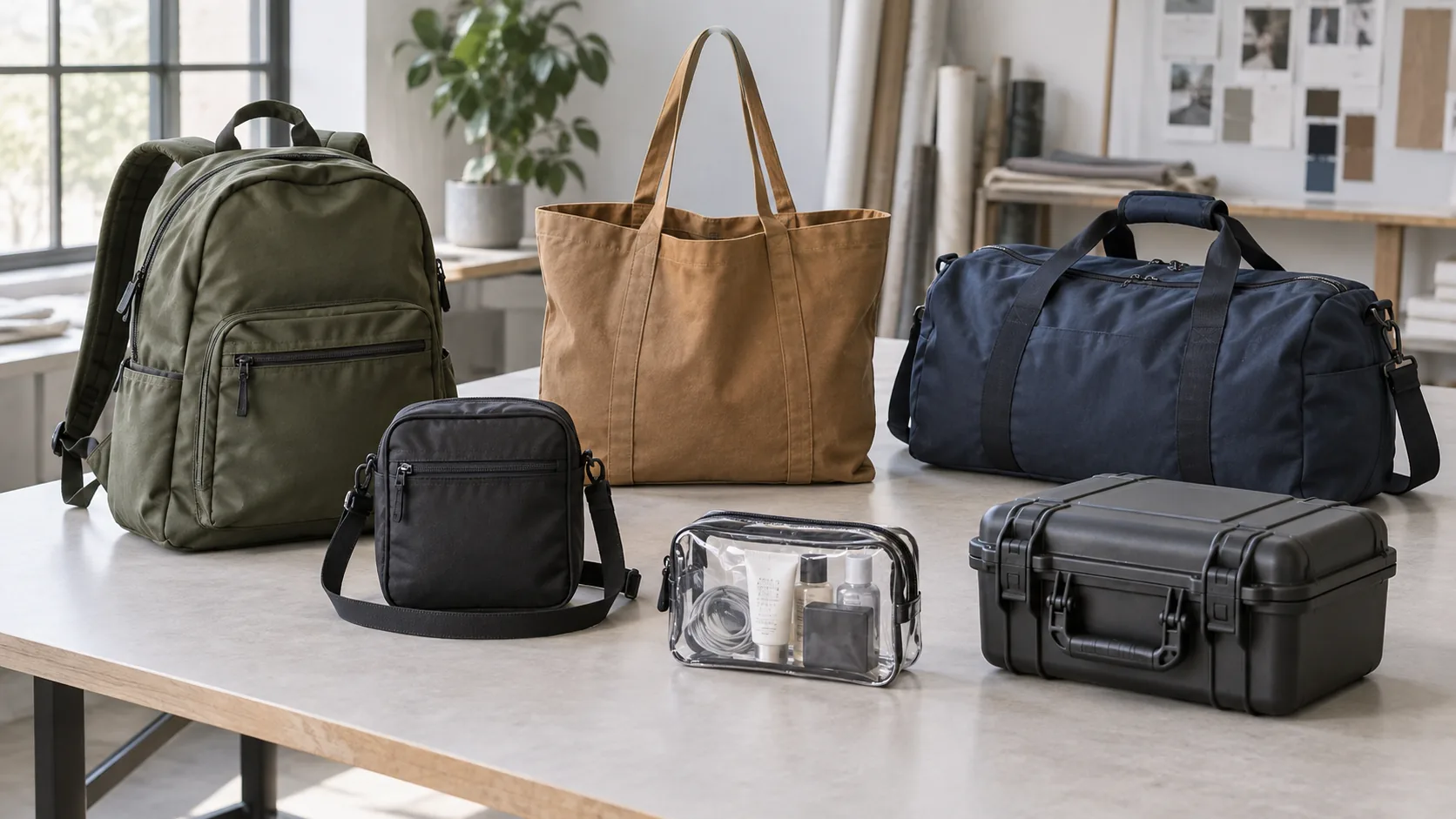
No universal standard divides every bag into one fixed taxonomy. A practical classification uses four overlapping layers:
| Layer | Question | Examples |
|---|---|---|
| Carry method | Where does the load sit? | Back, shoulder, crossbody, hand, waist, wheels |
| Opening and shape | How does the user reach the contents? | Panel zip, open top, flap, drawstring, roll top |
| Intended use | What must the bag carry or separate? | Work, travel, sport, food, tools, cosmetics, pets |
| Construction | What creates shape or function? | Soft, structured, framed, padded, insulated, welded |
One product can belong to several categories. A two-strap bag may also be a laptop bag, travel personal item, or camera carrier. A tote may also work as a shopper or beach bag; the tote bag guide separates that name from the opening, gusset, handles, structure, and dimensions a factory must build. The category name helps a customer find the product; the other three layers determine the build.
For development, add five observable fields to the name: main opening, carrying system, packed external dimensions, intended contents, and required protection or separation. Those fields expose differences that a list of bag names hides.
Which Back-Carried Bags Fit Different Loads?
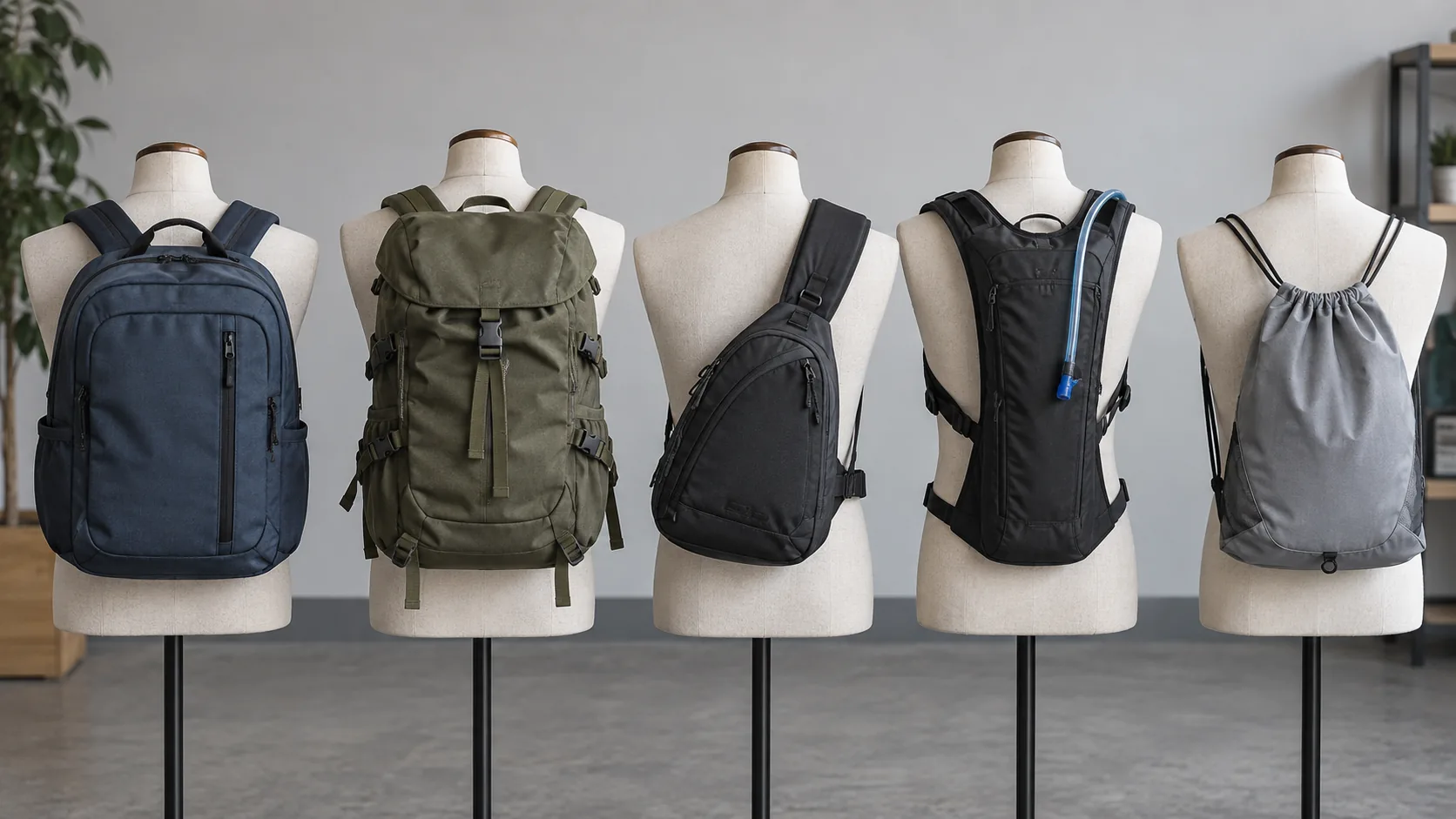
Merriam-Webster defines a backpack broadly as a pack usually carried on the back with two shoulder straps. That definition covers products with very different openings, structures, and loads.
- Everyday and school backpacks commonly use a panel zipper, simple organization, and two shoulder straps.
- Hiking packs and rucksacks may add top access, compression, a frame sheet, sternum strap, hip belt, or external attachment. The words do not guarantee any of those features.
- Sling backpacks use one main strap and rotate toward the front for access, but strap geometry and bag size vary.
- Hydration packs organize the interior around a reservoir compartment, hose routing, and a smaller cargo area.
- Drawstring packs close with a cord and usually have less structure, though material and reinforcement still vary by project.
The carrying system is a load path, not one component. Shoulder straps, webbing, adjusters, anchors, reinforcement, and shell material need compatible geometry and evidence for the intended load. A “heavy-duty” label does not establish a performance grade unless it points to an applicable specification and result. The backpack parts and accessories guide shows how to record these components, mating parts, routing, and attachment as separate fields.
Broad custom backpack programs can be divided by user, load, opening, and carrying system. Tactical positioning needs the same discipline: tactical backpack construction depends on defined interfaces and load paths rather than the market name.
How Do Shoulder and Crossbody Bags Differ?
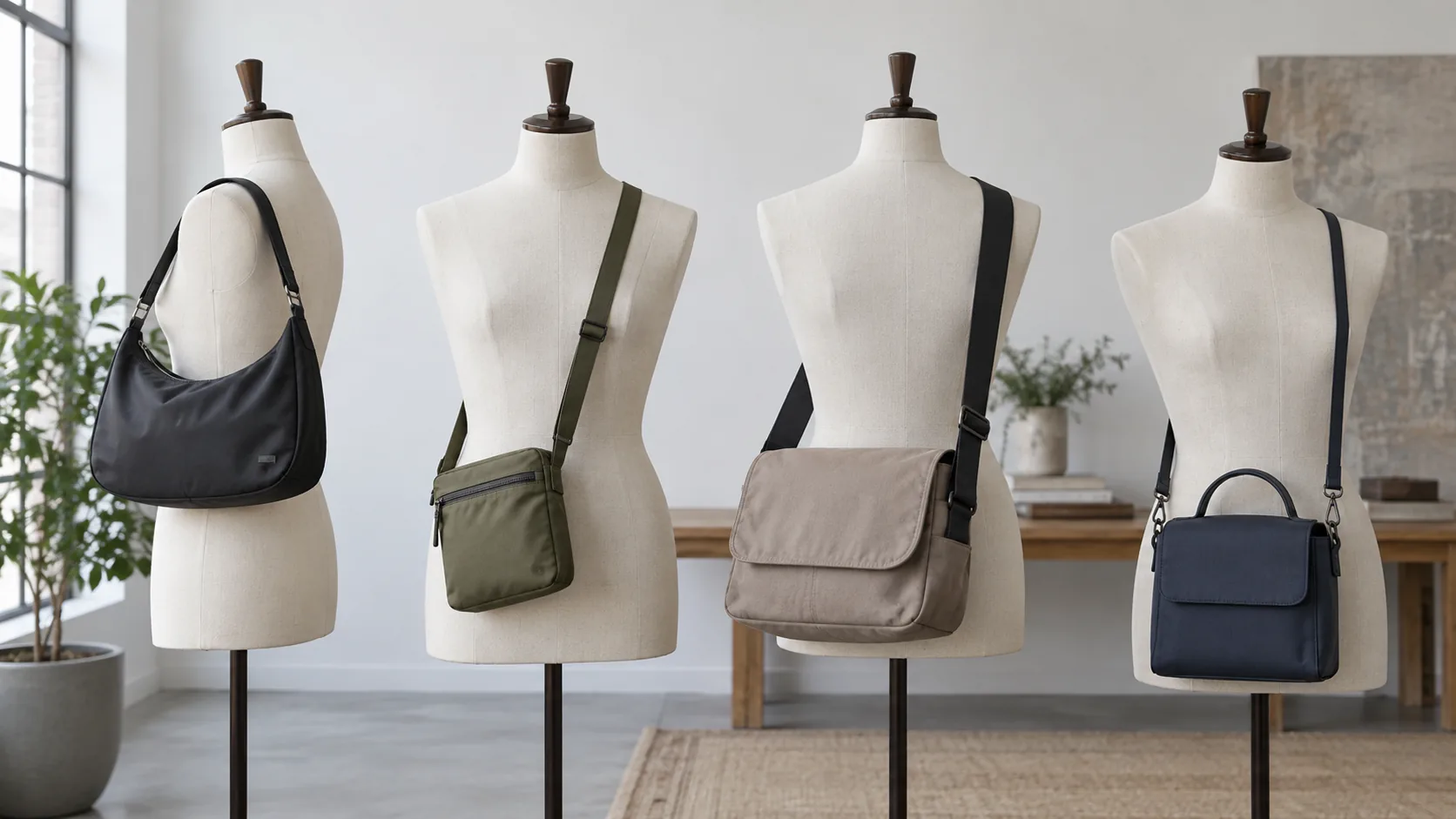
Shoulder and crossbody bags both hang from a strap, but strap length, body position, opening, and load behavior separate the common forms.
- Shoulder bags use a shorter strap and sit near the side of the torso. Check strap drop, opening security, and whether the bag remains upright during access.
- Crossbody bags use a longer strap worn diagonally. Bag position, stabilizing features, adjuster range, and access direction affect how the product behaves in motion.
- Messenger bags are commonly soft crossbody bags with a broad flap and a wide main compartment. Some use extra stabilizing straps or internal device organization.
- Satchels have a much wider language boundary. Merriam-Webster defines a satchel only as a small bag often with a shoulder strap, so the name cannot prove a top handle, rigid body, flap, or document format.
Retailers often place the same convertible product under shoulder, crossbody, messenger, or satchel navigation. A buyer should record the strap setup, intended wear position, main opening, closed-state access, largest item, and target load instead of treating those retail categories as construction standards. The satchel meaning guide separates the traditional name from the body, opening, and carry fields that still need their own specification.
Which Hand-Carried and Open-Top Bags Serve Different Tasks?

Hand-carried bags send the load through handles and their attachment points. Open-top styles also expose a tradeoff between quick access and content retention.
- Totes usually have two parallel handles and a broad top opening. Structure may range from a fold-flat textile body to a semi-rigid shell.
- Shoppers use tote-like carry for bulkier contents. Base size, handle clearance, opening, and loaded shape matter more than the word “shopper.”
- Top-handle bags place the primary carrying point above the body and often use a defined closure or frame.
- Bucket bags use a tall body and a drawstring, cinch, or top closure. They may be hand-, shoulder-, or crossbody-carried.
- Briefcases organize around documents, devices, or work tools, with varying degrees of structure and protection.
External width, opening width, usable floor, usable height, and handle drop answer different fit questions. A tapered tote can have a wide top and narrow base; a padded briefcase can have generous outside dimensions but less interior space. Record the measurement object and state for every critical dimension.
Which Travel and High-Capacity Bags Fit the Trip?
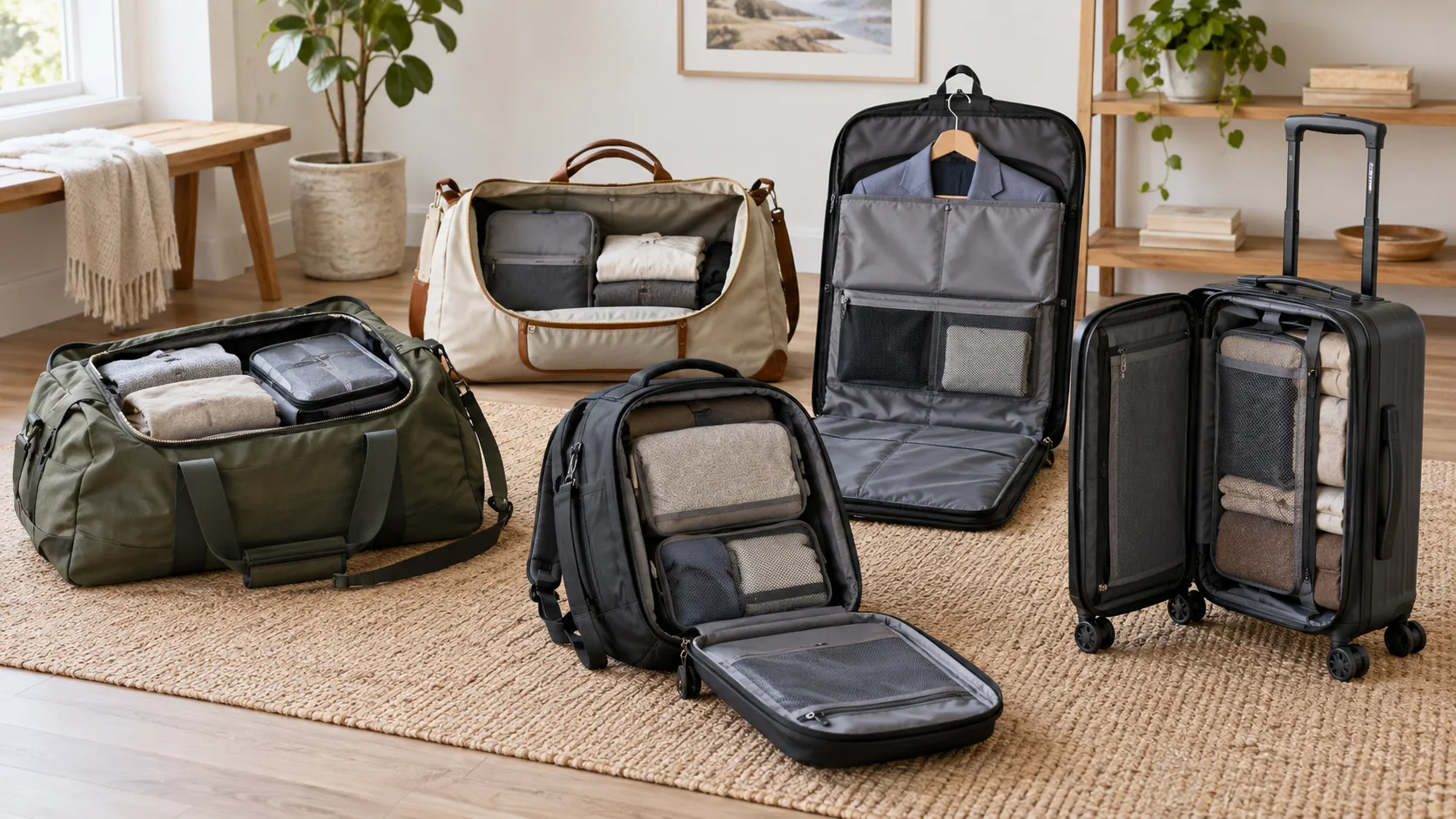
Travel bags differ by access, carry duration, packed dimensions, and transport rules. Merriam-Webster’s definition of a duffel bag is deliberately broad: a soft oblong bag for personal belongings.
- Duffels use a flexible body and hand or shoulder carry. Openings may be straight, U-shaped, or end-oriented.
- Weekenders are market-positioned for short trips, but the name does not set capacity or dimensions.
- Garment bags support hanging or folded clothing and need a defined fold, hanger, closure, and carry arrangement.
- Travel backpacks combine hands-free carry with luggage-oriented access and organization.
- Rolling carry-ons and luggage add wheels, handles, and more structure, which affect internal space and packed external size.
“Carry-on” describes an intended travel use, not automatic acceptance by every airline. Airlines control cabin-bag dimensions, weight, allowance, and fees. Measure the packed product in the state an airline will evaluate.
For soft gym and travel bags, the duffel carry-on guide explains how to check the operating airline, pack the intended load, and measure the bag at its furthest points.
Capacity also needs a method. ASTM F2153 covers a standardized capacity approach for backpacks and several related bags, including duffels and travel packs. Outside length × width × depth remains a bounding box, not a substitute for verified usable capacity.
For a travel line that includes duffels, gym and duffel bag development can begin with the actual packing list, access direction, and carrying time.
Which Small and Purpose-Built Bags Solve Specialized Tasks?
Some types of bags are named by wear position; others are named by contents or function.
- Waist bags, belt bags, and fanny packs overlap heavily. Strap range and wearing position decide whether a specific design also works crossbody.
- Clutches and wristlets use hand carry, with a wrist strap distinguishing the latter.
- Cosmetic and toiletry bags organize contents. For carry-on liquids, a separate quart-size clear pouch may be required; that rule does not define every larger toiletry organizer.
- Pouches are small organizers whose attachment, closure, structure, and contents must be specified.
- Cooler and lunch bags use insulation and a closure system, but the category name does not establish a holding time.
- Camera and equipment bags use padding, dividers, access control, and attachment around a defined equipment set.
- Tool bags need a load path, abrasion plan, and pockets sized to actual tools.
- Pet carriers require a defined animal fit, structure, ventilation, secure closure, and applicable transport requirements.
- Dry bags and wet bags describe opposite use directions in common market language: keeping external water away from contents versus containing wet contents. Neither name establishes a test level.
- Structured cases use molded, framed, or reinforced construction around a defined object and impact or handling scenario.
A separate compartment proves only that items occupy different spaces. It does not by itself prove sealing, odor control, hygiene, washability, or liquid containment.
Insulated performance also depends on the complete system. A peer-reviewed insulated-container study illustrates why environment, cooling source, loading, opening, measurement point, and test duration must be visible before time claims can be compared. Its results do not become a performance claim for a lunch bag.
For water protection, ISO 811:2018 tests textile-fabric resistance to water penetration. That fabric result does not cover the finished bag’s seams, corners, closures, or attachment points.
How Do Common Bag Styles Differ?
Compare observable fields first and treat the market name as navigation.
| Pair | Useful distinction | Where names overlap |
|---|---|---|
| Tote vs shoulder bag | Tote usually has two parallel handles and broad top access; shoulder bag centers on a longer shoulder strap | Totes may add shoulder-length handles or a detachable strap |
| Satchel vs messenger | Compare structure, top handle, flap, strap arrangement, and document access | Dictionary and retail use do not enforce one technical boundary |
| Sling vs crossbody vs waist bag | Compare strap path, adjuster range, body position, and rotation for access | One convertible product may support all three positions |
| Belt bag vs fanny pack | Often the same waist-worn product category | Naming varies by retailer, region, and positioning |
| Backpack vs duffel | Back carry with two straps versus hand or shoulder carry with a soft oblong body | Convertible duffels may add backpack straps |
| Tote vs bucket bag | Broad top with two handles versus taller body with cinch or drawstring closure | Hybrid products may combine two handles with a cinched body |
Labels such as small, medium, weekender, and carry-on do not settle fit. Compare the intended contents, opening, usable internal space, packed external dimensions, and carrying method.
How Should Buyers Choose a Bag Type for Development?
Start with a use case and fill in the decisions that affect construction:
- User and setting: who carries the bag, where, and for how long.
- Contents: the largest, heaviest, most fragile, and most frequently accessed items.
- Carry method: back, shoulder, crossbody, hand, waist, or wheels; include adjuster range and carry duration.
- Opening and access: panel, open top, flap, drawstring, roll top, or frame; note whether access occurs while worn.
- Packed dimensions and capacity: measurement points, product state, loading rule, and endpoint.
- Structure and compartments: soft or structured body, internal support, padding, and separation requirements.
- Load path: straps, handles, webbing, hardware, anchors, reinforcement, and base.
- Environment: rain, splash, spills, heat, dirt, abrasion, or other defined exposure.
- Cleaning and materials: shell, lining, coating or film, decoration, hardware, and an applicable care method.
- Branding and packaging: logo method, position, color reference, packed shape, and shipping support.
- Sample evidence: the product configuration, payload, state, conditions, endpoint, and acceptance criteria for each check.
The sample plan should match the risk. A static load check, repeated opening cycle, water exposure, carry evaluation, and shipping test answer different questions. Keep each result attached to the product version and method used.
Relevant bag project case studies can help a team frame a project-specific review without copying unrelated pass limits. A bag factory capability review can then focus on the processes and evidence required by the selected construction.
Frequently Asked Questions (FAQ)
Is a satchel the same as a messenger bag?
Not by a fixed technical rule. Compare body structure, top handle, strap setup, flap, opening, and intended contents; retail use overlaps.
Is a belt bag different from a fanny pack?
Usually not in the core carry concept. Both commonly describe a small waist-worn bag, while current products may also convert to crossbody wear.
Can a tote work as a laptop or work bag?
Yes, if the design adds the needed closure, device compartment, padding, base support, and handle load path. The word “tote” does not provide those features.
Is a duffel or backpack better for travel?
It depends on carrying time and access. A backpack supports hands-free back carry; a duffel favors hand or shoulder carry and a soft oblong packing space. Compare packed dimensions and the route.
Do bag names tell you the size?
No. Size words are incomplete without measurement points, product state, usable space, intended contents, and the rule or fit case being checked.
Conclusion
Useful bag selection starts with carry method, opening, contents, structure, dimensions, load path, and exposure. The name comes after those decisions.
Once those fields are defined, a custom bag manufacturer can quote and sample one controlled product instead of interpreting a loose style label.