
Backpack specifications become vague when every strap, loop, buckle, and pocket is grouped under the word “accessories.” The same informal name can also refer to different components.
Most backpacks combine a body, back panel, opening, shoulder straps, seams, and attachment points. Closures, adjusters, lining, pockets, frames, sternum straps, hip belts, trolley sleeves, lash tabs, bungees, and device sleeves depend on the design. Each component still needs its own material, geometry, attachment, and approval reference.
This guide uses “backpack accessories” for optional components built into a backpack. Separate retail add-ons such as rain covers, replacement pouches, or locks are outside its scope.
What Are the Main Parts of a Backpack?
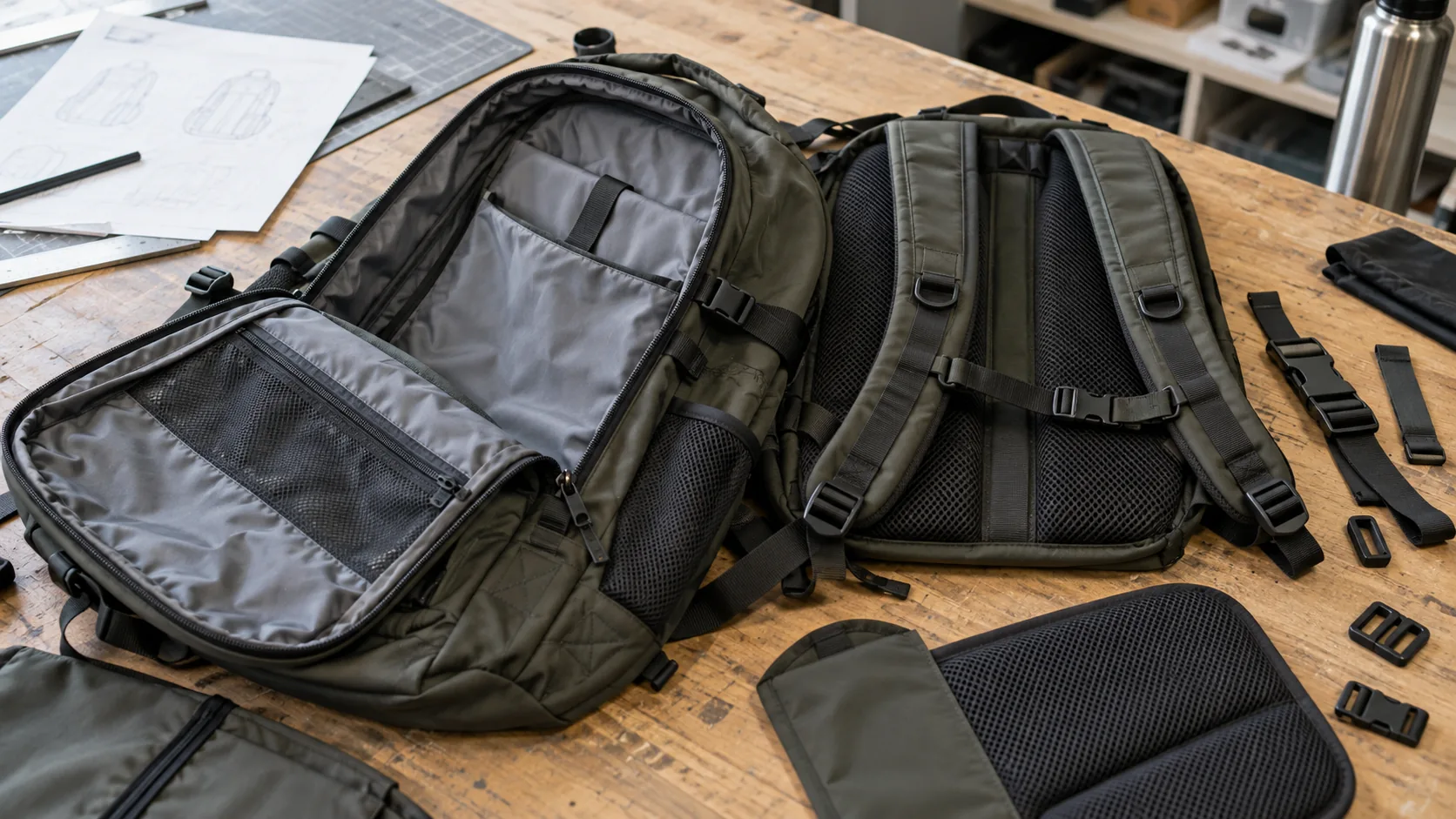
A basic backpack needs a body that contains the load and two shoulder straps that carry it on the back. Everything else depends on the opening, load, user, environment, and intended organization.
| Part or system | Function in the bag | Always present? | Fields to specify |
|---|---|---|---|
| Body and panels | Form the load-carrying space | Yes | Material code, panel shape, layers, seam construction |
| Back panel | Sits against the wearer and closes the rear of the body | Yes | Material, padding or structure if used, attachment |
| Shoulder straps | Connect the bag to the wearer | Yes | Shape, length range, layers, attachment geometry |
| Opening | Provides access to the main space | Yes | Location, usable opening, access state |
| Closure | Holds the opening in a selected state | Design-dependent | Zipper, flap, roll top, drawcord, snap, or other system |
| Seams and anchors | Join panels and transfer load between components | Yes | Seam or stitch reference, material stack, reinforcement, controlled sample |
| Adjusters and webbing | Change or hold strap length | Design-dependent | Item code, actual width, thickness, routing, direction |
| Pockets and compartments | Separate contents | Design-dependent | Usable dimensions, opening, closure, lining, intended item |
| Lining and internal structure | Cover internal surfaces or add organization and shape | Design-dependent | Material, backing, foam or board, edge treatment |
| Hardware | Connects, adjusts, or closes parts | Design-dependent | Type, supplier code, material, finish, mating component |
This anatomy is more useful than a fixed parts count. A drawstring backpack may have no rigid hardware or lining, while a travel backpack can include several zipper chains, sleeves, straps, frames, and reinforcement layers.
The backpack features guide expands the user-facing side of these choices. A product brief should translate each selected feature into components, interfaces, and sample checks.
What Do Backpack Straps, Adjusters, and Anchors Do?
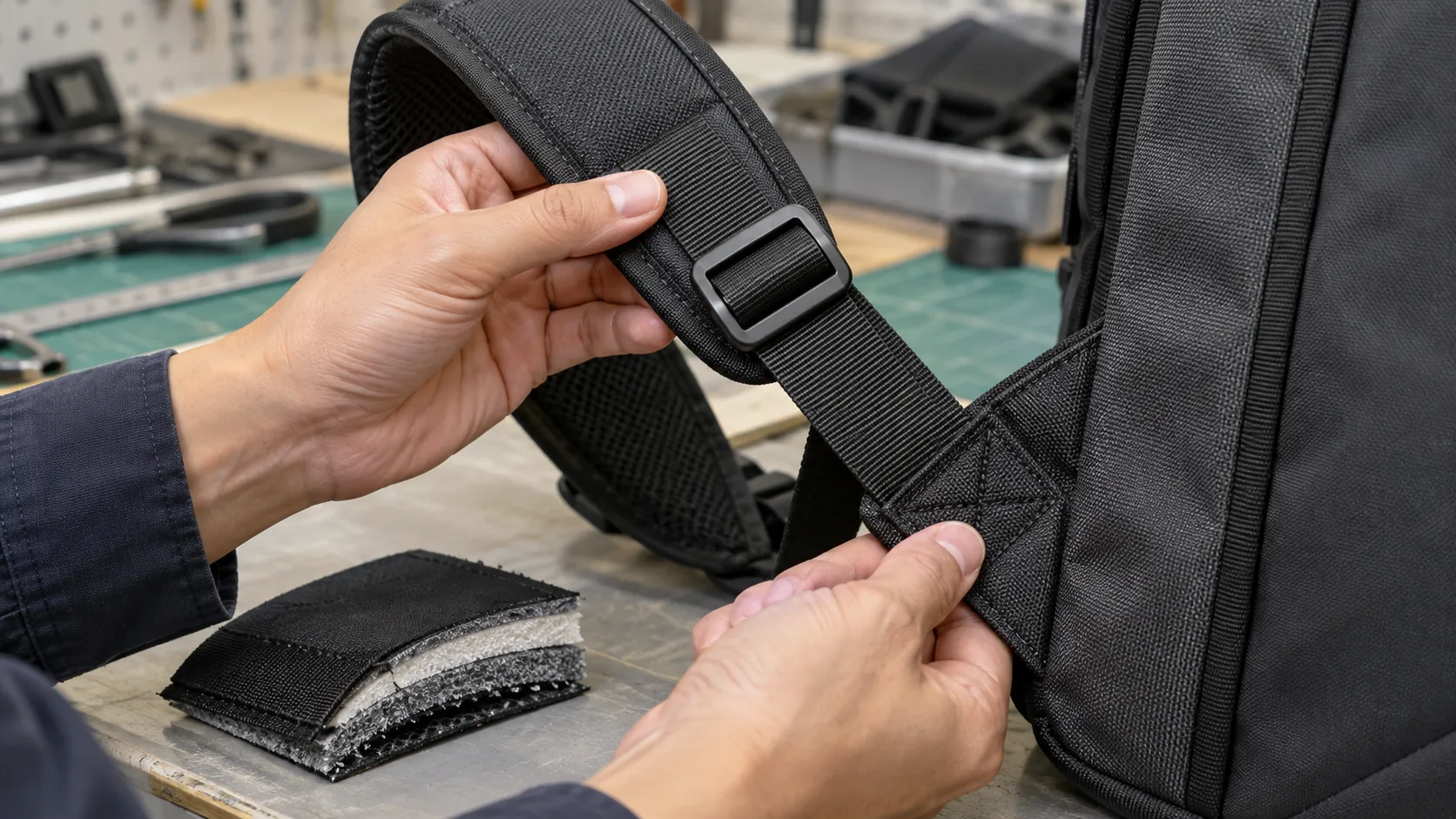
The shoulder strap is only one part of the carry path. Strap layers, webbing, adjusters, hardware, stitched anchors, reinforcement, and the body material work as an installed system.
Shoulder straps support the pack on the wearer. Their curve, spacing, length range, padding, surface fabric, and anchor locations affect fit, but no one geometry guarantees comfort for every body or load. Confirm the intended user range and evaluate the loaded sample instead of approving an isolated padded strap.
A sternum strap connects the two shoulder straps. A hip belt can add stabilization or take part in the load path when the pack and carry system are designed for it. Neither component is automatically required on a small daypack, and adding one does not prove ergonomic performance.
Adjusters set strap length. Their nominal size should not be the only matching field. Webbing and hardware with the same listed width may still differ in actual width, thickness, surface, edge, slot geometry, or threading route. Test the intended combination in its installed direction before approving a substitution.
Anchors deserve their own drawing or controlled sample. Record the material stack, reinforcement, seam or stitch geometry, direction, and attachment location. If a sample fails at an anchor, the location is an observation rather than a complete diagnosis. The material, stitching, reinforcement, routing, prior slip, and loading history still need review.
What Are Backpack Clips and Buckles Called?
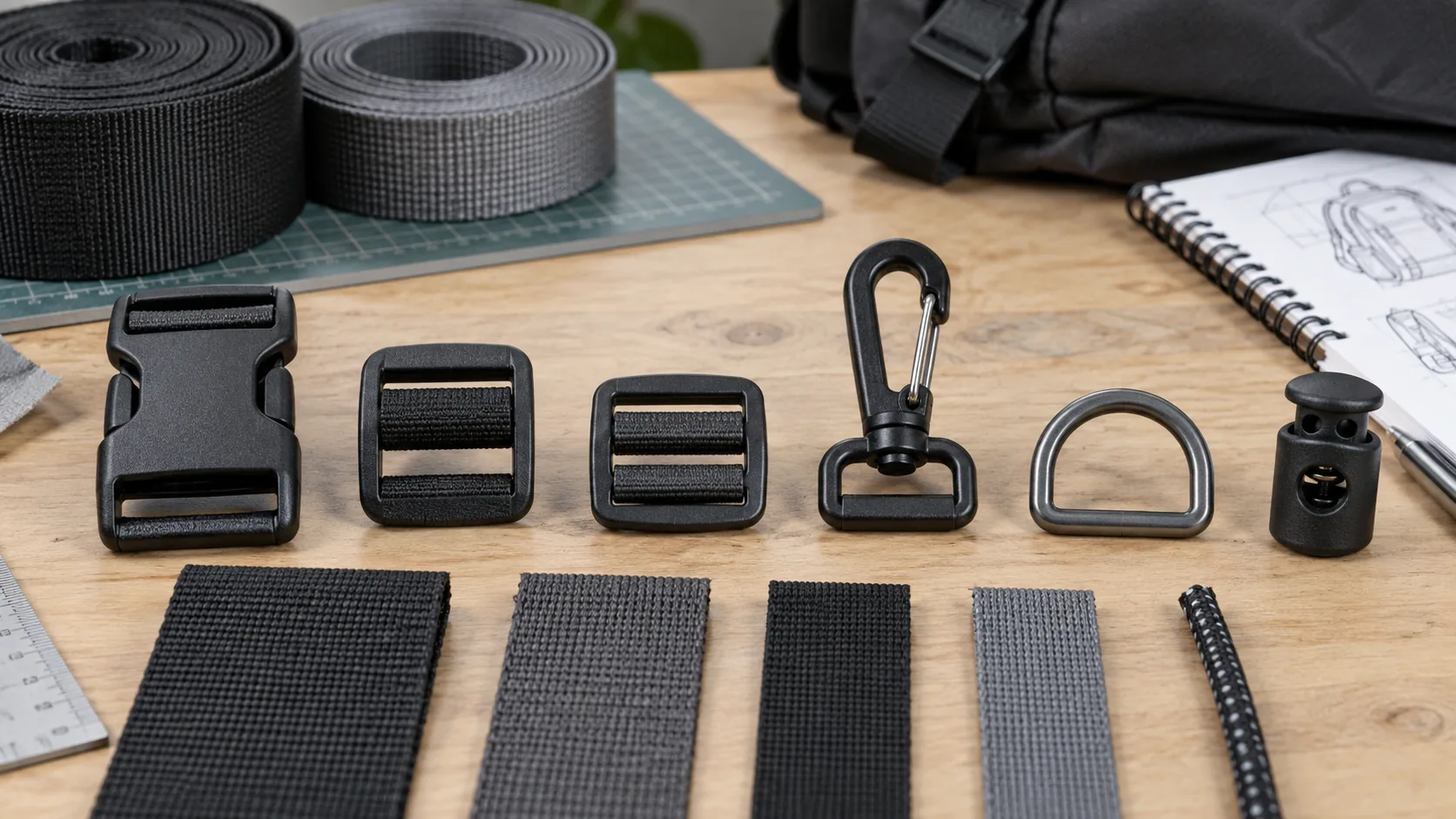
“Backpack clip” is an informal description. Side-release buckles, ladder locks, slides, hooks, rings, and cord locks have different geometry and jobs.
| Common component name | Typical function | Approval questions |
|---|---|---|
| Side-release buckle | Joins two parts and opens by pressing its release areas | Are the body and latch a matched set? Which item code, size, material, and routing apply? |
| Ladder lock or strap adjuster | Changes and holds webbing length through a routed path | Does the selected webbing fit and hold through the intended adjustment range? |
| Triglide or slide | Routes, anchors, or manages webbing depending on the assembly | What is the exact threading path and installed function? |
| Snap hook | Connects a detachable strap or accessory to an attachment point | Does the gate, opening, ring, orientation, and installed use match? |
| D-ring or loop | Provides an interface for another component | How is the ring captured, and how is its tab attached to the bag? |
| Cord lock | Adjusts or holds a drawcord or bungee | Do the cord diameter, spring or channel, and user operation match? |
The ITW Nexus catalog separates side-release buckle families by design and part, and its product pages list item-specific material and dimensions. This is why a line such as “25 mm plastic buckle” is not a complete replacement specification.
Do not infer a load rating from size, metal appearance, or the words “heavy duty.” Keep the supplier’s exact claim language and evidence attached to the actual component code. A component value also does not become an installed strap or whole-bag guarantee.
What Do Lash Tabs, Daisy Chains, and Front Loops Do?
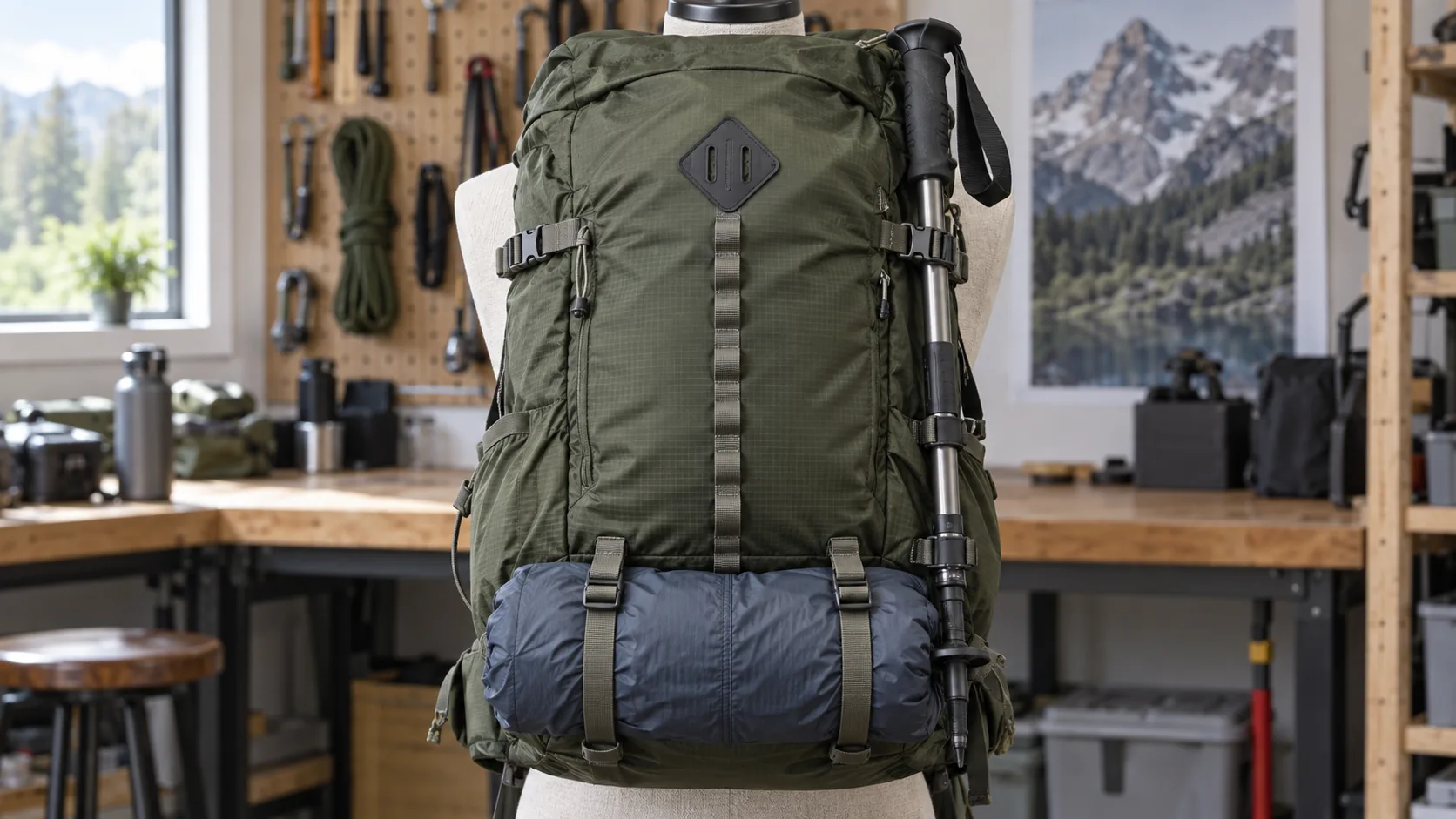
These attachment points can look similar, but their construction and intended use vary.
- Lash tab: a slotted patch or attachment point through which cord or webbing can be routed.
- Daisy chain: a length of webbing secured at intervals to create a row of loops.
- Gear loop: a loop positioned and sized for an intended item or attachment method.
- Compression strap: an adjustable strap that changes the packed shape or holds an item against the bag when the design allows it.
- Bungee or shock cord: elastic cord routed through guides or anchors for quick external retention.
The current Thule backpack-parts guide shows how these terms are used across commercial backpacks. Its examples describe particular products, not a universal construction standard.
An exterior loop should be treated as an organization or attachment point unless the product documentation defines another use and supplies appropriate evidence. Appearance alone does not establish which item it can hold or what load it can carry. Define the intended object, attachment method, number of restraint points, clearances, and interaction with the bag opening.
The backpack-loop guide gives users practical attachment examples. For product development, those examples still need to be converted into dimensions, materials, placement, and an approved loaded sample.
What Are Trolley Sleeves, Bungees, and Special Pockets For?
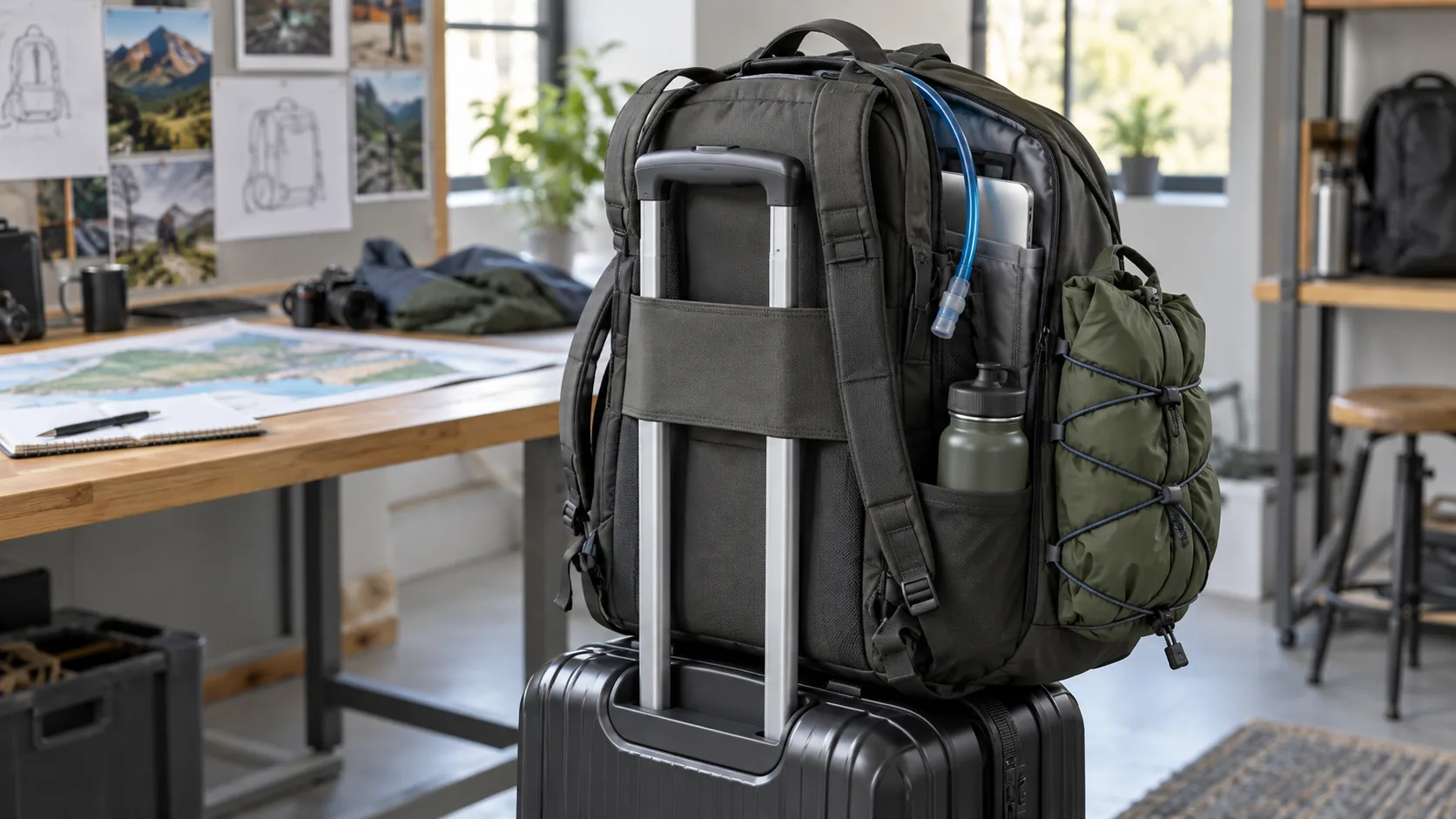
These are optional systems tied to a specific carry task. Adding all of them can increase weight, material use, sewing operations, and interference between parts.
A trolley sleeve is a panel or strap designed to pass over luggage handles. Specify its usable width and height, position, orientation, attachment, and the suitcase-handle range used during sample review. Also inspect the backpack side of the panel when the bag is worn.
Bungee cord gives fast external retention, but the cord, anchors, adjuster, route, and intended item form one system. A loose jacket and a rigid bottle create different movement and contact conditions. Do not present the bungee as secure storage for every object.
Special pockets should start with the item they must hold:
- a device sleeve needs usable width, height, depth, opening, base clearance, closure, and surrounding construction;
- a bottle pocket needs the intended container range, retention method, access position, and loaded-bag check;
- a hydration arrangement needs a reservoir space, hose route, exit, and retention points that work together;
- a shoe or laundry compartment needs a defined volume and a decision about separation, cleaning, ventilation, and closure;
- an organizer pocket needs an inventory of the items and their access order.
The market name does not prove protection, leak resistance, ventilation, or impact performance. Tie stronger claims to the actual pocket, installed construction, and relevant evaluation.
Which Closures, Materials, and Reinforcements Matter?
The opening, closure, panel material, lining, structure, seams, and reinforcement affect one another. They should be reviewed on the same prototype.
A zipper is a system rather than a single part. It can include elements or coil, tape, slider, puller, stops, end parts, and its installation in the bag. The YKK product catalog separates zipper types, slider functions, pull types, finishes, and plastic hardware categories. A size designation and color do not freeze all of those choices.
The ASTM D2061 scope covers separate strength tests for zipper chains, elements, stops, slider locks, sliders, pullers, and separable units. It also states that one test does not determine suitability for a specific end use. This supports a practical rule: compare results only after the test object, method, conditions, and endpoint are aligned.
Roll tops, flaps, drawcords, snaps, and hook-and-loop closures create different access and retention conditions. None is waterproof by name. If weather exposure matters, define the exposure and evaluate the complete opening, seams, installation, and bag rather than carrying a component claim over to the finished product.
Sewing terms also need enough detail to repeat. The Coats seam reference distinguishes seam classes and notes that stitch and thread choices vary by application. “Double stitched” alone does not define the seam, stitch, line spacing, thread, needle, material layers, start and stop, or reinforcement.
The relationship between parts is covered in more detail in how a backpack is made. For existing products, the backpack zipper repair guide helps separate a visible symptom from the component that may need repair or replacement.
How Should Brands Specify Backpack Parts and Accessories?
A usable component specification lets a supplier identify the same part, assemble it in the same orientation, and compare the sample against the same reference.
Industry insight: Approved cards `LOAD-01`, `LOAD-02`, `LOAD-04`, `LOAD-07`, and `ZIP-01` treat straps, hardware, anchors, and zippers as systems of parts and interfaces. Record item codes, materials, geometry, mating parts, routing, attachment, and evidence separately. Do not turn a market name or isolated component value into a whole-bag claim.
| Specification field | What to record | What to confirm on the sample |
|---|---|---|
| Intended use | User range, contents, load condition, access and environment | Pack the intended items and review the defined use states |
| Bag dimensions | Measurement points, packed state, units, and tolerance | Use the same method on the prototype |
| Component identity | Supplier, item code, material, finish, color | Match documents, sample, and installed part |
| Mating geometry | Actual width, thickness, slot or opening, paired component | Assemble and operate the intended combination |
| Routing and direction | Webbing path, slider direction, hook or buckle orientation | Compare with drawing and controlled sample |
| Attachment | Material stack, seam or stitch, reinforcement, placement | Inspect the installed interface, not only the loose component |
| Access and clearance | Opening size, adjustment range, interference with other parts | Test the actual objects and loaded bag |
| Appearance | Surface, color, alignment, visible stitch or edge requirements | Approve against a defined reference and viewing condition |
| Performance evidence | Object, method, conditions, endpoint, and acceptance basis | Keep results within their stated scope |
| Approval record | Drawing or spec version, BOM code, confirmed sample, change record | Link bulk inspection to the current approved references |
Volume and dimensions should use stated measurement conditions. The backpack measurement guide explains how inconsistent methods can produce numbers that look comparable but describe different states.
Once the component list and sample criteria are ready, a backpack manufacturer can quote the same controlled brief instead of filling missing fields with supplier defaults.
Frequently Asked Questions
What are the plastic clips on backpacks called?
Many are side-release buckles, but “plastic clip” can also refer to a ladder lock, slide, snap hook, cord lock, or another fastener. Identify the shape and function, then match the item code, material, dimensions, mating part, webbing, and routing.
What are the straps on a backpack called?
The main pair are shoulder straps. Other designs may use sternum straps, hip belts, compression straps, load-adjustment straps, or accessory straps. Each name describes a position or task, while the material, dimensions, range, anchors, and intended load still need definition.
What are the loops on the front of a backpack for?
They may be lash points, daisy-chain loops, gear loops, compression interfaces, or decorative details. Check the product documentation before attaching an item. Without a defined use and supporting evidence, do not infer a rating from the loop’s thickness or appearance.
What is a trolley sleeve on a backpack?
It is a panel or strap intended to pass over luggage handles so the backpack can sit on a rolling case. Fit depends on usable opening dimensions, handle geometry, bag position, and how the sleeve is attached. Review it on the intended luggage sample.
Are backpack accessories the same as backpack parts?
Not consistently. Retailers may use “accessories” for separate add-ons, while product developers may use it for optional installed components. State the intended meaning, then list each selected component in the BOM or specification instead of relying on the category word.
Final Check Before Sampling
Use the exact component name only as a starting point. Freeze the supplier code, material, dimensions, mating part, routing, attachment, finish, and controlled reference for the fields that carry project risk.
Send that component record with the drawing and sample requirements. The factory can then quote and build against the same backpack rather than interpreting a list of informal part names.