
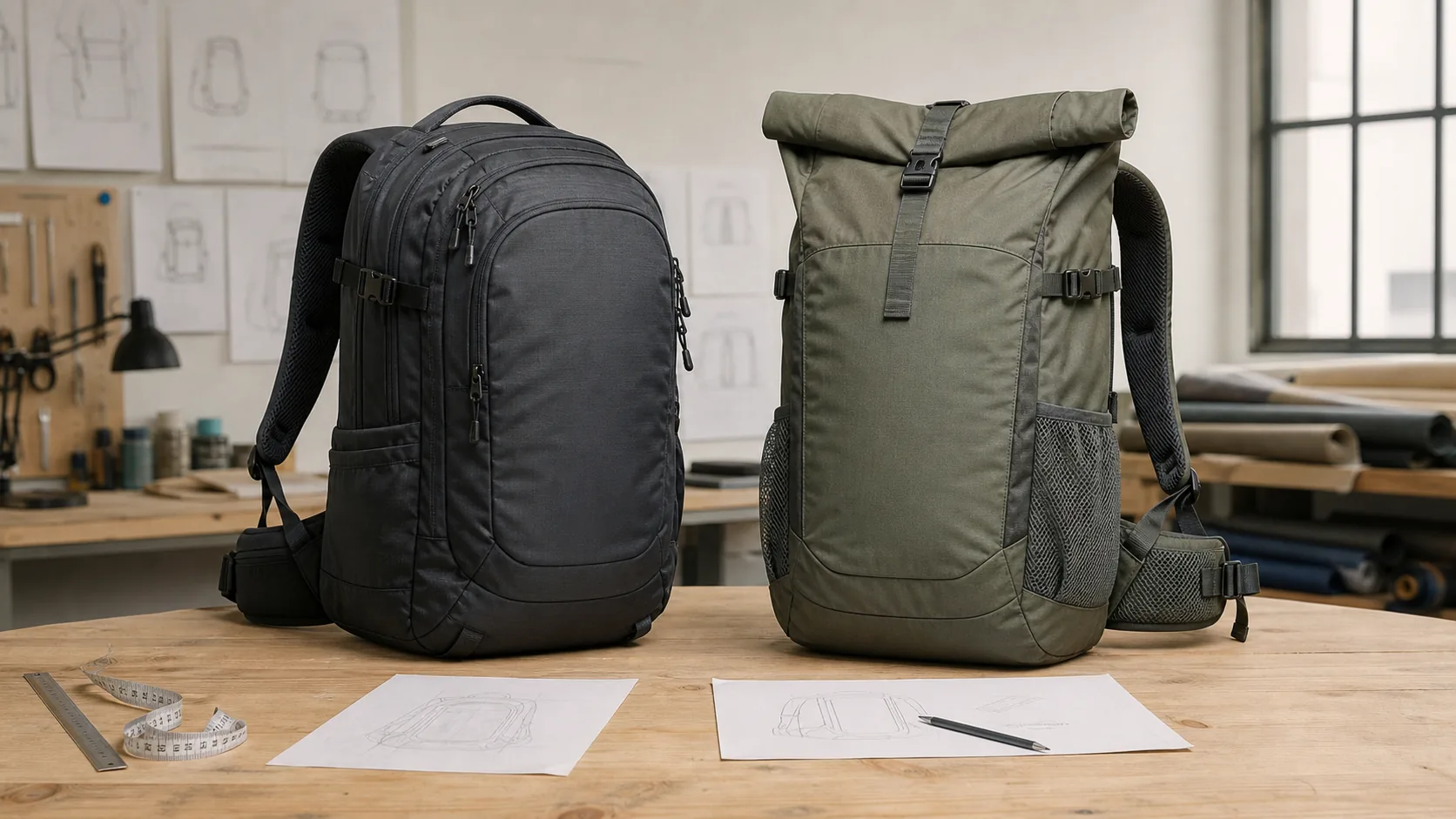
To measure a backpack, record its packed external height, width, and depth for physical size, then measure enclosed capacity separately in liters. A quick capacity estimate is `(height x width x depth in cm) / 1,000`, while a repeatable product test fills every enclosed compartment with standardized 20 mm plastic balls and measures the volume of the balls used. Curved packs can also be estimated with the elliptic-cylinder formula `V = pi x a x b x h`.
Many e-commerce brands and sourcing managers struggle with volumetric misalignment: a prototype may be marketed as a 40-liter pack but feel materially smaller in use because the supplier counted pockets, extensions, or geometric dead space differently. That discrepancy can lead to negative reviews, returns, and travel-compliance problems. A written measurement protocol aligns technical specifications, sample approval, production QC, and customer-facing claims.
Why do ratings differ when learning how to measure a backpack?
Manufacturer volume ratings differ significantly because of the lack of a universal standardized system across global brands and regional factories. When brands analyze how to measure a backpack, some choose to include external mesh pockets and collar extensions, while others restrict calculations strictly to zippered main compartments. This variance creates widespread confusion for product development managers sourcing from multiple partners.

How do brand measurement standards conflict?
Different outdoor gear companies use different boundaries when calculating published storage specifications. Some brands include exterior storage, while others calculate only fully enclosed compartments.
- Main Compartment Limits: Calculations are strictly locked to the primary zipped cavity.
- Side Mesh Integration: Stretch water-bottle pockets are included in total liter counts.
- Collar Expansion: Extended roll-top collars may be reported separately or included in the headline figure.
What factors create a gap between calculated and usable volume?
A flat-pattern calculation often assumes a perfect rectangular prism and overlooks the curves and seams of actual production. Standardizing specifications requires recognizing that usable three-dimensional space changes once seams are tensioned and components are attached.
- Seam Radii: Curved corners naturally shave off corner space.
- Foam Padding: Thick shoulder-harness frames and back panels consume interior room.
- Material Flexibility: Rigid fabrics limit expansion compared to stretchy fabrics.
Key takeaway: Maximum external dimensions can overstate usable capacity because they include curved corners, padding, hardware, and empty space outside the sewn body.
| Measurement choice | Quick estimate | Repeatable product specification |
|---|---|---|
| Side pockets | Included or excluded inconsistently | State whether each enclosed pocket is included |
| Irregular curves | Approximated from maximum dimensions | Captured with a physical fill test |
| Testing medium | Formula or soft-goods packing | Standardized 20 mm plastic spheres |
Understanding these conflicting standards allows B2B buyers to verify factory specifications before approving mass production runs.
How to measure a backpack using the geometric formula?
You can calculate a basic volume approximation by multiplying the height, width, and depth of the main compartment. Pack designers must first define consistent boundaries and measure a naturally filled sample rather than a collapsed empty bag. This approach works best for square utility bags and simple school packs.

What is the traditional LxWxH box formula?
Use the following measurement points so the calculation can be repeated:
- Height (H): Measure from the bottom seam of the back panel to the highest seam of the main body.
- Width (W): Measure across the midsection of the back panel from the left seam to the right seam.
- Depth (D): Measure from the front panel to the back panel while the bag is filled to its intended shape without overstuffing.
Multiply these three measurements in centimeters, then divide the final sum by 1,000 to find the capacity in liters.
For example, a rectangular compartment measuring 50 x 30 x 20 cm has a geometric volume of 30 liters. Treat that result as an estimate, not a certified capacity claim.
Why do irregular bag shapes skew this math?
Most modern designs are rounded, tapered, or ergonomically shaped to fit the human spine. When you apply a rectangular formula to a contoured bag, the equation treats empty air around the curves as usable volume.
- Tapered Profiles: Narrower tops reduce real volume while standard calculations assume uniform width.
- Unstructured Panels: Soft-sided utility designs collapse or bulge unpredictably.
- Specialized Bases: Rounded bottom edges reduce the footprint but improve comfort.
The traditional L x W x H formula is a fast baseline. The more tapered, padded, or compartmentalized the pack, the less closely that result will match usable capacity.
| Formula Type | Mathematical Equation | Recommended Use Case |
|---|---|---|
| Rectangular Prism | Volume = Height x Width x Depth | Square luggage, flat commuter packs |
| Cubic Conversion | Liters = (H cm x W cm x D cm) / 1,000 | Quick metric capacity checks |
| Imperial Conversion | Liters = (H in x W in x D in) / 61.024 | Quick imperial capacity checks |
While the geometric box formula is fast, product managers must upgrade to advanced equations when developing contoured or specialized designs.
How to measure a backpack with the elliptic cylinder formula?
The elliptic-cylinder formula estimates the volume of a curved pack by treating its cross-section as an ellipse rather than a rigid rectangle. It is useful during early pattern development because it reflects rounded sides better than the box formula, but the result should still be confirmed on a physical sample.

How does the elliptic cylinder formula work?
The equation is `V = pi x a x b x h`, where:
- Height (h): The vertical dimension measured along the central axis of the back panel.
- Semi-Major Axis (a): Half of the maximum side-to-side width of the main chamber.
- Semi-Minor Axis (b): Half of the maximum front-to-back depth of the pack body.
Use centimeters for all three inputs, divide the result by 1,000, and report the answer in liters. If the pack tapers substantially, measure more than one cross-section and treat the calculation as a comparison tool rather than a final label claim.
When does this formula improve a product brief?
The method is most useful when teams need to compare two curved concepts before a sewn sample is available. It can help identify whether a change to width, depth, or height is likely to move the design toward the target capacity.
- Box formula: Fastest option for square, consistent profiles.
- Elliptic cylinder: Better geometric approximation for rounded, tube-like bodies.
- Physical fill test: Best option for approving the capacity claim on a finished sample.
Use geometric formulas to guide design decisions, but use one documented physical method to approve the final liter specification.
| Comparison point | Box formula | Elliptic-cylinder formula |
|---|---|---|
| Shape assumption | Rectangular | Rounded cross-section |
| Input required | Height, width, depth | Height plus two semi-axes |
| Best application | Sharp-edged utility packs | Curved outdoor daypacks |
| Final verification | Physical sample still required | Physical sample still required |
Selecting the elliptic cylinder formula saves design teams from costly prototype iterations by delivering reliable pre-production measurements.
How to measure a backpack using the professional ASTM method?
ASTM F2153-07(2018) is a standardized physical method for measuring the unextended and extended capacity of backpacks and related bags. It fills enclosed compartments with standardized 20 mm plastic balls, then measures the volume of the balls used. The method improves repeatability and removes the geometric assumptions built into dimensional formulas.

What does ASTM F2153 standardize?
Instead of using formulas, the standard relies on a controlled physical fill procedure. It distinguishes between unextended and extended capacity and excludes areas that are not fully enclosed by fabric, such as open mesh bottle pockets.
- Standardized Medium: Uses non-compressible 20mm (0.75-inch) plastic spheres.
- Defined Boundaries: Specifies which enclosed compartments and extensions count.
- Measured Result: Converts the quantity of test media used into liters.
For sourcing teams, the important point is not merely naming the standard. The tech pack, approved sample, test setup, and reported unextended or extended figure must all use the same definition.
How can you replicate the ball test at your facility?
A factory can create an internal comparison station with standardized spheres and calibrated containers. If a contract or retail program requires a formal ASTM result, use the complete current standard and a qualified test provider rather than treating a simplified in-house check as certification.
- Step 1: Procure bulk quantities of standardized 20mm plastic balls or smooth wooden beads.
- Step 2: Define the closures, extensions, and enclosed pockets included in the test.
- Step 3: Fill without compressing the media, measure the quantity used, and record the setup with the result.
Key takeaway: A repeatable fill test gives brands a much stronger capacity specification than maximum-dimension math alone.
| Testing Stage | Key Equipment | Quality Control Standard |
|---|---|---|
| Preparation | Sealed zippers, closed closures | Maintain normal unexpanded fabric tension |
| Execution | 20mm spheres, pouring tube | Zero compression applied to the spheres |
| Recording | Calibrated volume containers and test record | Report the included compartments and result consistently |
Integrating a documented capacity check into outdoor bag quality control helps teams compare development samples, approved masters, and production units using the same definition.
Why is torso length vital for how to measure a backpack?
Torso length is a separate measurement from backpack dimensions and capacity, but it is vital for fit. A pack can have the correct liter volume and still carry poorly if the frame or harness does not match the user’s back length. Product specifications should therefore report capacity and fit range as separate fields.

How do you find your exact torso length?
Use a flexible tape and ask another person to take the measurement:
- Identify C7: Tilt your head forward to feel the prominent bony bump at the base of your neck.
- Find Iliac Crest: Slide your hands down to the top of your hip bones, with thumbs pointing backward.
- Measure Distance: Trace a flexible tape measure down the spine from C7 to the imaginary line connecting your thumbs.
This linear measurement in inches or centimeters determines your exact industry standard harness size.
How does torso sizing affect the way capacity is carried?
An improperly sized pack can prevent the hip belt and shoulder harness from sharing the load as designed. It can also place the top of a tall pack too close to the user’s head or leave the hip belt too low.
- Frame Height Limitations: Short torsos cannot support tall frames without causing head clearance interference.
- Weight Distribution: A supportive hip belt can transfer a substantial part of the load away from the shoulders.
- Harness Stability: Correct sizing keeps the load close to your center of gravity, minimizing sway.
Do not use liter capacity as a substitute for fit. Confirm the user’s torso range, hip-belt range, and expected load separately.
| Fit checkpoint | Correct signal | Warning signal |
|---|---|---|
| Shoulder harness | Wraps the shoulders without a large gap | Anchor point sits noticeably too high or low |
| Hip belt | Cups the top of the hip bones securely | Slides down or pinches at one edge |
| Frame height | Allows normal head movement | Interferes with the back of the head |
| Load position | Stays stable and close to the body | Pulls backward or sways during movement |
Publishing clear torso and hip-belt ranges helps customers choose the correct fit and gives product teams better evidence when reviewing returns.
How to measure a backpack for carry-on airline compliance?
Measuring a backpack for airline compliance requires checking its external height, width, and depth in the same packed condition a traveler will present at the airport. Airlines enforce external limits rather than internal liters, so even a moderately sized bag can fail a sizer if pockets bulge, wheels or handles protrude, or the frame cannot compress.
What are the standard airline sizer box dimensions?
A common US carry-on reference is 22 x 14 x 9 inches (56 x 36 x 23 cm), but there is no single worldwide airline limit. Personal-item rules vary even more. Check every target carrier before freezing a custom travel backpack specification.
- Measure the packed sample: Include handles, wheels, stuffed exterior pockets, and rigid frames.
- Test in a physical sizer: Confirm that the bag fits without force and that compression straps remain usable.
- Build to the carrier matrix: Use the smallest target limit when one SKU must serve several airlines.
Designing your travel bags precisely around these metrics secures hassle-free transit for your end customers.
How do you pack to avoid gate agent rejections?
Packing method and compression straps can determine whether a soft-sided bag fits a sizer. A multi-point compression system can reduce bulging, but it cannot compensate for a rigid frame that already exceeds the limit.
- External Compression Straps: Pulling dual side-release straps flattens bulging gear instantly.
- Avoid Overpacking: Keeping the top hood flat prevents exceeding the vertical height limit.
- Smart Compartment Loading: Place soft jackets on the outer face and heavy gear near the back panel.
Capacity does not determine airline compliance. The packed external envelope does.
| Travel category | Planning reference | Product-development note |
|---|---|---|
| Under-seat personal item | Carrier-specific; 18 x 14 x 8 in is one common US example | Verify route and carrier rules |
| Overhead carry-on | 22 x 14 x 9 in is a common US reference | Test the fully packed external envelope |
| Checked bag | Many carriers use a linear-dimension limit | Confirm fees, weight, and route-specific rules |
Sizing travel backpack patterns against a documented carrier matrix reduces avoidable compliance problems for end users.
How to measure a backpack built for tactical operations?
Tactical backpacks are measured by calculating the independent capacities of their highly compartmentalized pockets and adding the potential expansion of external modular webbing. When analyzing how to measure a backpack constructed for military or survival use, designers must evaluate both the base compartment volume and secondary storage systems. This compartmentalized design requires standard segment-by-segment physical testing to capture accurate volume counts.
How does MOLLE webbing affect volume calculations?
MOLLE (Modular Lightweight Load-carrying Equipment) systems let users mount external pouches that increase total carrying capacity. The base pack and every optional pouch should be measured and reported separately so buyers can compare like with like.
- PALS Grids: Stitched webbing loops allow secure attachment of specialized accessory pockets.
- Laser-Cut Platforms: Modern lightweight panels offer modularity without adding structural fabric weight.
- Modular Volume Calculation: Auxiliary pouches should be measured separately and added only to a clearly labeled configured total.
This distinction is important when specifying MOLLE tactical backpacks, because two products with the same base capacity may support very different external configurations.
How is weight distribution calculated in tactical carry?
Tactical applications also require deliberate weight distribution to maintain stability during movement. Splitting heavy gear among specialized pockets can keep dense items close to the torso and reduce sway.
- Hydration Sleeves: Place water weight directly against the spine for optimal balance.
- Secondary Tool Compartments: Organize dense gear in the middle of the pack body.
- Admin Pockets: Place lightweight navigation tools on the outer panel.
Separate the base enclosed volume from the optional storage capacity enabled by MOLLE attachments.
| Tactical storage area | Capacity reporting | Typical load assignment |
|---|---|---|
| Main compartment | Report as the base enclosed volume | Sleep systems, apparel, main rations |
| Hydration pocket | State whether it is included in base volume | Compatible water reservoir |
| MOLLE pouches | Report each pouch separately and provide a configured total | First aid, communications, or tools |
Evaluating tactical volume by compartment makes configured capacity easier to audit and helps design teams review load placement.
How to measure a backpack for women’s specific fitments?
Measuring a backpack for a women’s specific fit requires the same capacity protocol but a different fit-development brief. Women-specific models often use shorter torso ranges, narrower harness spacing, shaped shoulder straps, and differently angled hip belts. Those features should be validated on the intended size set rather than assumed from capacity alone.
How do women’s shoulder harness shapes differ?
Straight shoulder straps may rub the neck or sit poorly across the chest for some users. Curved S-shaped straps can redirect the webbing path and improve clearance.
- Anatomical S-Curve: Curves around the chest to reduce pressure and improve clearance.
- Narrower Spacing: Prevents straps from slipping off narrower female shoulder profiles.
- Shorter Strap Lengths: Matches shorter female torso lengths to keep the load stabilized.
These pattern changes can improve comfort when they match the intended user’s body dimensions.
Why does hip belt angling adjust the loaded center?
Many women-specific packs use a more canted hip belt to follow the intended wearer’s hip shape. Fit remains individual, so the design should be tested across the target torso and hip ranges.
- Canted Hip Belts: Angled construction matches the natural flared contour of female hips.
- Lower Load Point: Shifts the pack’s center of gravity lower to align with female physiology.
- Increased Padding: Distributes weight evenly across the iliac crest without pinching.
Women-specific pattern adjustments do not change physical capacity; they change how that capacity sits and carries.
| Design Feature | Standard Unisex Pattern | Women-Specific Pattern |
|---|---|---|
| Shoulder Harness | Straight, wider neck entry | S-shaped curve, narrower neck entry |
| Hip Belt Construction | Flat cylindrical shape | Flared and canted conical shape |
| Volume Placement | Centered high on the spine | Distributed lower to match pelvic stability |
Offering anatomically tailored models can broaden fit coverage without changing the capacity-measurement protocol.
Why choose ZhiWei when learning how to measure a backpack?
Choosing ZhiWei gives brands direct access to pattern development, material sourcing, sampling, and in-house production. The practical advantage is the ability to define capacity boundaries in the tech pack, test the development sample, and carry the approved method into production QC instead of relying on an unqualified liter claim.
How does our factory standardize volumetric testing?
Our facility keeps development and production under one team, allowing measurement points and capacity checks to be tied to the approved master sample.
- 100% Pre-shipment Inspection: Every finished unit is checked against the approved requirements.
- Documented Capacity Protocol: Buyers can specify included compartments, packed dimensions, and the required verification method.
- Certified Operations: ZhiWei presents BSCI and ISO 9001 credentials for buyer review.
A clear protocol reduces ambiguity when development, marketing, and QC teams compare samples and production units.
How can you secure custom B2B manufacturing options?
ZhiWei supports trial orders starting from 100 pieces on eligible projects, with standard sample development in 7 to 10 days after specifications are confirmed. If you want to align dimensions, capacity, fit range, and QC criteria before bulk production, contact ZhiWei for a technical specification review.
- Flexible Low MOQs: Launch niche sizes or test experimental colors with only 300 units.
- Rapid Prototyping: Standard sample development is typically completed in 7 to 10 days after the specification is confirmed.
- Tailored Sourcing: Access high-grade tactical fabrics, premium zippers, and water-repellent materials.
Put the measurement method in the product specification before sample approval; do not try to resolve a capacity definition after production begins.
| Sourcing metric | ZhiWei planning reference |
|---|---|
| Minimum order quantity | Trial orders from 100 pieces on eligible projects |
| Sample lead time | Standard samples in 7 to 10 days after specification confirmation |
| Quality assurance | 100% pre-shipment inspection against approved requirements |
ZhiWei combines technical development support with flexible trial-order options for brands that need to validate a new backpack specification before scaling.
What are the leading FAQs about how to measure a backpack?
The leading FAQs address the practical steps of calculating physical capacity using everyday tools and choosing the right pack for your specific travel needs. When researching how to measure a backpack at home, consumer questions often center on manual testing and fitting. These simple methods can provide reliable estimates before buying technical gear.
Can I measure volume using household items?
Yes. You can approximate volume at home with uniform plastic balls or other clean, dry test media and a container with known volume. This is useful for comparison, but it is not a substitute for following the full ASTM procedure when a formal standard result is required.
- Fill the Pack: Fill the defined enclosed compartments without stretching the fabric or compressing the media.
- Transfer to Metric: Pour the items carefully into a large kitchen measuring pitcher.
- Convert to Liters: Note the milliliter count and divide by 1,000 to determine total liters.
If you use food items such as dry beans, place them inside a clean liner so dust and residue do not enter the bag.
What is the best capacity for a weekend trip?
A capacity of 35 to 50 liters is a practical starting range for many 2-to-3-day trips. The final choice depends on the size of the sleep system, shelter, food, weather layers, and any shared equipment.
- Lightweight Weekend: 35 to 40 liters is ideal for summer camping with compact gear.
- Standard Weekend: 40 to 48 liters accommodates extra food and heavier layers.
- Cold-Weather Weekend: Around 50 liters may be needed for bulky winter sleeping bags and insulation.
Choose capacity only after reviewing the actual gear list, because pack weight and fit matter as much as liters.
How do I know if my backpack frame is too big?
Your backpack frame may be too big if the shoulder-harness anchors sit above the shoulders with a visible air gap, the hip belt cannot center over the top of the hip bones, or the pack interferes with normal head movement.
- The Shoulder Gap: If you can slide your hand between the harness and your shoulder, the torso is too long.
- Sagging Base: If the hip belt rests on your upper thighs, the frame is too tall.
- Head Clearance: If you cannot tilt your head back comfortably without hitting the pack, the frame is oversized.
Adjusting the suspension or switching to a shorter torso size will instantly realign the load-bearing weight.