
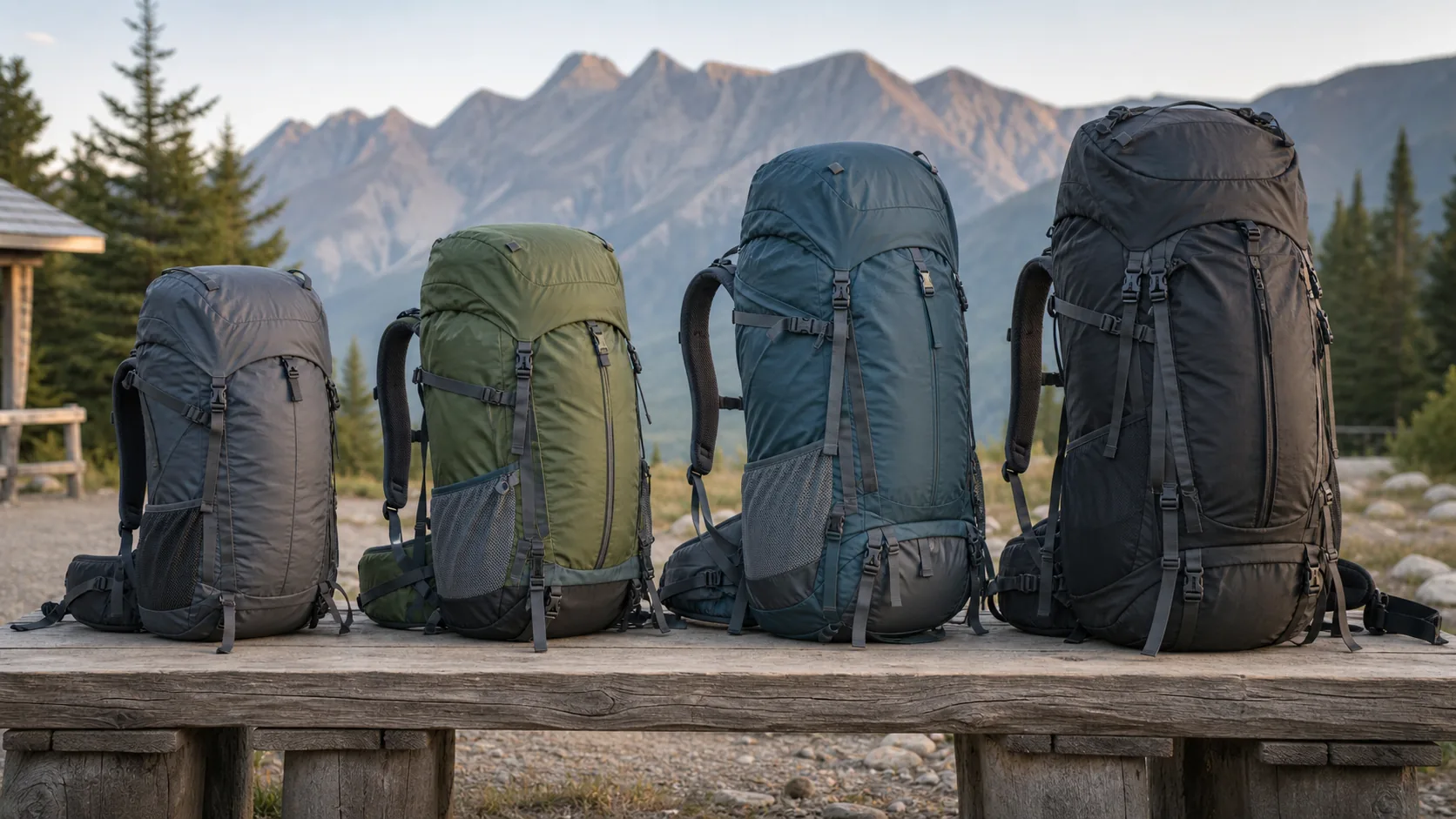
For most three-season backpacking trips, a 45L to 60L backpack is the practical range. Choose 28L to 40L for ultralight overnights or short trips with compact gear, around 50L for a versatile weekend-to-week-long pack, and 60L or more for bulky equipment, winter conditions, bear canisters, or long food carries.
The right size depends less on the number of days alone than on the volume and weight of the gear you actually carry. A compact sleeping bag and shelter can make a 40L pack feel roomy, while traditional equipment, cold-weather layers, or family gear can fill a 60L pack quickly. Start with your complete gear pile, then choose the smallest backpack that holds it without forcing items outside or leaving large amounts of unused space.
What Backpack Size Do You Need by Trip Length?
Trip length is the fastest starting point, but it is not the final answer. Weather, food, water, and gear bulk can move you up or down a size.

| Trip or Packing Style | Practical Capacity Range | Best Fit |
|---|---|---|
| Ultralight overnight | 28-36L | Experienced hikers with compact gear |
| 1-3 nights | 35-45L | Lightweight three-season kits |
| 3-5 nights | 45-55L | Most moderate backpacking setups |
| 5-7 nights | 50-65L | Longer food carries or extra comfort items |
| Winter or expedition use | 60-75L+ | Bulky insulation, specialty gear, or group equipment |
These ranges assume the backpack carries shelter, sleep system, clothing, cooking equipment, food, water, and basic safety items. If another hiker carries part of the shared shelter or cooking kit, you may be able to use a smaller pack. If you carry equipment for children, photography, climbing, or cold weather, you may need more space.
Is 50L the safest all-around choice?
For many backpackers, yes. A 50L pack can handle short trips without feeling enormous and still has enough room for several days of food. It also encourages better packing discipline than an oversized expedition pack.
When should a beginner choose 60L?
A 60L pack can be easier for a beginner whose sleeping bag, pad, and tent are not especially compact. It provides some flexibility while the gear system is still being refined. That extra capacity should be treated as working room, not an invitation to add unnecessary items.
The best quick answer is simple: start around 50L for general three-season backpacking, go smaller only when you know your gear is compact, and go larger when conditions genuinely add bulk.
How Does Backpack Capacity Actually Work?
Backpack capacity is measured in liters. The rating represents storage volume, but brands do not always count pockets in exactly the same way. Some figures emphasize the closed main compartment, while others include the lid, hip-belt pockets, or expandable exterior storage. Two packs with the same stated capacity can therefore feel very different.

A tall, narrow 50L pack also carries differently from a shorter, wider 50L pack. Shape affects where a bear canister fits, how easy the bottom of the pack is to reach, and whether the load remains close to the back.
What do liter ratings tell you?
A liter rating is useful for comparing the broad storage class of a backpack. It does not tell you:
- How much space padding, dividers, or a frame consumes
- Whether a rigid bear canister fits through the opening
- How efficiently the main compartment uses its shape
- Whether exterior pockets are included in the published capacity
- How comfortably the suspension carries the loaded weight
How do external pockets change usable space?
Stretch side pockets, a front mesh pocket, a lid, and hip-belt pockets can make a pack more usable without increasing the main compartment. They keep water, snacks, rainwear, maps, and wet layers accessible. However, soft exterior storage should not be treated as a substitute for a correctly sized main compartment. Important gear should remain secure, and the pack should not depend on loose items hanging from the outside.
Should capacity match gear volume?
Yes. Lay out the entire kit before choosing the pack, including the usual maximum food carry and the container used in bear country. If possible, take the gear to a store or load it into a test sample. For product teams evaluating heavy-duty outdoor backpacks, realistic load testing is equally important because volume, frame structure, strap reinforcement, and expected carrying weight must work together.
| Capacity | Effective Use Case | Typical Limit |
|---|---|---|
| 28-36L | Ultralight overnights and fastpacking | Little room for bulky or optional gear |
| 38-42L | Streamlined multi-day trips | Requires compact equipment |
| About 50L | Versatile three-season backpacking | Moderate food and layer capacity |
| 60L+ | Long carries, winter, or bulky loads | More empty weight and overpacking risk |
Capacity is only useful when it describes a pack that fits the gear and carries the resulting weight well.
Is a 60-Liter Pack Right for Long-Distance Trips?
A 60-liter pack is a strong choice for extended trips, winter conditions, long food carries, and setups that include a bear canister or bulky insulation. It can also suit new backpackers whose equipment has not yet been reduced to a compact lightweight system.

When does 60L make the most sense?
Consider a 60L pack when several volume demands occur together:
- Five or more days between resupply points
- Cold-weather sleeping bags and insulated clothing
- A rigid bear canister
- Long water carries in dry terrain
- Shared group gear or specialty equipment
- A traditional or comfort-focused gear list
The longer the food carry and the colder the weather, the more useful the extra capacity becomes. A supportive internal frame and properly fitted hip belt are important because a large pack may carry considerably more weight than a minimalist model.
What are the trade-offs of going bigger?
Larger packs usually weigh more when empty, create a bulkier profile, and make it easy to add items that are not truly needed. Gear can also shift if a large pack is only half full and the compression system is weak.
| 60L Advantages | 60L Drawbacks |
|---|---|
| Fits bulky sleeping systems and layers | More empty weight |
| Easier bear-canister placement | Can encourage overpacking |
| Handles long food carries | Bulkier on narrow trails and transport |
| Gives beginners packing flexibility | Excess space on short summer trips |
Choose 60L because the trip or equipment requires it, not simply because more space feels safer.
Why Is 50 Liters the Versatile Sweet Spot?
Fifty liters covers the widest range of common three-season trips for many backpackers. It can carry a moderate base kit, several days of food, rainwear, and a few comfort items without the bulk of a large expedition pack.

Is 50L enough for a week-long trip?
It can be. A week-long trip in 50L is realistic when the shelter, sleeping bag, and pad are compact and the hiker does not carry excessive clothing or duplicate equipment. Food volume becomes the main constraint, so resupply distance and calorie density matter.
A 50L pack is particularly well suited to:
- Weekend and three-to-five-day trips
- Longer trips with regular resupply
- Three-season conditions
- Moderate food carries
- Hikers who want a few comfort items
How does a 50L pack compare for comfort?
Most packs in this class use an internal frame, padded hip belt, sternum strap, and load lifters. Those components can stabilize a moderate load better than a small frameless pack. Comfort still depends on torso fit, hip-belt fit, and the manufacturer’s recommended load range.
| Feature | 50L Performance |
|---|---|
| Weekend trip fit | Excellent when compressed |
| Three-to-five-day capacity | Excellent for most moderate kits |
| Week-long capacity | Good with compact gear and food |
| Bear-canister compatibility | Model-dependent; test the opening and position |
| Ultralight potential | Moderate |
If you want one backpack for a mix of overnights, long weekends, and occasional longer trips, 50L is often the most forgiving choice.
Are 38L to 42L Packs Best for Streamlined Multi-Day Trips?
Packs in the 38L to 42L range work well when the gear list is compact and intentional. They reduce empty weight and discourage extras, but they leave less flexibility for cold-weather clothing, bulky food, or a large bear canister.

Who benefits most from a 42L pack?
A 42L pack suits experienced hikers with a low-volume three-season kit. It can handle two-to-five-day summer trips, streamlined thru-hiking sections, and moderate resupply intervals when the shelter and sleep system compress well.
Ideal users include:
- Experienced backpackers who know their standard loadout
- Hikers with a base weight around 15 pounds or less
- Summer and mild shoulder-season travelers
- People who prefer a narrow, controlled pack profile
Cold-weather use is possible only when insulation is highly compressible and food planning is disciplined. The pack has little reserve space if conditions change.
When should you choose 38L?
A 38L pack is a more specialized choice for overnights, two-to-three-night trips, and fast-moving lightweight setups. Many packs in this category use a light frame or removable stay, though some are frameless.
| Trip Type | 38L Fit | 42L Fit |
|---|---|---|
| Summer overnight | Excellent | Excellent |
| 2-3 nights | Good with compact gear | Excellent |
| 4-5 nights | Tight | Good with careful food planning |
| Winter conditions | Usually too small | Limited |
| Fastpacking | Excellent | Good |
| Beginner-friendly | Limited | Moderate |
These sizes reward an efficient gear system. If your equipment currently fills a 55L pack, buying a 40L model will not make the gear smaller.
Are 28L to 36L Packs Enough for Ultralight Backpacking?
Yes, but only for hikers whose equipment, food, and safety system already fit within that volume. Packs from 28L to 36L are designed for high-mileage travel, fastpacking, summer overnights, and genuinely ultralight loads.
What kind of trips suit 36L?
A 36L pack can work for one-to-three-day trips when the shelter and sleep system are compact. Many models use running-vest-style straps, minimal frames, or simple roll-top construction to reduce empty weight.
Common uses include:
- Fastpacking and high-mileage days
- Summer overnights
- Short trips with an ultralight base kit
- Routes with frequent food and water access
The reduced pack weight can support faster movement, but minimal suspension is less forgiving when the load becomes heavy. Check the recommended load limit and do not assume that a small pack will carry dense weight comfortably.
Can 28L handle an overnight?
It can handle an ultralight summer overnight, especially for a skilled hiker using a small shelter, quilt, compact pad, and simple food plan. It is also a useful size for long day hikes and peak-bagging missions.
| 28L Use | Practicality |
|---|---|
| Long day hike | Excellent |
| Ultralight summer overnight | Good for experienced users |
| Peak bagging or scrambling | Excellent |
| Multi-day trip | Highly gear-dependent |
| Winter backpacking | Generally unsuitable |
A 28L pack is rarely the best first backpacking purchase. There is no room for a bulky sleeping bag, unnecessary clothing, or poorly planned food.
How Do You Match Your Gear to the Right Pack Size?
Start with the complete gear pile, not a capacity number. Include shelter, sleep system, cooking equipment, clothing, electronics, repair items, first aid, toiletries, the largest normal food carry, and the water containers required for the route.
What should you ask before choosing a size?
- How many days of food will I carry between resupply points?
- Do local rules require a bear canister?
- Am I hiking in summer, shoulder season, or winter?
- Is my shelter shared or carried entirely by me?
- Do I carry camera, climbing, fishing, or family equipment?
- Do I value comfort items or a streamlined kit?
Pack those items into a test backpack before removing tags or approving a production sample. The pack should close without straining the zipper or roll top, and the compression straps should still have useful adjustment. Avoid choosing a pack that only works when essential equipment is lashed loosely to the outside.
How does base weight influence pack choice?
Base weight means the carried equipment excluding consumables such as food, water, and fuel. It is not a perfect measure of volume, but it can identify whether a small pack is realistic.
| Base Weight | Common Capacity Starting Point |
|---|---|
| Under 12 lb | 28-36L |
| 12-18 lb | 38-50L |
| 18-25 lb | 50-60L |
| Over 25 lb | 60L+ |
These are starting points, not rules. A light synthetic sleeping bag may occupy more space than a heavier down bag, and a dense camera kit may add weight without much volume. The gear’s actual shape and compression matter as much as the scale reading.
Finally, load the pack with the amount of food and water expected on the hardest day. Walk with it, use stairs, and check whether the load remains close to the back. A capacity decision is not complete until the loaded pack feels stable.
What Features Matter Beyond Just Capacity?
Frame type, torso fit, hip-belt design, pocket layout, ventilation, and access can matter more than a small difference in liters. A well-fitted 40L pack can feel more capable than a poorly fitted 55L pack because it controls the load instead of pulling away from the body.
Which frame type should you choose?
Choose the suspension according to the total loaded weight:
- Frameless: Lightest option for compact loads, commonly preferred by experienced ultralight hikers
- Internal frame: The most versatile choice for moderate and heavier backpacking loads
- Removable stay or frame sheet: A hybrid design that can reduce weight when support is not needed
A padded hip belt should wrap the upper hips without creating pressure points. Shoulder straps should stabilize the pack while the hips carry much of the weight. Load lifters, when present, help keep the top of the backpack from leaning backward.
Does ventilation matter?
Ventilation can improve comfort in hot or humid conditions. Suspended mesh panels create airflow but may curve the main compartment and reduce usable depth. Foam channels keep the load closer but may feel warmer. Test both the comfort and packing geometry.
Which access and pocket features are useful?
| Feature | Priority | Reason |
|---|---|---|
| Correct torso and hip-belt fit | Essential | Controls comfort and load transfer |
| Frame matched to load | High | Prevents sagging and instability |
| Secure water storage | High | Keeps hydration accessible |
| Front stretch pocket | Medium-high | Separates wet layers and quick-access gear |
| Compression straps | Medium-high | Stabilize partial loads |
| Roll top or lid | Preference-based | Changes access and expansion |
For hiking brands and sourcing teams, outdoor gear applications provide useful context for matching capacity with fabric strength, harness construction, weather resistance, and field use.
How Should B2B Buyers Plan Backpacking Pack Sizes?
B2B buyers should build an assortment around clear user and trip profiles rather than stocking every possible liter rating. Mid-capacity packs usually address the widest audience, while one compact lightweight model and one larger load-hauling model can cover the most important adjacent needs.
Which capacity groups deserve priority?
A practical line architecture might include:
- 38-42L: Lightweight and experienced users
- 48-52L: Versatile three-season customers
- 58-65L: Beginners, long carries, and bulky gear
The exact mix should come from the brand’s audience, climate, price point, retail data, and return reasons. A specialty winter or expedition line may need larger capacities, while a thru-hiking brand may center the range below 45L.
What should private-label brands verify?
Capacity claims should be tested with representative equipment rather than pattern dimensions alone. Product teams should also verify:
- Torso sizes and harness adjustment range
- Comfortable and maximum recommended load
- Bear-canister orientation where relevant
- Pocket capacity and bottle retention
- Compression performance with a partial load
- Strap, seam, buckle, and zipper durability
- Rain resistance and drainage behavior
A documented outdoor durability case can help buyers frame questions about fabric strength, strap reinforcement, testing, and quality control before approving production.
What is the final recommendation?
For personal use, start with 50L unless your current gear clearly points elsewhere. Choose 38L to 42L when you already own compact equipment and pack carefully. Choose 60L or more when winter layers, long food carries, a bear canister, or shared group gear creates real volume.
For a private-label line, define the target load and user before deciding the liter number. If you need help translating a capacity plan into compartments, materials, suspension, and production specifications, talk to our team about a backpack project built around real loadouts.
FAQ
Can I use a 40L pack for a five-day trip?
Yes, if the shelter and sleep system are compact, the weather is mild, and the food carry is efficient. Test the full five-day load before the trip. If food, a bear canister, or cold-weather clothing has to hang outside, move to a larger pack.
What is the best backpack size for a first-time backpacker?
A 50L to 60L pack is the safest starting range for most beginners. Choose closer to 50L for compact three-season gear and closer to 60L for traditional equipment, extra comfort items, or longer trips.
How do I know if my backpack is too big?
The pack may be oversized if it has large dead space, the load shifts even after compression, or you routinely fill the extra room with unnecessary items. It should compress securely around the normal load without collapsing or pulling away from the back.
What is the best pack size for winter backpacking?
Winter backpacking commonly requires 60L or more because insulated sleeping systems, extra clothing, stove equipment, and higher-volume food add bulk. The exact size depends on temperature, trip length, and whether group equipment is shared.
Can one pack work for weekend and week-long trips?
Yes. A well-fitted 50L pack is the most versatile single-pack option for many three-season hikers. Use its compression system for weekend loads and plan compact food and gear for longer trips.