
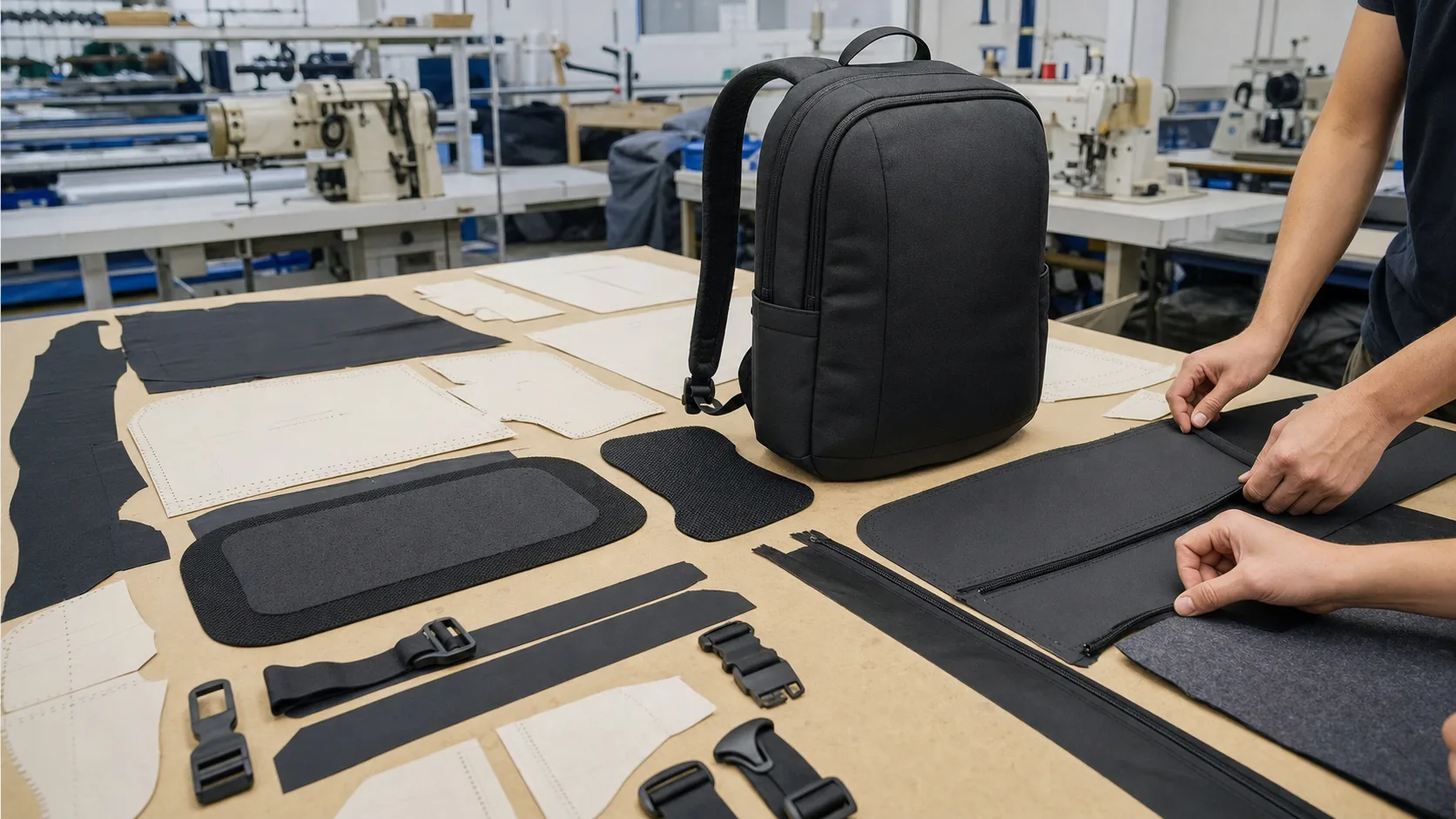
To make a backpack at commercial scale, turn an approved design into a controlled pattern, cut and label the panels, prepare the straps and pocket subassemblies, join the shell, bind or finish the seams, install the hardware, and inspect the completed bag against the product specification. A simple backpack sewing pattern gives manufacturers a clear blueprint for improving production speed and controlling fabric waste without sacrificing the functions buyers need.
Production line managers often deal with designs that slow down sewing, increase handling, and create avoidable scrap. Every additional seam or intricate pocket detail adds operations and potential failure points. A clean, modular template makes the process easier to train, measure, and repeat while leaving room for project-specific materials, branding, dimensions, and performance requirements.
Why Learn How to Make a Backpack?

Understanding how to make a backpack helps production teams control material use, labor allocation, and assembly quality. Breaking the product into defined modules also makes it easier to identify where variation begins instead of waiting until final inspection to find a distorted panel or misaligned strap.
What Are the Primary B2B Cost Advantages?
Keeping production costs under control while maintaining quality is a continuous challenge. A clean pattern layout removes ambiguity for cutting and sewing operators, which can improve throughput and reduce avoidable rework. The actual savings must be measured during sampling and pilot production because they depend on fabric width, marker efficiency, equipment, design complexity, and operator skill.
- Reduced Material Scrap: Optimized marker layouts can improve fabric utilization, especially when mirrored or shared components nest efficiently.
- Accelerated Onboarding: Clear pattern labels, notches, operation sheets, and approved samples reduce training variability.
- Consistent Tolerances: Fewer unnecessary seams and clearly defined allowances lower the chance of dimensional drift.
Standardizing Your Internal Production Line
Every minute removed from avoidable handling can increase daily capacity. Standardizing operating procedures around approved sewing patterns means teams spend less time interpreting drawings and more time completing repeatable operations. The standard should define the sequence, machine type, seam construction, inspection point, and acceptable tolerance for each critical step.
| Production Parameter | Complex or Uncontrolled Pattern | Simple Standardized Pattern |
|---|---|---|
| Assembly time | More operations and handling changes | Fewer documented operations |
| Material waste | Irregular pieces are harder to nest | Repeatable marker plan |
| Defect control | Problems appear late in assembly | Checkpoints tied to subassemblies |
Managers should audit marker use and operation sheets whenever a pattern revision, material change, or production-line change is introduced. That connects the pattern on screen with what operators actually cut and sew.
What Is the Best Process for How to Make a Backpack?

An effective commercial guide balances ease of assembly with the structure expected by the target user. A lightweight promotional pack, a laptop commuter bag, and an OEM project for custom travel backpacks may share basic construction logic, but they require different materials, pocket layouts, reinforcement, and validation plans.
Key Phases of Commercial Pattern Development
A reliable bag starts with a controlled pattern and an approved physical sample. If digital pieces, notches, grain directions, or seam matches are poorly calibrated, operators may compensate by stretching or trimming parts during assembly, creating inconsistent finished goods.
- Digitization (CAD/CAM): Store graded pattern files in formats compatible with the factory’s software and cutting equipment, such as DXF or supported apparel-pattern formats.
- Seam Allowance Validation: Set each allowance according to the material stack, seam construction, binding method, and machine attachment. One allowance does not suit every operation.
- Nesting Optimization: Minimize unusable space on marker sheets while respecting grain, coating direction, print orientation, nap, and paired components.
- Sample Approval: Sew and measure a physical sample before releasing the pattern to bulk cutting.
Why Is Sequential Assembly Crucial for Speed?
An unbalanced assembly floor creates queues and idle time. Pre-staging secondary parts such as zippers, pockets, labels, webbing, foam, and padded straps allows the main joining operations to receive complete subassemblies in the correct sequence.
- Workstation Isolation: Set up independent subassembly stations for repeatable small components.
- Balanced Line Capacity: Match the output of preparation stations to the pace of final joining.
- Standardized Checkpoints: Inspect each critical subassembly before it becomes difficult to repair.
| Assembly Workstation | Pre-Staging Responsibility | Main Assembly Task |
|---|---|---|
| Station A | Prepare shoulder straps and webbing | Attach adjusters and reinforcement |
| Station B | Prepare front panel and pocket zipper | Complete front subassembly |
| Station C | Stage front, back, gusset, and lining | Join shell and finish interior seams |
Separating strap and pocket preparation from final joining keeps specialized operations visible and helps supervisors identify the real bottleneck.
How Do Materials Affect How to Make a Backpack?

Material selection changes how to make a backpack because the textile, coating, foam, lining, thread, and hardware determine the needle system, stitch type, machine feed, seam allowance, and reinforcement method. Materials should be selected as a complete system rather than as isolated specifications.
Selecting Durable Nylon Versus Polyester Fabric
Customers expect commercial bags to survive their intended environment. The appropriate choice depends on target weight, abrasion exposure, colorfastness, UV exposure, water-resistance requirements, hand feel, and budget. Heavy-duty custom tactical backpacks are useful examples of projects where fabric and reinforcement decisions must be validated together.
- 500D-1000D High-Tenacity Nylon: Common in rugged applications where abrasion resistance and reinforcement are priorities; coating and weave still affect performance.
- Ripstop Polyester: Can support lightweight sports or promotional packs, with water resistance and UV performance depending on the exact textile and finish.
- Ballistic-Style Nylon: Often selected for abrasion-prone travel or work bags, but its weight and stiffness must suit the pattern and sewing equipment.
Which Load-Bearing Hardware Supports Reliable Construction?
A finished bag is limited by the compatibility of its fabric, seams, webbing, buckles, adjusters, and zippers. Hardware should be checked for dimensions, operating temperature, cycle life, pull performance, corrosion exposure, and ease of assembly under the project’s test plan.
- Acetal Buckles: Frequently used where impact resistance, low weight, and repeatable molding are important.
- Load-Bearing Webbing: Nylon or polyester webbing should match the adjuster geometry and the required slip resistance.
- D-Rings and Attachment Hardware: Resin or metal options must be selected for the intended load, environment, and corrosion risk.
| Fabric Class | Typical Hardware Direction | Primary Use Case |
|---|---|---|
| Lightweight polyester | Lightweight molded buckles and adjusters | Everyday or promotional bags |
| Heavy-duty nylon | Reinforced resin or specified metal hardware | Tactical, work, or rugged outdoor bags |
Bonded nylon thread around Tex 70 is common in many medium- to heavy-duty bag operations, but thread size, needle size, seam construction, and machine capability must be confirmed for the actual material stack.
Where Can We Simplify How to Make a Backpack?

Simplifying how to make a backpack means removing operations that do not support the target function, appearance, or durability. Straightforward panel geometry, shared components, and fewer interior dividers can lower handling time, but simplification should not remove reinforcement, safe edge finishing, or features required by the product brief.
Optimizing Seam Allowance and Cutting Layouts
Uniform rules make training and automation easier, although the allowance itself may vary by operation. Designing useful symmetry into panels can reduce the number of unique cutting pieces and simplify bundle management.
- Controlled Allowances: Document the allowance for each seam family instead of relying on one assumed value throughout the bag.
- Symmetrical Panels: Use common left and right pieces when the design allows, reducing unique dies and pattern files.
- Integrated Pockets: Consider flat slip pockets or shared pocket components when expansion, waterproofing, or security requirements do not demand more complex construction.
- Clear Notches: Mark alignment points without weakening the finished seam or confusing similar components.
Should You Simplify Complex Zipper Installations?
Concealed zipper paths, curved openings, storm flaps, and laminated waterproof zippers can add preparation and alignment operations. Exposed reverse-coil zippers or straighter tracks may be faster to assemble, but the decision must account for appearance, water ingress, opening access, slider clearance, and the buyer’s product positioning.
- Predictable Stitch Lines: Standardized zipper paths make guides and work instructions easier to repeat.
- Appropriate Tooling: Folders, zipper feet, templates, or programmable sewing can improve consistency when volume supports the setup.
- Operator Ergonomics: A stable work surface and manageable material stack reduce unnecessary handling and fatigue.
| Optimization Target | Complex Implementation | Simplified Implementation |
|---|---|---|
| Zipper installation | Concealed or highly curved zipper path | Straight exposed reverse-coil path where suitable |
| Seam binding | Manual feeding around variable curves | Controlled curves with a compatible binder setup |
Any claimed time saving should come from a timed pilot run using the intended materials and operators, not from a universal minutes-per-unit assumption.
Who Benefits When Learning How to Make a Backpack?

Emerging brands, established retailers, product developers, sourcing teams, and contract manufacturers all benefit from a controlled baseline pattern. It gives each team a shared reference for discussing dimensions, features, costing, testing, and production risk.
Empowering Custom Product Design Teams
A standardized core architecture gives designers a reliable platform for aesthetic and functional changes without rebuilding the entire production method for every colorway or pocket update.
- Design Freedom: Teams can evaluate external pockets, trims, prints, and materials against a known structure.
- Sourcing Predictability: Approved dimensions improve forecasts for fabric, foam, lining, webbing, buckles, and zippers.
- Faster Sampling Decisions: A controlled base pattern makes it easier to isolate the effect of each revision.
How Do Commercial Brands Reduce Prototyping Time?
Digital CAD systems let a design office check seam matches and compare marker layouts before committing material to a physical sample. They do not eliminate sampling, because bulk behavior still depends on fabric stretch, coating, foam compression, operator handling, and equipment setup.
- Virtual Nesting Trials: Compare layout options and estimate fabric utilization.
- Digital Adjustments: Revise dimensions without redrawing complete paper boards.
- Controlled Cutting Export: Send approved files to compatible automated cutters or print full-scale markers for manual cutting.
| Development Phase | Manual Paper Workflow | Digital CAD-Assisted Workflow |
|---|---|---|
| Pattern modification | Redraw and recheck affected pieces | Revise linked pieces and verify seam matches |
| Sample preparation | Trace or mark pieces manually | Export controlled markers or cutter files |
Store master patterns with revision numbers, approval status, material notes, and a change history so every location works from the same released version.
Can Custom Tools Change How to Make a Backpack?
Professional equipment can transform how to make a backpack from a largely manual process into a controlled production system. Folder attachments, templates, programmable sewing, and automated cutting reduce handling variation when they are correctly set up for the material and operation.
Industrial Sewing Machines Versus Standard Tooling
Domestic or light-duty equipment is rarely designed for sustained commercial runs through dense fabrics, foam, webbing, binding, and multiple seam layers. Industrial machines offer appropriate feed systems, duty cycles, work surfaces, and attachments, but they still require correct needles, thread, tension, maintenance, and operator training.
- Compound-Feed Machines: Help control shifting across layered nylon, foam, and lining assemblies.
- Programmable or Pneumatic Bar-Tackers: Apply repeatable reinforcement patterns at defined stress points.
- Automatic Edge Binders: Finish compatible interior seam paths with controlled tape feeding.
Why Use Heavy-Duty Cutting Templates?
Precision acrylic, composite, or metal templates help manual cutting and marking teams repeat panel shapes. If corresponding panels vary, sewing operators may stretch, trim, or force pieces together, moving the defect downstream.
- Smooth Guide Edges: Support controlled rotary or straight-knife movement when the tool and material are compatible.
- Integrated Notch Slots: Mark alignment locations consistently.
- Durable Construction: Retain usable dimensions over repeated cycles when stored, checked, and maintained correctly.
| Tooling Type | Key Advantage | Production Impact |
|---|---|---|
| Laser cutting table | Repeatable digital cutting; heat-sealed edges on compatible synthetics | Reduces separate marking and edge-sealing operations |
| Bar-tack sewing jig | Controls placement and orientation | Improves reinforcement consistency before testing |
Tooling improves repeatability, but it does not guarantee a load rating. The finished backpack must pass the project-specific validation plan.
What Quality-Control Steps Define How to Make a Backpack Safely?
Product safety and durability depend on controlled construction and validation against the intended use. A bag for school, commuting, travel, outdoor work, or tactical use should not inherit a test load from an unrelated design. The risk assessment, sampling plan, and acceptance criteria must match the buyer’s specification and applicable market requirements.
Implementing Quality-Control Inspection Points
A seam failure can trigger returns and damage buyer confidence. Inspection should begin before cutting and continue at the points where a defect can still be corrected efficiently.
- Incoming Inspection: Verify ordered fabric, coating, color, weight, hardware, webbing, zipper, thread, and other specified properties.
- In-Process Checks: Inspect stitch formation, seam allowance, reinforcement placement, component orientation, and critical dimensions.
- Final Inspection and Testing: Check function, appearance, measurements, labels, packing, and any required performance tests before release.
Teams can also review a documented outdoor durability case when planning how field-use requirements translate into materials, reinforcement, and validation.
How Do You Perform a Tension Test on Straps?
Use a documented fixture, conditioned samples, calibrated equipment, and a load profile defined by the product specification or applicable test method. Testing should record sample size, load, duration, cycle count, failure mode, and acceptance result.
- Static Load Test: Hold the loaded bag or strap assembly for the specified duration and inspect seam stretch, webbing slip, and hardware deformation.
- Dynamic or Drop Test: Apply a defined load, height, orientation, surface, and cycle count to evaluate impact behavior.
- Post-Test Seam Inspection: Examine reinforcement stitches, thread breaks, fabric tearing, hole growth, buckle damage, and permanent distortion.
| Inspection Stage | Primary Focus | Acceptance Basis |
|---|---|---|
| Material verification | Fabric, webbing, hardware, and trim | Approved specification and incoming plan |
| Stitch inspection | Stitch formation, density, backtack, and position | Approved sample and operation sheet |
| Stress testing | Strap and handle attachment system | Project test method and defined load |
Document machine settings and inspection results so teams can identify drift, trace affected batches, and correct the cause rather than only repairing individual bags.
How Does Scaling Affect How to Make a Backpack?
Scaling changes how to make a backpack by shifting attention from one skilled operator to line balance, repeatable work content, bundle control, equipment utilization, and traceability. A pattern that works for samples may need added notches, guides, operation splits, or tooling before it is suitable for bulk production.
Transitioning from Manual Labor to Automation
Manual sewing remains useful for sampling, special operations, and low-volume work. As volume grows, automation can improve repeatability in operations that are stable enough to justify programming and fixtures.
- CNC Fabric Cutting: Cuts nested panel batches from controlled digital files.
- Automated Pattern Sewing: Repeats suitable pocket, label, patch, or webbing operations within the programmed work area.
- Modular Assembly Lines: Groups related tasks and balances work content across operators.
Can Lean Manufacturing Principles Cut Waste?
A floor layout that reduces movement and clarifies material flow can lower handling time and work-in-process. Lean tools are most useful when teams measure the actual constraint instead of moving equipment based on assumptions.
- U-Shaped or Cellular Layouts: Keep related operations close when product mix and space support the arrangement.
- Kanban Material Staging: Replenish defined quantities of components at the required workstation.
- Waste Audits: Track fabric remnants, rework, waiting, transport, excess inventory, and downtime.
| Operational Scale | Primary Production Method | Capacity Basis |
|---|---|---|
| Low-volume samples | Skilled operator with flexible manual equipment | Sample complexity and available labor |
| Bulk production | Balanced multi-operator line with selective automation | Timed pilot run and verified line balance |
Arrange the production floor so cut pieces move in a controlled direction, remain identified by size and color, and reach assembly without unnecessary sorting.
Why Partner With a Manufacturer to Make a Backpack?
An experienced manufacturing partner can simplify how to make a backpack by reviewing pattern feasibility, sourcing compatible materials, planning operations, producing samples, and scaling an approved specification. The brand still needs clear requirements and approval checkpoints, while the factory contributes production engineering and execution.
Overcoming Design Bottlenecks in Mass Production
A manufacturing review can identify tight curves, inaccessible seam paths, excessive material stacks, weak reinforcement geometry, or components that are difficult to source consistently.
- Design-for-Manufacture Feedback: Refine patterns and construction details before bulk release.
- Material Sourcing Coordination: Align fabric, foam, lining, webbing, hardware, and minimum order constraints.
- Project-Specific Testing: Agree on sample selection, methods, loads, cycles, reporting, and acceptance criteria before testing begins.
Tailored Bulk Solutions for Global Supply Chains
End-to-end coordination can connect pattern refinement, sampling, material approval, production planning, quality control, packing, and shipment. The exact equipment, capacity, lead time, MOQ, certifications, and test scope should be confirmed for each project rather than treated as universal promises.
| Client Bottleneck | In-House Constraint | Manufacturing Partner Contribution |
|---|---|---|
| Limited machinery | High investment and maintenance cost | Access to suitable equipment for agreed operations |
| Sourcing hurdles | Supplier MOQs and technical-material qualification | Consolidated sourcing and material approval support |
| Scaling risk | Sample process does not match bulk flow | Pilot production, line balancing, and controlled release |
Brands ready to move from a sewing pattern to an approved bulk-production plan can contact ZWbags to discuss dimensions, construction, materials, branding, testing, quantities, and delivery requirements.
FAQ About How to Make a Backpack
These questions address common technical and production decisions that arise when converting a simple backpack pattern into a commercial product.
Can I Scale a Simple Pattern for Heavy-Duty Use?
Yes, but changing only the fabric is not enough. Review the entire load path, including panel geometry, seam type, thread, webbing, reinforcement, buckles, adjusters, and attachment points. Build and test a representative sample against the intended use before approving bulk production.
What Is the Best Thread Type for High-Stress Seams?
Bonded nylon thread is common in commercial bag production, and Tex 70 is a frequent starting point for medium- to heavy-duty assemblies. The final choice must match the fabric stack, needle, stitch construction, machine, seam appearance, environmental exposure, and performance requirement.
How Do I Know Whether a Sewing Pattern Is Production-Ready?
A production-ready pattern includes dimensions, seam allowances, grain or material direction, alignment notches, component names, cut quantities, revision status, and construction references. It should also match an approved physical sample and pass the project’s fit, function, and performance checks.
Can I Customize the Dimensions of a Standard Pattern?
Yes. Recheck corresponding seam lengths, gusset geometry, pocket placement, zipper length, strap position, balance, capacity, material utilization, and finished measurements after any dimensional change. Produce another sample when the change can affect construction or performance.
What Is the Best Way to Handle Bulk Zipper Sewing?
Use a repeatable zipper preparation method, clear alignment marks, compatible feet or guides, controlled tape tension, and an in-process check before the zipper is enclosed by later operations. Jigs, folders, or programmable sewing may help when the zipper path and order volume justify the setup.