
A slim document case and a wheeled work bag may both be sold as briefcases. The name alone does not tell you what fits or how you will carry it.
Types of briefcases include rigid attaché cases, soft zip-top and flap designs, document portfolios, laptop briefcases, expandable cases, wheeled cases, and backpack-briefcase conversions. These are overlapping descriptions, not exclusive categories: compare the body, opening, carry system, interior layout, and intended contents.
What Makes a Bag a Briefcase?
The useful starting point is document carry. Oxford’s briefcase definition describes a flat case for papers and documents. It does not prescribe leather, a lock, a laptop sleeve, or a particular carrying method.
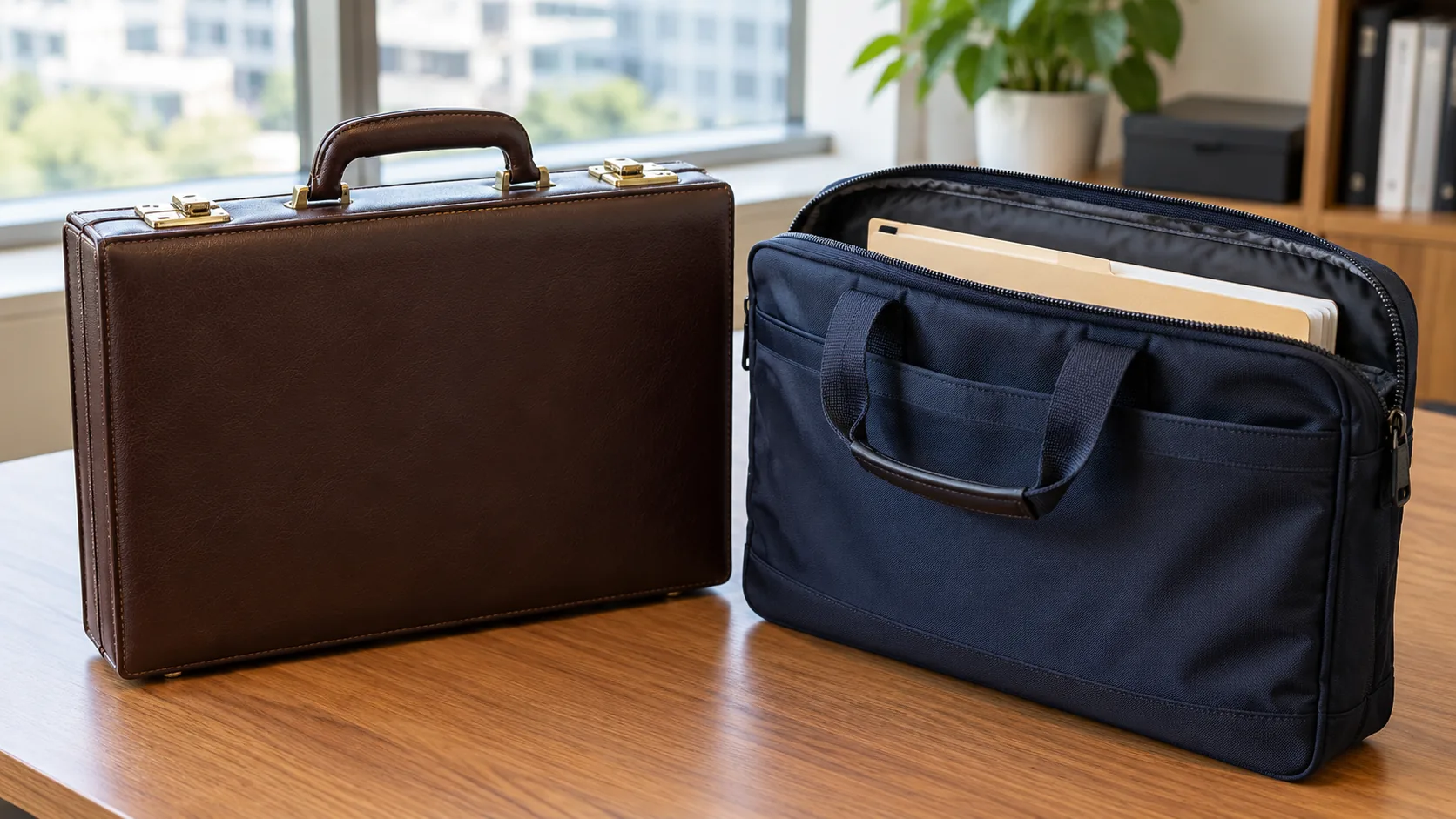
For this guide, a briefcase is a work-carry format organized around documents, devices, or presentation materials. That is a working scope for comparison, not a rule that makes every rectangular bag a briefcase. A flat silhouette can conceal very different interiors: loose papers against a lining, a padded device sleeve, divided files, or a removable sample tray.
Record five things before comparing models: the body structure, opening, carrying options, interior organization, and intended contents. A photo can suggest these fields, but it may not show the reinforcement, sleeve depth, or strap attachment. Ask for those details separately when they affect your choice.
This page stays within briefcase formats. For the larger distinction between body shape, carrying method, and purpose, the types of bags guide covers the broader category framework. A shoulder strap does not make two bags the same construction, and a work-use label does not establish device protection.
Which Briefcase Formats Should You Compare?
Use the following formats as a comparison list. They are not an official count or mutually exclusive categories. An expandable laptop briefcase can also have wheels; a flap-over design can have both a top handle and a detachable shoulder strap.
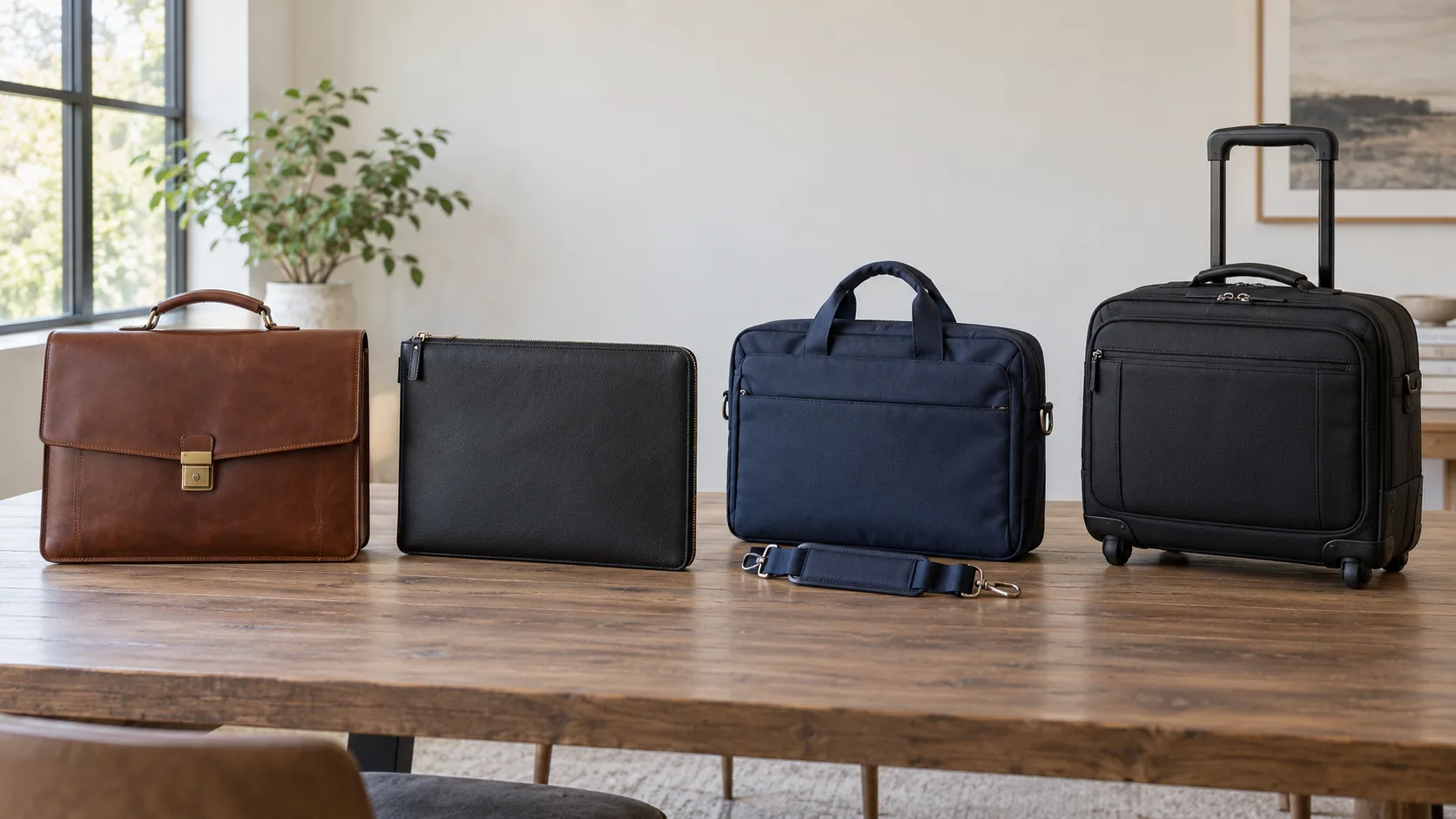
| Format | Body and opening cues | Carry and organization to inspect | Main tradeoff to check |
|---|---|---|---|
| Rigid attaché-style case | Firm shell or frame with a hinged lid in the design being compared | Top handle; document divisions or a fitted interior | Lid clearance, usable depth, hinges, and latches |
| Soft zip-top briefcase | Flexible or partly reinforced body with zip access | Short handles; optional strap; main compartment and pockets | Opening width, base shape, and access when loaded |
| Flap-over briefcase | Front flap over a soft or partly structured body | Handle and/or strap; closure tabs, buckles, or other fasteners | Actual closure coverage and the steps needed to reach contents |
| Portfolio or document case | Thin, flat format; closure and handles vary | Under-arm or hand carry; paper layout, sometimes a device pocket | Folder thickness, opening, and whether padding is present |
| Laptop briefcase | Device-oriented layout; shell and closure can vary | Sleeve, retaining feature if present, accessory storage | Finished sleeve dimensions and clearance around the actual device |
| Expandable briefcase | A section changes depth, often through an expansion gusset | Check organization in both configurations | Expanded dimensions, closure behavior, and carrying shape |
| Rolling briefcase | Wheeled base and an extendable pulling handle | File/device compartments; lift handle for stairs or storage | Wheel clearance, loaded balance, pulling-handle action, and lift access |
| Convertible backpack-briefcase | More than one carrying mode with stowable or removable straps | Hand, shoulder, and backpack arrangements actually supplied | Strap storage, conversion steps, and access in each orientation |
Read the laptop row as a purpose, the expandable row as a feature, and the rolling row as a carrying system. Combining them does not create a contradiction. It creates a longer specification. A supplier still needs to know which body, opening, and interior you mean.
Where do related names overlap?
Oxford’s attaché-case entry identifies a small, hard, flat case for business documents. Its portfolio entry identifies a thin, flat case for documents or drawings. These definitions explain the basic distinction; they do not determine a product’s padding, handle count, or closure hardware.
| Name in a listing | Useful clue | Detail the name leaves unresolved |
|---|---|---|
| Briefcase | Work and document carry | Body structure, opening, and interior |
| Attaché case | A hard, flat document-case form | Hinge, latch, lining, and usable depth |
| Portfolio | A thin document or drawing case | Handle presence, closure, and padding |
| Document case | Papers are the stated use | Folder thickness, dividers, and device accommodation |
| Laptop bag | A device is the stated use | Sleeve geometry, opening, and protection evidence |
| Messenger-style work bag | A strap-led work-carry description | Flap or zip access, strap routing, and body shape |
| Rolling case | A wheeled carrying arrangement | Interior purpose, wheel assembly, and lift handles |
| Convertible backpack-briefcase | More than one carrying arrangement | Supplied straps, storage, attachment, and conversion method |
For example, “portfolio-style case, zip closure, no handle, unpadded interior” is a clearer purchase description than “executive portfolio.” The extra fields matter even if the seller uses both names for the same item. They also prevent the briefcase comparison from becoming a detailed messenger-bag or backpack taxonomy.
How Do Structure, Opening, and Carry Options Differ?
A rigid shell holds a defined profile. A semi-structured body may use a reinforced base, walls, or frame while retaining flexible panels. A soft body can change shape with its contents. Inspect the actual parts rather than assigning one structure to every leather, nylon, or laptop briefcase.
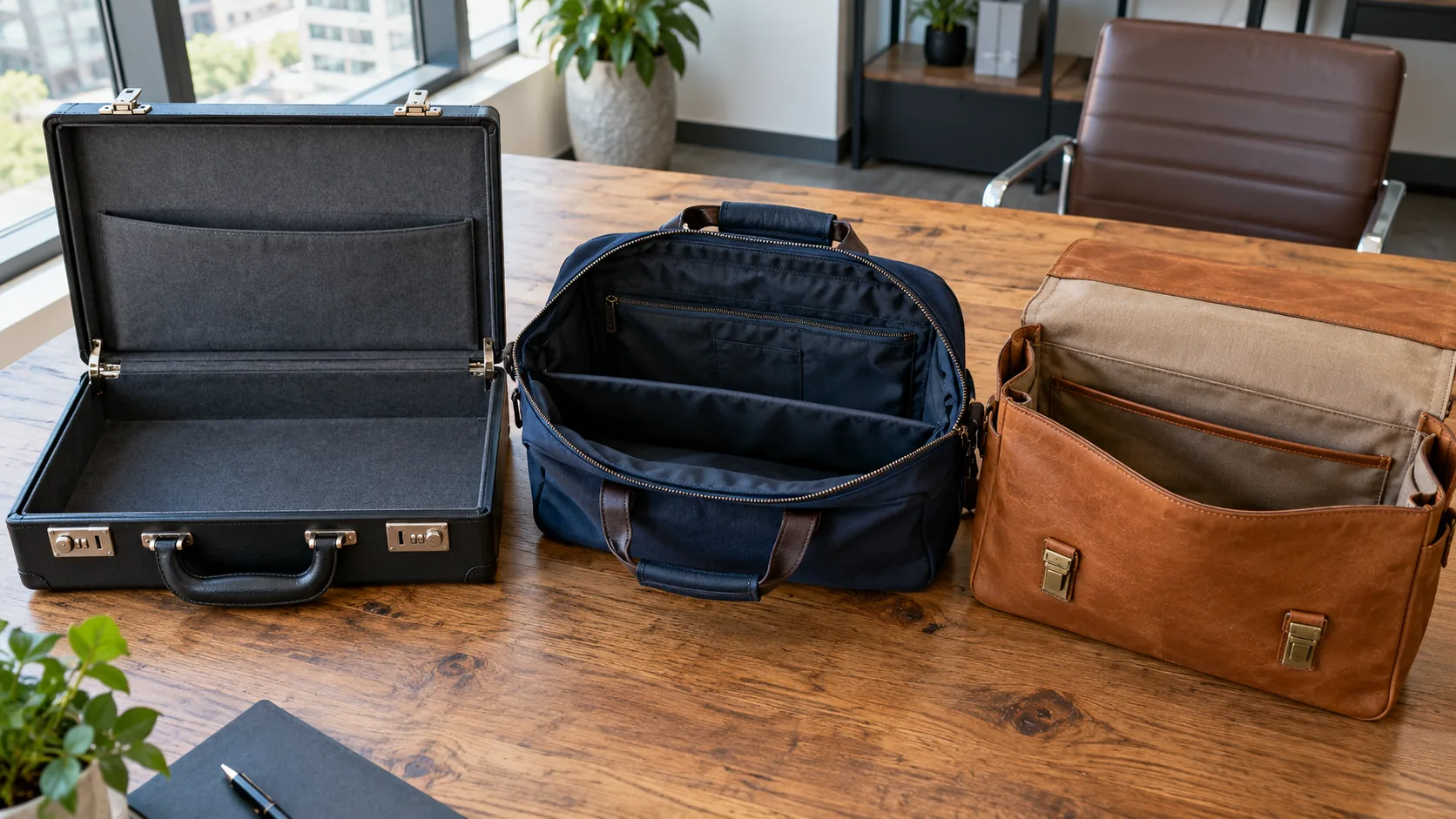
Rigidity alone is not evidence of security, impact protection, or water resistance. A latch describes a closure; it does not prove resistance to forced entry. Padding identifies an interior construction; it does not establish a drop-test result. If either claim matters, request evidence for that particular product configuration and scenario.
Opening layout affects where and how you can reach the contents. A hinged case needs space for its lid. A zip opening may be confined to the top or extend around additional edges. A flap may cover another closure underneath. An open document holder has a different retention arrangement from a zipped portfolio. Check the actual sequence rather than assuming that one closure is always faster or more protective.
Try the access task you expect to repeat: take out a folder, retrieve the charger without removing the laptop, or open a presentation case on a small table. Look for binding at the zipper, contents pressing against the lid, and pockets that become hard to reach when the main compartment is filled.
Carrying options need their own checks. A shoulder strap can leave the hands available, but its presence does not prove comfortable loaded carry. Wheels support the case on a suitable surface; you may still have to lift it over steps or into storage. A convertible design should be checked in each intended mode, including where unused straps go and whether changing orientation changes access to the contents.
For a development project, trace the actual support assembly from handle or strap through its hardware, attachments, reinforcement, and body panel. Record the components that exist in that design. A rating for one clip or ring cannot establish the carrying performance of the whole briefcase.
How Do You Check Laptop, Document, and Sample Fit?
Measure the objects you intend to carry, not just the category written on the bag. A laptop screen-size label refers to the screen diagonal, a convention described in MIT’s laptop-selection article. It does not give the computer’s outside width, depth, or thickness.
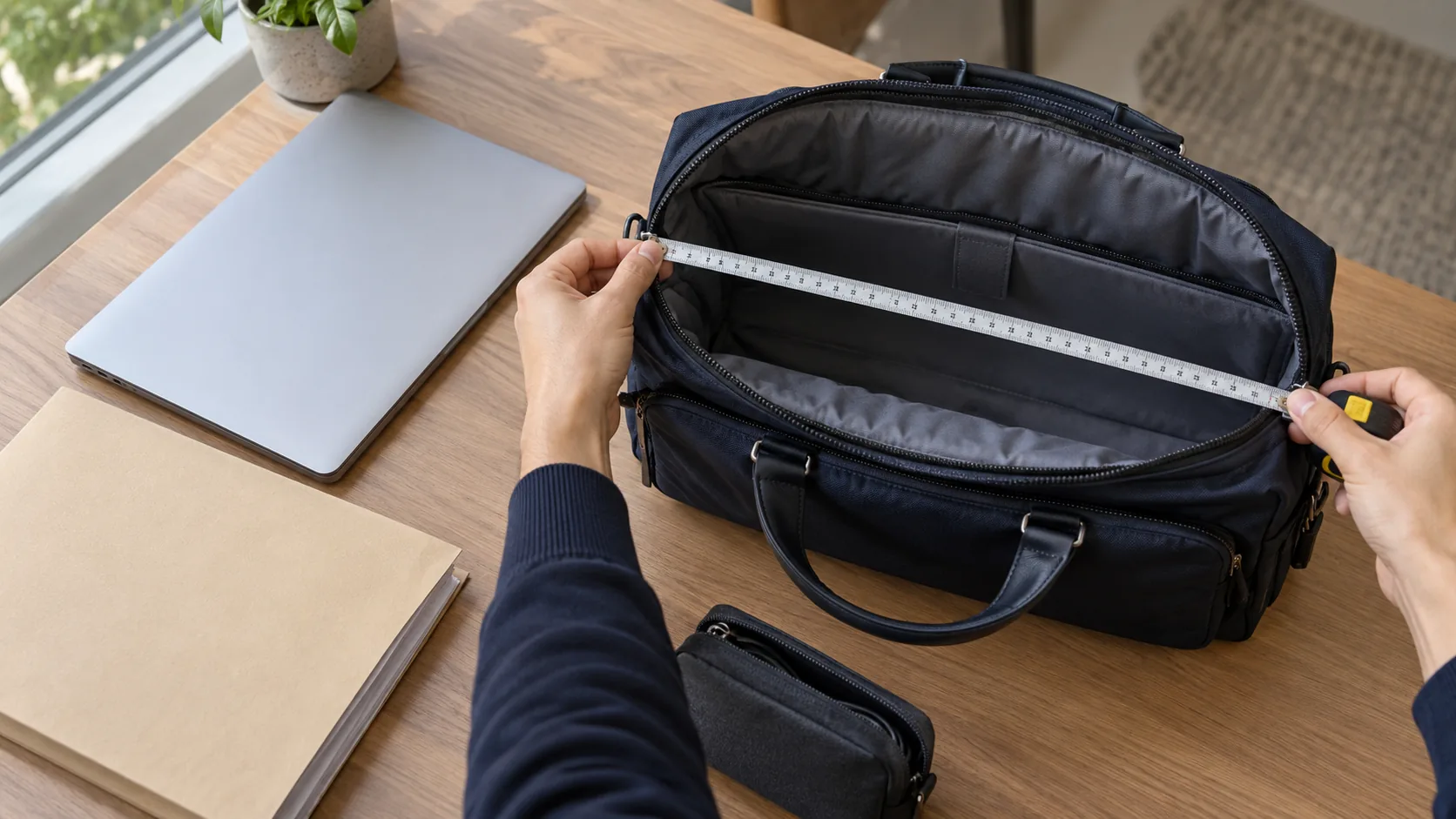
Use the laptop’s actual body dimensions, including a protective cover if it will stay on. Compare them with the finished sleeve and the path into it. Padding, seams, pocket construction, and a narrow zipper aperture can reduce the space available inside a bag with generous exterior dimensions.
The fit check has three separate questions:
- Can the object pass through the opening without forcing the frame, zipper, or device?
- Does it sit in the intended compartment in its normal carrying orientation?
- Can the bag close and the object be removed with the rest of the intended loadout in place?
For documents, check the folder or binder rather than a loose sheet. Covers, tabs, binding, and a filled spine change the envelope that must fit. For sales samples, include the tray, dividers, packaging, and any protruding parts. “Fits the contents” is incomplete if those contents cannot be inserted or retrieved normally.
A development drawing should distinguish exterior dimensions, usable internal space, and opening clearance. Define the measurement points and state: empty or with a reference load, expansion closed or open, and any padding condition relevant to the method. Target dimensions, project-agreed tolerances, and appearance references have different jobs; a photograph or approved sample does not replace a dimensional measurement.
There is no universal finger-width allowance for every device or folder. Record the intended fit and confirm it with the actual object, a dimensionally representative dummy, or another agreed reference. If a divider, lining, or padding thickness changes later, repeat the affected fit checks instead of assuming the outside dimensions settle the question.
Which Format Fits Your Work Routine?
Begin with the contents and the route. Walking between transit stops, moving a case between a car and a meeting room, and pulling files through a building impose different access and carrying tasks. A job title by itself does not decide the format.

| Work routine | Formats worth comparing | Check with the intended contents |
|---|---|---|
| Folders and office documents | Attaché-style, flap, zip-top, or document case | Folder envelope, divider layout, and access on the available table |
| Laptop commute | Laptop briefcase or convertible design | Sleeve fit, accessory placement, carrying modes, and strap storage |
| Sales presentations | Structured, expandable, or rolling case | Sample-tray dimensions, opening clearance, and arrangement for presenting |
| Business travel | Expandable, rolling, or strap-equipped briefcase | Loaded exterior dimensions, lifting tasks, and access to travel essentials |
| Bound legal or professional files | Attaché-style or another document-oriented layout | Actual binder thickness, paper space, dividers, and closure pressure |
| Mixed walking and transit | Convertible or strap-equipped design | Mode changes, unused straps, and access in each carrying orientation |
These are starting points, not rankings. A wheeled case deserves particular attention where the route includes stairs or uneven surfaces. A convertible deserves attention where its backpack straps must be stowed before a meeting. Neither feature eliminates the need to check the actual route and loadout.
Use a reference loadout when comparing samples. Bring the same device, folder, charger, and other relevant items to each check. Note which carrying arrangement was used and whether the case was expanded. A comment such as “easy to carry” becomes more useful when it identifies the person, contents, route, and setting of that observation; it is still not a universal comfort claim.
For air travel, the relevant size allowance belongs to the particular carrier and journey. Check it separately against the bag’s loaded configuration. This guide does not assign a universal cabin size or treat a luggage sleeve, lock, or retail travel label as proof of airline acceptance.
What Do Material Labels and Performance Claims Mean?
A briefcase can use different materials for the shell, lining, reinforcement, frame, handle, strap, and hardware. “Leather briefcase” may describe the exterior while leaving the other components unspecified. “Nylon briefcase” identifies a fiber at some level; it does not describe every layer or the finished performance.
Keep yarn size and fabric weight separate. Denier describes yarn linear density, not fabric mass per unit area. Weave, yarn construction, coating, backing, and other layers belong in separate fields. Compare the particular materials and assembly instead of assuming that leather is more durable or textiles are lighter.
When evaluating a nylon bag material specification, identify which panel it covers and which construction, finish, and evidence belong to it. A fabric result is not automatically a result for the seams, zipper, attachments, or complete case.
| Retail phrase | Question to resolve before relying on it |
|---|---|
| Genuine leather | Which components use leather, and what material construction, thickness, and finish are specified? |
| Water-resistant | Which object was assessed, by what method and exposure conditions, and with what result? |
| TSA-friendly | What specific feature or claimed screening benefit does the seller mean, and what applicable evidence supports it? |
| Anti-theft | Which mechanism and threat does the claim address, and what evidence supports its stated scope? |
| Shockproof | What finished configuration, payload, impact conditions, and acceptance criteria were assessed? |
| Fits a 15.6-inch laptop | What are the usable sleeve dimensions and opening clearance, and which actual device was checked? |
Do not turn those questions into guarantees of your own. A concealed zipper is an observable feature, not proof that theft cannot occur. A material finish does not establish that a closed, loaded briefcase keeps its contents dry. If evidence is absent, describe the construction that can be verified and leave the broader performance claim unconfirmed.
For load-bearing attachments, SATRA TM244 provides a useful example of evidence scope. Its public description concerns luggage fittings and their attachments under tensile loading, recording failure force and location. It does not certify comfortable carry, rolling performance, impact protection, or every briefcase bearing a similar handle.
That distinction also applies to an informal sample check. Opening a case and lifting it with the intended contents can reveal fit or access problems. It does not replace a mechanical test where one is needed, and it cannot turn a component’s report into a complete-product rating.
What Should a Briefcase Development Brief Include?
Turn the chosen format into a short, buildable description. For example: “soft zip-top work case, two hand-carry handles, detachable shoulder strap, padded device sleeve, separate folder section, no expansion.” Then add the contents, dimensions, drawings, and any performance requirements needed for that project.
Before requesting a quote from a custom bag manufacturer, separate decisions that a reference image may leave hidden. The image can show appearance; it cannot settle material codes, lining, reinforcement, pocket dimensions, or attachment details.
Keep component records clear. For the parts that need control, distinguish supplier or item code, material and construction, finish, color reference, quantity, placement, and required performance evidence. Drawings can reference those master rows rather than maintaining a second conflicting description. A low-risk stock component may need a simpler record; completeness of a form is not proof of product performance.
Check the sample against the intended configuration
- Dimensions: exterior, usable interior, and opening clearance with defined measurement points and state.
- Structure: shell, base, frame, and reinforcement locations actually specified.
- Opening: zipper path, flap coverage, hinges or latches, and access with the intended contents.
- Handles and straps: attachment layout, adjustment, hardware pairing, and the carrying modes supplied.
- Interior: pocket and divider fit, device retention if specified, and access to accessories.
- Optional systems: expansion open and closed; wheels, pulling handle, and lift handles where present.
- Appearance and branding: placement, method, color or finish reference, and any separately required durability evidence.
Use the loaded case for the relevant handling tasks, but record what was checked. If mechanical validation is required, identify the sample and version, payload and distribution, mounting or carrying arrangement, closure state, chosen method, and acceptance criteria. Include conditioning, cycle, or impact fields only when the selected scenario requires them. Applicable controlled methods may supply defaults; irrelevant fields can be marked not applicable and unresolved requirements remain open.
Keep approval and changes traceable
An approved sample is a comparison reference, not a guarantee that later production lots match it. Identify its version, approval date, and which fields it controls through appearance or feel. Dimensional and performance conclusions need their own measurements or applicable records, and later lots need evidence for the conclusions made about those lots.
When a change affects fit, access, or support, record what changed, why, who approved it, the revision, and where it takes effect. Update the relevant specification, component record, drawing, and sample reference together. Account for work in progress or stock if the change affects them. This can be a concise project record; it is not a claim that every bag order requires the same paperwork.
Keep the approved specification, measurement records, and identified reference sample available when assessing the next lot.
Frequently Asked Questions
Is an attaché case the same as a briefcase?
An attaché case is a more specific hard, flat document-case form; briefcase is the broader comparison term here. Check the actual shell, lid, handle, and closure rather than assuming that either name establishes a lock or a protection level.
Is a portfolio a laptop briefcase?
Not necessarily. Portfolio describes a thin document or drawing case. A particular product may include device space, but verify its usable dimensions, opening, padding, and carrying features. The name alone does not establish a laptop compartment.
Which briefcase type works for a daily laptop commute?
Compare device-oriented briefcases and, if you need another carrying mode, convertible designs. Confirm actual device fit, charger storage, loaded access, and the intended carrying arrangement. A padded sleeve or shoulder strap does not by itself prove protection or comfort.
Are hard-shell briefcases more secure or durable?
Shell rigidity alone cannot answer that. Security and durability claims need a defined scope and evidence for the particular construction, closures, attachments, and use conditions. Choose a rigid form when its shape suits the contents; do not infer a performance rating from that shape.
Can one briefcase cover office work and travel?
It can if its layout, carrying options, and loaded dimensions suit both tasks. Check the reference loadout in each intended configuration, including expansion, lifting, and access. For flights, verify the relevant carrier’s current allowance separately rather than relying on a travel label.