
The name “roller bag” can describe several wheeled formats, so checking a listing’s wheel layout and measurements helps avoid comparing different products.
A roller bag is a bag or case designed to move on integrated wheels, guided by a fixed or telescoping pull handle. The term covers several structures and does not itself establish size, airline acceptance, material, capacity, or intended use.
What Does Roller Bag Mean?
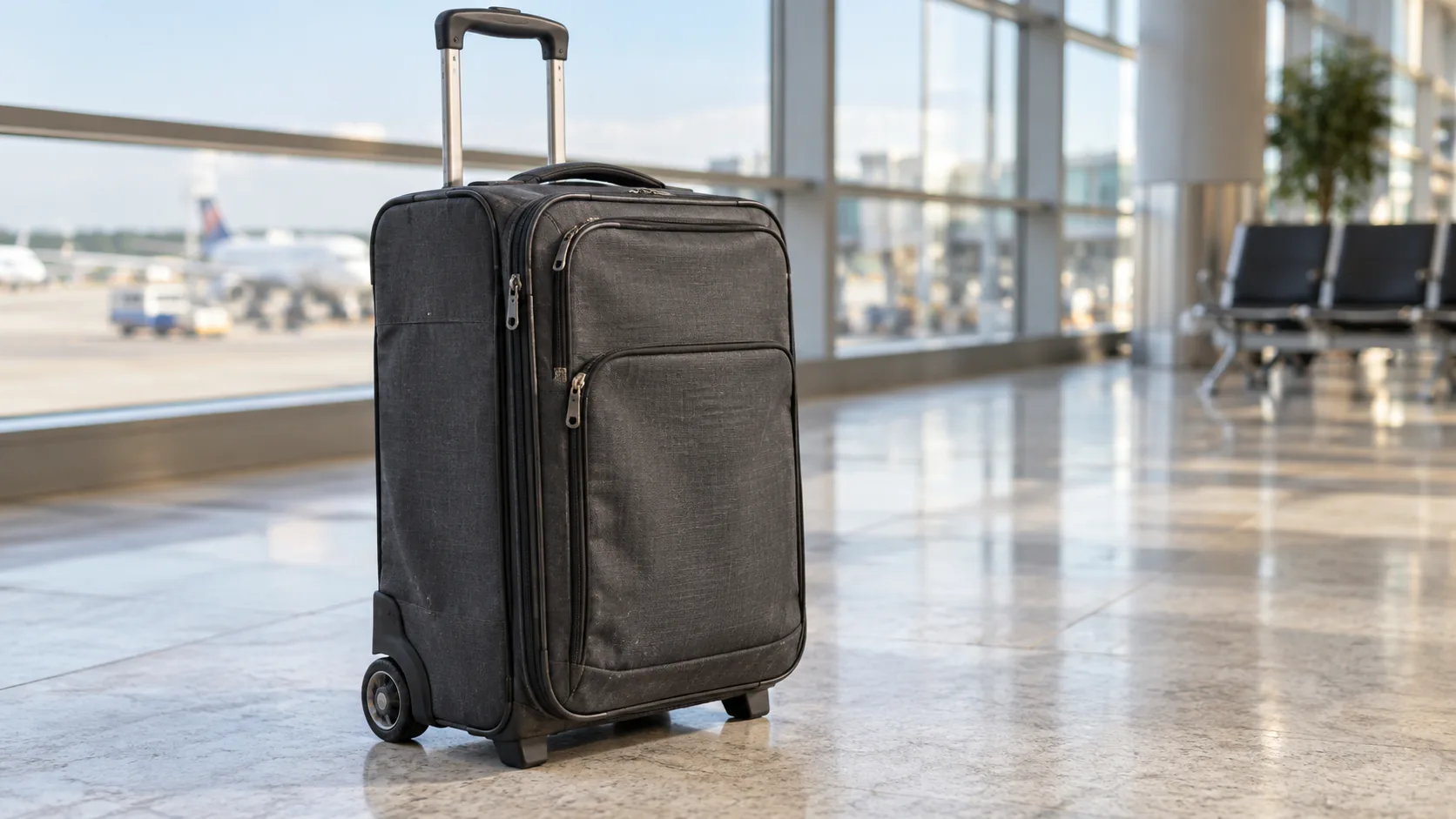
In travel-luggage descriptions, “roller bag” can name the wheeled-luggage family or refer more narrowly to a two-wheel upright case. Check the product photos and specification before comparing it with a spinner or a wheeled duffel.
A suitcase and a roller bag describe different aspects of a product. A suitcase describes a case format; wheels and a pull handle make it a wheeled suitcase. A soft duffel on wheels is a roller bag too, even though its body is not a suitcase.
“Roll bag” is a separate dictionary term. Dictionary.com defines a roll bag as a small zippered duffel used for everyday equipment or supplies. The entry does not define wheeled luggage, so do not assume that “roll bag” and “roller bag” are interchangeable.
One documented wheeled-luggage milestone is Bernard Sadow’s US patent 3,653,474, filed on February 16, 1970, and granted on April 4, 1972. It describes luggage with rollers and a transport strap. Those dates document that patent, not the first wheeled bag or the start of worldwide retail sales.
This guide covers travel luggage. A wheeled bag for particular equipment needs its own brief because the body structure, load distribution, and handling conditions can differ. The wheel-and-handle checks still apply, but they do not establish protection for a particular instrument, tool, or piece of sports equipment.
Which Types of Roller Bags Are Common?
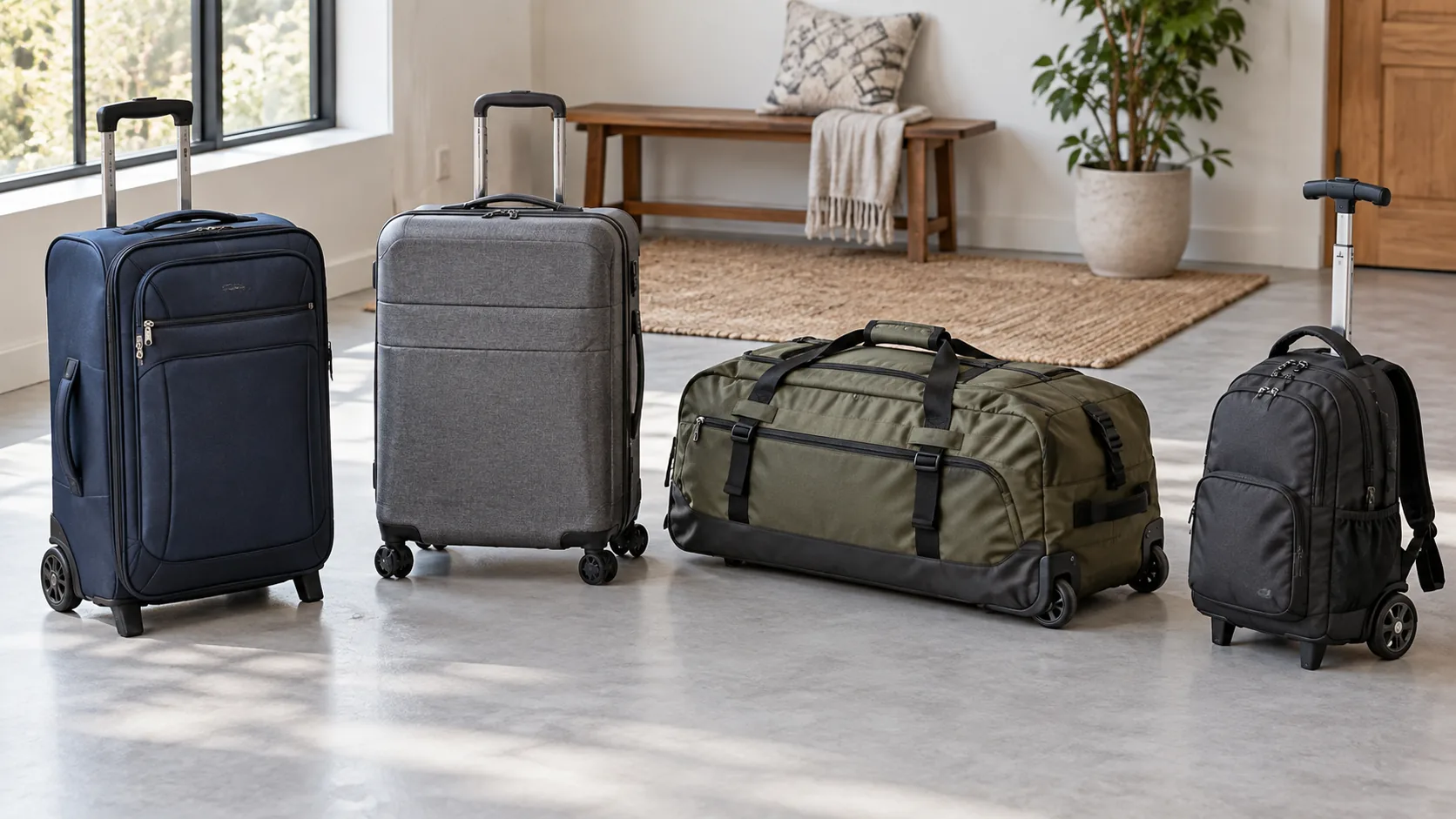
The table separates four common formats. Read the use column as a starting point for comparison, not a performance guarantee.
| Format | Wheel layout | Body structure | Handle system | Use to consider |
|---|---|---|---|---|
| Two-wheel upright roller | Two fixed wheel units along one edge | Hard or soft case tilted onto its wheels to roll | Pull handle plus lifting handles | Travel routes where the actual wheels and clearance suit the ground |
| Spinner | Four swiveling wheel units at the corners; each unit may contain paired wheels | Hard or soft case that can roll upright | Pull handle plus lifting handles | Smooth terminals and movements in tight spaces |
| Wheeled duffel | Often two wheel units at one end | Flexible duffel body with product-specific base support | Pull handle or pulling arrangement, plus grab handles | Bulky gear where the base and attachments suit the load |
| Rolling backpack | Product-specific wheel layout on a backpack body | Backpack with a rolling base, sometimes with stowable straps | Pull handle and shoulder straps | Routes combining rolling with short carrying sections |
Body material is a separate choice from wheel layout. A hard shell does not identify a spinner, and a fabric body does not identify a two-wheel roller. Our guide to bag types explains other body formats if you are also comparing totes, duffels, and backpacks.
For a rolling backpack, check where the straps go during wheeling. Loose straps may reach the ground; a storage pocket or retaining arrangement needs to keep them clear without making the carrying setup difficult to use.
How Do Two-Wheel and Spinner Designs Differ?
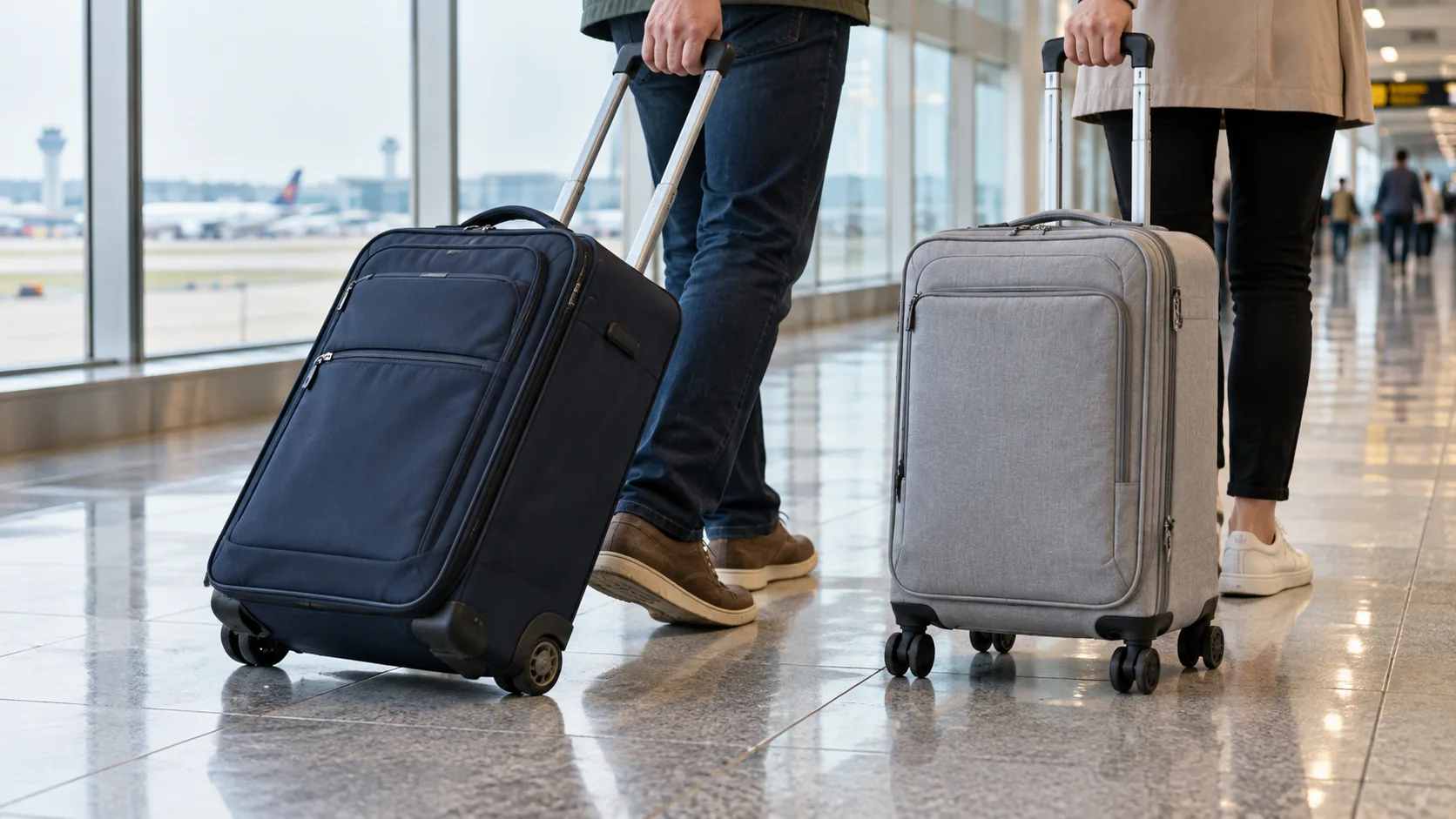
A two-wheel roller rolls on fixed wheels along one edge. You tip the bag toward you and pull it behind you, with part of the load supported through the handle. A spinner uses swiveling wheel units and can roll upright alongside you, in front of you, or sideways.
Wheel layout and build interact. A two-wheel design with larger wheels and enough body clearance may negotiate a particular pavement better than a spinner with small exposed wheels. That comparison can change with different wheel diameters, housings, loads, or surfaces. Wheel count alone does not establish strength, rolling effort, or service life.
Inspect wheel exposure rather than assuming it from the label. Recessed wheels sit partly within the body or housing; externally mounted units project farther from it. The housing, mounting points, clearance, and available packing space need to be considered together.
Try the bag with the load you intend to carry. Check whether the handle height suits your pulling position, whether the wheels track or swivel as expected, and whether the underside clears the surfaces you plan to cross. An empty showroom demonstration leaves the packed balance untested.
Which Parts Determine How a Roller Bag Moves and Stands?
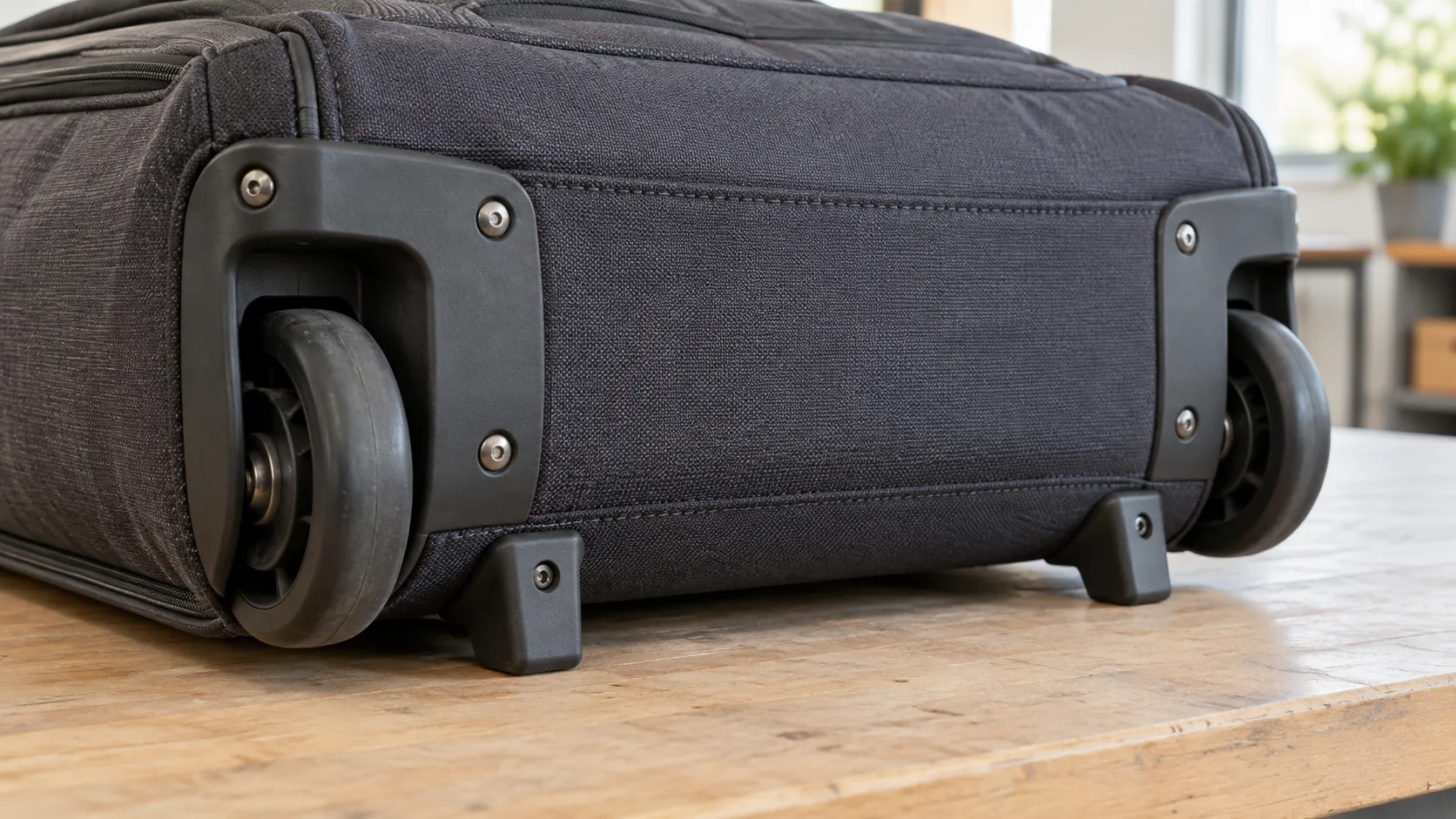
When you inspect a roller bag in a store, a development sample, or a product specification, look at the components and the places where they connect:
- Wheel housing and axle. Check the wheel’s mounting, visible fasteners, freedom of movement, and position relative to the body. A protected wheel still needs clearance to turn.
- Wheel size and material. Read the specification for the actual wheel and bearing. Test the assembled bag on relevant surfaces rather than inferring performance from a material name.
- Base support. Identify what supports the bag when upright: feet, rails, wheel units, or the case itself. Check stability with the intended load on a level floor.
- Telescoping handle. Check extension, locking positions, tube movement, and access for replacement. If a second bag will ride on the handle, include it in the evaluation.
- Grab handles. Top and side handles are how you lift the bag onto racks and into vehicles. Inspect their attachments to the body as well as the grip itself.
- Body clearance. Check the gap between the underside and the ground in the bag’s normal rolling position. A body that clears a smooth floor may still scrape a threshold.
On a rolling backpack, also inspect the shoulder straps and their connections. Our backpack parts and accessories guide covers those carrying components separately from the wheel system.
For a product brief, distinguish a supplier’s wheel component from the wheel assembly installed on the bag. A component report describes the object tested; it does not by itself prove how the mounted wheel, housing, fasteners, and surrounding body perform together.
If a sample wobbles, jams, or loses a fitting, record the observation before assigning a cause. Note the part and mounting location, the load and surface, what happened, and photographs of the affected area. The same symptom can require a component check, an attachment check, or a finished-bag evaluation.
When Does a Roller Bag Fit the Trip or Use Case?
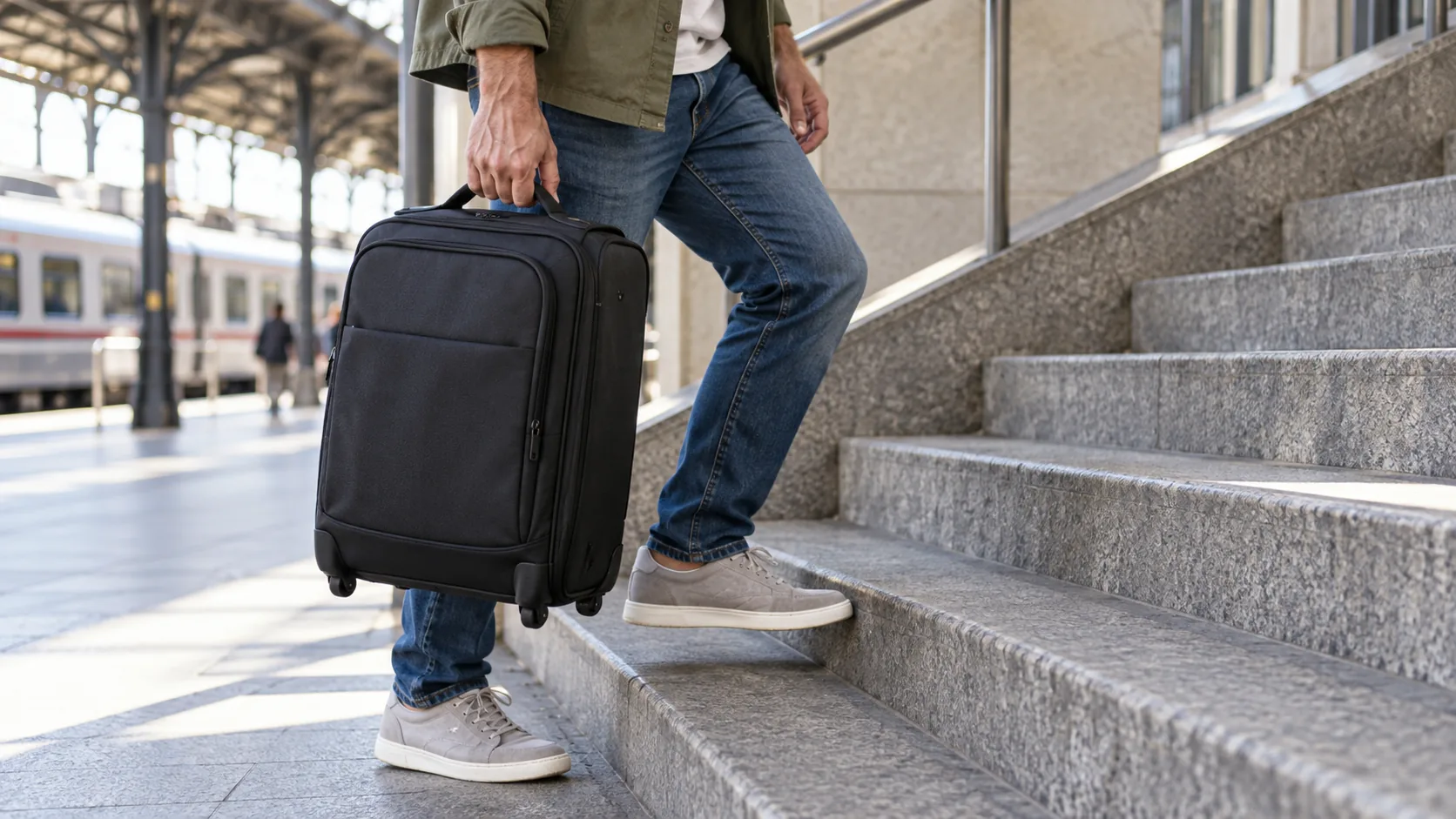
A roller format fits a trip only as well as it fits the surfaces and handling steps between door and destination.
Count the lifting steps in your route: car to curb, curb to platform, and platform to rack. Wheels reduce carrying along suitable ground, but you still need to lift the bag where the route requires it. If the route favors carrying, compare the whole journey using our guide to traveling with a backpack or a suitcase.
| Condition | What to evaluate | Check on the actual bag |
|---|---|---|
| Smooth terminals and long concourses | Upright movement and changes of direction | Loaded tracking or swivel action, handle height, and stability |
| Rough streets, cobblestones, or gravel | Wheel size, housing exposure, and clearance | Whether wheels catch or the body scrapes on the relevant surface |
| Stairs and changes of level | Carrying weight and lifting access | Grab-handle position, grip clearance, and packed balance |
| Mixed taxi, train, and plane travel | Repeated lifting and restricted storage | Packed outer dimensions, lifting points, and the space available |
| Heavy or dense equipment | Load support and restraint | Base structure, attachments, item movement, and protection required |
| Bulky, soft gear | Body shape and closure under load | Whether the items fit without forcing the zipper or distorting the rolling base |
A flexible duffel can accommodate an awkward shape, but flexibility does not establish load support or protection for fragile equipment. Evaluate those separately. For a route mixing smooth and rough surfaces, test the troublesome part of the route rather than choosing from the airport-floor demonstration alone.
How Should Size, Capacity, and Packed Dimensions Be Compared?
A roller bag’s “size” can refer to three different measurements:
- External envelope: the outermost dimensions, with the included protruding parts clearly identified. These measurements relate to sizers, bins, racks, and vehicle storage.
- Body interior: the usable packing space inside the bag. Handle channels, wheel housings, padding, and compartments may reduce or divide that space.
- Packed dimensions: the actual outside size after loading. Soft panels and pockets can bulge, and opening an expansion zipper may change the envelope.
Two bags with the same external dimensions can offer different packing space. A capacity figure also needs a stated measurement basis before it can be compared with another figure; multiplying the outer dimensions gives a bounding box, not the bag’s measured usable capacity.
For a sample or specification, record the measurement directions, units, and state of the bag. State whether wheels, handles, and projecting pockets are included. Keep empty, loaded, and expanded measurements separate. This is a project measurement record, not a claim that every manufacturer follows one industry-wide protocol.
| Measurement field | Record alongside the number |
|---|---|
| Height, width, and depth | Axis direction, units, and measurement points |
| Bag state | Empty or loaded; expansion closed or open |
| Protruding parts | Whether wheels, handles, and outer pockets are included |
| Load | The contents used for the packed measurement |
| Capacity | The stated method or basis, separate from outer dimensions |
For a flight, check the operating airline’s current rules before buying or packing. The FAA’s carry-on guidance directs travelers to their airline for item counts and maximum sizes. “Roller bag” does not establish carry-on status, and an empty nominal measurement does not establish that a loaded or expanded bag will fit.
What Should Buyers Check in a Roller Bag Sample?
A sample inspection lets you record visible condition and handling behavior. It does not replace a defined durability evaluation or establish how every production bag will perform.
- Wheel housing: look for visible damage, unwanted movement at the mounting, and obstructions to rotation.
- Handle operation: extend the pull handle, try its available lock positions, and record movement or difficulty without assuming every design must feel identical.
- Base stability: stand the bag on a level floor with the intended load and note whether it remains upright.
- Lifting handles: check each intended lifting point within the product’s stated loading instructions; observe the grip and attachments.
- Corner protection: examine guards and surrounding panels for damage, interference, and exposed attachment points.
- Zipper and closure: operate the closure around the loaded bag and note snagging, strain, or misalignment.
- Packed balance: try the intended load arrangement and rolling position. Record tipping or pulling behavior rather than prescribing one packing arrangement for every format.
- Repair access: ask whether wheels and handles are replaceable units and whether suitable replacements are available. Access affects repairability, but it does not determine total service life.
- Packaging: record the condition on arrival and how vulnerable fittings were protected. Keep shipping observations separate from the bag’s rolling performance.
Wheel-system durability and telescoping-handle performance need separate evidence. SATRA’s luggage-method catalogue lists different methods for those objects. Its TM248 public scope describes assessing abrasion and structural damage to loaded wheeled luggage during a rolling-road test. A wheel-system result therefore cannot stand in for a handle result, or vice versa.
When requesting a test, define the sample configuration and the fields relevant to the chosen method: load and its distribution, rolling or lifting position, surface or fixture where applicable, observation points, and the result being assessed. Cite controlled method conditions where appropriate; mark inapplicable fields and unresolved items explicitly. Do not convert a test distance or cycle count into promised years of use.
Choosing one travel bag and developing a wheeled product for a brand involve different decisions. For development, use this checklist as a sample-review record, with the intended user, load, route, and unresolved questions attached. Our custom bag development team can review feasibility against that brief; a request for review does not confirm that ZWbags already makes the proposed roller format.
Frequently Asked Questions
Is a roller bag the same as a suitcase?
A wheeled suitcase can be a roller bag, but wheeled duffels and rolling backpacks also fit the broader travel-luggage meaning. The terms overlap without describing the same body format.
Is a spinner a roller bag?
It fits the broad meaning of wheeled luggage. Some listings use “roller” specifically for a two-wheel case, so check whether the product has fixed wheels or swiveling wheel units.
Is a roller bag automatically a carry-on?
No. Wheels and a pull handle say nothing about airline acceptance. Check the operating airline’s current rules and the bag’s actual loaded or expanded dimensions.
Is a roll bag a shorter name for a roller bag?
Do not assume so. The dictionary entry for “roll bag” describes a small zippered duffel, which need not have wheels. Confirm the intended product from its description.
Do two-wheel or four-wheel bags last longer?
Wheel count alone does not establish durability. Compare the actual wheel assembly, mounting, handle, load, and intended surfaces. If test results are supplied, check the tested product and conditions before comparing them.