
Two bags sold as “shoulder bags” can sit under the arm or down at the hip. The name alone does not describe the fit.
Common types of shoulder bags include totes, hobos, baguettes, saddle bags, satchels, buckets, messengers, and clutches with straps. Their names overlap. Compare the actual shoulder strap or handles, body shape, opening, and intended contents before choosing a format.
This guide uses a broad shoulder-carried family, then separates short and long same-side carry from diagonal crossbody carry. For a brand developing a range, those differences also become fields in the sample brief.
What Counts as a Shoulder Bag?

A shoulder bag hangs from a shoulder by a strap or sufficiently long handles. The Oxford dictionary definition of shoulder bag describes shoulder suspension using a strap; it does not set a particular body shape or capacity.
For comparison here, short shoulder carry places the bag nearer the underarm, while a longer setting can place it lower beside the torso. The exact position depends on the wearer, the bag, and the strap setting. A strap worn diagonally across the torso is a crossbody configuration, even when the same bag can also be carried from the nearer shoulder.
That broad family is a working classification, not an official list of mutually exclusive products. A retailer may separate “shoulder bag” and “crossbody” categories, while a convertible bag fits both. Describe the configuration you are evaluating rather than assuming that every product with the same label hangs in the same way.
Keep four questions separate: What shape is the body? What supports it? Where does it sit when worn? How does it open? The broader types of bags guide covers the surrounding bag families; this page focuses on shoulder fit and carry setup.
Which Shoulder-Carried Shapes Should You Compare?
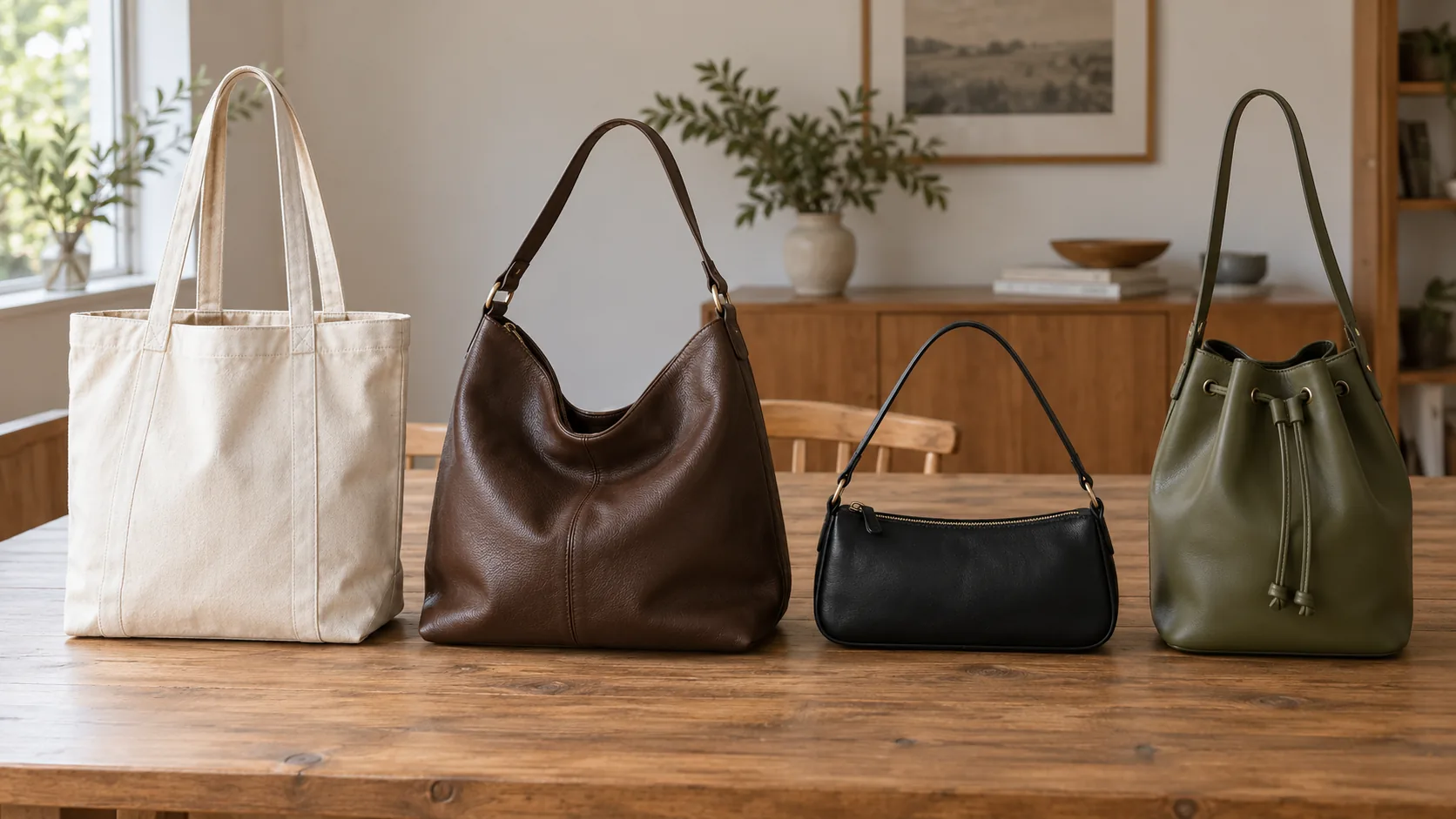
Use these descriptions to identify a sample, not to infer dimensions, protection, or load capacity. The table gives recognizable style cues and the shoulder-carry question each one raises. Actual closures and construction vary within a style.
| Style | Body and opening cues | Shoulder setup to check | Contents and nearby formats |
|---|---|---|---|
| Tote | Broad main cavity, often rectangular; open or closable versions | Whether both handles clear the shoulder and clothing together | Check flat items, bottle position, and small-item pockets; overlaps with shoppers |
| Hobo | Soft, slouching or crescent-like profile; closure varies | Single-strap drop with the body filled, rather than flattened | Check whether small items remain reachable as the body folds |
| Baguette | Compact, horizontally elongated body; flap or zipper versions | Underarm space, opening access, and any adjustable or removable strap | Check the actual phone, wallet, and other essentials; overlaps with compact handbags |
| Saddle | Flap-front profile with a curved lower edge in common usage | Same-side setting versus a longer diagonal setting | Check the usable mouth and interior, rather than the curved exterior outline |
| Satchel | A body-style label with varied structure and closures; may include a handle and shoulder strap | Which strap or handle is intended for shoulder use | Check documents or devices against the interior and opening; overlaps with messenger styles |
| Bucket | Deep, upright body; drawstring, zipper, or other openings | Drop and access to the mouth when carried beside the body | Check retrieval of items at the base and any internal dividers |
| Messenger | Rectangular body, commonly with a broad flap and long strap | Whether it is intended for same-side or diagonal carry | Check flat contents, flap clearance, and any stabilizing features separately |
| Convertible clutch | Compact hand-carried body fitted with a usable strap | Strap attachment, shoulder clearance, and storage of detached hardware | Check whether conversion leaves access and the intended appearance usable |
A tote with short handles may be hand-carried even though a similar tote has shoulder-length handles. The tote bag guide explains that format without making shoulder carry a requirement for every tote.
Crossbody and sling describe an overlapping carry setup rather than additional rows of shoulder shapes here. A sling worn diagonally across the chest or back belongs in the diagonal-carry comparison; it does not tell you how a short shoulder strap should fit under a coat. The same separation applies to satchels and messengers: their names do not settle the strap path. For that body-style boundary, the satchel meaning guide goes into more detail.
| Keep the body | Change the support or wear position | What changes in the comparison |
|---|---|---|
| Soft hobo-like body | Short single strap to a longer adjustable strap | Underarm clearance and lower same-side carry become different sample checks |
| Tote body | Short handles to longer paired handles | A hand-carry version becomes a candidate for shoulder carry; loaded clearance still needs checking |
| Flap-front satchel or messenger | Same-side carry to diagonal carry | The strap path changes, while the body-style name may stay the same |
| Compact clutch body | Add a detachable strap | Shoulder carry becomes possible only if the attachments and strap setting suit it |
How Do Strap Drop and Handle Count Change Fit?

Strap length and strap drop describe different things. Finished strap length follows the strap from end to end. In this guide, drop means the vertical distance from the top of the raised strap or handles to the bag body’s top edge in a stated measurement setup. A product sheet should show the measurement points and whether the bag is empty, filled, or worn.
Two straps with the same end-to-end length can produce different drops because their attachments and bag bodies differ. A soft bag can also change shape when filled. Record the setting and measurement condition before comparing numbers; an unexplained drop measurement leaves those variables open.
For short shoulder carry, check the space between the shoulder and the top of the bag with the intended clothing. Can the wearer put it on and remove it without forcing the opening? Does the top closure remain reachable? A fit check in a thin shirt does not answer the same question as a check over the jacket the product is meant to accommodate.
For longer same-side carry, record where the bag sits and what happens during ordinary movement. Check adjustment access, whether the slider changes position, and whether the body interferes with the wearer’s routine. These are observations to record on the sample, not consequences to predict from one strap dimension.
With a two-handle tote, try both handles together. Note if one drops away, if the handles twist, and how the opening sits against the arm. With a single strap, check its contact area, twist, and attachment orientation. Neither setup establishes comfort or a safe load by itself.
| Shoulder-fit field | What to record |
|---|---|
| Strap or handle geometry | Finished length, width, thickness, handle count, and adjustment range where present |
| Drop | Measurement points, strap setting, bag state, target, and agreed tolerance |
| Attachment | Position on a drawing, hardware item, pairing, orientation, and reinforcement |
| Intended position | Underarm, beside the waist, or lower at the hip, checked with the intended wearer and clothing |
| Convertible settings | Which modes are intended, how the strap changes, and what must be rechecked in each mode |
Follow the actual support assembly from the strap or handles through any sliders, rings, clips, stitched tabs, reinforcement, and bag panel. Include only the components the design has. A ring specification alone does not approve its sewn attachment or the finished bag.
Avoid promising posture improvement, weight distribution, injury prevention, or all-day comfort from handle count, strap width, or drop. Those claims require evidence that applies to the product and its intended use.
What Do Opening, Structure, and Contents Change?

Start with the contents list. Exterior length, width, and height do not show whether a notebook passes through the mouth, whether a bottle stays upright, or whether the closure operates after the bag is filled.
A soft body can fold around its contents, but check whether that folding hides pockets or presses items together. A structured body may retain its outline; that alone does not prove impact protection for a device. If protection is part of the brief, specify the protective construction and the evidence needed for that claim.
Closures also need a practical check. An open mouth can be reached without operating a zipper, but access while wearing it still depends on drop, opening width, and the arm’s position. For a zipper, check the opening length, end positions, operation with the intended contents, and reach from the shoulder. For a flap, check lifting space and the fastening. For a drawstring, check mouth clearance and retrieval from the base.
Closing a bag does not automatically make it waterproof, theft-resistant, or able to retain every small item. Those are separate claims with separate construction and evidence requirements.
Use the following choices as starting points for a sample comparison, not recommendations that one named style always wins.
| Intended use | Shoulder-carry question | Contents or opening check |
|---|---|---|
| Daily essentials | Does the desired short or long setting leave access usable? | Try the actual phone, wallet, keys, and other listed items |
| Work or documents | Do the handles or strap suit the intended clothing and carry position? | Check the largest flat item against the mouth, interior, and closure |
| Travel organization | Can the bag be put on, removed, and closed in the intended routine? | Check mixed contents, small-item pockets, and any stated protective features |
| Larger loads | Does the configured sample remain usable at the proposed load? | Record load mass and distribution; review attachments and applicable testing separately |
| Convertible use | Can each intended strap setting be fitted and operated? | Recheck access, hardware orientation, and appearance after conversion |
For a retail range, keep the merchandising name alongside the functional description. “Baguette” can identify a silhouette, while the specification records the closure, drop, usable interior, and fit configuration. A shopper-facing style name and a factory-facing dimension sheet do different jobs.
How Should You Check a Loaded Shoulder Bag?

Check the sample with the intended contents, wearer, clothing, strap setting, and closure state. Record those conditions so a later comparison uses the same setup. If different sizes or carry modes are offered, decide which configurations need their own checks.
Watch the loaded position and the user’s actions rather than approving only a tabletop photograph. Can the wearer put the bag on, adjust it, open it, retrieve the listed items, close it, and remove it? Check whether a handle moves off the shoulder, a slider shifts, or the body changes position during the movements chosen for the project.
| Sample check | Record the observation and approval basis |
|---|---|
| Loaded position and clearance | Bag position, underarm space, clothing, strap setting, and intended reference |
| Handle or strap behavior | Twisting, slipping, adjustment movement, and any contact issue observed |
| Attachments | Movement, visible deformation, abrasion, or other change at the hardware, tabs, seams, and panels |
| Closure and pockets | Operation with the contents in place; reach and retrieval from each relevant pocket |
| Hanging appearance | Shape, balance, and symmetry compared with the agreed sample or drawing under the same setup |
| Finish | Seam, edge, hardware, and surface appearance against the recorded visual criteria |
A wear-and-access check is different from an attachment-strength test. SATRA TM244 addresses the strength of load-bearing luggage fittings and their attachments, including straps, handles, clips, and rings. Its public description uses tensile loading and records failure force, type, and location. It does not provide a shoulder-fit rule or demonstrate this bag’s comfort.
If a mechanical test is needed, agree on an applicable controlled method or project protocol, the sample identity and configuration, load conditions, endpoint, and acceptance criteria. Cite controlled method defaults where appropriate. Mark irrelevant fields as not applicable and unresolved conditions as open items, rather than filling them with invented values.
An approved sample provides a comparison reference. It does not establish that every later production lot has the same measurements or performance. Keep the sample version and approval date, and identify which later checks require measurements, test records, or visual comparison.
What Should a Shoulder-Bag Development Brief Record?
Give the development team a carry description that can be checked: intended same-side or convertible use, wearer and clothing assumptions, bag position, and contents. Add the body and component fields needed to build and evaluate that configuration.
- Body dimensions by size, usable opening, structure, pockets, and intended contents or load.
- Strap or handle count, finished dimensions, adjustment range, drop measurement setup, and intended settings.
- Attachment positions, hardware pairing and orientation, sewn connections, reinforcement, and material specifications.
- Closure type and operation, lining, edge finish, branding placement, and visual references.
- Sample-check conditions, applicable test methods, acceptance criteria, and outstanding decisions.
Separate a dimensional target from its tolerance and from an appearance reference. A drop target needs measurement points and a defined bag state; an approved photograph can show an intended profile but cannot replace those written fields. Set tolerances for the project rather than importing a generic shoulder-bag allowance.
For the actual components, keep supplier or item code, material and construction, finish, color reference, quantity, placement, and relevant performance requirements in separate fields. A drawing can point to the controlled component row instead of repeating material details in several places. Simplify low-risk items where appropriate; a filled-in record is not proof of performance.
If you change handle length or anchor position after a fit review, record what changed, why, who approved it, the new revision, and the affected sizes or orders. Update the drawing, component record, and sample reference together. Decide what must be rechecked, including access and fit in any affected carry modes, and how the change applies to work already in progress.
Bring that brief and the unresolved questions to a custom bag manufacturer for a scoped sample request. Include the intended carry setup and contents so the discussion starts with a product that can be evaluated, rather than a style name alone.
Frequently Asked Questions
What are the main types of shoulder bags?
Totes, hobos, baguettes, saddle bags, satchels, buckets, messengers, and strap-equipped clutches are useful style names to compare. They overlap, and each name leaves details such as strap drop, opening, structure, and usable capacity to the actual product.
Is a crossbody bag also a shoulder bag?
It can belong to the broad shoulder-carried family used here. Crossbody describes a diagonal strap path across the torso. A convertible bag may also support same-side shoulder carry, but check that setting rather than assuming a long strap works in every mode.
Is every tote suitable for shoulder carry?
No. A tote needs handles that can be worn on the shoulder with the intended clothing and contents. Check both handles together, underarm clearance, opening access, and loaded position. Short-handle versions may be intended for hand carry.
How long should a shoulder-bag strap be?
Choose the length and adjustment range from the intended wearer, clothing, bag position, and carry modes. Define drop separately with measurement points and a stated bag condition, then check the loaded sample. This guide supplies no universal strap length or drop.
Which shoulder bag can carry a heavier load?
The style name cannot establish that. Assess the actual strap or handles, attachments, reinforcement, body, and intended load with applicable evidence. A loaded fit check and an attachment-strength test answer different questions; neither a wide strap nor a large body alone proves comfort or load capacity.