
Packing cubes are zippered fabric organizers used inside a suitcase or backpack. They group clothing and small items into removable modules. Standard cubes mainly improve organization; compression cubes add a mechanism that can reduce the packed depth of soft contents. Neither type reduces weight or changes an airline’s baggage allowance.
The useful question is not whether packing cubes are “worth it” in general. It is whether their size, opening, materials, and construction match the bag and contents you plan to use.
What Are Packing Cubes?
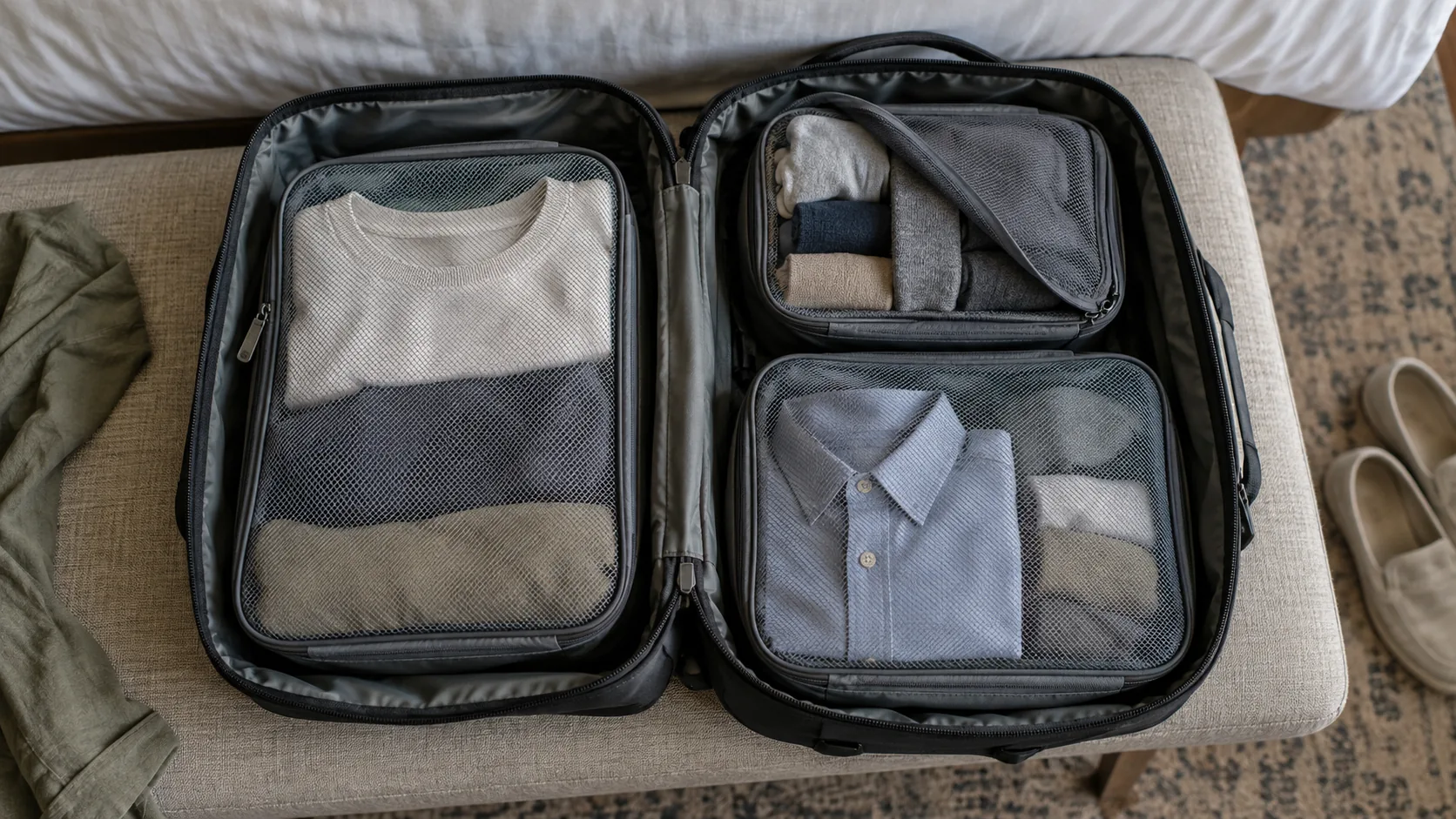
A packing cube is a soft-sided container that sits inside another bag. Most have a zippered opening, fabric sidewalls, and either a solid or mesh top panel. Unlike a fixed divider, a cube can be removed, rearranged, or moved between bags.
The product is simple, but its function depends on several separate parts:
- The footprint determines where the cube can sit inside the main compartment.
- The depth determines how much folded or rolled clothing it can hold.
- The opening controls how easily it can be packed and unpacked.
- The shell, mesh, seams, and zipper determine how the cube behaves when full.
- The handle determines whether the loaded cube can be lifted without pulling on a weak panel.
Product listings often describe shell fabric by fiber name and denier. These are useful identification fields, but they are not complete performance specifications. ASTM separates the measurement of fiber linear density in ASTM D1577 from yarn linear density in ASTM D1907/D1907M. A denier value therefore describes mass per length; it does not directly state fabric thickness, weave density, tear strength, abrasion resistance, coating, or finished-product life.
For comparison, record the fiber or polymer, yarn or filament specification, fabric construction, mass, finish, and any performance evidence separately. A larger denier number alone does not establish that one packing cube will last longer than another.
What Do Packing Cubes Actually Do?
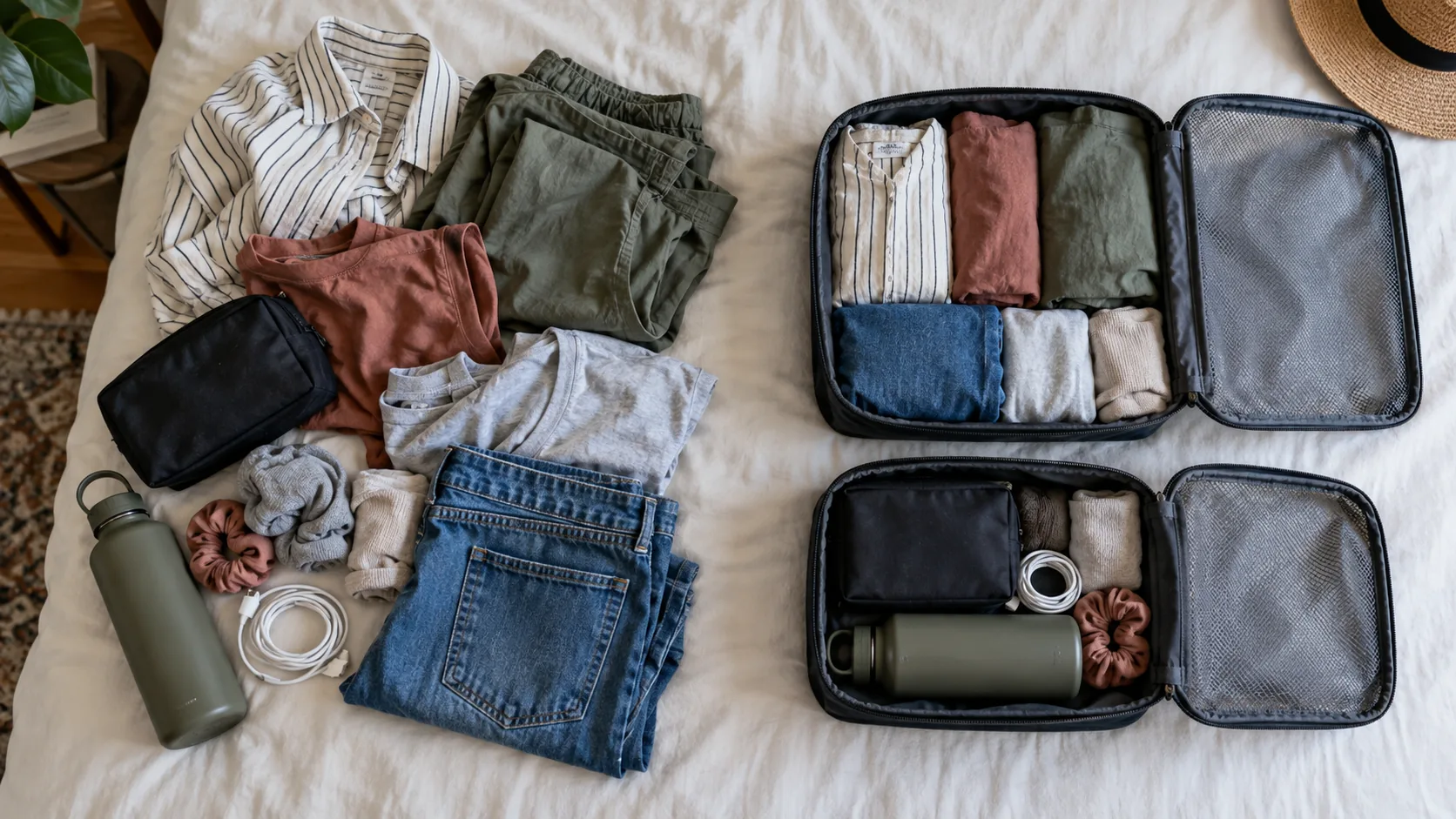
Packing cubes improve grouping, access, and load control. Their core benefit is organizational: one category can be removed without disturbing everything around it.
They can help in four distinct ways:
- Grouping: socks, underwear, shirts, cables, or other categories stay together.
- Access: a traveler can remove one module instead of unpacking the whole bag.
- Shape control: soft clothing becomes a more predictable block that is easier to arrange.
- Separation: clean clothes, worn clothes, shoes, or small accessories can be assigned to different compartments.
Those functions should not be stretched into claims the construction cannot support. A mesh panel does not contain liquids. A coated shell does not make a cube waterproof when water can pass through seams, zipper openings, or other panels. A clean/dirty divider creates separation, but it does not by itself prove odor containment, hygiene, or washability.
The same distinction matters when selecting mesh. “Mesh” names a broad structural family, not one material with fixed airflow, stretch, snag, or retention performance. If airflow is a required product claim, ASTM D737 provides a method for measuring air permeability in textile fabrics. The result still belongs to the tested material, conditions, pressure difference, area, and units. A visible mesh panel is not a numerical airflow result.
What Types of Packing Cubes Are Available?
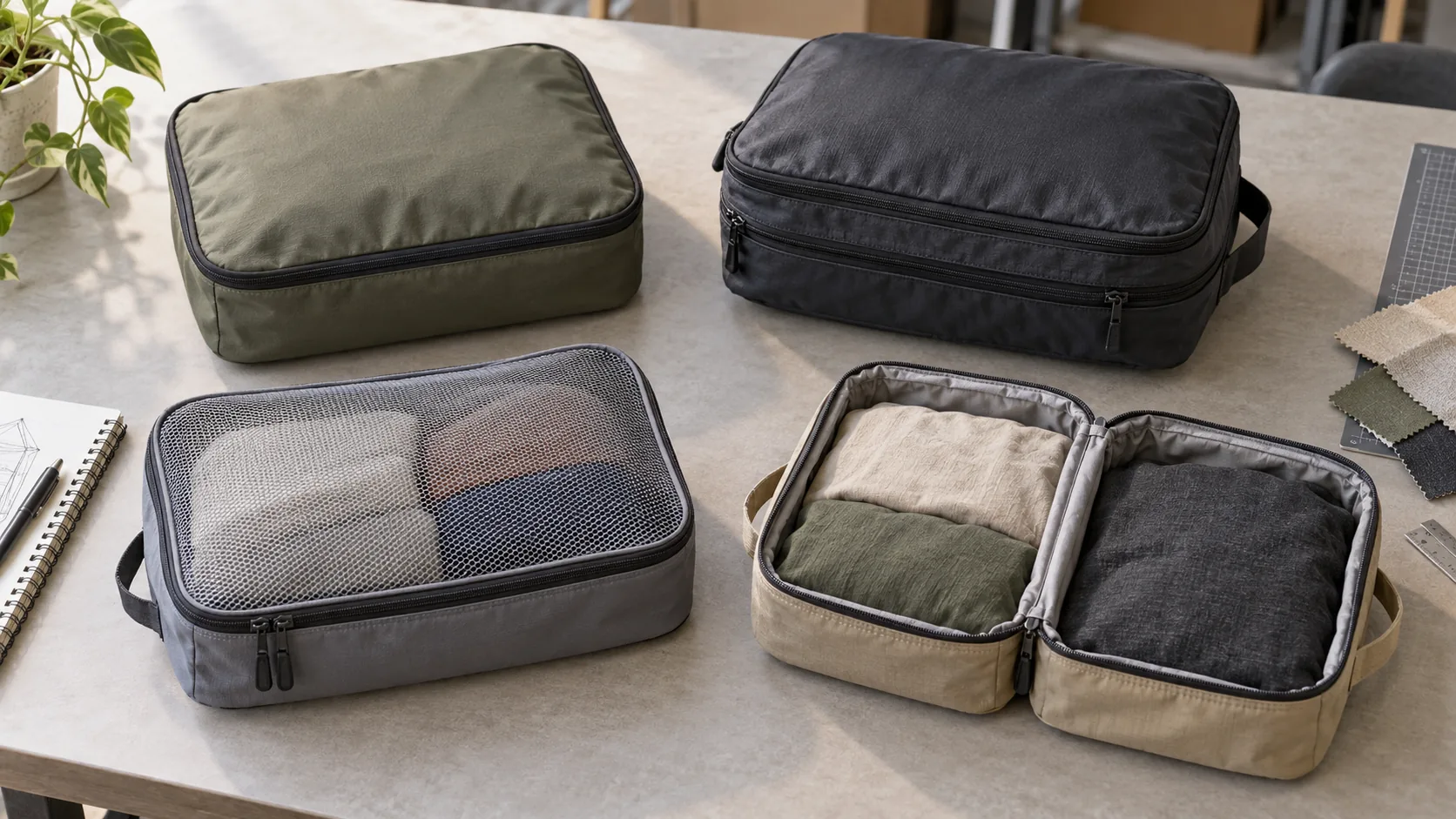
Packing cubes are best classified by mechanism and task, not by brand or color. The main variants are standard cubes, compression cubes, mesh-panel cubes, divided cubes, shoe cubes, and structured organizers.
| Type | Main job | What to check |
|---|---|---|
| Standard cube | Groups general clothing | Opening size, usable depth, shell, seams, and packed shape |
| Compression cube | Reduces the depth of compressible contents | Compression zipper or straps, gusset construction, and zipper access when full |
| Mesh-panel cube | Makes contents visible and allows air exchange | Mesh structure, opening geometry, snag exposure, and panel placement |
| Divided cube | Separates two groups of contents | Divider attachment, usable volume on each side, and whether the divider is solid or permeable |
| Shoe cube | Keeps footwear separate from clothing | Wipe-clean surfaces, opening size, outsole contact area, and cleaning instructions |
| Structured organizer | Holds cables or small hard items in position | Hidden support layers, pocket layout, closure, and protection required |
A compression cube usually adds a second zipper around a gusset or another tightening mechanism. It works best when the contents contain air that can be displaced. Thick knitwear may compress visibly; rigid items and already dense loads may change very little. The same mechanism can increase stress on the zipper path when a user forces an overfilled cube closed.
Divided cubes also need precise language. A second compartment can separate worn clothing from clean clothing, but the divider construction determines what crosses between them. If a brand needs liquid, odor, or contamination control, that requirement needs its own material and finished-sample verification. “Clean/dirty” is a layout description, not evidence of a barrier.
Repeated sizes are not automatically filler. Two identical cubes may serve different travelers, packing zones, or clothing categories. A set becomes poorly composed only when its quantities and dimensions do not match the intended bag and use case.
How Should You Choose Packing Cube Sizes?
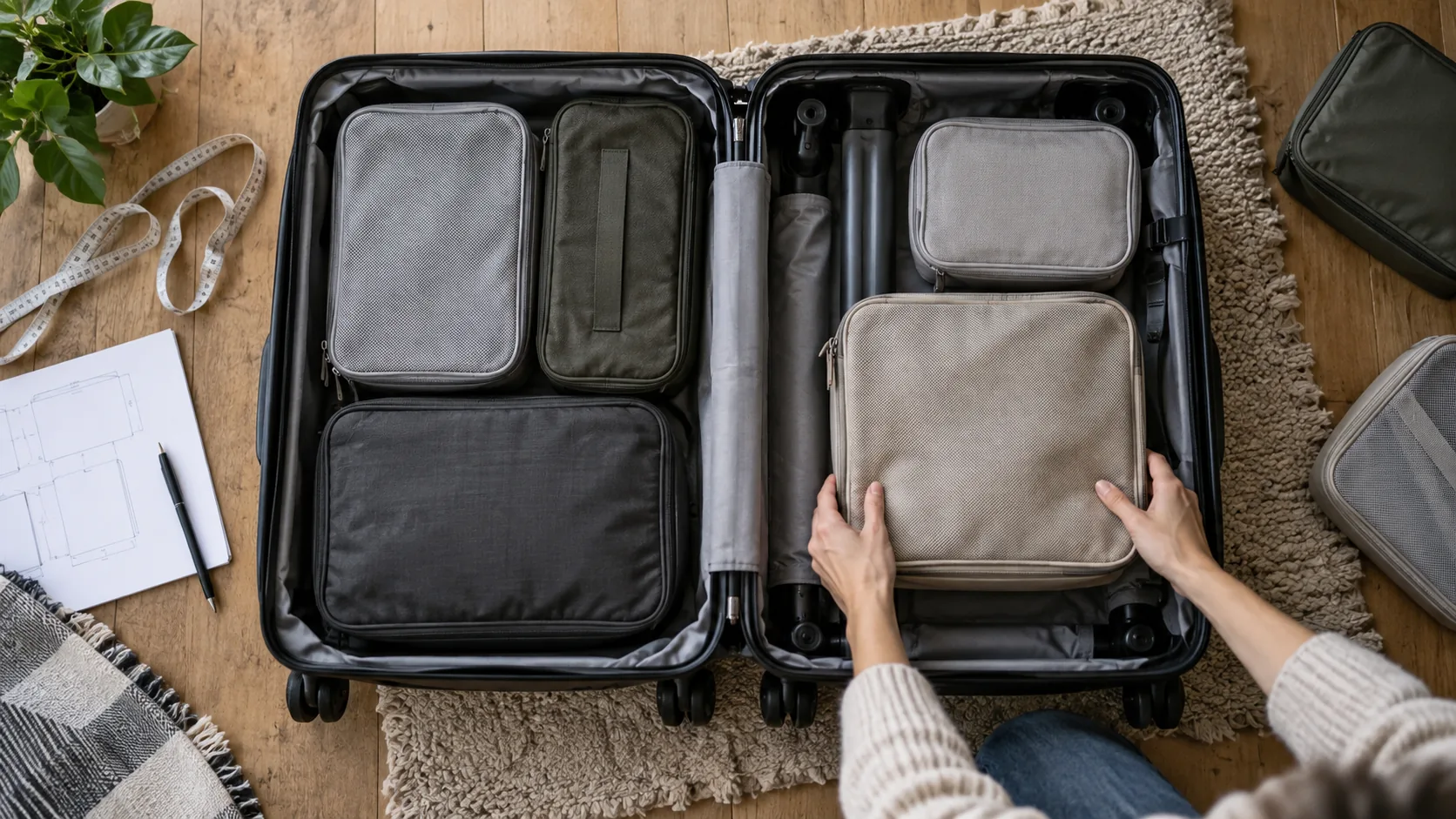
Choose packing cube sizes from the target bag’s usable cavity and opening. A generic small-medium-large label does not tell you whether the set will pass wheel wells, tapered corners, fixed dividers, or a narrow backpack opening.
Use this sequence:
- Measure the usable length, width, and depth of the compartment in its intended packed state.
- Record obstructions such as wheel housings, frame channels, handle tubes, padding, dividers, and curved corners.
- Measure the opening separately. A cube can fit the cavity but still fail to pass through the opening.
- Map the largest useful cube first, then use smaller footprints for the remaining geometry.
- Check the plan with the actual contents, not empty shells alone.
- Load the full set into the target bag and measure the bag again.
Our guide to measuring a backpack explains why external dimensions, calculated volume, and usable internal capacity are different records. The same boundary applies here: a cube dimension is meaningful only when the measurement state and points are defined.
Bag style changes the answer. A clamshell backpack can accept wide, shallow cubes through a large panel opening. A top-loading backpack often needs narrower modules that enter vertically. A suitcase may offer a broad rectangular footprint but lose space around wheel wells and the telescopic-handle housing. The travel-backpack packing guide shows how organizers fit into a complete load rather than being treated as isolated boxes.
For a product-development brief, record each cube’s flat external dimensions, intended packed dimensions, opening path, target contents, target bag, and measurement method. “Medium cube” is not a reproducible specification.
Do Packing Cubes Save Space?
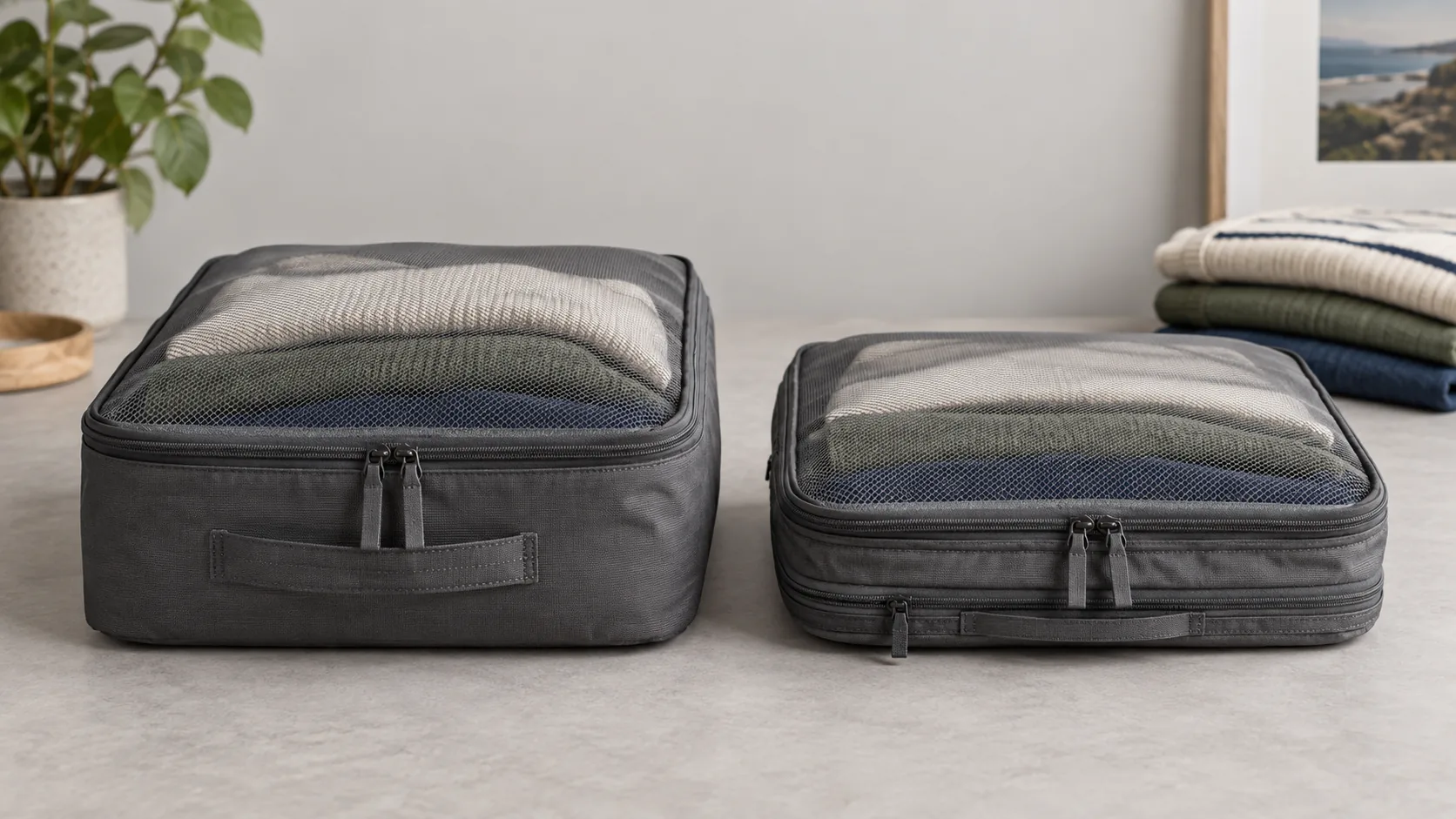
Standard packing cubes mainly organize space. Compression cubes can reduce the depth of some soft loads, but the result depends on the contents, fill level, mechanism, and measurement method. No universal percentage applies to every bag and load.
Three separate effects often get combined under “save space”:
- Regularity: cubes can turn loose garments into shapes that are easier to arrange.
- Compression: a gusset zipper or straps can reduce the depth of contents that contain compressible air.
- Allowance: the airline still evaluates the actual bag, not the internal organizer.
Cube fabric, seams, and corners occupy some volume. Regular shapes may use a particular bag more efficiently, but they may also leave gaps in a tapered or irregular compartment. The net result changes with the bag geometry and the user’s original packing method.
Compression does not remove mass. After loading, check the bag’s maximum external outline, including bulging pockets and any expanded section. The FAA advises travelers to confirm the number and maximum size of carry-on items with their airline because carrier rules can differ and change; its current carry-on baggage guidance also makes clear that fit in the aircraft remains relevant. Packing cubes do not create a separate exemption.
Brands making a volume-reduction claim should define the test object, contents, starting fill, closure method, measuring points, conditioning, endpoint, and calculation. A before-and-after photograph can illustrate the mechanism, but it does not replace a repeatable method.
Which Features Matter Most?
The best comparison is component by component. Appearance alone does not reveal zipper compatibility, seam behavior, hidden support layers, or how the cube holds its shape under load.
Shell and mesh
Record fiber identity, fabric construction, linear-density fields where relevant, mass, finish, and coating as separate items. For mesh, also record the structure, yarn, opening geometry, direction, panel position, and edge attachment. Do not convert a mesh count, visible hole size, or marketing term into an airflow or snag-resistance claim without an applicable method.
If nylon is being considered for the shell, the nylon bag material guide explains why polymer name, yarn, weave, finish, and test evidence need separate control.
Zipper system
A zipper is a system of chain or elements, tape, slider, puller, stops, and installation details. Record the actual component source or code, size designation, slider and pull configuration, zipper path, opening behavior, and approved reference. A nominal size alone does not prove that parts from different suppliers are compatible.
ASTM D2061 contains several strength tests for zippers and zipper parts and explicitly notes that no single test establishes suitability for every end use. A compression cube may need more than one evidence point because slider, chain, stops, puller, and installed zipper path face different loads. Finished-sample opening and closing checks should use the target fill and failure observations, not a bare “zipper passed” statement.
Seams, handles, and hidden structure
There is no universally correct seam construction for every packing cube. The seam must suit the fabric, fray behavior, load, required finish, and production method. Record the seam and stitch construction, thread, allowance, binding or edge finish, reinforcement locations, and the failure mode to be checked.
Handles should be assessed at their attachment, not only by pulling the webbing itself. Structured organizers may also contain interfacing, foam, or stiffener that cannot be confirmed from a finished photograph. List each hidden layer, its location, and its approved-sample reference in the specification.
Care and set composition
Do not assume machine washing from the shell fiber alone. Mesh, coatings, binding, labels, printing, support layers, and zipper finishes may require different care. Approve the care instruction against the finished sample.
For the set, confirm size, quantity, color identification, nesting behavior, target bag, and intended category for each piece. The aim is not the largest piece count. It is a combination that solves the planned packing jobs.
What Should Brands Verify Before Production?
A packing cube set should be reviewed as a system inside its target bag. A written specification keeps quotation, sample approval, testing, and bulk inspection tied to the same product version.
| Specification field | Record before sample approval |
|---|---|
| Size and measurement | Flat and packed dimensions, measurement points, state, units, and project tolerance |
| Target bag | Model or approved reference, usable cavity, opening, and obstructions |
| Target contents | Item categories, fill condition, and required arrangement |
| Shell | Fiber or polymer, construction, mass or yarn field, finish, coating, color reference |
| Mesh | Construction, opening geometry, direction, placement, and required endpoint |
| Zipper | Component code or source, size system, slider, puller, stops, path, and opening behavior |
| Compression mechanism | Gusset or strap construction, full-load closing method, and acceptance observations |
| Seams and thread | Seam/stitch construction, thread, edge finish, reinforcement, and failure observations |
| Handle | Material, dimensions, attachment, target loaded condition, and endpoint |
| Hidden layers | Interfacing, foam, stiffener, divider, and location |
| Care and labels | Approved instruction, label content, placement, and attachment |
| Set and packaging | Piece count, size mix, nesting, color coding, and retail pack configuration |
Targets, tolerances, and approved samples do different jobs. A target records design intent. A tolerance needs defined measuring points and a method. An approved sample can carry visual and handling references, but it does not replace written dimensions, material identity, or test evidence.
Review a complete loaded set before approval. Check whether each cube passes through the bag opening, whether the planned stack fits without distorting the bag, whether the compression zipper can be operated at target fill, and whether handles and seams remain stable during normal removal. A custom bag manufacturer can then quote and sample against the same controlled fields instead of interpreting category names.
Frequently Asked Questions
Are packing cubes useful for backpacks?
Yes, if the cube dimensions match both the usable cavity and the opening. Clamshell packs can accept wider, flatter cubes; top-loading packs often need narrower modules that can enter vertically.
Do compression packing cubes reduce weight?
No. Compression changes the shape and volume of some soft contents, not their mass. The cube itself also adds material and hardware to the load.
Should clothes be rolled or folded in packing cubes?
Use the method that suits the garment and cube. Rolling can fill small cavities with soft garments. Flat folding may be better for items where concentrated creases matter. Neither method is universally superior.
Are packing cubes waterproof?
Do not assume so. A coated shell can resist water while mesh, seams, zipper paths, and openings remain entry points. A waterproof or water-resistant claim needs a defined object, exposure, state, endpoint, and post-test inspection.
Can packing cubes be machine washed?
Follow the finished product’s care instruction. Shell fabric alone does not determine care because mesh, coatings, printed labels, support layers, and zipper finishes may respond differently.
Do packing cubes change airline baggage rules?
No. Airlines apply their rules to the actual carried bag and its total weight or external dimensions. Check the specific carrier’s current official guidance before travel, especially when the packed bag is close to a stated limit.
Turn a Packing Plan Into a Verifiable Specification
Packing cubes work when their geometry and construction match the bag, contents, and access pattern. Start with the target bag’s usable cavity and opening, select cube mechanisms by task, and verify the complete loaded set.
For sourcing, avoid shorthand such as “high-denier fabric,” “breathable mesh,” “heavy-duty zipper,” or “medium cube” unless each term points to controlled fields and evidence. A clear specification should identify the component, construction, measurement state, test object, conditions, endpoint, and approved reference. That gives the supplier and buyer the same basis for quotation, sampling, and production review.