
A clutch bag is a compact handbag designed primarily for hand carry. Traditional versions have no fixed handle or shoulder strap, while many current designs add a removable wrist loop, chain, or narrow strap. The name describes the carry format; it does not define one size, material, closure, or level of structure.
That distinction is useful for both shoppers and product teams. A phone may fit the body but not pass through the opening. Two bags with the same outline may behave differently because one is a soft pouch and the other is a molded box. Start with the carry method and required contents, then choose the body, opening, construction, and hardware.
What Is a Clutch Bag?
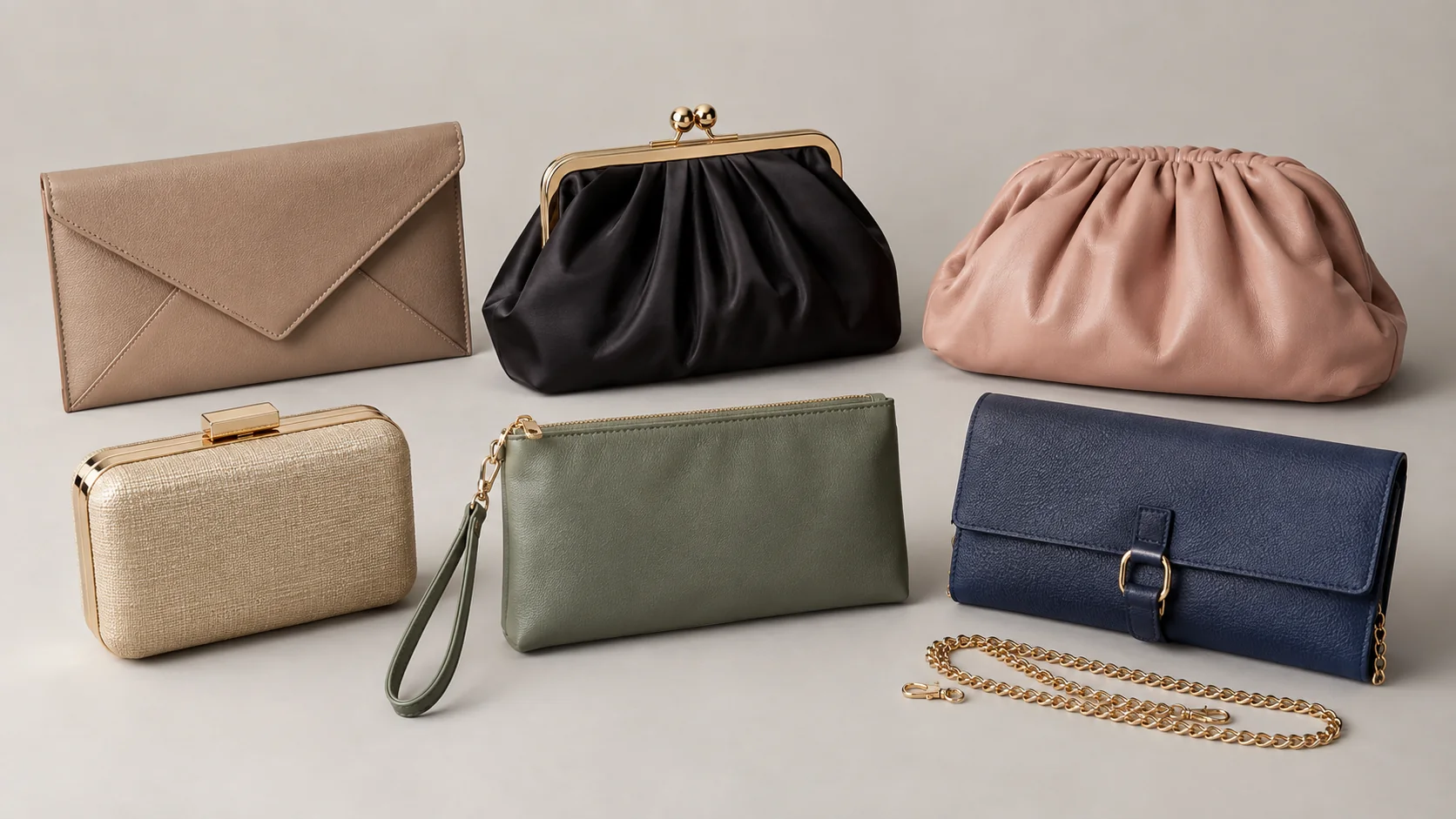
Dictionary.com defines a clutch in the handbag sense as a small purse carried in the hand and usually made without a handle or strap. That definition establishes the traditional boundary, but retail use is broader. Detachable hardware is now common, and a removable chain does not erase the bag’s hand-carried mode when the chain comes off.
The category therefore works best as a carry concept rather than a complete product specification. It can include a flat envelope, a framed evening bag, a soft zip pouch, or a rigid box. It can be made from leather, coated fabric, woven textile, molded material, or a combination of layers. None of those choices follows automatically from the word “clutch.”
A permanently attached shoulder strap usually makes a product function more like a small shoulder bag. A detachable strap creates an overlap: the same body can operate as a clutch in one configuration and a shoulder bag in another. Store categories do not apply this boundary consistently, so product descriptions should name the actual carry hardware instead of relying on the style name alone.
Which Features Define a Clutch Bag?
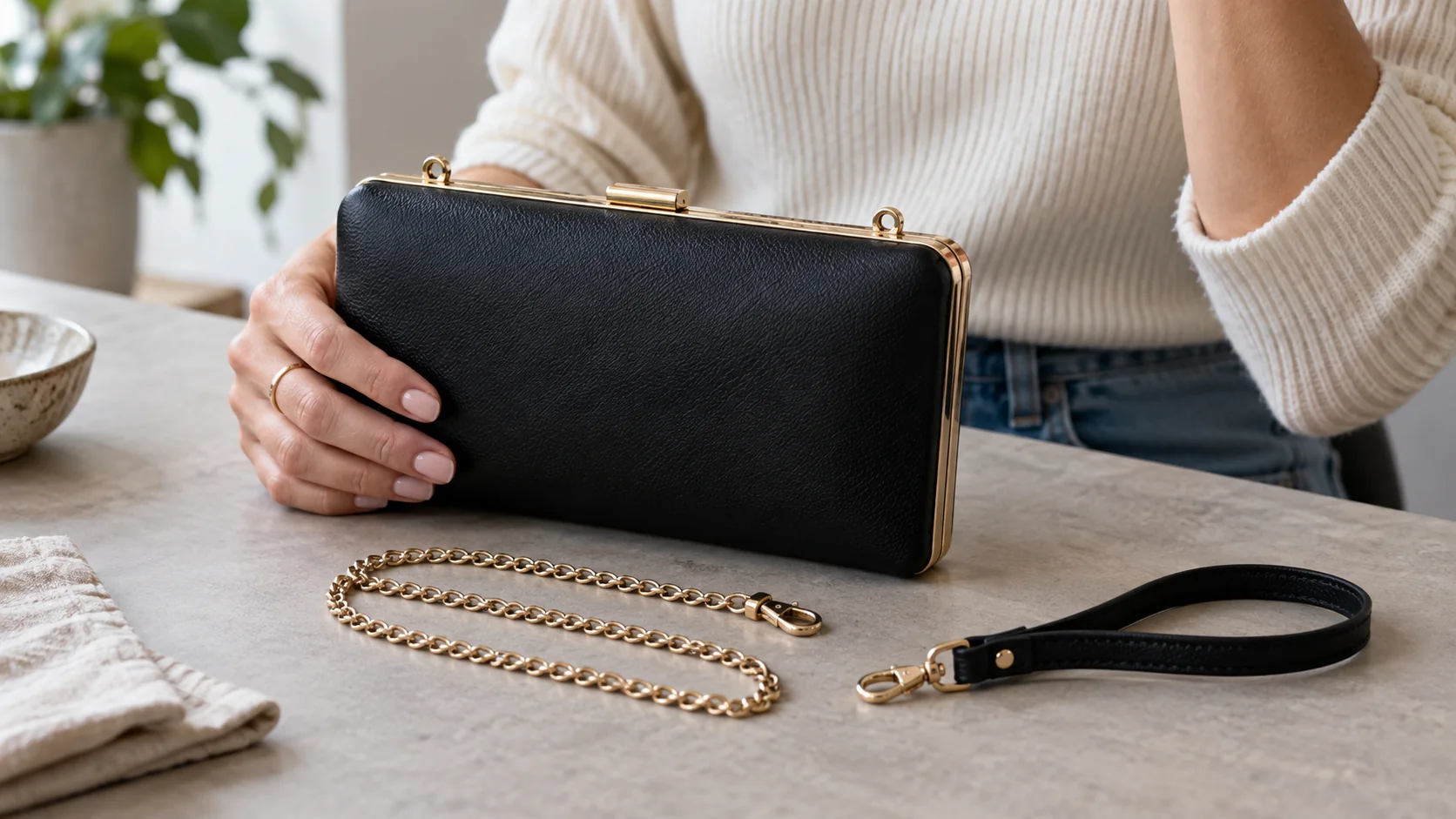
Six fields turn “clutch” from a loose label into a clear product description.
- Primary carry method: held in the hand, tucked under the arm, or supported by removable hardware.
- Body format: flat, gusseted, softly gathered, framed, or fully rigid.
- Clear opening: the usable space after a zipper, frame, flap, or hinge restricts access.
- Closure: zipper, magnetic flap, snap, frame, turn lock, or another defined system.
- Structure: soft, interlined, board-supported, or molded.
- Intended contents: the exact phone, cards, keys, cosmetics, or other items that must fit together.
The clear opening deserves separate attention from the external body. A framed clutch can look wide enough for a phone while the metal frame leaves a smaller pass-through. A zip-top design may lose usable width near the end stops. A deep gusset increases capacity, but it does not fix a narrow opening.
Carry hardware also changes the construction. A decorative chain still transfers load into rings, tabs, and seams. If the strap is optional, the specification should state whether attachment points remain visible when it is removed and where the chain sits when packed inside.
What Are the Six Main Types of Clutch Bags?
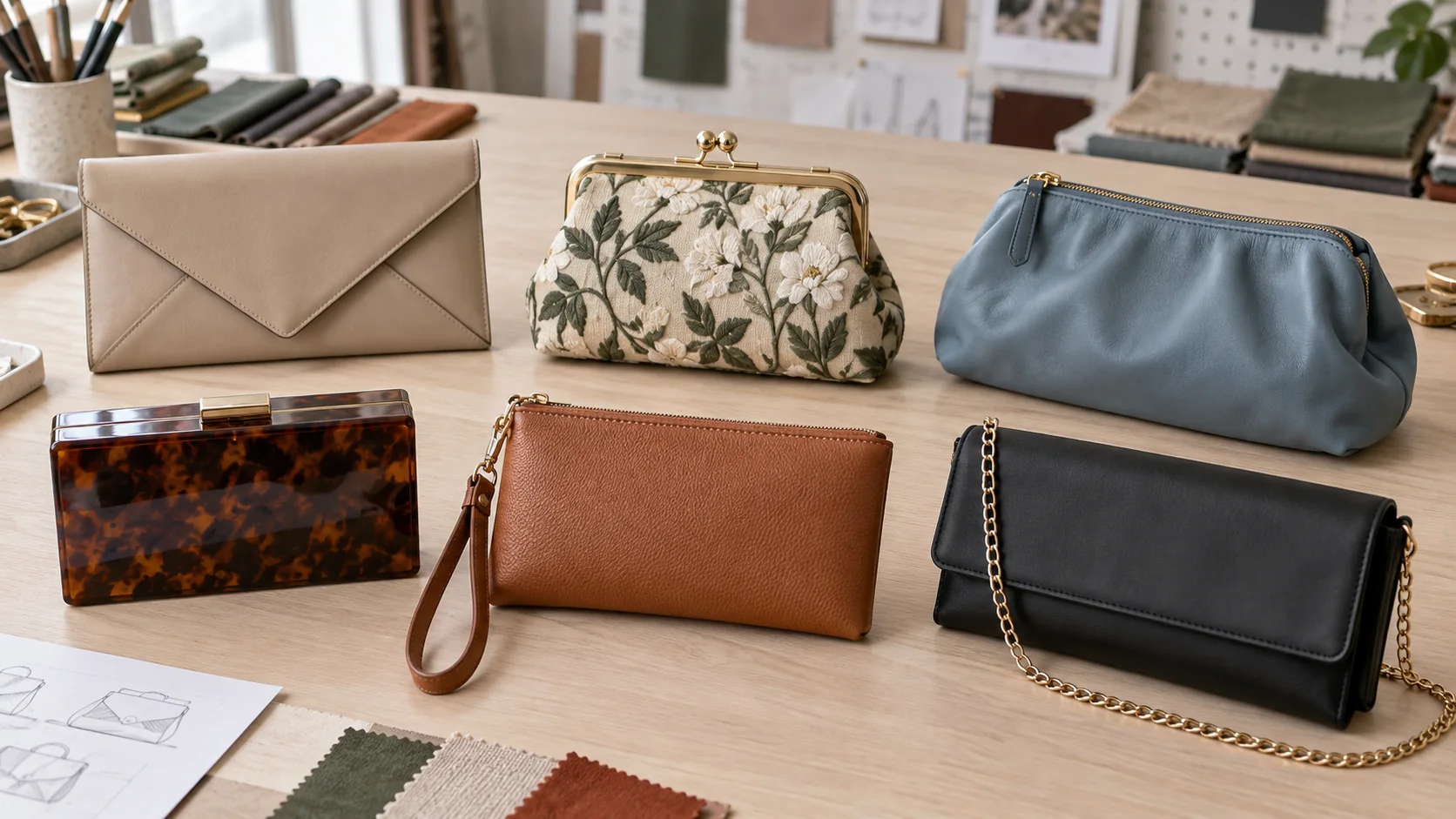
Clutch types are easier to compare by construction and access than by occasion. “Evening” describes where a bag may be used; “framed” tells a developer how it opens and where the body must support hardware.
| Type | Construction and access | Practical trade-off |
|---|---|---|
| Envelope clutch | Flat body with a fold-over flap | Slim profile, but limited depth for bulky contents |
| Framed clutch | Body fixed into a hinged top frame | Crisp opening and shape; clear opening may be smaller than the body |
| Pouch clutch | Soft body with zip, drawstring, or gathered top | Flexible and packable; silhouette changes with the load |
| Box clutch | Rigid shell or stiff panel system | Holds geometry and protects contents; less flexible inside luggage |
| Wristlet clutch | Compact body with an attached or detachable wrist loop | Adds retention without full shoulder carry; loop attachment needs reinforcement |
| Convertible clutch | Detachable chain or strap on a clutch body | Supports two carry modes; adds hardware, weight, and attachment decisions |
The types can overlap. An envelope body can carry a removable chain, and a framed body can include a wrist loop. Choose the base construction first, then describe optional carry hardware as a separate field.
Names also vary by seller. The broader guide to handbag and purse styles shows why the visible outline alone is an unreliable classifier: carry method, opening, and structure often separate neighboring bag families more clearly than marketing names do.
Clutch vs Wristlet, Pouch, and Shoulder Bag
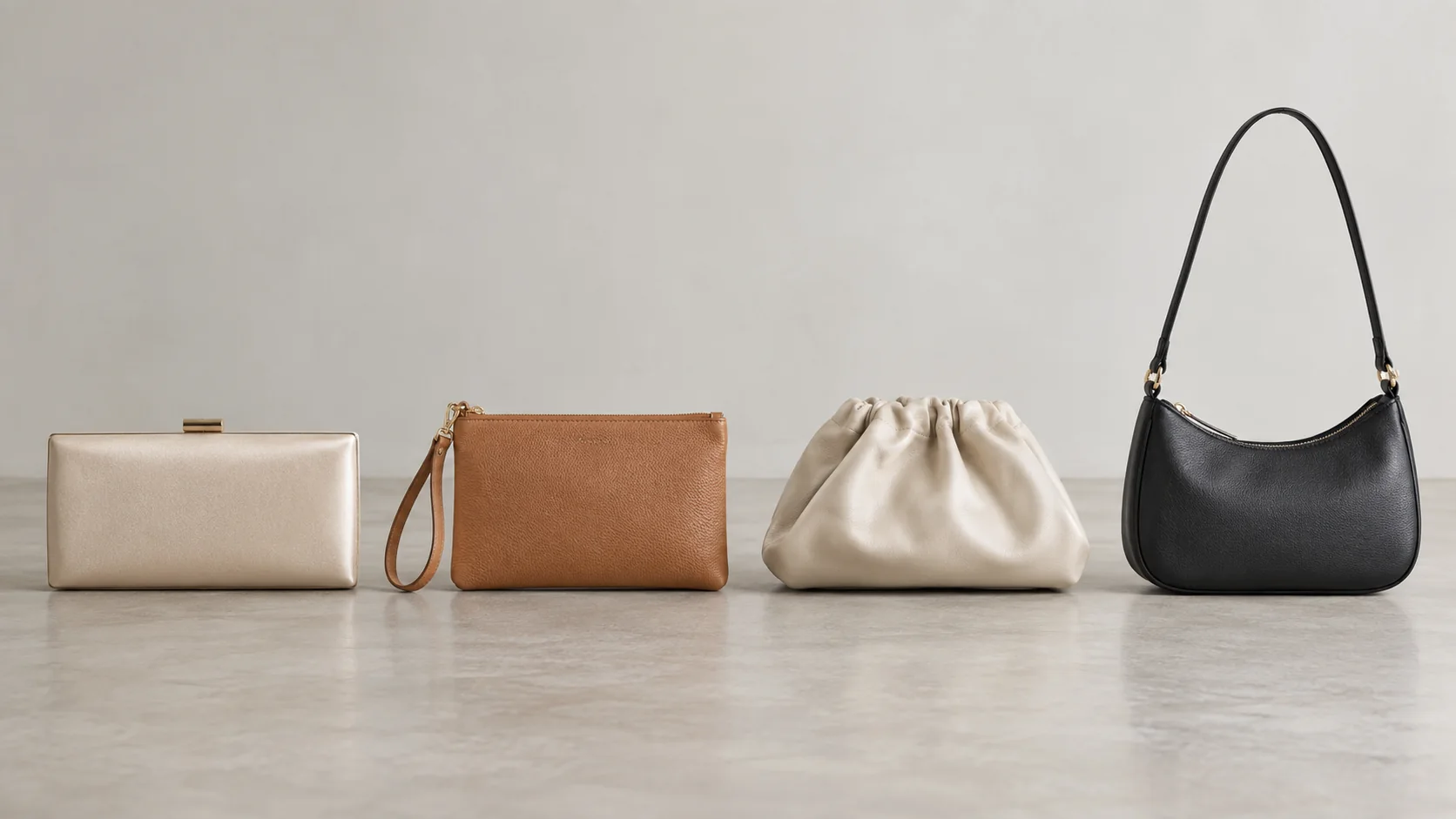
A clutch is defined mainly by hand carry. A wristlet is identified by its wrist loop, a pouch by its soft container-like body, and a shoulder bag by a strap intended for shoulder carry. Because those features describe different dimensions of a product, one bag can fit more than one label.
| Bag term | Main identifying feature | Possible overlap with a clutch |
|---|---|---|
| Clutch | Primary hand carry | May add removable chain or wrist loop |
| Wristlet | Wrist loop | Can also be a clutch if the body is primarily hand-carried |
| Pouch | Soft, minimally structured body | A hand-carried pouch can be sold as a pouch clutch |
| Shoulder bag | Shoulder-length strap | A convertible clutch becomes shoulder-carried when its strap is attached |
| Small purse | Broad size-and-use term | May include clutches, wristlets, and mini shoulder bags |
The cleanest comparison uses three questions: What supports the bag during use? Can that support be removed? How does the opening work? This avoids circular arguments about labels and gives the buyer information that affects daily use.
Satchels sit farther away from the category because they normally have fixed handles or a shoulder strap and more carrying capacity. The satchel meaning and selection guide covers that format in detail.
How Big Should a Clutch Bag Be?
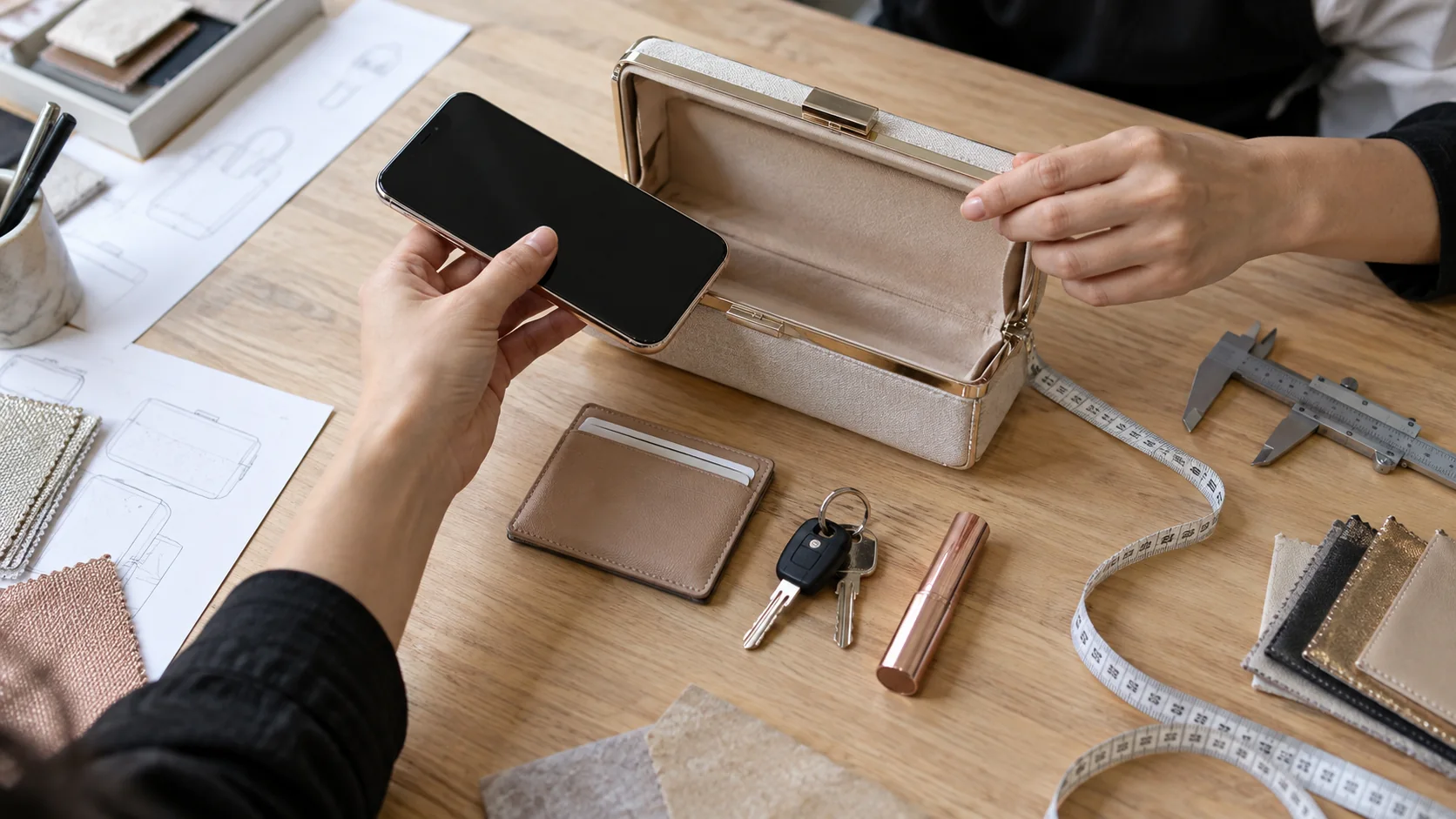
There is no single clutch size that works for every phone, closure, or contents list. A useful size starts with the actual carry set and works outward from it.
- List the contents. Put the phone, cardholder, keys, cosmetics, and any non-negotiable item on the table together.
- Record the largest item. Use the product maker’s current dimensions for a phone or device rather than estimating from its model name.
- Arrange the real stack. Position the items as they will sit inside the bag, then measure the combined length, width, and thickness.
- Choose the opening. Confirm the largest item can pass through the clear opening without forcing the zipper, frame, or edge finish.
- Allow for construction. Lining, seam allowances, interlining, gussets, and hardware reduce internal usable space.
- Test the loaded sample. Check closure function, retrieval, shape, and hardware contact with the actual contents.
External dimensions, clear opening, and internal usable space should appear as separate fields. The measurement principles in the backpack dimension and capacity guide apply here too: external size does not equal usable space.
A contents-first method also prevents a common sampling problem. Increasing body width may not help if the phone still catches on a narrow frame, while increasing gusset depth may create more volume than the closure can control. Change the limiting dimension, not the easiest line on the drawing.
How Do Materials and Construction Change a Clutch?
The face material is only one layer in the finished bag. Structure may come from interlining, board, foam, a molded shell, or a combination of support materials hidden between the face and lining.
Soft textiles and thin coated fabrics can fold or gather. Firmer leather and synthetic constructions can support a crisp envelope face or painted edge, provided the selected thickness and layer stack suit the process. A molded or board-supported body can hold a box shape even when the visible surface is flexible.
Synthetic material names need the same precision. “Faux leather” is a broad market term, not a complete construction. The PU leather bag material guide separates the surface polymer, textile backing, finish, thickness, and bag-making process. For products marketed in the United States, the FTC Leather Guides in 16 CFR Part 24 also matter when describing leather, imitation leather, and related composition claims.
Edge treatment, closure support, and hardware reinforcement should follow the chosen assembly. A turned edge, painted edge, or binding produces a different thickness at the opening. A frame needs a stable attachment area. A magnetic closure needs enough support to keep the two sides aligned. A chain ring needs a defined tab, reinforcement layer, and stitch or fastening method.
Which Tests and Sample Checks Matter?
Testing should match the component, material, and failure mode. One generic “quality test” cannot prove that the whole clutch is suitable for every load and use pattern.
ASTM D6193 identifies stitch and seam types and explains that seam performance depends on variables including fabric, seam type, stitch type, stitch density, thread tension, and elasticity. For woven constructions, ASTM D1683/D1683M measures failure in sewn seams under a defined method, while also stating that the result does not predict actual wear performance.
Zippers need their own evidence. ASTM D2061 contains several strength tests for zipper chains, sliders, stops, and pullers and says that no single test establishes suitability for a specific end use. A clutch specification should therefore identify the zipper component, test object, sample condition, method, and acceptance endpoint rather than recording “zipper passed.”
Finished-sample checks remain necessary because material and hardware tests do not reproduce every installed condition. A practical review can include:
- passing the actual reference phone through the opening;
- closing the fully loaded bag without forcing or distortion;
- opening and closing the selected closure for an agreed cycle count;
- checking strap rings, tabs, wrist loops, and chain connections under an agreed load;
- inspecting seam movement, puckering, edge damage, frame alignment, and hardware contact;
- confirming the bag still meets the approved external and clear-opening dimensions.
The project owner and supplier should agree on methods, conditioning, sample count, pass values, and allowed failure modes before testing. Copying an isolated number from another product does not create a valid acceptance plan.
What Should Brands Specify Before Sampling?
A reference photo can communicate proportion and mood, but it cannot replace a specification. Translate every visible choice into a field that can be measured, named, or approved.
| Specification area | Record before sampling |
|---|---|
| Carry configuration | Hand carry, wrist loop, detachable chain, detachable strap, or combination |
| Dimensions | External length, height, and depth with measurement condition |
| Usable access | Clear opening width and height after closure intrusion |
| Body construction | Flat, gusseted, framed, interlined, board-supported, or molded |
| Materials | Face, backing, lining, reinforcement, thickness or weight, finish, and color reference |
| Closure | Type, size, location, finish, and attachment method |
| Hardware | Rings, hooks, chain, pullers, feet, plates, and finish standard |
| Logo | Method, dimensions, position, and color or finish |
| Tolerances | Allowed deviation for each controlled dimension |
| Approval checks | Contents fit, opening pass, closure function, attachment review, workmanship, and appearance |
Keep the approved physical sample tied to the same bill of materials and drawings used for production. If a material, frame, zipper, magnet, or reinforcement changes, record the substitution and decide which checks need to run again.
Once the specification and acceptance plan are ready, a custom bag manufacturer can quote and sample against defined inputs instead of interpreting a style photograph.
Frequently Asked Questions
What does clutch bag mean?
A clutch bag is a compact handbag intended primarily for hand carry. Traditional clutches have no fixed handle or shoulder strap, although many current versions include a removable chain, strap, or wrist loop.
Do clutch bags have straps?
Some do. A detachable strap creates a convertible design that can return to hand carry when the strap is removed. Product descriptions should say whether the strap is fixed or removable and identify its length and attachment points.
What is the difference between a clutch and a wristlet?
A clutch is identified by hand carry; a wristlet is identified by a wrist loop. A small hand-carried bag with a wrist loop can fit both descriptions.
Will a phone fit in a clutch bag?
It will fit only if the phone can pass through the clear opening and sit inside with the rest of the contents. Check the phone maker’s dimensions, the loaded contents stack, the opening after closure intrusion, and the sample itself.
Is a box clutch the same as an envelope clutch?
No. A box clutch uses a rigid shell or stiff support system that holds its geometry. An envelope clutch is usually flatter and closes with a fold-over flap. Either format can add removable carry hardware.
What should a brand send to a manufacturer?
Send drawings or a tech pack covering external and opening dimensions, body construction, face and lining materials, reinforcement, closure, hardware, logo, tolerances, color references, packaging, and sample-approval checks. Include the actual reference contents when fit is part of the requirement.