
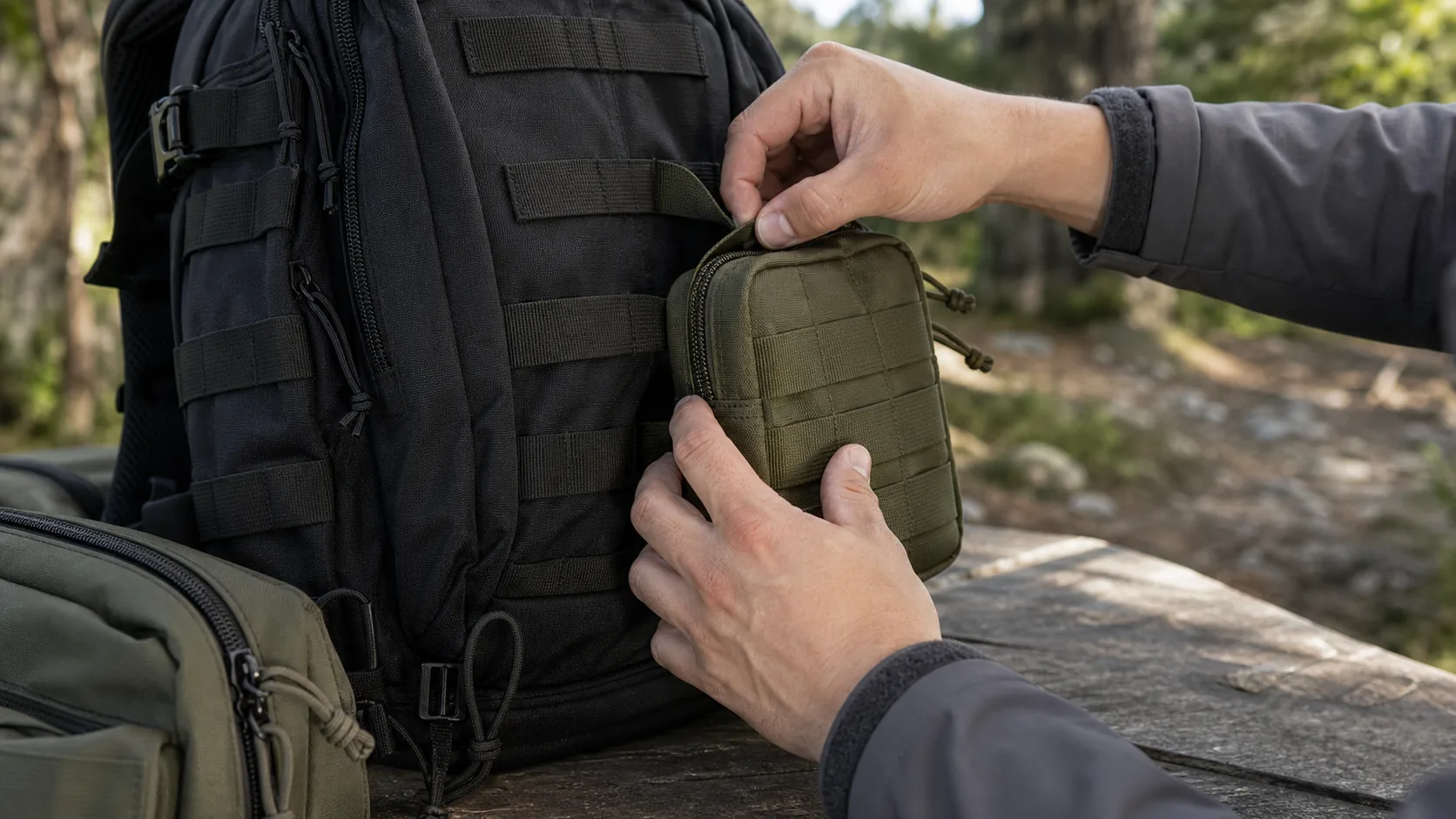
The loops on a tactical backpack are attachment points for pouches, tools, hydration tubes, straps, and lightweight gear. Some form the PALS grid used by MOLLE-compatible accessories; others are daisy chains, D-rings, lash tabs, elastic retainers, or simple routing loops. They may look similar, but they are not interchangeable and they do not all carry the same load.
That distinction matters when a pack must move from a daily work setup to an outdoor, medical, photography, or field loadout. A loose pouch can bounce, snag, or pull the bag off balance, while the right attachment keeps frequently used gear accessible without crowding the main compartment. On well-designed MOLLE tactical backpacks, the loop layout is part of the load-bearing structure rather than decoration.
What are the loops for on a tactical backpack?
What are the loops for on a tactical backpack? Their main job is to let you secure compatible gear outside the main compartments and route smaller items where they remain controlled. A front webbing grid can carry a first-aid or utility pouch, shoulder loops can guide a hydration hose, and a light daisy chain can hold gloves or a small carabiner.

The advantage is not simply more capacity. External attachment points give the user control over access. Gear needed quickly can stay outside, while clothing, electronics, and other protected items remain inside. The setup also changes without replacing the entire bag.
Which items belong on external loops?
Use the loops for items that are compatible with the attachment system, reasonably light for their position, and unlikely to create a snag hazard.
- Utility or first-aid pouches with proper MOLLE straps
- A hydration hose routed along the shoulder strap
- Gloves, a cap, or a light jacket on a low-load clip
- A compact flashlight in a fitted holder
- Trekking accessories secured with a retaining strap
A metal carabiner clipped through one narrow webbing loop is not a substitute for a pouch woven through several PALS rows. The first arrangement places force on one point; the second spreads it across the panel.
Key Takeaway: Tactical backpack loops improve access and modularity only when the attachment, load, and location match.
| Loop location | Typical use | Main benefit |
|---|---|---|
| Front panel | Modular utility pouch | Fast access and flexible capacity |
| Shoulder strap | Hydration tube or small light | Keeps controls close to the user |
| Side panel | Bottle pouch or radio pouch | Uses narrow exterior space |
| Lower panel | Bedroll or jacket straps | Controls bulky, lightweight gear |
Which systems explain what are the loops for on a tactical backpack?
The systems behind what are the loops for on a tactical backpack include PALS webbing, MOLLE-compatible attachments, daisy chains, laser-cut slots, lash tabs, and elastic cord anchors. In the outdoor and tactical industry, these structures are selected according to load, access, abrasion, weight, and the type of accessory the user needs to mount.

How are MOLLE and PALS different?
MOLLE means Modular Lightweight Load-carrying Equipment. PALS, or Pouch Attachment Ladder System, is the ladder-like field of horizontal webbing and stitched channels used to mount compatible pouches. In everyday product language, people often call the visible grid "MOLLE webbing," but PALS is the more precise name for the attachment surface.
A secure pouch is woven alternately through the pack grid and the pouch's backing rows. This interlocking path matters. Running the strap straight behind the entire panel is faster, but it allows more movement and concentrates stress.
What is a daisy chain?
A daisy chain is a row of separate loops rather than a full ladder grid. It suits light clipping and lashing tasks, such as securing gloves or routing cord. It is usually less stable for a wide, heavily loaded pouch because the accessory cannot be woven across multiple rows and columns.
What are laser-cut slots?
Laser-cut attachment panels replace raised strips with precisely cut openings in laminated material. They offer a flatter profile and can reduce loose edges, but their performance depends on laminate strength, slot spacing, edge quality, reinforcement, and how the panel is joined to the bag.
Key Takeaway: "Loop" is a broad visual description. The actual system determines what can be attached and how securely it will ride.
| System | Visual clue | Best suited to |
|---|---|---|
| PALS grid | Repeated horizontal rows with vertical bar-tacks | MOLLE-compatible pouches |
| Daisy chain | Individual fabric loops in a line | Light clipped or lashed items |
| Laser-cut panel | Flat slots cut into laminate | Low-profile modular pouches |
| Elastic anchors | Cord threaded through small tabs | Compressible, lightweight gear |
How do you identify what are the loops for on a tactical backpack?
You identify what are the loops for on a tactical backpack by checking the pattern, material, stitching, location, and whether the loop is part of a repeating attachment grid. A true PALS-style panel follows a consistent ladder layout. Random decorative webbing may resemble it but fail to accept standard pouch straps correctly.

What spacing should you check?
Traditional PALS construction commonly uses 1-inch webbing arranged in horizontal rows, with vertical stitching creating channels about 1.5 inches wide. Production tolerances still matter. If the channels are too narrow, stiff attachment straps will not pass through; if they are too wide, a loaded pouch can shift.
Do not judge compatibility from one measurement alone. Check several rows, the vertical alignment, and the usable width after seams or compression straps interrupt the grid.
What does strong stitching look like?
The vertical divisions should have dense, even bar-tacks or another validated reinforcement pattern. Look for skipped stitches, loose thread, puckered fabric, and stitches placed too close to the webbing edge. At high-stress ends, the panel should transfer force into reinforced bag construction rather than a thin unsupported shell.
Does the webbing material matter?
Yes. Nylon webbing is common where abrasion resistance and strength are priorities, while polyester may be chosen for lower moisture absorption or colorfastness. The correct choice depends on the complete specification, not a fabric name alone. Webbing, thread, base fabric, coating, and reinforcement must work as one system.
Key Takeaway: Consistent geometry makes accessories fit; material and stitch quality determine whether that fit lasts.
| Inspection point | What to look for | Warning sign |
|---|---|---|
| Channel width | Repeated, usable spacing | Rows that narrow near seams |
| Bar-tacks | Dense and evenly placed | Loose thread or missed stitches |
| Base panel | Reinforced behind the grid | Webbing sewn to a thin single layer |
| Slot edges | Clean and stable | Peeling laminate or cracked corners |
What gear fits what are the loops for on a tactical backpack?
Gear that fits what are the loops for on a tactical backpack includes purpose-built modular pouches, fitted holders, compression straps, and low-load accessories with secure retainers. Compatibility is more important than category. A camera lens pouch, radio holder, medical pouch, or bottle carrier can work well if its backing matches the grid and its weight suits the panel.

Which pouches work best?
Choose a pouch with enough attachment columns and rows to control its full width and height. A tall radio pouch needs upper retention so the device does not lever away from the bag. A medical pouch should be recognizable and reachable, but its placement must not interfere with movement or access to other compartments.
For ordinary first-aid supplies, keep the kit appropriate to the user's training and activity. Specialized trauma equipment should be carried only when the user is trained to use it and local policies allow it.
Can you attach a radio, flashlight, or bottle?
Yes, with a fitted holder and secondary retention where needed. Radios should keep the antenna clear without placing a hard object where it repeatedly strikes the arm. Flashlights need a holder that protects the switch from accidental activation. Bottle pouches should support the base and restrain the neck.
Can any carabiner go on any loop?
No. Accessory carabiners are useful for keys, gloves, or other light items, but they are not automatically rated for climbing, rescue, fall protection, or human support. Never infer a safety rating from shape alone, and never use a backpack loop as a life-safety anchor.
Key Takeaway: Match the accessory backing to the attachment field, then add retention for tall, hard, or valuable items.
| Accessory | Preferred attachment | Extra check |
|---|---|---|
| Utility pouch | Fully woven modular straps | Bottom corners do not lift |
| Radio | Fitted pouch plus top retention | Antenna and controls remain clear |
| Flashlight | Sized holster | Switch cannot activate accidentally |
| Bottle | Supported bottle pouch | Neck cord or elastic is secure |
Where are what are the loops for on a tactical backpack placed?
The placement of what are the loops for on a tactical backpack controls access, balance, movement, and snag risk. Front panels offer the largest modular field, side panels suit narrow equipment, shoulder loops keep hoses and controls close, and lower straps handle bulky but relatively light gear. A durability-focused backpack project should test these zones under realistic loading rather than treating every loop as equally strong.

What belongs on the front panel?
The front panel is useful for flat or medium-sized pouches that need regular access. Keep the load close to the bag. Thick, heavy modules pull the center of gravity backward, make the pack harder to set down, and can block the main zipper.
What belongs on the side panels?
Side panels are well suited to bottles, radios, tripod feet, or long tools secured at more than one point. Balance the left and right sides when possible. A heavy object on one side creates constant torsion through the harness.
What are shoulder and bottom loops for?
Small shoulder-strap loops route hydration tubes, communication cables, or compact controls. They should not carry heavy swinging objects near the chest or face. Bottom straps can secure a bedroll, rain shell, or sleeping pad, provided the item does not hang below the pack or interfere with walking.
Key Takeaway: Place quick-access gear where it can be reached, but keep dense weight close to the back and near the body's natural center of gravity.
Are all what are the loops for on a tactical backpack load bearing?
No, not all structures covered by what are the loops for on a tactical backpack are load bearing. Some are routing guides, some retain stretch cord, and some are decorative. Even a properly sewn PALS panel is designed for equipment carriage, not towing, climbing, belaying, lifting a person, or arresting a fall.
What are lash tabs and D-rings for?
Lash tabs, sometimes called pig snouts, accept cord or narrow straps for light external gear. D-rings provide a fast clipping point for keys, gloves, or a small accessory. Their capacity depends on the ring material, stitching, backing, and bag construction, so a user should follow the manufacturer's stated limit when one is available.
What do elastic cords hold?
Elastic shock cord is useful for compressible items such as a wet shell, gloves, or a folded map case. It is a retention system, not a secure mount for heavy metal tools. Inspect the cord for loss of elasticity, sheath abrasion, and cracked cord locks.
Why do some loops fail?
Common causes include overloading one point, clipping a heavy item instead of distributing the load, poor bar-tacking, UV and abrasion damage, and repeated snagging. The first visible warning may be elongation around a stitch hole, frayed webbing edges, or a panel pulling away from the base fabric.
Key Takeaway: If the use involves human safety or a sudden shock load, a backpack loop is the wrong anchor unless the product carries a specific certified rating for that purpose.
Who benefits from knowing what are the loops for on a tactical backpack?
People who benefit from knowing what are the loops for on a tactical backpack include hikers, field technicians, photographers, emergency volunteers, security teams, commuters, and buyers developing modular outdoor products. The system is valuable whenever users need the same bag to support several organized loadouts.
How do hikers and field teams use them?
Hikers may route a hydration tube, attach a small accessory pouch, or secure a damp rain shell outside. Field technicians can separate meters, cables, gloves, and repair tools by task. The goal is not to cover every open row; it is to create a predictable layout that does not interfere with walking, climbing, or vehicle entry.
How do photographers use them?
Photographers can mount a padded lens pouch, battery organizer, or tripod retention strap. Valuable gear needs both impact protection and positive closure. A bare lens case swinging from one clip is faster to attach, but it is a poor trade when the route includes brush, crowds, or uneven ground.
How do everyday users use them?
For everyday carry, loops can support a compact organizer, bike light, key tether, or bottle pouch. A restrained setup usually works better in public spaces than a wide exterior loadout. Keep straps tidy and avoid exposed hard tools that can catch on seats, doorways, or other people.
Key Takeaway: The best modular setup is task-specific, balanced, and easy to inspect, not the one with the most attachments.
What quality details define what are the loops for on a tactical backpack?
Quality details that define what are the loops for on a tactical backpack include accurate spacing, suitable webbing or laminate, reinforced stitching, clean attachment paths, and validation with the intended load. For brands and distributors, these details matter because visual compatibility does not guarantee long-term performance across an e-commerce bag project.
What should a product sample prove?
A sample should prove that target pouches can be installed without excessive force, remain stable during movement, and can be removed without damaging the panel. Load the largest planned accessory, walk or cycle the pack through realistic movement, and inspect the webbing, bar-tacks, base fabric, and pouch straps afterward.
Which production checks matter?
- Measure channel spacing at several points, including near seams.
- Check bar-tack density, placement, and thread tension.
- Confirm webbing color and shrinkage against the approved sample.
- Test interrupted grids around zippers and compression straps.
- Inspect laser-cut slot corners for cracking or delamination.
- Verify that mounted pouches do not block essential openings.
Does camouflage or infrared treatment change the purpose?
Color matching, UV resistance, and specialized low-signature materials may be relevant to a defined professional specification, but they do not change the basic attachment function. Such claims should be supported by material documentation and testing. A matching color alone is not proof of infrared performance.
Key Takeaway: Buyers should approve the loop system with the actual accessory set, not with a ruler and an empty backpack alone.
How should you use what are the loops for on a tactical backpack safely?
You should use what are the loops for on a tactical backpack safely by weaving compatible straps fully, limiting external weight, controlling loose ends, balancing the load, and inspecting every attachment before use. A stable setup should remain quiet and close to the bag when you walk, bend, and set the pack down.
How do you attach a MOLLE pouch correctly?
1. Align the pouch with the required rows and columns.
2. Pass each attachment strap through the first pack row.
3. Return it through the matching row on the pouch backing.
4. Continue alternating between pack and pouch until fully woven.
5. Close the snap or retainer and check that the pouch corners do not lift.
Do not skip rows to save time. After mounting, load the pouch and perform a movement check. If it slaps, tilts, or pulls the panel out of shape, change the position or reduce the load.
What should stay inside the pack?
Keep valuables, fragile electronics, sensitive documents, and small loose items inside protected compartments. Heavy dense equipment also belongs close to the back unless a dedicated exterior carrier was designed for it. External space is useful, but it exposes gear to rain, dirt, impact, theft, and snagging.
When should you stop using a loop?
Stop if you see torn stitches, stretched holes, cracked laminate, badly frayed webbing, a deformed ring, or separation from the base fabric. Removing a sewn grid by cutting stitches can damage waterproof coatings and structural layers, so repairs should follow the manufacturer's guidance.
Key Takeaway: A correct weave, sensible load, and quick pre-use inspection prevent most loop-related problems.
The loops turn a fixed backpack into a configurable carrying platform, but their value comes from disciplined use. Understand the system, keep dense weight close to your body, and give every external item a secure attachment and a clear purpose. For OEM development, pouch compatibility, reinforcement, and realistic movement testing should be approved together. To discuss a modular backpack specification, contact us today.
FAQ: What are the loops for on a tactical backpack?
Can I attach non-tactical items to the loops?
Yes. Gloves, a light jacket, camera accessories, bike gear, or a compact organizer can be attached when the holder is compatible and the load remains secure. Avoid hanging valuable or heavy items from a single clip.
How do I know whether a pouch is MOLLE compatible?
Check for a matching field of horizontal backing rows and attachment straps designed to weave through a PALS grid. Confirm the required number of rows and columns rather than relying only on the product label.
Can I clip a water bottle directly to one loop?
You can clip an empty or very light bottle temporarily, but a full bottle should sit in a supported pouch with neck retention. This reduces swinging, noise, and concentrated stress on one loop.
Can backpack loops be used for climbing or rescue?
No, unless the product is specifically certified and documented for that life-safety use. Standard backpack webbing, D-rings, and accessory carabiners must never be treated as climbing anchors.
Should I cut off loops I do not use?
Usually not. Cutting can weaken seams, expose stitch holes, damage coatings, and reduce future compatibility. Leave unused loops in place or ask the manufacturer about an approved modification.