
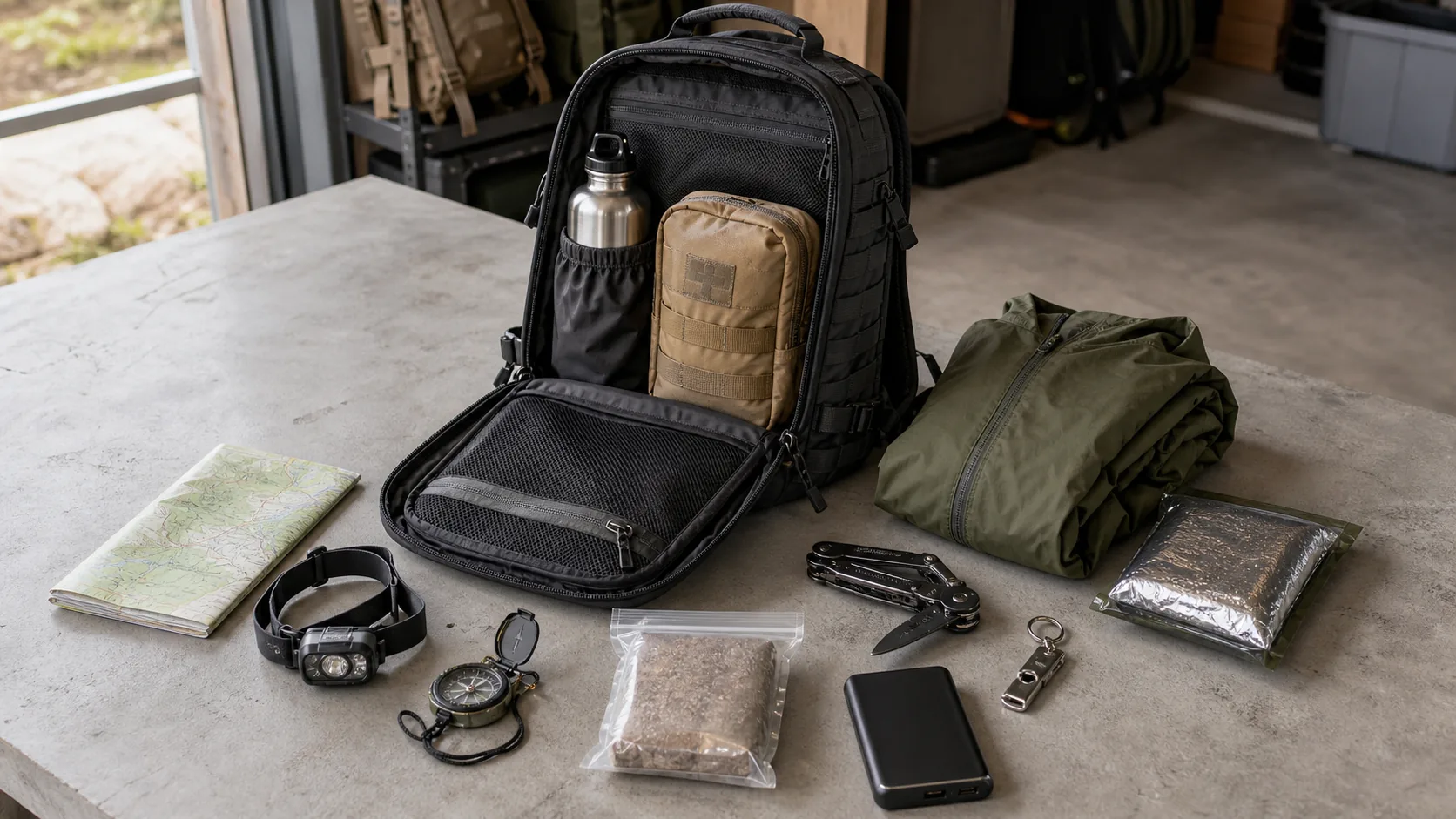
What should be in a tactical backpack? Pack water, navigation, light, weather protection, a task-appropriate medical kit, communication gear, and only the tools required for your route or duty. For evacuation-specific planning, the guide to what a bug out bag is starts with the route, household needs, and actual contents before choosing the pack. Choosing the right features and maintaining the pack properly keeps this loadout secure and functional in demanding environments.
Imagine being out in freezing rain on a time-sensitive trek when a backpack strap snaps, spilling priority tools into the mud and leaving you with an unbalanced load. Searching in the dark for emergency equipment because your pack lacks a clear layout adds fatigue and delays your response. Understanding what should be in a tactical backpack? and maintaining its load-bearing structure keeps gear protected, balanced, and accessible when time matters.
What should be in a tactical backpack?
A tactical backpack should contain field tools suited to the task, reliable navigation gear, a user-appropriate medical kit, and a robust hydration system. Identifying what should be in a tactical backpack helps you prepare for uncertainty during field work or extended outdoor trips. Without these core items, a demanding environment can expose gaps in water, shelter, communication, or route planning. A careful inventory selection creates a practical baseline for field readiness.

Having a clear structure for your loadout eliminates guesswork when packing for tough environments. When you know precisely what goes into your bag, you save critical preparation time.
What are the core survival items?
When you are deep in the wilderness, your life-support system depends entirely on your core survival tools. If your primary gear fails, you need reliable backups that can withstand high stress and harsh environmental exposure.
Think about it:
- Industrial-grade multi-tools for instant mechanical repairs in the field.
- High-lumen waterproof flashlights with tactical strobe signal capabilities.
- Heavy-duty navigation systems including physical military topographic maps and tactical compasses.
Key Takeaway: Prioritizing durable mechanical tools and navigation equipment secures your baseline survival potential and keeps you on the correct path.
| Core Item | Recommended Use Case | Priority Level |
|---|---|---|
| Multi-Tool | Quick field repairs and adjustments | Critical |
| Navigation Compass | Route mapping and direction tracking | High |
| Tactical Flashlight | Low-light signaling and illumination | High |
Review this baseline survival equipment list to establish your core loadout before packing.
Why must you plan what should be in a tactical backpack?
You should plan what should be in a tactical backpack before packing so the load supports stamina, reduces strain, and keeps priority equipment accessible. Strategic planning helps you avoid duplicate or single-purpose gear that hinders mobility on long routes. A deliberate packing plan also protects hard equipment from internal impacts. For product teams, a durability-focused backpack project shows why load planning and reinforced construction should be evaluated together.

Every extra ounce of weight translates directly to fatigue after miles of travel. By actively planning, you can streamline your loadout for peak physical performance.
How does load distribution impact you?
Proper weight distribution protects your spine and shoulders from severe fatigue during intense physical tasks. When you pack your heaviest gear close to your back, you align the weight with your body's natural center of gravity.
Here is why:
This principle keeps dense gear near your natural center of gravity and reduces backward pull from the pack.
- Heavy items should sit close to your spine at mid-back level.
- Medium-weight gear belongs in the outer middle pockets.
- Lightweight bulky gear, like sleeping systems, should sit at the bottom.
Key Takeaway: Balancing your load prevents long-term joint fatigue and allows you to move with maximum speed and agility across uneven landscapes.
| Pack Zone | Recommended Contents | Load Impact |
|---|---|---|
| Upper Spine | Heavy water bladders, radios | Excellent center of gravity |
| Middle Outer | Medical kits, utility tools | Rapid accessibility |
| Pack Bottom | Sleeping bags, spare clothing | Solid platform foundation |
Analyze these pack zones to distribute gear weight efficiently and minimize bodily stress.
How do you organize what should be in a tactical backpack?
You organize what should be in a tactical backpack by applying a zone-based layout with quick-access modular attachments. Grouping inventory by function prevents wasted time when looking for medical or communication gear under pressure. A standardized layout also builds retrieval habits for low-light conditions. For B2B buyers serving outdoor and tactical applications, clear compartment ownership can improve usability across a product range.

Maintaining a logical structure prevents smaller items from shifting and getting lost at the bottom of the main compartment. It keeps your setup balanced and reliable during rapid movements.
Why are modular pouches so helpful?
Modular pouches let you customize storage capacity around specific operational goals. If you need to change the loadout, you can attach or detach specialized MOLLE pouches without repacking the entire bag.
The best part?
This modular system lets a product team adapt pouch placement without redesigning the main compartment for every use case.
- Quick-attach utility pouches for immediate field tool deployment.
- Insulated water bottle pockets that secure tightly to MOLLE webbing.
- Reinforced document pouches to safeguard identification and maps.
Key Takeaway: Modular pouches expand carrying capacity while keeping priority gear accessible.
| Pouch Type | Attachment Method | Best Utility Use Case |
|---|---|---|
| MOLLE Utility | Heavy snap straps | Quick-access tools and spare parts |
| Velcro Admin | Hook-and-loop patch | Maps, IDs, and daily pens |
| Compression | Side buckle straps | Securing bulky rain jackets |
Consider these modular attachments to expand your pack's external carrying potential.
To survive in the wild, what should be in a tactical backpack?
For wilderness use, what should be in a tactical backpack includes water treatment, emergency shelter, insulation, signaling gear, and a route-appropriate fire-starting method where local rules allow it. These core items support safety when you are far from services. Preparing for severe weather and temperature changes requires gear selected for the actual climate. Wilderness kits should prioritize utility, durability, and weather resistance over dramatic extras.

Without clean drinking water or dry shelter, an outdoor trip can become dangerous quickly. Choose dependable tools that suit the route, season, and local rules.
What are the top survival tools?
When you face unpredictable elements, having specialized tools can mean the difference between survival and disaster. You must carry tools that can clear brush, build emergency shelters, and ignite fire in freezing, damp conditions.
The catch is:
Cheap, uncertified tools will fail under pressure, leaving you completely vulnerable in deep wilderness.
- Heavy-duty ferrocerium rods for reliable, spark-based fire ignition.
- Compact folding saws and survival knives for processing firewood.
- Mylar space blankets to reflect body heat and prevent hypothermia.
Key Takeaway: Route-appropriate survival tools support shelter, signaling, and warmth when conditions change.
| Survival Tool | Primary Function | Weather Rating |
|---|---|---|
| Ferrocerium Rod | High-temperature spark generation | All-weather proof |
| Survival Knife | Wood processing and rope cutting | High durability |
| Mylar Blanket | Reflecting radiation body heat | Wind and rain proof |
Use this table as a starting point, then adjust the kit for climate, terrain, duration, and fire restrictions.
For everyday duty, what should be in a tactical backpack?
For everyday duty, what should be in a tactical backpack includes multi-purpose tools, an administrative organizer, weather protection, and backup power for approved devices. Commuters and field professionals need fast access to documents, communication gear, and practical daily supplies. A balanced everyday carry setup prepares you for delays, outages, or changing work sites. A clean layout lets you shift between administrative tasks and outdoor work without carrying unnecessary equipment.

An optimized duty pack should not be overly bulky, allowing you to move freely in tight public spaces. It serves as your daily command center on the go.
How do you secure office equipment?
Keeping work gear safe from impact requires dedicated internal compartments. When moving between outdoor and office settings, you need a neat way to organize pens, notebooks, and electronics.
Think about it:
If your administrative items are tossed loosely into a large compartment, they will scratch your valuable gear.
- Hard-shell cases for protecting high-end sunglasses and lenses.
- Padded zippered organizer sleeves for document safety.
- Elastic pen loops and key clips to keep small items secure.
Key Takeaway: Utilizing dedicated administrative compartments keeps your daily business tools pristine and readily accessible during professional meetings.
| Admin Feature | Target Gear | Security Level |
|---|---|---|
| Padded Sleeve | Documents, small tablets | Medium protection |
| Hard-Shell Zone | Eyewear, fragile sensors | High impact resistance |
| Elastic Loops | Pens, tactical lights, keys | Anti-slip retention |
Utilize these structural internal features to organize your daily business tools efficiently.
What can you exclude from a light everyday loadout?
Remove duplicate tools, bulky comfort items, and clothing that performs poorly in expected weather. Every item should support the route, duty, or credible emergency scenario rather than fear-based overpacking.
The practical test is simple:
- Replace duplicate single-purpose tools with one dependable multi-tool.
- Choose compact food and weather layers suited to the planned duration.
- Leave behind equipment you are not trained or authorized to use.
Key Takeaway: A lighter everyday loadout improves mobility while preserving water, communication, weather protection, and medical basics.
To protect electronics, what should be in a tactical backpack?
To protect electronics, what should be in a tactical backpack includes padded sleeves, waterproof dry bags, and dedicated cord organizers. Tablets, GPS units, and satellite communicators are sensitive to impact and moisture. Without protective layers, a drop or rain shower can damage navigation or communication equipment. Electronics should remain separated from water reservoirs and hard tools.
Interior padding cushions devices from drops or rough handling in transit. Keeping these items dry helps them function when needed.
How do you organize cables?
Fumbling through a massive ball of tangled wires during an emergency wastes critical time and risks damaging connector pins. You must organize your power cords and data cables systematically so you can power up devices instantly.
Here is why:
A clean cable management system prevents wear and tear, extending the lifespan of your charging accessories.
- Elastic web grids that hold individual cables securely in place.
- Color-coded labels for rapid identification of power versus data lines.
- Water-resistant zippered tech pouches to seal out ambient moisture.
Key Takeaway: Keeping cables organized and dry reduces connector damage and speeds up device setup in the field.
| Organizer Type | Best Suited For | Protection Level |
|---|---|---|
| Elastic Grid | Multiple charging cables, USBs | High organization |
| Tech Pouch | Heavy-duty power banks, adapters | Water-resistant safety |
| Cable Ties | Long power cables, extension cords | Basic tangle prevention |
Refer to this cable organization guide to secure your electronic systems during operations.
For medical emergencies, what should be in a tactical backpack?
For medical emergencies, what should be in a tactical backpack depends on training, local requirements, trip length, and credible risks. A basic kit can include gloves, dressings, gauze, tape, antiseptic wipes, and personal medication. Place it in a clearly identified pouch that can be reached without unpacking the main compartment. Trauma equipment should only be carried and used by people trained for it.
How should you configure the medical pouch?
Organize supplies by function and check expiration dates before each trip. The American Red Cross recommends tailoring a kit to household or activity needs, while trained users may add specialized equipment required by their role.
The practical rule is:
- Keep protective gloves and wound-care supplies dry and easy to reach.
- Add prescribed medication and emergency contact information where appropriate.
- Pair specialized trauma equipment with recognized hands-on training.
Key Takeaway: A visible, task-appropriate medical pouch supports a faster response without encouraging untrained treatment.
| Medical Group | Example Contents | Access Priority |
|---|---|---|
| Basic care | Gloves, dressings, gauze, tape | High |
| Personal | Prescribed medication, contact card | High |
| Role-specific | Trained-use trauma supplies | Per protocol |
Review the pouch regularly and replace damaged, opened, or expired supplies.
For hydration, what should be in a tactical backpack?
For hydration, what should be in a tactical backpack? includes a reliable reservoir or bottle, a protected drinking interface, and a treatment method when refill sources may be unsafe. Dehydration can reduce physical performance and judgment during strenuous activity. An accessible water source lets you drink without repeatedly opening the pack. Capacity should match climate, duration, exertion, and refill availability.
Relying on one container creates a single point of failure. For remote routes, separate primary and reserve water containers can provide useful redundancy.
Why use hydration reservoirs?
Hydration bladders allow you to drink water continuously through an insulated tube without breaking your physical stride. When you keep your hands free, you can maintain focus on your path and keep your tools ready.
Think about it:
If you have to stop and retrieve a heavy bottle every twenty minutes, you lose valuable operational momentum.
- Hands-free drinking tubes with secure bite valves and dust covers.
- Insulated reservoir sleeves that keep water cool in scorching heat.
- Wide-mouth openings for rapid filling and easy interior cleaning.
Key Takeaway: An integrated hydration bladder supports regular drinking while keeping the user's hands free.
| Hydration Component | Operational Advantage | Maintenance Level |
|---|---|---|
| Hands-Free Bladder | Drink water without stopping | Medium (requires drying) |
| Insulated Hose | Prevents water freezing or overheating | Low |
| In-Line Water Filter | Purifies raw water source on the go | High (requires flushing) |
Use these hydration features to support steady performance during long operations.
How should product specs support the loadout?
Product specifications should match expected weight, abrasion, moisture, and access demands. Fabric weight alone does not define durability; seam construction, reinforcement placement, hardware, coatings, and test methods also shape field performance.
Why choose high-denier fabrics?
High-denier woven fabrics can provide strong resistance to abrasion and demanding environmental wear, but denier alone does not predict finished bag durability. When a load includes hard tools or electronics, the shell, lining, reinforcement, and internal protection must work as one system.
The catch is:
Lighter fabrics can reduce pack weight, while heavier constructions may better suit repeated abrasion. Testing should reflect the intended surface, load, and duty cycle.
- Project-specified woven nylon or polyester for the target abrasion level.
- Water-repellent polyurethane coatings to shed heavy rainfall.
- Double-stitched stress zones to prevent seam failure under heavy loads.
Key Takeaway: Match fabric, reinforcement, and test methods to the intended load rather than choosing by denier alone.
| Fabric Type | Denier Rating | Best Operational Setting |
|---|---|---|
| Heavy woven nylon | Project set | High-abrasion field applications |
| Ripstop polyester | Project set | Outdoor and mixed daily use |
| Lightweight nylon | Project set | Lower-load urban applications |
Evaluate these fabric specifications to select the appropriate durability level for your operational requirements.
How does the right list answer what should be in a tactical backpack?
The right answer to what should be in a tactical backpack starts with water, navigation, light, weather protection, communication, medical basics, and task-specific tools. A disciplined list reduces excess weight and makes priority gear easier to retrieve. For B2B brands, compartment design and material testing should follow real loadouts rather than generic capacity claims. Contact us today to discuss an OEM/ODM sample built around your users, equipment, and market requirements.
What FAQs clarify what should be in a tactical backpack?
These answers clarify what should be in a tactical backpack when cleaning, selecting materials, flying, balancing weight, and adding modular pouches.
Can I wash my tactical backpack in a washing machine?
Usually no. Follow the care label because machine agitation can damage coatings, foam, buckles, and zipper assemblies. Spot-clean or hand-wash with mild soap when the manufacturer permits it, then air-dry away from direct heat.
What's the best denier rating for daily heavy-duty use?
There is no single best rating. Denier measures yarn mass rather than complete bag durability, so buyers should also compare weave, coating, seam design, reinforcement, hardware, and test results against the intended use.
Can I use a tactical backpack as airline carry-on luggage?
Sometimes. Carry-on acceptance depends on the packed dimensions and the airline's current limits, while security rules vary by item and jurisdiction. Check both the airline and screening authority before travel; for example, TSA does not allow knives in carry-on bags.
How do I know if my pack's weight distribution is correct?
A balanced pack stays close to your body without pulling backward or swaying from side to side. If you must lean forward, feel sharp pain, or develop numbness, stop, reduce the load, and adjust the hip belt, shoulder straps, and load placement.
Can I attach custom pouches to any tactical pack?
Not always. MOLLE-style pouches still need compatible webbing spacing, attachment straps, clearance, and load support. Test the exact pouch and pack together, then confirm that the attachment remains tight without blocking zippers or creating snag points.