
Two bags can both be called mesh and still hold, carry, and wash very differently. The name leaves important details unanswered.
A mesh bag is a bag made wholly or partly from an open textile or net-like structure. Mesh describes its openings, not one fiber or performance grade. The exact material, construction, seams, closure, and contents determine what the finished bag can do.
Start with the intended use, then check the structure and finished sample. That gives you a more useful comparison than a label such as “fine mesh” or “heavy-duty.”
What Is a Mesh Bag?
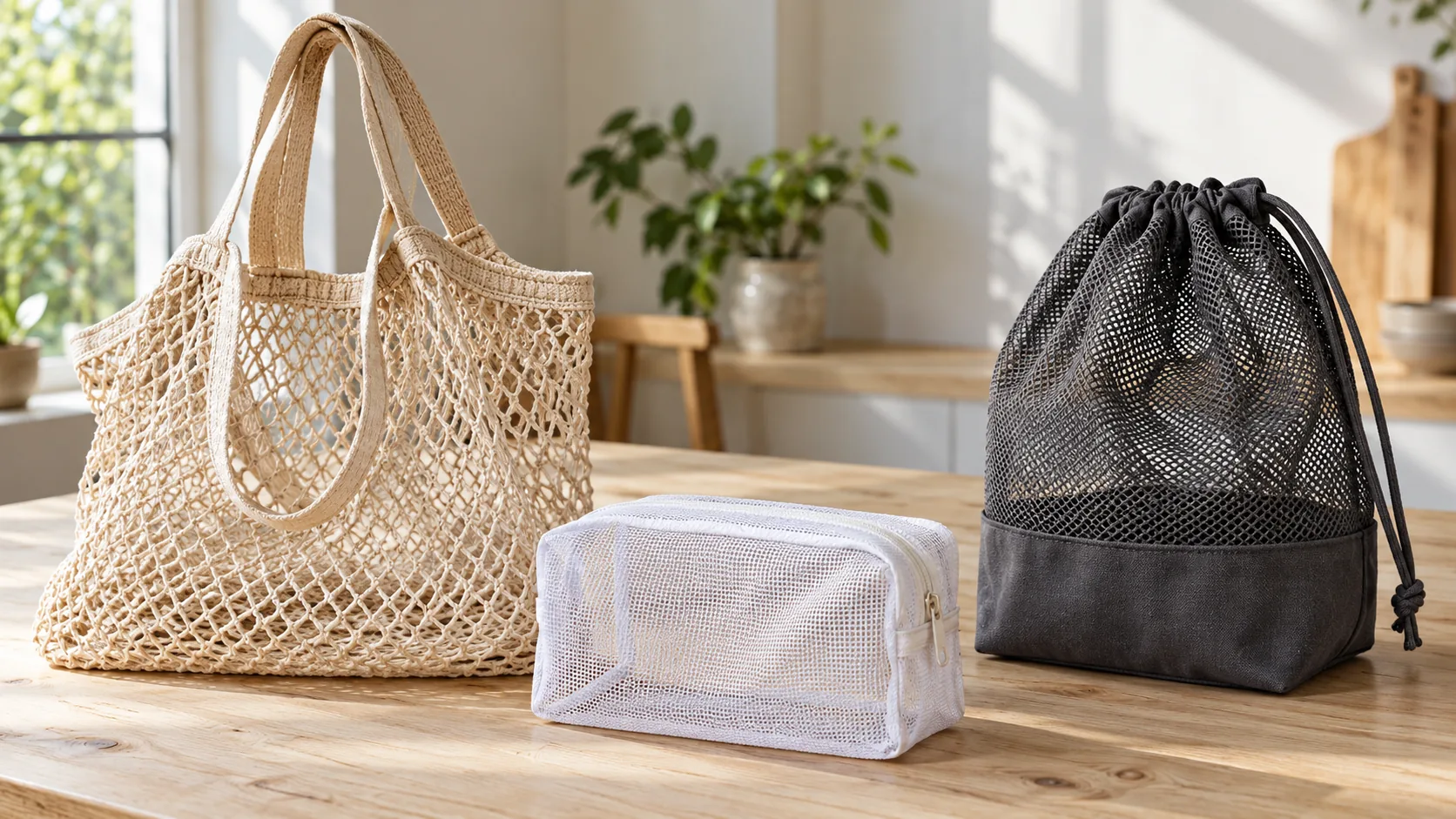
A mesh bag has repeated openings in all or part of its body. It may be an open-net shopping tote, a zipped wash pouch, a drawstring equipment sack, or a backpack with mesh panels. Collins defines a mesh bag as a bag made from netted string; commercial designs also include finer textile mesh and mixed solid-and-mesh panels.
Those designs do not share one specification. A bag that holds a basketball may let an earplug fall through. A zipped wash pouch may contain small garments but have no suitable carrying handles. A mesh panel on a backpack says nothing about the rest of its shell.
For a first check, ask three questions: What needs to stay inside? What exposure will it face? How will it be carried or handled? The answers narrow the choice before you compare fibers or fabric weights.
This guide covers consumer and sewn-bag applications. Wire mesh, industrial filter bags, medical containment, and food-infusion filters require separate specifications and evidence.
What Do Fiber and Mesh Construction Tell You?
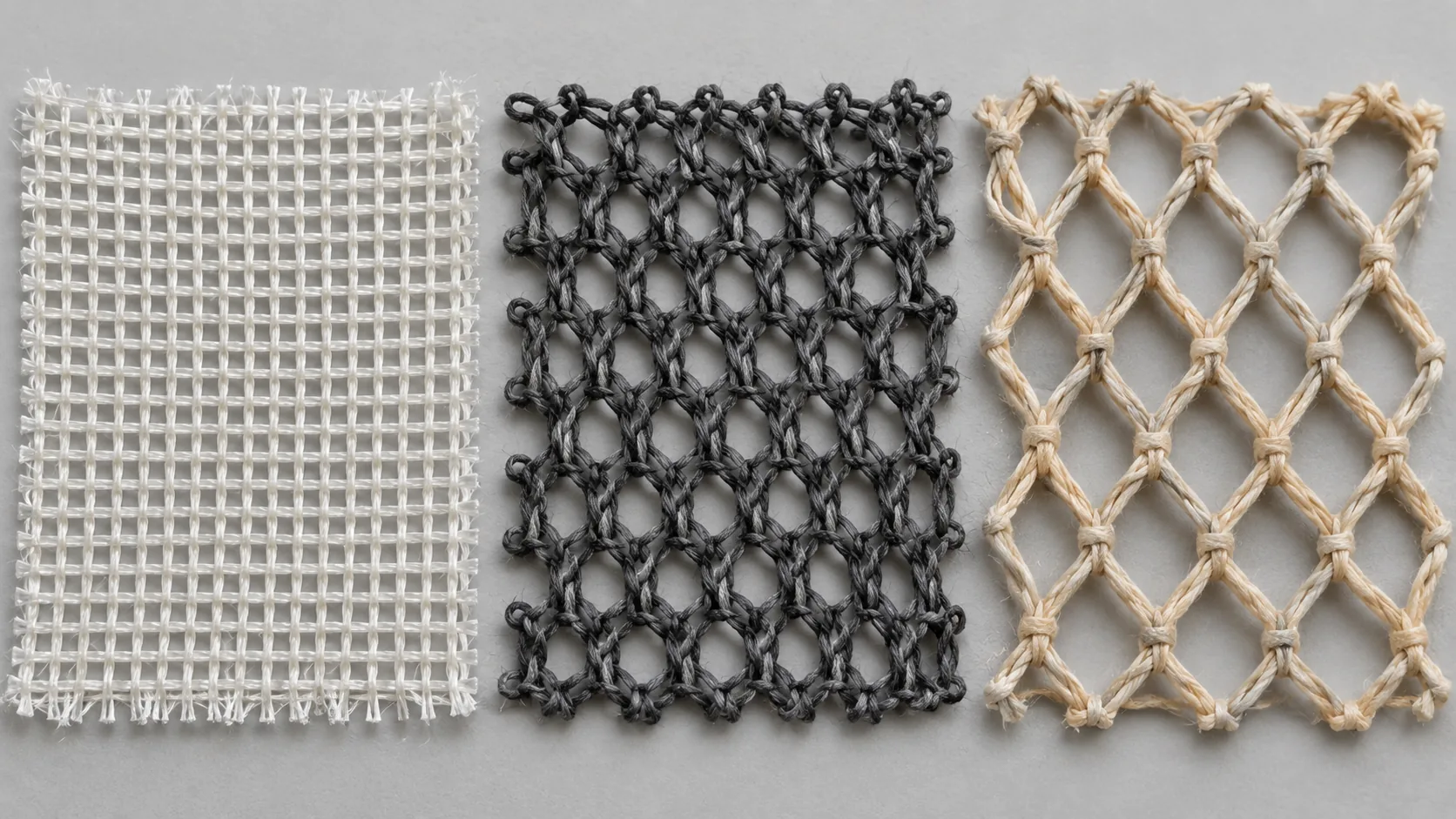
Mesh is often sold as a material or fabric name, but it does not identify the fiber. Keep composition separate from the way the openings are made.
Fiber identity. Ask what the mesh body contains, and record the composition of solid panels, bindings, lining, and straps separately. Nylon, polyester, polypropylene, and cotton are possible choices, not interchangeable specifications. For example, IKEA lists its KUNGSFORS mesh bags as 100% cotton, while MMI Textiles’ Jason Mills mesh range lists polyester fabrics with different weights and finishes. These are product examples, not a market-share claim.
For the broader fiber comparison, see polyester bag material and nylon bag material. Neither fiber name establishes the strength or drying time of a finished mesh bag.
Yarn and construction. A monofilament is a single filament; a multifilament yarn contains several. Ask whether the structure is woven, knitted, knotted, or formed by another process. MMI’s knit-mesh guide describes raschel and tricot production, while Sefar describes precision-woven monofilament mesh. The Sefar example establishes that woven mesh exists; its medical-product approvals do not transfer to consumer bags.
Opening geometry. Record the clear opening, shape, direction, and whether the specimen is relaxed or under a stated load. For woven mesh, mesh count and thread diameter are separate fields. Sefar’s technical definitions distinguish opening size, thread count, yarn diameter, and open-area percentage. Those definitions are useful vocabulary, not bag-specific acceptance values. Do not treat a mesh-count number as a strength or airflow rating, or apply a square-woven calculation to a stretch-knit net.
Weight, finish, and stretch. Specify fabric mass with units, thickness where relevant, any coating or finish, and the direction and conditions of a stretch check. GSM is mass per area, not the bag’s carrying capacity. A stretch result also needs a separate check for the opening size and shape after recovery.
Which Types of Mesh Bags Serve Different Uses?
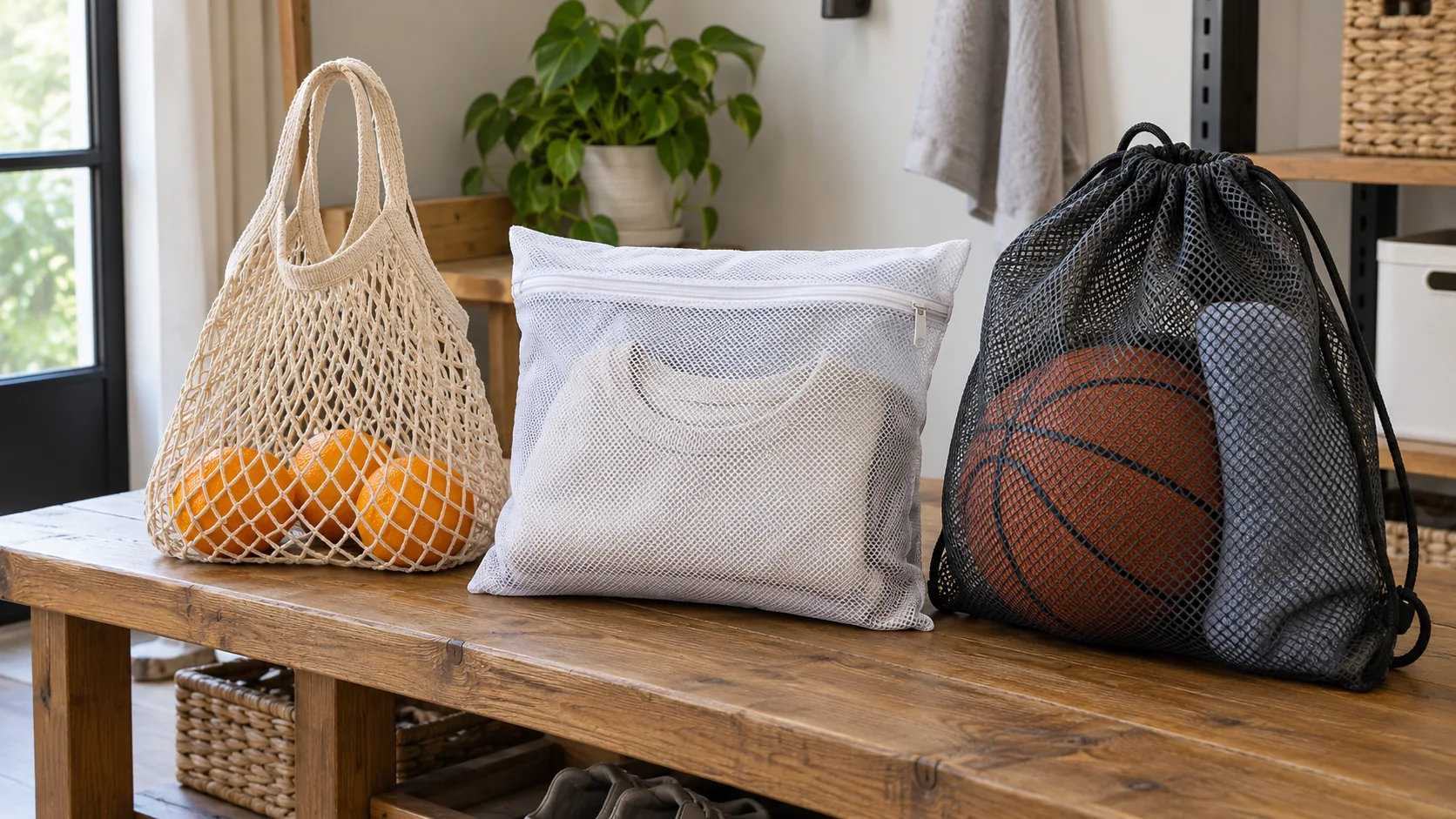
Choose the application before the mesh. The table below identifies checks to make, not a universal construction for each use.
| Bag type | What the design needs to address | What to check on the actual sample |
|---|---|---|
| Laundry or wash pouch | Containment through the permitted wash process | Garment instructions, pouch care limits, opening size, closure security, and exposed snag points |
| Produce or shopping net | The size and weight of the intended contents | Smallest-item retention, handles, shape under load, cleaning instructions, and any required food-contact documentation |
| Sports-equipment sack | Equipment shape, carrying method, and wet or dry use | Protruding edges, small accessories, drawcord security, attachment points, and the permitted load |
| Beach or pool bag | Separation of wet gear and items needing protection | Drainage route, solid pockets, lining, closures, and exposure limits |
| Organizer pouch | Visibility and small-item containment | Corner gaps, zipper ends, lining, and whether the smallest item can pass through stretched openings |
| Drawstring bag | Closure and carrying arrangement | Whether the cord closes the mouth, serves as a carrying strap, or does both; inspect the corresponding anchors |
| Mesh backpack or mesh-panel backpack | Back carrying and the location of open panels | Shoulder-strap attachment, base, pocket construction, lining, and protection needed for the contents |
What Is a Mesh Backpack?
A mesh backpack carries on the back and uses mesh in its body or panels. Check how much of the main compartment is actually open mesh. A solid-shell backpack with a mesh bottle pocket or back panel is a different construction from a largely mesh equipment pack.
As one current example, TYR’s Big Mesh Mummy Backpack combines a mesh main body with shoulder straps, pockets, and barrel-lock closures. That illustrates the subtype; it does not establish a waterproofness, school-policy, or load rating for other mesh backpacks.
For a private-label sports bag, the gym bag manufacturing page is a relevant starting point for a project inquiry. Identify the proposed mesh zones and protection requirements, then ask whether the specific construction is feasible. Do not assume that every mesh design is offered.
What Changes Airflow, Drainage, Visibility, and Containment?
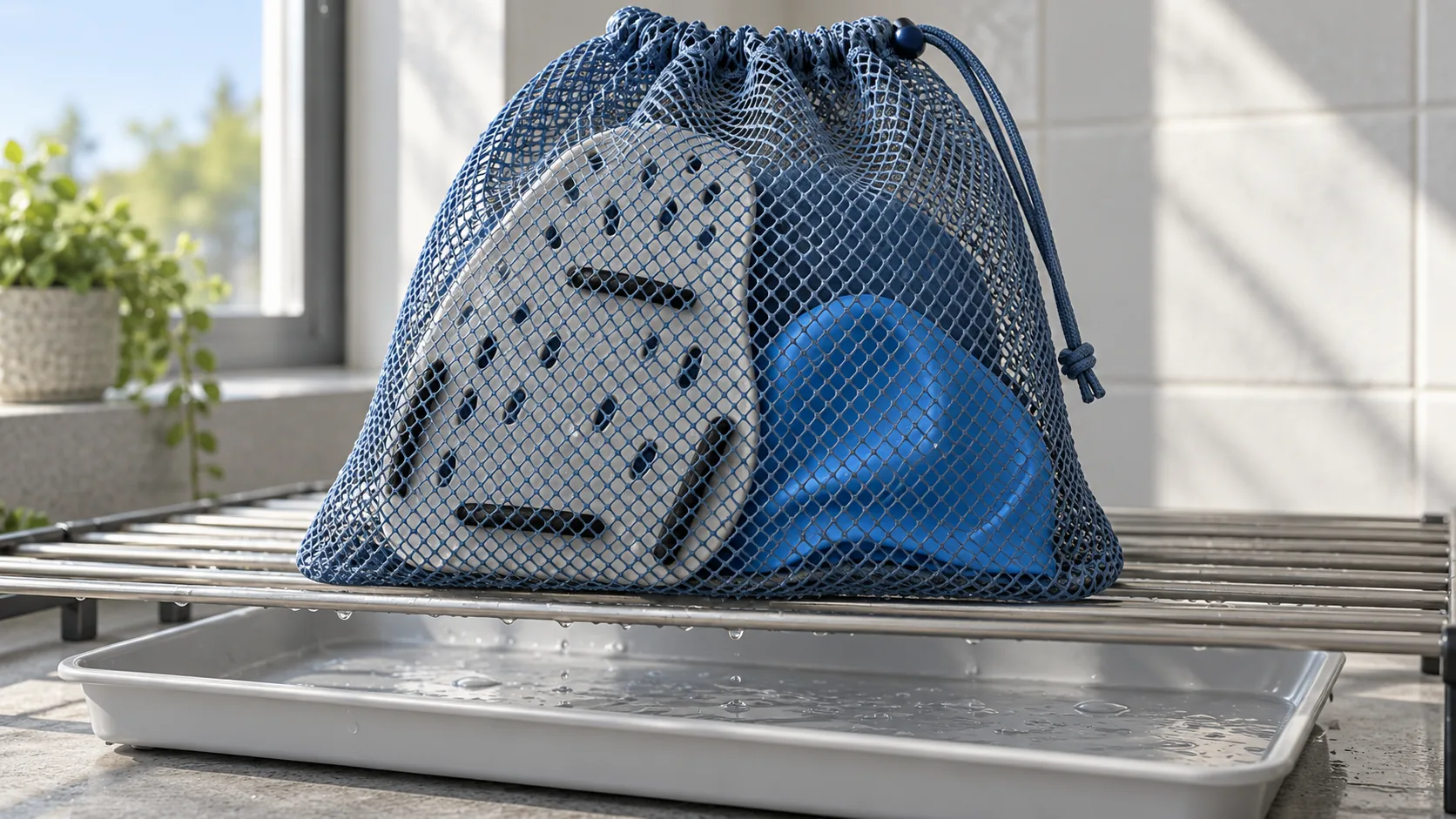
These are four different properties. A visible hole does not verify all four.
Airflow: ask for evidence if a numerical air-permeability claim matters. ASTM D737-18(2023) covers measuring textile-fabric air permeability. Have the laboratory confirm applicability and report the specimen, conditioning, pressure difference, test area, and units. A fabric result alone does not prove that a packed bag prevents odor or feels comfortable against the body.
Drainage and drying: inspect the whole bag. A liner, solid base, pocket, or folded panel may change where water collects. If a drying-time claim is required, agree on the wetting procedure, load, bag orientation, temperature, humidity, and endpoint before comparing samples. Do not infer a drying time from polyester, nylon, or mesh alone.
Visibility: check the bag with its intended contents and lighting. Fine openings, dark yarns, overlap, lining, and solid pockets change what can be seen. Visibility is not proof that a bag complies with a venue’s clear-bag rules.
Containment: use the smallest intended item, including any detachable parts. Check relaxed and loaded openings, corners, zipper ends, and the closed mouth. An item may protrude or escape at a closure even when it cannot pass through the body mesh. A separate solid pouch or lining changes the design and needs its own check.
Food-contact suitability, odor control, mold resistance, and environmental claims need evidence relevant to the actual product. None follows from the presence of holes.
Which Seams, Edges, and Closures Matter?
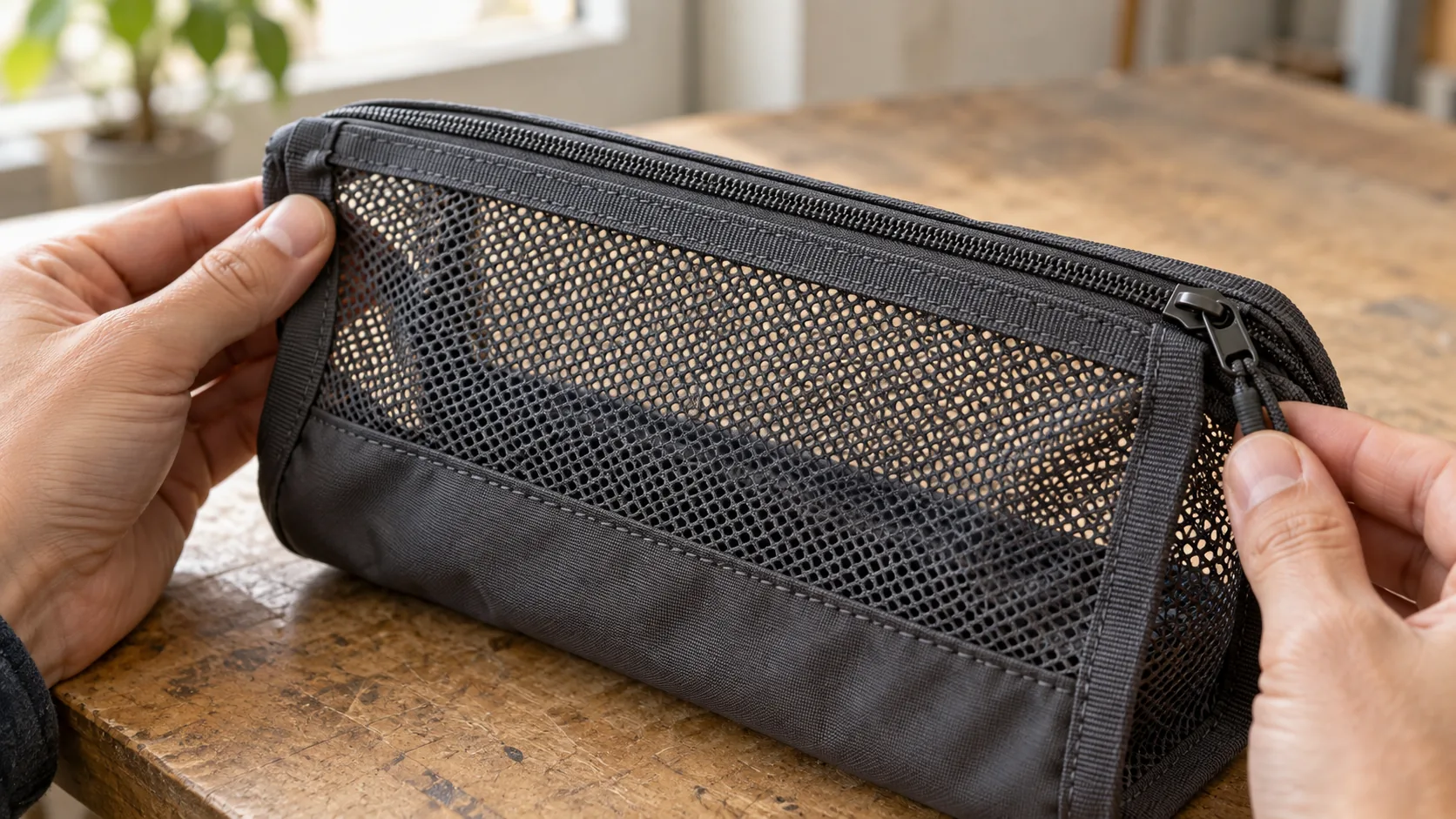
Inspect the transitions as well as the mesh field. The questions below make those areas visible in a specification and sample review; they are not a claim about the most frequent failures.
- Cut edges and binding: are exposed ends secured, and does the binding cover the edge throughout the seam?
- Mesh-to-solid seams: which layers are joined, how are they supported, and do openings or stitches change when the approved load is applied?
- Handles and straps: where does the load enter the bag, and what anchors or reinforcement are actually present?
- Zippers: inspect tape attachment, end stops, corner gaps, slider access, and contact with the contents. A protective slider cover may be useful for a wash pouch, but it is not universal.
- Drawcord channels: check the closure gap, cord routing, stops, and attachment points. Establish whether the cord is only a closure or also part of the carrying system.
- Contact points: look for exposed components that could catch the intended contents during the permitted use or cleaning process.
Do not specify a familiar snagging test without checking its scope. ASTM D3939/D3939M-26 explicitly excludes open constructions such as nets from its mace method, because the points can reach the felt backing instead of the specimen. Ask the laboratory to select an applicable method for the actual fabric and end use. A buyer-defined contact check can support development, but should not be reported as an ASTM result.
What Should Buyers Put in a Mesh-Bag RFQ?
A quotation request needs enough detail to identify the construction being priced. Start by replacing broad sales phrases with fields that can be checked.
| Sales phrase | Information to request |
|---|---|
| “Polyester mesh” | Composition by component, yarn or filament form, construction, opening geometry, mass, and finish |
| “Fine mesh” | Measured opening and units, direction, specimen condition, tolerance, and smallest-item containment check |
| “Heavy-duty mesh” | Intended contents, permitted load, carrying or handling method, duration or cycle count, and agreed acceptance criteria |
| “Breathable mesh” | The specific claim, applicable measurement method, specimen and test conditions; no substitute claim about odor or hygiene |
| “Quick-drying bag” | Finished-bag wetting and drying procedure, load, environment, orientation, and defined endpoint |
Include dimensions and measurement state; mesh supplier or article reference; component list; openings and tolerances; edge and seam construction; closure and hardware; handle or strap attachment; required color and care limits; packaging; and a dated reference sample. List the claims you intend to make and the evidence required for each. Agree in writing before substituting a mesh, binding, zipper, or reinforcement.
A procurement record is not the same as a legally required label. The FTC’s textile and wool labeling guide lists net, tote, laundry, and sports-gear bags, as well as backpacks, among products not covered by the Textile Act labeling requirements. That is not the guide’s separate category where fiber claims trigger disclosure requirements. Products containing or represented to contain wool can fall under the Wool Act, including products exempt under the Textile Act. Confirm the actual product’s requirements for its intended market; this is not a blanket exemption from all labeling or advertising obligations. A written supplier composition statement remains useful for procurement regardless.
How Should a Mesh-Bag Sample Be Approved?
Approve against written requirements, not appearance alone. Use this sequence as a development checklist and agree on the method, load, cycle count, conditions, and acceptance criteria before testing. There is no universal “mesh bag passed” threshold.
- Identify the sample. Record the revision, supplier/article references, component list, dimensions and measurement state, opening geometry, mass, and finish. Keep photographs and the agreed reference.
- Pack the intended contents. Check fit and retention with the smallest items, protruding edges, and any separate accessory pouch. Observe the body, corners, and closure under the stated load.
- Check seams and handling. Examine bindings, stitch movement, anchors, and closure operation during the agreed carrying or handling procedure. Record changes rather than simply writing “strong.”
- Use only the permitted cleaning or exposure procedure. Confirm both the bag’s instructions and the contents’ care instructions. Where relevant, compare dimensions, closure operation, color transfer, openings, and seam condition before and after the agreed process.
- Verify the claims separately. Use suitable evidence for air permeability, drainage, drying, or other claimed properties. An informal visual or odor observation is not a quantified test or a safety certification.
- Freeze the approved reference and production checks. Retain the sample and versioned specification, record deviations, and agree on inspection and substitution controls. One accepted development sample does not guarantee every production unit will match it.
A mesh wash bag does not make a non-machine-washable item machine washable. There is also no universal filling fraction or dryer permission for every pouch. For a specific example, GUPPYFRIEND’s washing-bag instructions exclude tumble drying. Follow the actual product’s instructions rather than copying another bag’s limits.
Frequently Asked Questions
Is mesh a material, and are all mesh bags nylon?
Mesh can be used as a fabric name, but it does not specify a fiber. Nylon, polyester, polypropylene, cotton, and other materials can form open structures. Ask for the actual composition and construction rather than assuming nylon.
Is a mesh backpack waterproof?
The name is not a waterproof rating. Check the complete construction, including open areas, lining, solid compartments, and closures. Protect items that need to stay dry with a suitable enclosure rather than relying on the word mesh.
Can any mesh bag be used for laundry?
No. Choose a bag intended for the proposed wash process, check its closure and snag points, and follow both bag and garment instructions. A sports-equipment net or shopping tote is not automatically a wash pouch.
Do larger openings mean better airflow and drainage?
Opening geometry is relevant, but it does not provide a measured airflow or drainage result. Yarn, finish, lining, contents, and orientation also matter. State the property you need and verify it under agreed conditions.
How do I check small-item retention and durability?
Use the smallest intended contents and the stated load. Check stretched openings, seams, corners, and closure gaps during the agreed handling and care procedures. Record the conditions and changes; no fiber name or GSM value guarantees durability.
A useful mesh-bag specification keeps composition, open structure, assembly, and intended use separate. Choose the application first, then approve a sample against those details.
For a development inquiry, take that component list, intended load, mesh zones, closure, and evidence requirements to the custom bag manufacturing page. Ask for a feasibility review of the specific design before relying on it in a quotation or product claim.