
A purchase order that simply says “felt fabric” rarely survives sampling. Fiber content, thickness, and construction can all change once buyers inspect the actual swatch.
Felt fabric commonly describes a fibrous sheet formed without weaving or knitting, using physical or chemical consolidation. The market also uses “felted fabric” for woven or knitted material finished to create a felt-like surface. Confirm both fiber content and construction before approving either one for a bag component.
Once those facts are confirmed, you can decide whether pressed wool felt, needle-punched synthetic felt, or a felted woven construction fits the component.
What Is Felt Fabric?
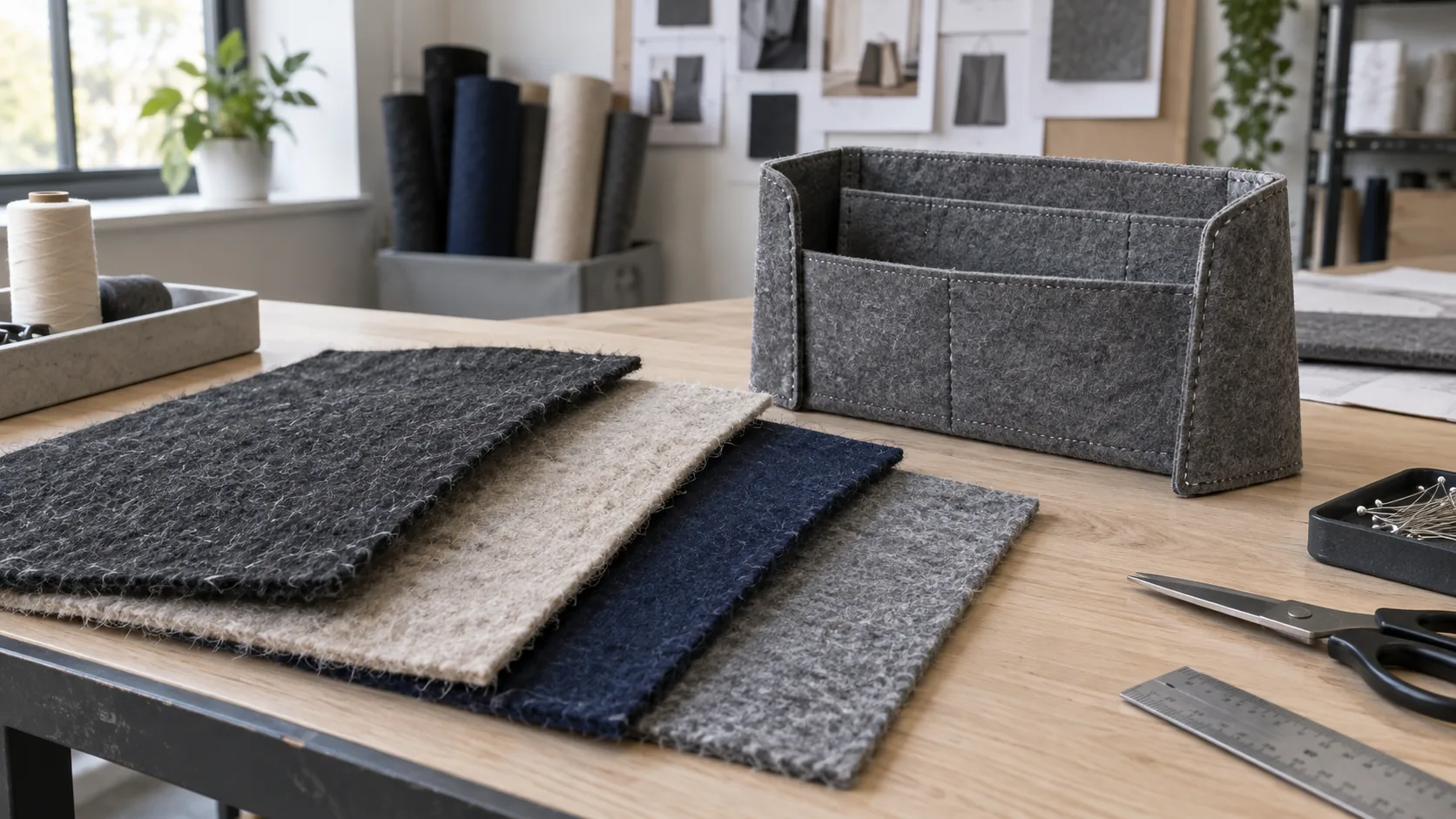
In its narrower sourcing sense, felt is a fibrous sheet formed directly from fibers rather than yarns held together by a weave or knit. Wool, polyester, acrylic, rayon, and fiber blends may be used, but the material name alone does not establish the fiber content.
The current ISO 9092:2026 nonwovens vocabulary defines a nonwoven as an engineered fibrous assembly given structural integrity by physical and/or chemical means, excluding weaving, knitting, or papermaking. That definition helps separate a nonwoven sheet from a woven or knitted fabric that is felted after construction.
The word “felt” still needs context. ASTM D2475-22, for example, covers roll and sheet felt suitable for mechanical use and explicitly does not act as a universal specification for every felt-like product. A bag buyer should record the terminology used, the material form, and the source specification instead of assuming that every product sold as felt belongs to one interchangeable class.
Terminology checkpoint: Ask whether the swatch is a nonwoven felt sheet or a woven or knitted base with a felted surface. “Felt cloth” can refer to either in casual trade language.
How Is Felt Fabric Made?
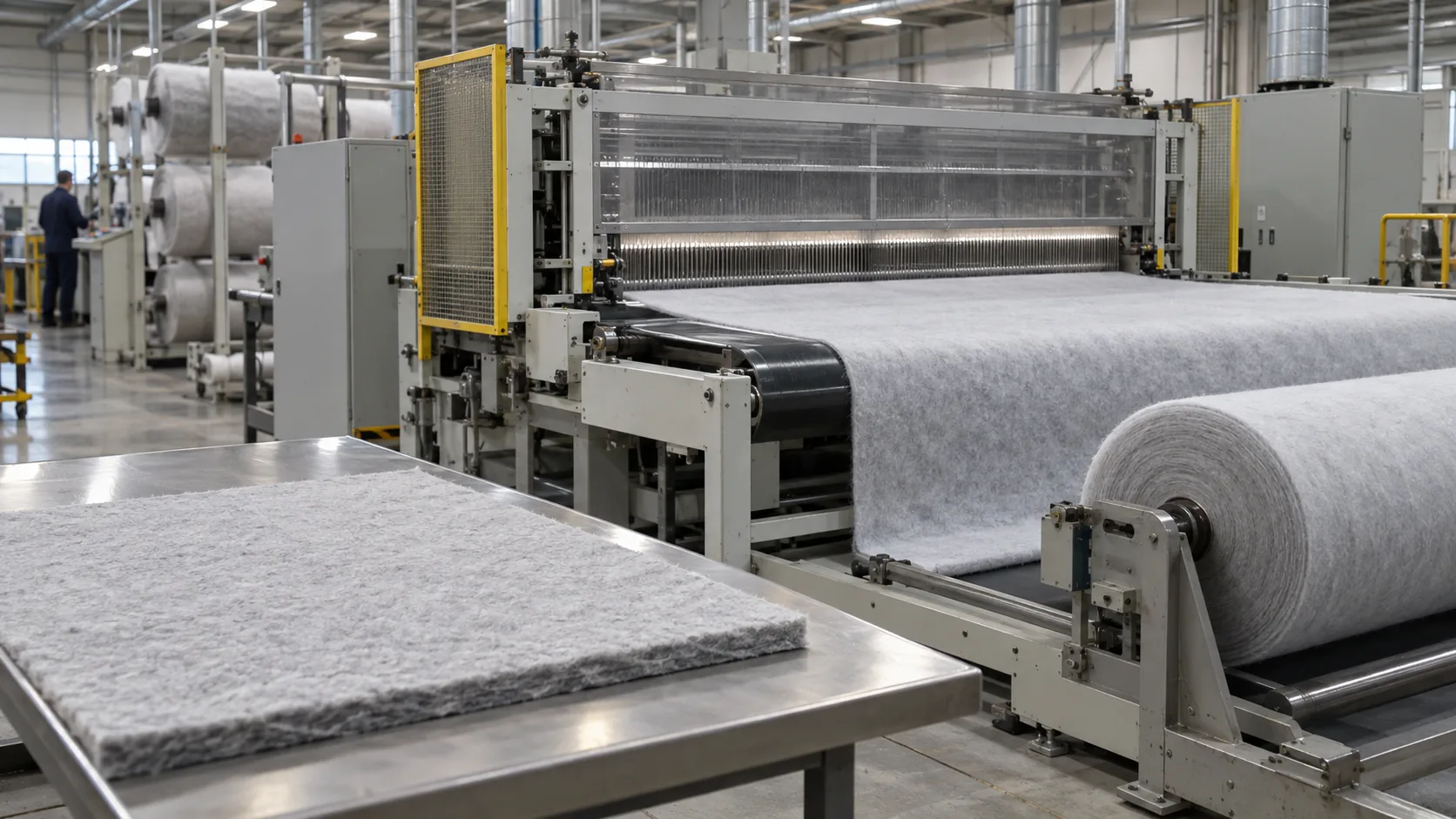
Nonwoven felt reaches its finished state through one or more processes, and not every felt uses every step:
- Matting and pressing. Loose fibers are layered, then compressed with combinations of moisture, heat, pressure, and agitation. This route is associated with traditional wool felt because the fiber surface can interlock under those conditions.
- Needle punching. Barbed needles repeatedly pass through a fiber web and mechanically entangle the fibers. The method can be used with wool, synthetic fibers, recycled fibers, and blends.
- Thermal bonding. Heat activates thermoplastic fibers or binder fibers within a prepared web.
- Chemical bonding. A binder helps consolidate the web, subject to the exact product recipe and finish.
- Finishing. Calendering, coating, laminating, brushing, or other finishing steps can change the surface and handling of the sheet.
Construction insight: Keep web formation and bonding or consolidation as separate fields. A supplier may describe how the web was formed and how it was bonded, and one description does not replace the other. Likewise, “needle-punched” identifies a mechanical consolidation route; it does not identify the fiber content.
Which Types of Felt Matter for Bags?
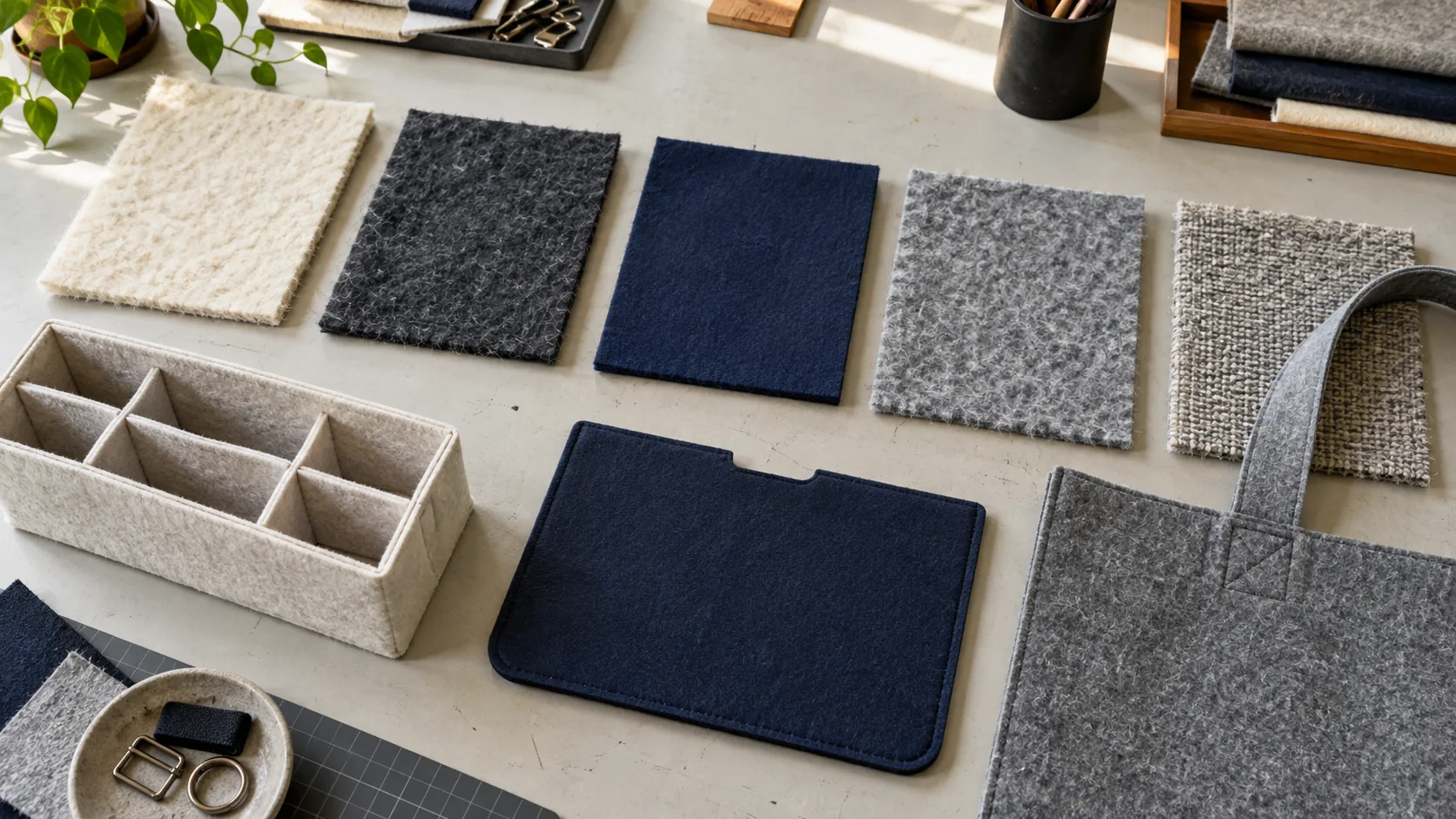
The fiber and construction combination determines what a felt swatch can and cannot do. A label naming “felt” identifies a broad family, not a complete specification.
| Construction | What the description indicates | What still needs confirmation |
|---|---|---|
| Pressed wool felt | Wool-based fibers consolidated through a felting process | Wool percentage, blend content, mass, thickness, density, and finish |
| Needle-punched felt | A web mechanically consolidated with needles | Fiber type, web formation, mass, thickness, backing, and edge finish |
| Synthetic felt | A sheet made mainly from manufactured fibers such as polyester or acrylic | Exact generic fiber, recycled-content evidence if claimed, consolidation, and finish |
| Blended felt | Two or more fiber types are present | Blend ratio, which layers contain them, construction, and care requirement |
| Felted woven or knitted fabric | A yarn-based base fabric is felted after formation | Base fiber, weave or knit, finish, edge behavior, and finished weight |
None of these constructions is automatically better for a bag component. A pressed wool felt organizer panel and a needle-punched polyester divider can both be appropriate for different appearance, structure, care, and cost targets. The comparison should use declared constructions and approved samples, not the generic name alone.
What Changes Felt Fabric Performance?
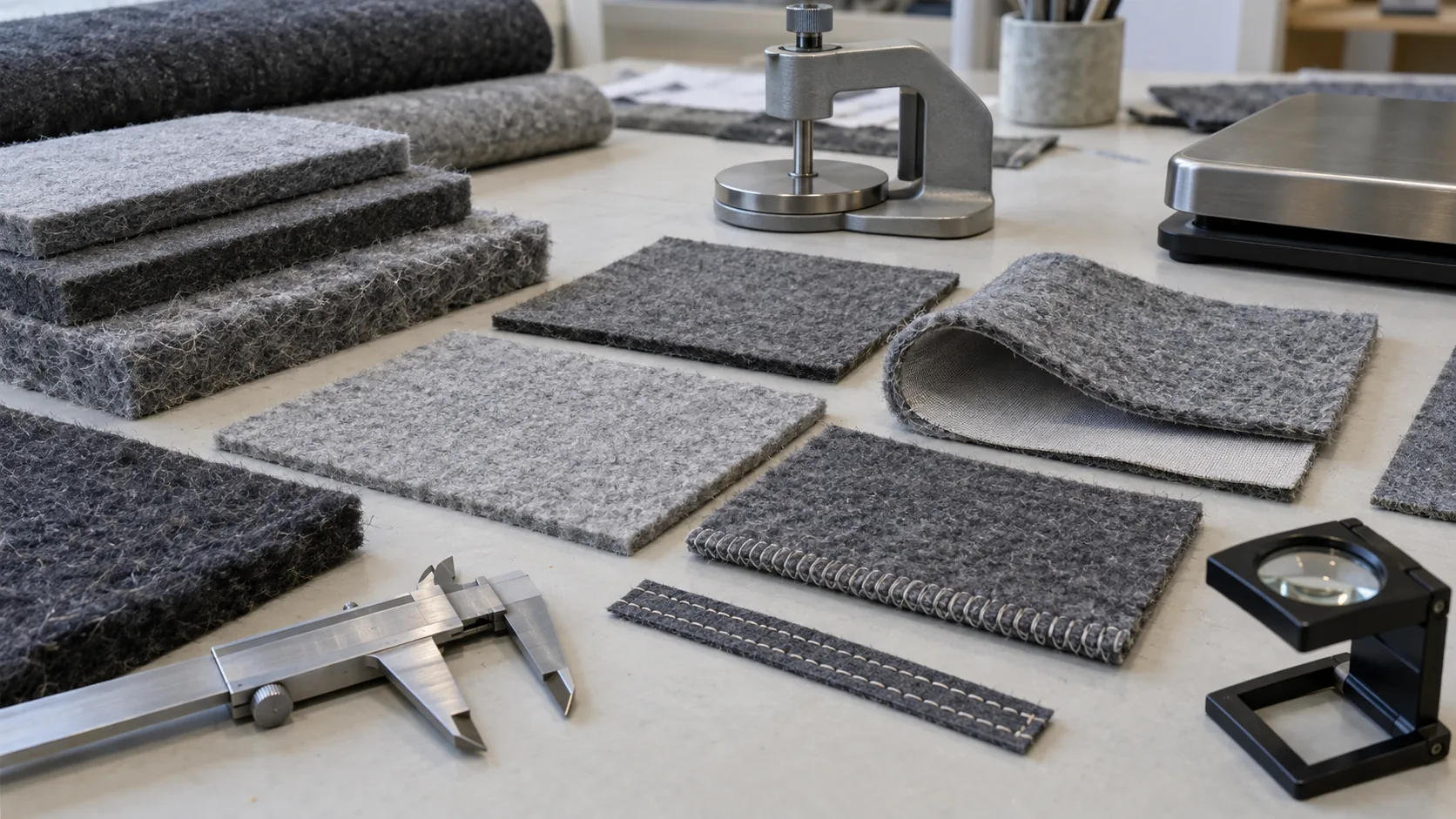
Thickness is the number buyers ask about first, but it is not reliable on its own. The following fields work together:
- Fiber content. Wool, polyester, acrylic, rayon, and blends respond differently to moisture, heat, flexing, and care.
- Web formation and consolidation. Pressed, needle-punched, thermal-bonded, and chemically bonded sheets can handle differently even when their nominal thickness is similar.
- Mass per unit area and density. Two felts with the same thickness can contain different amounts of fiber and feel very different in firmness or compression.
- Scrim or internal reinforcement. A supporting layer can change dimensional stability and tear behavior.
- Stiffness and finish. Calendering, resin treatment, brushing, or other finishes can change hand, surface appearance, and shape retention.
- Backing or lamination. A textile, foam, film, or adhesive layer changes the behavior of the complete panel.
- Color, edge treatment, and stitching. These affect appearance and durability at the component and seam level.
- End use. A visible exterior panel, hidden divider, and laptop sleeve layer place different demands on the material.
Substitution checkpoint: Do not approve a substitute because its thickness or GSM matches the original. Freeze the relevant fiber, mass, thickness, scrim, finish, consolidation, backing, and reference-sample fields according to project risk. This is a comparison framework, not a promise that those fields alone prove cushioning or durability.
Where Is Felt Fabric Used in Bags?

Felt appears in several bag components, and the right specification changes with the job:
- Organizers and dividers. A cut-edge-friendly sheet can simplify internal partitions, but density, stiffness, seams, and load still need approval.
- Tote panels and visible shells. Pressed or blended felt can create a distinctive surface when the selected density, finish, edge treatment, and structure support the design.
- Laptop sleeve layers. Felt can provide a soft contact surface, while protection depends on the complete fit, padding, backing, seam, closure, and bag construction.
- Lining accents. A lighter felt can add a soft interior surface without making the entire shell from felt.
- Protective inserts. Denser felt may be used around contents, although a prototype should be compared with foam or a molded insert when repeated impact matters. Buyers evaluating more rigid protection can also review custom EVA cases as a different construction route.
- Presentation packaging. Felt may support a soft, premium handfeel where appearance and product presentation matter more than outdoor exposure.
The final component needs to be reviewed in the assembled product. Material behavior can change after cutting, sewing, lamination, edge finishing, and packing, which is why understanding how a backpack is made is useful when a felt panel becomes part of a larger construction.
How Does Felt Compare With Woven Fabric, Foam, and Synthetic Leather?
Compare complete candidate constructions for the same component and use rather than ranking generic material names.
- Versus woven fabric. A woven material such as polyester fabric for bags may be preferable for a thin shell that needs yarn-based tensile and tear performance. Felt offers a different surface and generally does not unravel like a woven cut edge, although loose material can still shed fibers, fuzz, or distort.
- Versus foam. Foam can provide controlled cushioning or rebound when the correct grade and geometry are specified. Felt gives a textile surface but should not be assumed to deliver the same compression response.
- Versus synthetic leather. PU- or PVC-faced constructions can provide a wipeable, structured surface. Felt is not a direct substitute when cleaning, rain exposure, or a sharply finished exterior is the primary requirement.
For any comparison, align the component, thickness, finished mass, backing, seam design, exposure, cleaning method, and evidence required. If water protection is central, compare the complete opening, seam, zipper, and lining system used in waterproof backpack construction rather than treating the face material as the finished claim.
Can Felt Get Wet, Fray, Stretch, or Shrink?
- Can felt get wet? Felt is not inherently waterproof. Moisture response depends on fiber, density, finish, backing, exposure time, and the finished construction.
- Does felt fray? A nonwoven felt sheet has no woven yarn structure to unravel, but a loose or low-density edge can shed fibers or fuzz. A felted woven or knitted fabric retains an underlying yarn structure and may behave differently at a cut edge.
- Does felt stretch? Many felt sheets have limited elastic recovery compared with a knit and may distort under sustained load. Direction, construction, backing, and seam placement all matter.
- Does felt shrink? Wool-containing felt can change under heat, moisture, and agitation. The final care instruction must match the actual fiber, dye, finish, adhesive, backing, trims, and assembled product.
Do not convert a property observed on one swatch into a category-wide claim. Water, stretch, shrinkage, and care statements should be confirmed on the selected material and finished sample.
How Should Buyers Specify Felt Fabric for Sampling?
A felt swatch is a starting point, not an approved specification. Before sampling, record:
- component and intended use;
- declared fiber content and blend percentages;
- recycled-content documentation if a claim will be made;
- web formation, when relevant;
- consolidation or bonding route;
- color and finish;
- mass per unit area, thickness, and applicable tolerances;
- density or firmness target when it is measured and agreed;
- scrim, backing, lamination, or adhesive construction;
- stiffness and handfeel reference;
- edge finish and stitching method;
- branding method and its effect on the material;
- care requirement for the finished product;
- target quantity and commercial assumptions; and
- required test evidence for any performance claim.
For products covered by US textile labeling rules, the FTC Textile Fiber Rule requires specific fiber-content and identification disclosures. Confirm the exact product’s obligations rather than treating a supplier’s marketing name as a compliant fiber statement.
Test-report checkpoint: When nonwoven mechanical results are directional, retain the machine direction (MD) and cross-machine direction (CD), test object, method and version, conditioning, and endpoint. An undirected breaking, elongation, or tear number should not be compared casually with a directional result.
Approve a traceable material swatch and a finished sample before production. A custom bag manufacturer can then translate the controlled material record into patterns, seams, reinforcement, prototypes, and a quotation. Use relevant bag project case studies to frame questions, but keep acceptance criteria specific to the current product.
Frequently Asked Questions
What is felt made of?
Felt may be made from wool, polyester, acrylic, rayon, recycled fibers, or blends. Confirm the generic fiber names and percentages for the actual material rather than inferring them from appearance.
Is felt a woven fabric?
Not usually when the term refers to a nonwoven felt sheet. However, some woven or knitted fabrics are felted after construction, so buyers should confirm the underlying structure.
Does felt fray at the edges?
Nonwoven felt generally does not unravel like woven cloth, but low-density material may fuzz or shed fibers. Felted woven or knitted material can show different edge behavior.
Can felt get wet or be washed?
Only under the conditions approved for the finished product. Fiber, finish, backing, adhesive, dye, trims, and construction all affect water response and care, so the product label and validated care method should control.
Should I choose wool felt or synthetic felt?
Neither is universally better. Compare the declared fiber, construction, finish, care, appearance, cost basis, and evidence required for the component, then approve the physical sample.
Conclusion
“Felt” on its own is not a specification. A sourcing-ready record identifies the fiber content, material form, web and consolidation route where relevant, mass, thickness, finish, backing, component, and evidence needed for the intended use.
Approve the traceable swatch and finished sample before production. When those fields are ready, start your custom bag project with the construction and acceptance requirements clearly defined.