
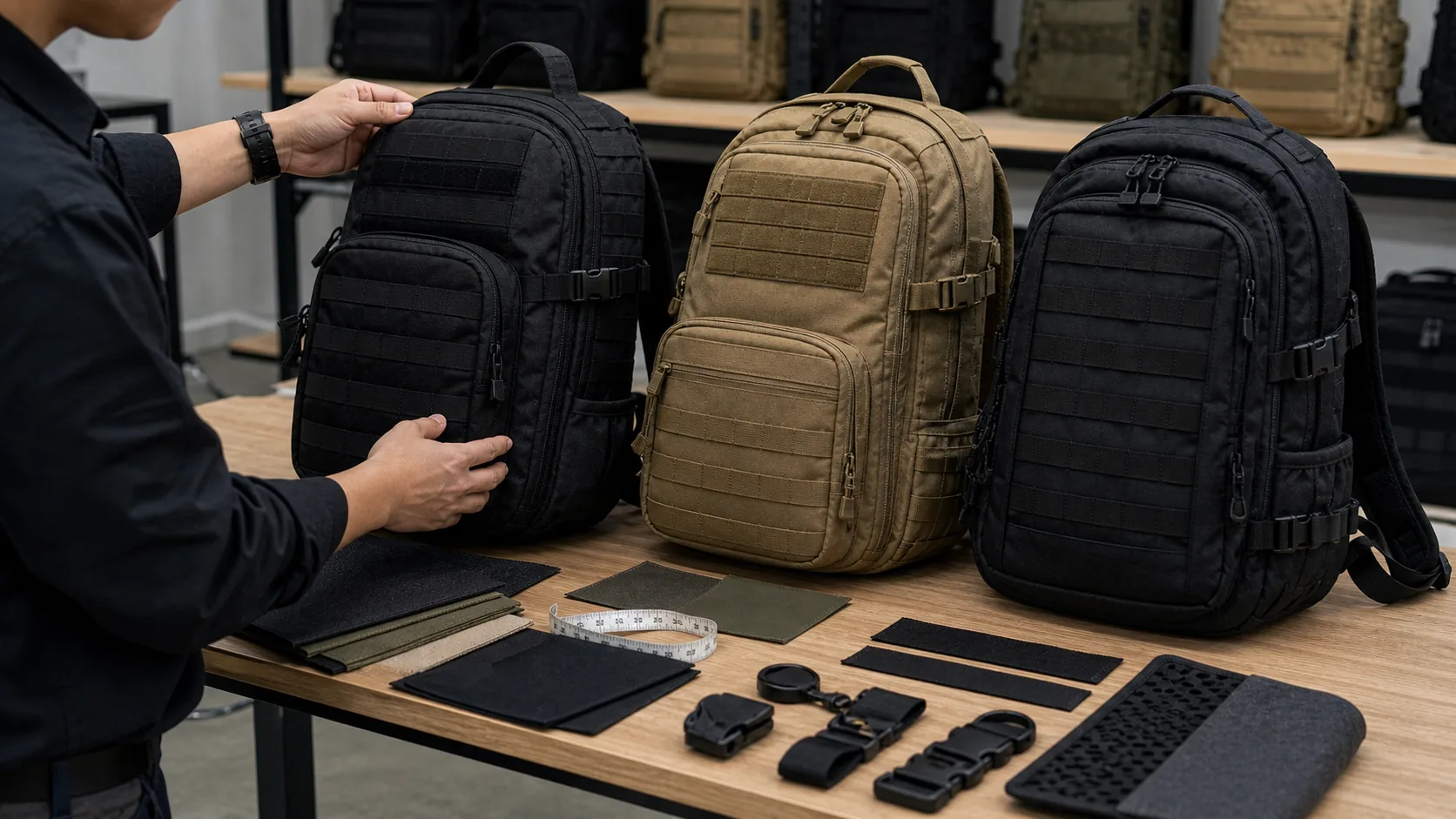
To choose a tactical backpack, match the pack to the user’s load, carry duration, environment, access needs, material expectations, and comfort requirements. A strong tactical pack should not only look rugged; it should carry weight safely, organize equipment predictably, and survive repeated use without weak straps, poor zippers, or wasted pocket space.
For B2B buyers, the decision also affects product reviews, returns, warranty claims, and repeat orders. Buyers developing custom tactical backpacks should compare samples with a clear checklist instead of choosing by appearance alone.
1. What Defines How to Choose a Tactical Backpack?

A tactical backpack is defined by practical utility, reinforced construction, modular organization, and load-bearing support. The best choice depends on how the pack will be used: daily commuting, outdoor travel, professional field work, emergency preparedness, or retail product development.
The first step is to define the use case before reviewing features. A pack designed for urban EDC may need a clean exterior and laptop sleeve, while a larger outdoor pack may need compression straps, hydration routing, and stronger frame support.
What Is Tactical Utility?
Tactical utility means every feature serves a carry, access, protection, or organization purpose. It is not just about dark colors or exterior webbing. A useful tactical backpack should make gear easier to carry, reach, separate, and protect.
Useful baseline features include:
- Reinforced grab handles
- Durable zippers and pullers
- Organized admin pockets
- Compression straps for load control
- Structured shoulder straps and back panel
| Design Element | Practical Purpose | Buyer Check |
|---|---|---|
| Bar-tack stitching | Reinforces stress points | Inspect handles, strap anchors, and webbing |
| Muted colorways | Supports outdoor or professional use | Match the target market |
| Admin panel | Organizes small tools and accessories | Check pocket size and access |
The right tactical backpack should feel intentional. Extra loops, patches, and pockets add value only when they support the user’s real workflow.
2. Does Size Affect How to Choose a Tactical Backpack?

Size affects how to choose a tactical backpack because capacity must match the expected packing list and carry duration. A pack that is too small forces users to strap gear outside awkwardly; one that is too large adds bulk, weight, and poor load control.
Most buyers should compare usable internal dimensions, not just stated liters. Pocket layout, frame shape, laptop sleeves, and thick padding can all reduce real packing space.
How Do EDC and 3-Day Packs Differ?
Everyday carry tactical backpacks often fall around 15L to 30L and work best for daily tools, electronics, documents, compact medical kits, or commuting gear. Larger 3-day style packs often sit around 35L to 65L and support clothing, food, hydration, layers, and outdoor equipment.
| Pack Category | Typical Capacity | Best Use |
|---|---|---|
| EDC pack | Around 15L to 30L | Daily work, commuting, short field tasks |
| 24-hour pack | Around 25L to 40L | Day trips, compact outdoor use |
| 3-day pack | Around 40L to 65L | Multi-day gear and bulkier loads |
For retail and wholesale planning, capacity should be tested with real items. Laptop size, bottle height, jacket bulk, and pouch placement can matter more than a single liter number.
3. Does Load Weight Dictate How to Choose a Tactical Backpack?

Load weight is one of the most important factors when choosing a tactical backpack. Heavier loads need stronger suspension, better strap geometry, stable compression, and sometimes a hip belt or frame sheet.
Shoulder padding alone does not prove comfort. A pack should hold weight close to the back, reduce sway, and distribute pressure without rubbing the neck, shoulders, or lower back.
How Do Shoulder, Sternum, and Hip Straps Help?
Shoulder straps carry and stabilize the pack, while sternum straps help keep the harness in position. A hip belt can shift part of the load toward the pelvis when the pack has enough structure and the torso fit is correct.
Important comfort checks include:
- Shoulder strap curve and foam recovery
- Sternum strap adjustment range
- Hip belt support on larger packs
- Load lifters for taller or heavier models
- Compression straps to keep cargo close
| Strap System | Main Role | What to Inspect |
|---|---|---|
| Shoulder straps | Carry and pressure control | Foam density, width, edge binding |
| Sternum strap | Stabilizes shoulder straps | Slider range and buckle quality |
| Hip belt | Shares heavier loads | Padding, anchor strength, fit range |
For B2B sourcing, test comfort with the intended payload. Empty-sample impressions are not enough for serious pack evaluation.
4. How Does Frame Type Affect How to Choose a Tactical Backpack?

Frame type affects how a tactical backpack carries weight and keeps its shape. Smaller packs may use foam structure or a flexible frame sheet, while larger packs may need HDPE sheets, aluminum stays, or a more supportive harness.
Buyers serving the outdoor and tactical industry should choose frame support according to load, climate, user size, and mobility requirements.
Should You Choose Frame Sheets or Stays?
Frame sheets help prevent pack sag and protect the back from hard objects inside the main compartment. Aluminum stays add more structure for heavier loads and can help transfer weight when paired with a suitable hip belt.
| Frame Option | Best For | Trade-Off |
|---|---|---|
| Foam-only panel | Light daily use | Limited support under heavy loads |
| HDPE frame sheet | EDC to medium loads | Adds structure without much bulk |
| Aluminum stays | Heavier outdoor loads | Adds cost and weight |
| External frame | Oversized or specialty cargo | Bulky and less urban-friendly |
The right frame is not always the strongest one. It should support the intended load without making the pack unnecessarily heavy or rigid.
5. How Do Openings Influence How to Choose a Tactical Backpack?

Opening style determines how quickly users can see, organize, and retrieve gear. A tactical backpack may use a top-loading opening, panel opening, clamshell zipper, rolltop, Y-access zipper, or several access points combined.
The best opening depends on the user’s workflow. A commuter may want a quick laptop compartment, while a field user may need broad visibility and fast access to organized pouches.
What Are Clamshell, Top-Load, and Rolltop Layouts?
Clamshell openings lay the backpack flatter, making gear easier to view and pack. Top-load designs are simple and strong but can bury items at the bottom. Rolltops can improve weather resistance when properly built, though they may slow access.
| Opening Style | Strength | Buyer Caution |
|---|---|---|
| Clamshell | High visibility and organization | Zipper quality is critical |
| Top-load | Simple and familiar | Lower items can be hard to reach |
| Rolltop | Good weather protection potential | Access can be slower |
| Y-access | Fast center access | Requires careful zipper construction |
For sample review, open the pack repeatedly with realistic contents. Stiff corners, weak zipper support, or poorly placed dividers can make an otherwise strong pack frustrating to use.
6. How Does Security Impact How to Choose a Tactical Backpack?
Security features should protect valuable items, controlled equipment, documents, and electronics without making the pack hard to use. Depending on the target market, this may include hidden pockets, lockable zippers, suspended laptop sleeves, RFID pockets, or discreet document storage.
For general B2B product pages, keep security claims practical. A backpack can improve organization and access control, but it should not be marketed as a substitute for professional safety procedures or legal compliance.
Which Secure Compartments Matter Most?
Many buyers prioritize a suspended laptop sleeve because electronics are common in travel, work, and field use. Hidden pockets can also help store passports, IDs, keys, or sensitive documents.
Useful security features include:
- Lockable zipper sliders
- Suspended padded laptop sleeve
- Hidden rear or side pocket
- Internal document sleeve
- Secure zipper garage or flap
| Compartment | Main Benefit | What to Test |
|---|---|---|
| Laptop sleeve | Protects electronics from impact | Padding, suspension, and fit |
| Hidden pocket | Reduces visible access | Placement and usability |
| Lockable zipper | Helps deter casual opening | Slider quality and zipper support |
The best security layout is quiet, accessible, and legal for the intended market.
7. Does MOLLE Change How to Choose a Tactical Backpack?
MOLLE and PALS-style webbing change how to choose a tactical backpack because they allow users to attach compatible external pouches. This can expand capacity, organize frequently used gear, and adapt the pack for different tasks.
However, more webbing is not automatically better. Excessive exterior rows can add weight, increase snag points, and make the pack look too specialized for everyday markets.
What Is the Benefit of a MOLLE Matrix?
A MOLLE-compatible matrix lets users attach pouches by weaving straps through the pack webbing and pouch grid. For quality, buyers should check spacing, bar tacks, reinforcement, and pouch compatibility on the actual sample.
| MOLLE Option | Advantage | Buyer Check |
|---|---|---|
| Sewn webbing | Familiar and repairable | Stitch strength and spacing |
| Laser-cut panel | Cleaner and lower profile | Slot edge quality and laminate strength |
| Hybrid layout | Balanced appearance and utility | Placement and reinforcement |
A durability-focused backpack project can help buyers think beyond the visible grid and evaluate reinforcement, strap stress, and repeated-use performance.
8. Does Hydration Guide How to Choose a Tactical Backpack?
Hydration capability matters when the backpack is intended for outdoor use, long walks, travel, emergency kits, or physically demanding work. A hydration-compatible pack usually includes a reservoir sleeve, hose port, hanger loop, and routing channels.
Water is heavy, so reservoir placement should keep weight close to the back and centered. Poor hydration placement can throw off balance or interfere with other compartments.
What Makes a Hydration System Practical?
A practical hydration layout should separate the reservoir from sensitive items, route the hose cleanly, and allow easy cleaning after use. The sleeve should also fit common reservoir sizes without sagging.
| Reservoir Size | Typical Water Weight | Common Use |
|---|---|---|
| 1.5L to 2L | Moderate | Day hikes and compact packs |
| 2L to 3L | Higher | Longer outdoor use |
| Bottle pockets | Variable | Travel, commuting, or users avoiding bladders |
If the backpack targets travel or commuting, side bottle pockets may be more useful than a full hydration bladder system.
9. How Do Materials Determine How to Choose a Tactical Backpack?
Materials determine abrasion resistance, tear strength, weight, water resistance, appearance, hand feel, and price. Common choices include 500D nylon, 1000D nylon, heavy polyester, ripstop nylon, coated fabrics, reinforced bottom panels, and mesh padding.
Material selection should be based on finished-product testing, not just denier. Weave, yarn quality, coating, backing, stitching, and panel design all affect performance.
Which Fabric Balance Works Best?
High-denier nylon can be useful for high-wear areas, but it may add weight and cost. Polyester can be practical for commercial tactical-style packs. Ripstop can help reduce weight in selected panels.
| Fabric Type | Strength | Trade-Off |
|---|---|---|
| 1000D nylon | High abrasion resistance when specified well | Heavier and more expensive |
| 500D nylon | Good balance for many packs | Less structure than heavier fabrics |
| Polyester | Cost-effective and stable | Performance depends on grade and coating |
| Ripstop nylon | Lightweight tear control | Not ideal for every high-wear panel |
For sourcing teams, material decisions should connect to use case, target price, and expected warranty risk. A retail cost control case is useful when balancing material upgrades against unit cost.
10. Does Activity Define How to Choose a Tactical Backpack?
Activity should define the final backpack specification. A tactical-style travel pack, outdoor rucking pack, range-adjacent gear pack, emergency kit, and daily work pack all need different pocket layouts, materials, and access points.
For e-commerce and retail brands, this matters because generic feature lists often create confused products. A pack should be built for a clear buyer and a clear packing workflow. An e-commerce product testing case can help teams validate a new layout before committing to a larger order.
How Do You Match Layout to Use Case?
Start with the packing list, not the feature list. Identify the largest item, heaviest item, most frequently accessed item, and most damage-sensitive item. Then choose compartments, materials, and access points around those requirements.
| Use Case | Useful Features | What to Avoid |
|---|---|---|
| EDC and commuting | Laptop sleeve, admin panel, clean exterior | Excessive exterior webbing |
| Outdoor rucking | Frame support, hip belt, hydration routing | Poor compression control |
| Travel | Clamshell access, document pockets, bottle storage | Overly bulky exterior attachments |
| Emergency kit | Clear organization and stable pockets | Hard-to-reach buried compartments |
Choosing a tactical backpack is ultimately a specification exercise. When capacity, suspension, frame support, access, security, MOLLE layout, hydration, material, and use case all match, the product feels purposeful instead of overloaded. For OEM or private-label development, contact us today with your target user, capacity range, and required feature set.
FAQ
Can I use a tactical backpack as a carry-on for commercial flights?
Yes, many EDC and travel-oriented tactical backpacks can work as carry-on or personal-item bags if they meet the airline’s size rules. Remove restricted tools and check current airline and security requirements before travel.
What is the best way to clean a dirty tactical backpack?
Use mild soap, cool or lukewarm water, a soft brush, and air drying in shade. Avoid bleach, high heat, fabric softener, and machine washing unless the care label allows it.
How do I know if my tactical backpack fits my torso correctly?
The shoulder straps should sit smoothly, the pack should stay close to your back, and any hip belt should rest around the top of the hips rather than the waist. Test fit with realistic weight.
Can I attach non-tactical gear to a MOLLE system?
Yes, compatible pouches, bottle holders, utility organizers, and outdoor accessories can attach to MOLLE-style webbing when the strap spacing and weaving method fit correctly.
What is the best tactical backpack material?
There is no single best material for every use. Heavy nylon may suit high-abrasion products, while lighter nylon or polyester may be better for EDC, travel, or cost-sensitive retail lines.