
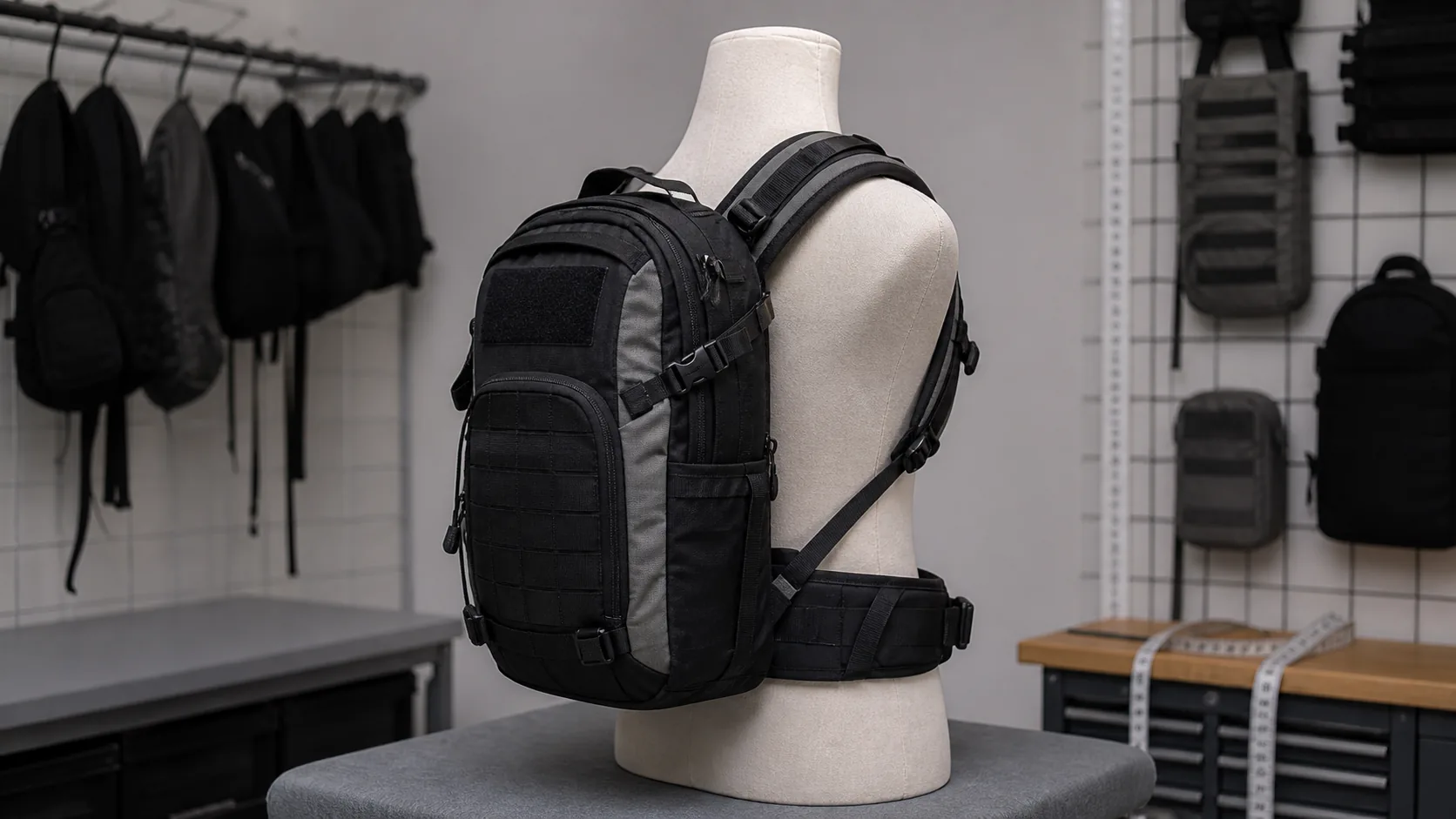
A womens tactical backpack should solve three practical problems at once: fit, organization, and durable daily performance. For brands and buyers, the best design is not simply a smaller version of a standard pack. It needs shorter torso proportions, curved shoulder straps, stable load support, and a compartment layout that feels useful in real work, travel, training, outdoor, and everyday carry situations. ZWbags supports custom development for tactical backpacks when buyers need size, fabric, pocket, and branding details matched to a specific customer group.
What makes a womens tactical backpack fit right?

Proper fit starts with torso length, strap shape, and how the pack sits against the hips. A womens tactical backpack usually needs a shorter back panel than a generic unisex design, because a long frame can push the hip belt too low or make the shoulder straps rub near the neck. Curved shoulder straps also help the bag sit more naturally across the chest without creating pressure points.
Why does torso length matter?
When the back panel is too long, the load can hang from the shoulders instead of transferring cleanly through the waist and hips. That leads to quicker fatigue, poor balance, and complaints from end users.
Key fit details to review:
- Shorter back-panel options for smaller torso ranges
- Shoulder straps with a curved profile and enough padding
- Sternum strap placement that adjusts without pulling the straps inward
- Hip belt shape that stabilizes the bag without feeling bulky
| Fit Area | Design Choice | Buyer Benefit |
|---|---|---|
| Torso panel | Shorter frame length | Better balance for smaller users |
| Shoulder straps | Curved padded straps | Less neck and chest pressure |
| Hip belt | Dense foam support | More stable load transfer |
For production, the safest approach is to test samples with the intended user group instead of assuming one size will work for all customers.
Why do you need a womens tactical backpack daily?

Daily use depends on organization as much as strength. A womens tactical backpack should keep work items, tech accessories, outdoor tools, and small personal items easy to find. For e-commerce and retail buyers, this matters because product reviews often mention pocket placement, laptop fit, bottle access, and whether the bag feels too bulky for regular use. These decisions also affect how a pack performs in e-commerce bag projects where clear function and repeatable quality drive customer satisfaction.
Which compartments help most?
Admin pockets, padded sleeves, clamshell openings, mesh dividers, and quick-access top pockets all serve different daily tasks. The layout should be organized without becoming crowded.
Useful daily organization features include:
- A padded laptop or tablet sleeve
- Front admin pockets for pens, cables, and cards
- Mesh pockets for small loose items
- Side pockets sized for common water bottles
- A main compartment that opens wide enough for packing
| Setup | Compartment | Ideal Use |
|---|---|---|
| Tech | Padded sleeve | Laptop or tablet protection |
| Admin | Front zip panel | Small-item sorting |
| Main | Clamshell opening | Clothing, gear, or samples |
A strong daily layout reduces searching and makes the backpack feel more premium even before the user notices the fabric or hardware.
How should a womens tactical backpack handle weight?

Weight handling depends on the suspension system, not only the fabric. A womens tactical backpack should hold its shape when loaded and avoid sagging away from the body. Back padding, frame sheets, load lifters, and hip belts all help distribute weight more evenly. The goal is a stable carry for dense items such as tools, range accessories, camera gear, work equipment, or outdoor supplies.
Do suspension systems reduce strain?
They can, when they are designed and fitted correctly. A thin back panel may be enough for a light commuter bag, but a tactical-style pack often needs more structure. Dense foam, breathable mesh, and a supportive waist belt can make the same load feel more manageable.
Important suspension details:
- HDPE frame sheet or removable stays for structure
- Breathable back padding for longer wear
- Hip belt that stabilizes heavier loads
- Load lifters that keep the top of the pack close to the body
| Component | Common Material | Function |
|---|---|---|
| Frame sheet | HDPE plastic | Reduces sagging |
| Back padding | EVA foam and mesh | Improves comfort and airflow |
| Load lifters | Nylon webbing | Helps tune balance |
Buyers should confirm the intended load range before approving the final structure, because too much padding can add unnecessary cost and weight.
Can a womens tactical backpack survive outdoors?

Outdoor durability comes from fabric choice, coating, zipper quality, seam construction, and reinforcement placement. A womens tactical backpack used for hiking, training, travel, or field work should resist abrasion and light rain while keeping the structure comfortable. ZWbags’ outdoor and tactical industry experience is relevant when buyers need rugged materials without making the finished bag feel oversized.
Which materials are worth checking?
Nylon and polyester can both work, but the final performance depends on denier, coating, weave, and stitching quality. Buyers should also inspect stress points such as the strap base, handle, zipper ends, and bottom panel. For a deeper example of wear resistance priorities, see this outdoor durability case.
Key durability points:
- Reinforced bottom panel for rough surfaces
- Water-resistant coating for daily weather exposure
- Bartack stitching at high-stress points
- Reliable zippers and pullers that work with gloves
| Fabric Area | Common Choice | Purpose |
|---|---|---|
| Main shell | 500D or 600D fabric | Balanced strength and weight |
| Bottom panel | Heavier reinforced fabric | Abrasion protection |
| Lining | Polyester or nylon | Interior structure and finish |
Durability should be matched to the user’s real environment. A city EDC pack and a field-oriented pack do not need the exact same material specification.
What capacity fits a womens tactical backpack best?

Capacity should support the mission without encouraging overpacking. For many users, a 25-35 liter womens tactical backpack offers a practical balance between storage and movement. It can hold a jacket, water bottle, tablet, first aid pouch, tools, and daily accessories while still feeling compact enough for travel or commuting.
Is 30 liters a useful reference size?
Yes, as a starting point. A 30L design often gives enough room for daily carry and outdoor use, but the right size depends on the target market. A minimalist EDC audience may prefer 15-20L, while outdoor buyers may need a larger pack with stronger support.
Capacity planning guide:
- 15-20L for quick daily carry
- 25-35L for day trips, work, training, and travel
- 40L or more for multi-day packing and heavier loads
| Size Range | Best Fit | Mobility |
|---|---|---|
| 15-20L | Light EDC | Highest |
| 25-35L | Daily and outdoor crossover | Balanced |
| 40L+ | Extended trips | More restricted |
The best capacity is the one that supports the customer’s normal load without forcing the pack to become wide, stiff, or uncomfortable.
How customizable should a womens tactical backpack be?
Customization can include MOLLE panels, laser-cut webbing, colorways, fabric weights, zipper pulls, lining colors, logo placement, and interior pocket layouts. A womens tactical backpack does not need every tactical feature available; it needs the right features for the customer segment. A clean retail version may use subtle laser-cut panels, while a more technical version may need stronger exterior attachment points.
Does laser-cut MOLLE add real value?
Laser-cut MOLLE can reduce bulk and create a cleaner profile compared with traditional sewn webbing. It is useful when users need modular pouches but still want the bag to look modern and streamlined.
Customization options to evaluate:
- Traditional or laser-cut MOLLE panels
- Hook-and-loop patch areas
- Side compression straps
- Hydration routing
- Color combinations for retail positioning
| Webbing Type | Look | Best Use |
|---|---|---|
| Traditional MOLLE | More technical | Outdoor and tactical users |
| Laser-cut MOLLE | Cleaner and lighter | Modern retail designs |
| Minimal webbing | Low profile | Urban everyday carry |
For bulk production, buyers should confirm which features are functional requirements and which are only styling cues.
Does quick access matter in a womens tactical backpack?
Quick access matters when users need to reach work tools, medical supplies, travel documents, electronics, or outdoor essentials without unpacking the whole bag. A womens tactical backpack can use clamshell openings, top stash pockets, side-entry compartments, and high-contrast linings to make access faster.
Which access features are most useful?
The most useful features are the ones that match real user behavior. A clamshell opening helps packing and inspection. A top pocket is good for small items. A side pocket can work for a tablet or document sleeve if the internal structure supports it.
Access features to consider:
- Clamshell zipper for full opening
- Top pocket for keys and small accessories
- Interior contrast lining for visibility
- Elastic loops for organized tools
- Pullers that are easy to grip
| Access Feature | Benefit | Best Application |
|---|---|---|
| Clamshell zip | Full visibility | Packing and organization |
| Top stash pocket | Fast grab | Keys, cards, or small tools |
| Contrast lining | Easier search | Dark or crowded compartments |
Avoid adding too many zippers or hidden compartments if they make the product confusing or expensive to manufacture.
Are low-profile features useful in a womens tactical backpack?
Low-profile styling helps a tactical-inspired pack work in more settings. Many customers want organization and durability without a product that looks overly aggressive. Muted colors, cleaner front panels, hidden zipper tracks, and restrained webbing can make a womens tactical backpack easier to use for travel, commuting, retail, and outdoor crossover markets.
What makes a tactical backpack look more discreet?
The biggest factors are silhouette, color, hardware, and panel layout. A smooth front panel looks more urban, while heavy webbing and oversized buckles make the bag look more technical. Neither direction is automatically better; the right choice depends on the buyer’s target audience.
Low-profile design choices:
- Muted black, gray, olive, or tan colors
- Minimal front webbing
- Hidden or color-matched zippers
- Smaller patch areas
- Clean side profile
| Feature | Visibility | Design Purpose |
|---|---|---|
| Muted colors | Low | Everyday styling |
| Hidden zippers | Low | Cleaner appearance |
| Smooth front panel | Medium | Retail-friendly look |
For women’s tactical bag lines, low-profile styling often broadens the product beyond a narrow tactical audience.
How do buyers choose the best womens tactical backpack?
Choosing the best womens tactical backpack means comparing fit, capacity, materials, pocket layout, and sample quality together. Buyers should not approve a design based on photos alone. A real sample should be loaded, worn, opened, packed, and inspected before production.
What should be checked before production?
Start with fit and comfort, then move to construction. Check whether the shoulder straps sit naturally, whether the hip belt supports the load, and whether the back panel feels too long. Then inspect zipper movement, stitching consistency, lining quality, and how well the bag stands when packed.
Pre-production checklist:
- Confirm target torso range and capacity
- Test loaded samples with representative users
- Check zipper smoothness and puller strength
- Review bartacks on strap anchors and handles
- Confirm fabric, coating, and lining specifications
- Record any changes before bulk approval
| Evaluation | Focus Area | Success Metric |
|---|---|---|
| Fit test | Shoulders and hips | No painful rubbing |
| Hardware | Zippers and buckles | Smooth repeated operation |
| Structure | Back panel and base | Stable when loaded |
The best sourcing decision balances comfort, durability, target price, and repeatable manufacturing quality. To develop a custom line, buyers can contact us today with capacity, material, color, and feature requirements.
FAQ About Womens Tactical Backpacks
Can a standard unisex tactical backpack work for women?
Sometimes, but it depends on the user’s torso length and load. A smaller user may need a shorter back panel, curved shoulder straps, and better hip-belt placement.
What material is best for a rugged womens tactical backpack?
Many buyers choose 500D, 600D, or 1000D fabric depending on the balance of strength, weight, and target cost. Coating, stitching, and reinforcement matter as much as denier.
Is 30L the best capacity for women?
It is a useful middle range, but not a universal answer. Light EDC users may prefer 15-20L, while outdoor or travel users may need 25-35L or more.
Should a womens tactical backpack use MOLLE?
MOLLE is useful when customers need modular pouch attachment. For urban or retail designs, laser-cut or minimal webbing may look cleaner while keeping some flexibility.
How should buyers test a sample before bulk production?
Load the sample with realistic items, check strap comfort, open every zipper repeatedly, inspect stress points, and confirm that the final pocket layout matches the intended use.