
A supplier may describe a polyester bag as waterproof even though the only confirmed detail is the fiber name. If rain later enters through a seam or zipper, that description does not tell the buyer which part of the product failed.
Polyester is not automatically waterproof. Water protection depends on the complete construction: woven fabric, face finish, coating or laminate, seams, closures, openings, and the finished bag. Each claim also needs evidence from the test object and exposure that match the intended use.
This guide shows bag buyers how to turn a vague waterproof request into a controlled material and product specification.
Is Polyester Waterproof?
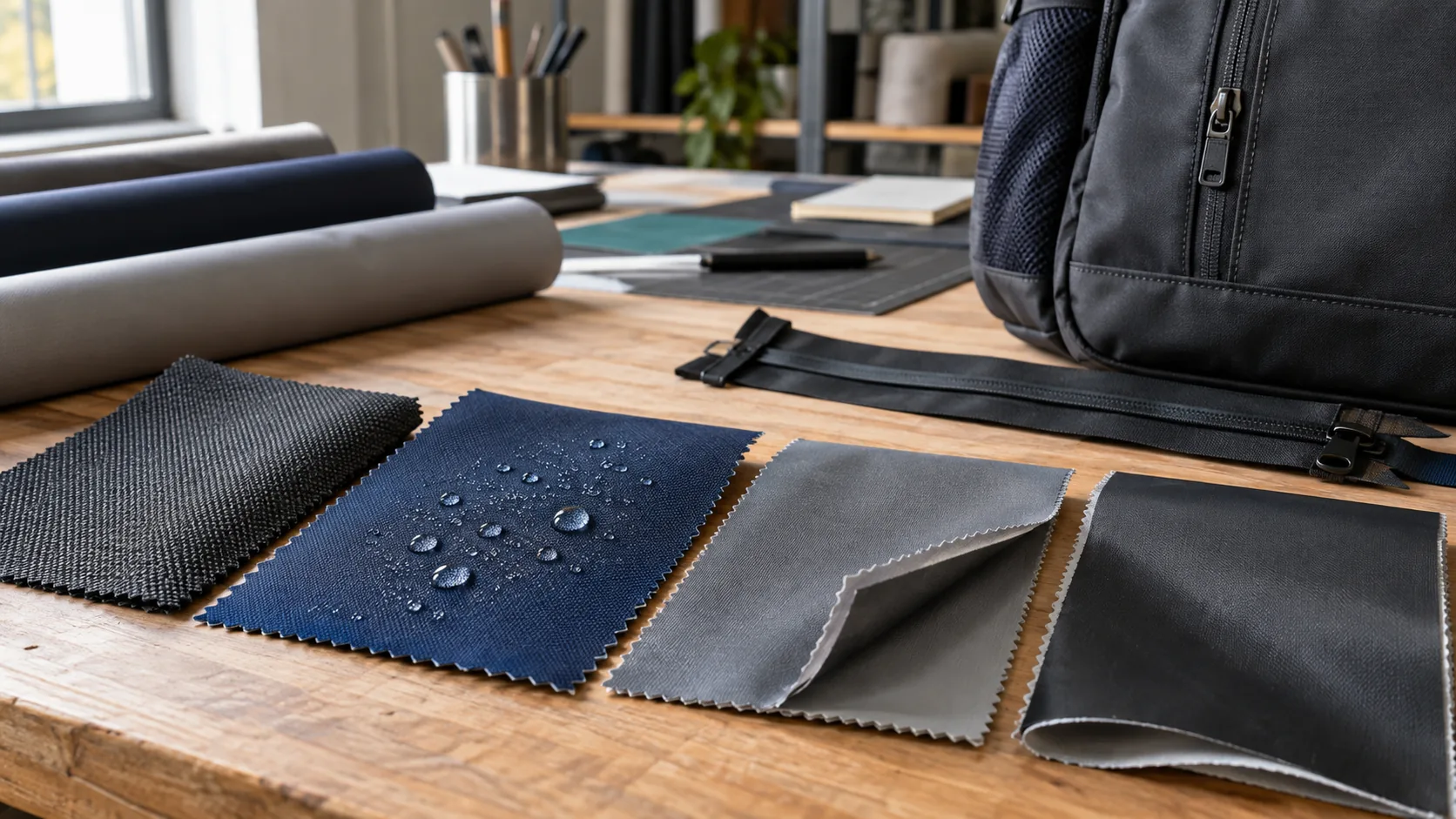
Polyester identifies a fiber family, not a water-protection grade. The word alone does not disclose the weave, fabric mass, face finish, backing, coating, laminate, or panel construction.
Four different test objects are often confused:
- Polyester yarn. Fiber identity helps describe the raw material but does not prove that a fabric blocks water.
- Uncoated woven polyester. The weave is not a continuous barrier. Its resistance to wetting or penetration depends on the exact construction and must be tested rather than inferred from the fiber name.
- Coated or laminated polyester. A compatible polymer layer may create a barrier across an intact fabric specimen. Its continuity, adhesion, flex response, and aging still matter.
- The finished bag. Panels are cut, stitched, welded, bound, fitted with hardware, and opened by a zipper, flap, drawcord, or roll top. These details introduce water paths that a flat fabric result cannot evaluate.
The useful sourcing question is therefore not simply “is polyester waterproof?” It is “which construction must manage which water exposure, and what evidence will demonstrate that performance?”
What Do Water Repellent, Water Resistant, and Waterproof Mean?
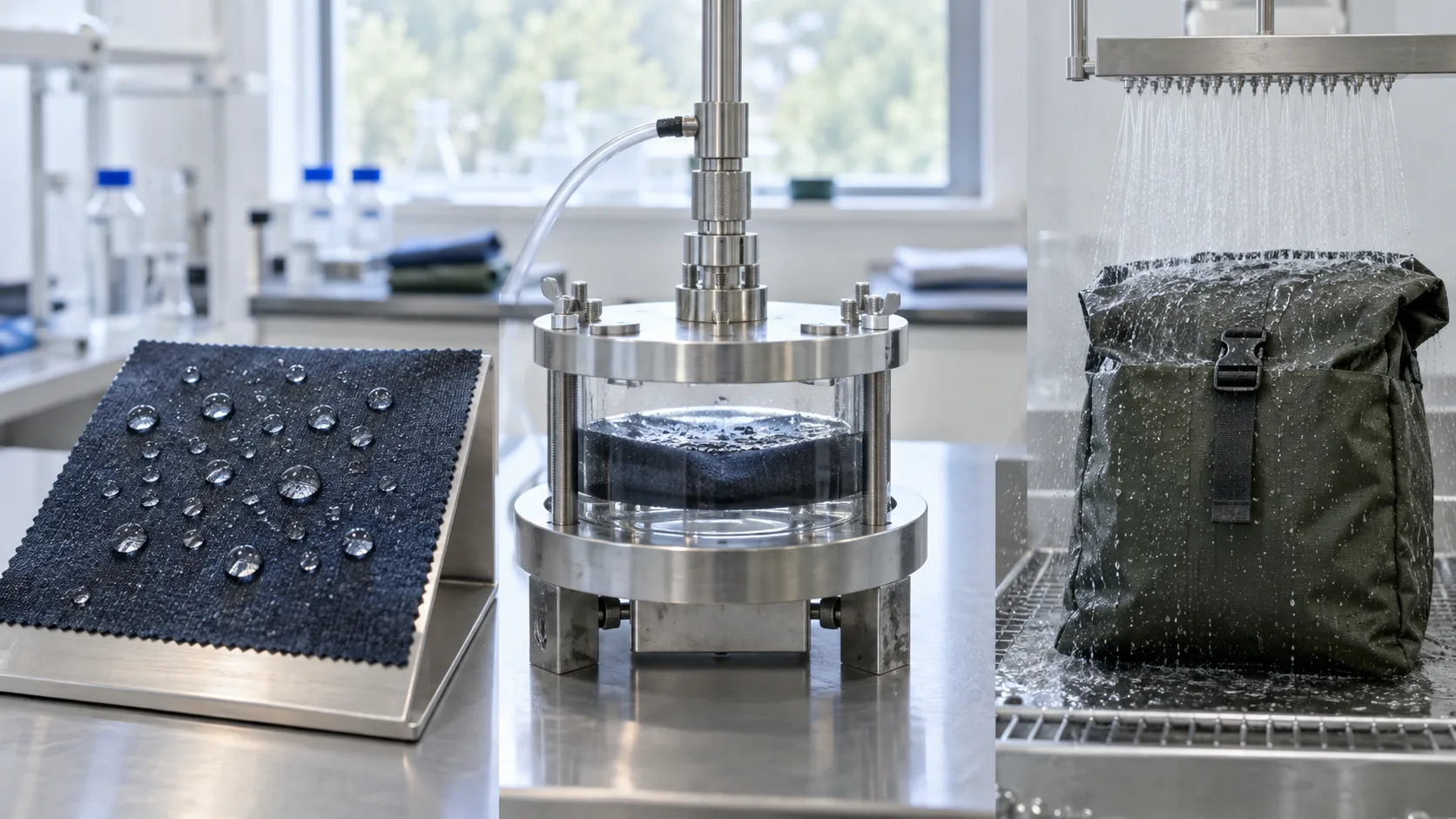
These terms describe different performance questions and should not be treated as interchangeable labels.
Water repellent usually describes surface wetting. Water beads or sheds from the face instead of spreading immediately across it. The result belongs to a named specimen, finish, method, and condition; it does not prove resistance to water under pressure.
Water resistant needs a defined exposure and acceptance criterion. Limited rain, directional spray, wet-ground contact, and hydrostatic pressure are different conditions. The term has little purchasing value until the specification identifies the test object, method, conditioning, and threshold.
Waterproof for a finished bag should be tied to a stated use scenario. A closed bag exposed to rain is a different product requirement from a bag expected to tolerate immersion. Closure state, orientation, load, duration, water delivery, and acceptable internal moisture all affect the claim.
The FTC Textile Fiber Rule addresses fiber-content and related labeling for covered textile products; it does not turn the word polyester into a finished-bag waterproof rating. Buyers should define the performance claim operationally in the purchase specification.
How Do Weave, Weight, and Denier Affect Water Resistance?
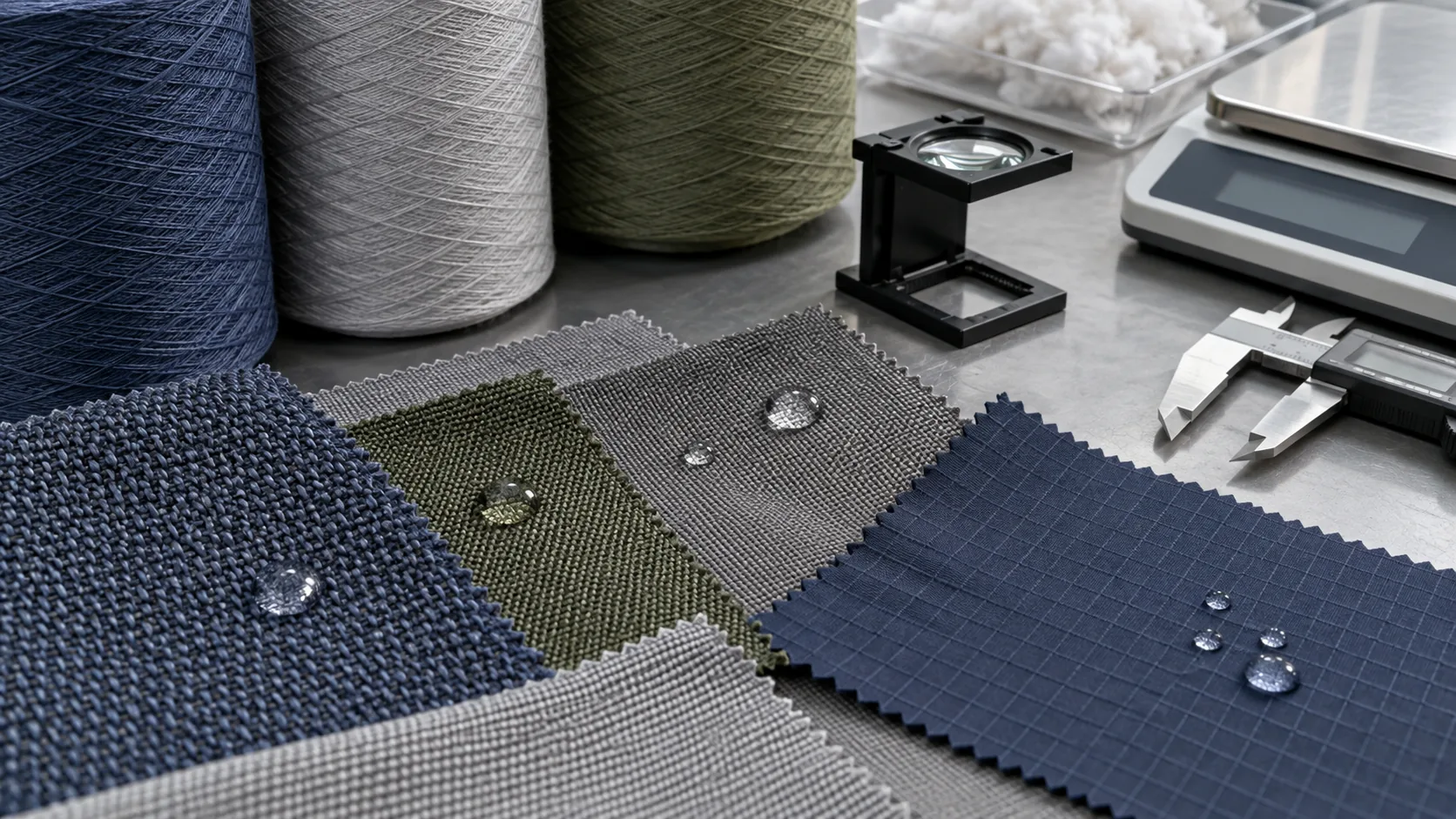
Weave, fabric mass, and denier help identify a fabric, but none of them independently proves water protection.
- Weave and yarn density influence the size and distribution of spaces in the construction. A more compact weave may behave differently from an open one, but the actual result still depends on the full fabric and finish.
- Finished fabric mass reflects material per unit area and may include a finish, coating, or backing. A higher value does not disclose which layer added the mass or whether the barrier is continuous.
- Denier measures yarn linear density. It does not measure coating quality, seam leakage, or hydrostatic resistance.
This is why two fabrics sold as 600D polyester can produce different results. One may be uncoated, another may have a face-side repellent finish, and others may use different back coatings or laminates. Even when the nominal denier matches, weave, yarn construction, mass, finish, layer uniformity, and test history can differ.
Request the technical sheet and a traceable swatch. Record fiber, yarn construction, warp and weft denier, weave, finished mass, coating or laminate, application side, finish, and relevant test result. Treat “600D” as one field in that record, not as a waterproof grade.
How Do DWR, Coatings, and Laminates Change Polyester?
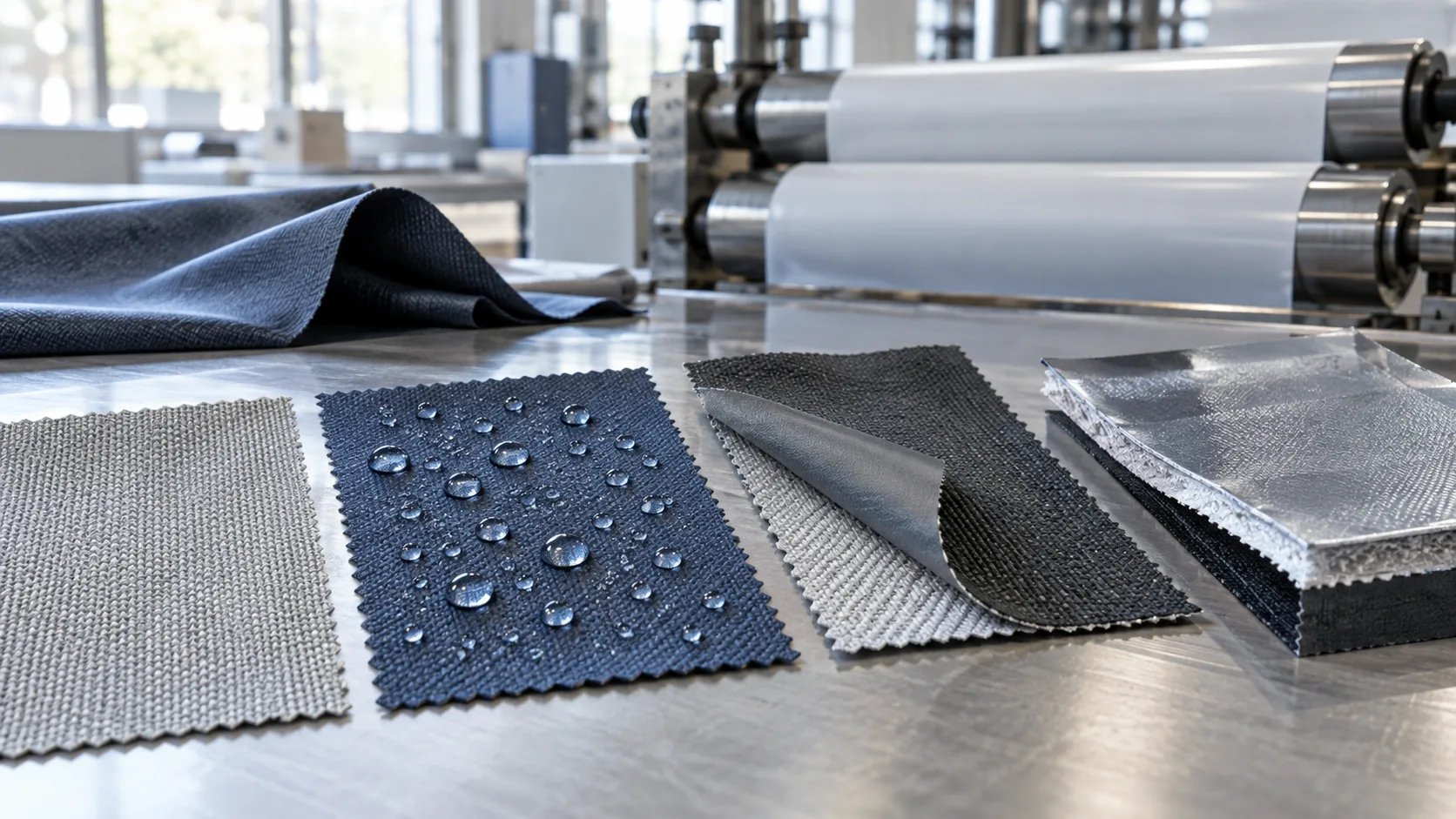
A face finish and a barrier layer solve different water-management problems.
A durable water-repellent finish, or DWR, changes how the fabric surface wets. It can help droplets bead and shed, but it does not by itself convert a woven textile into a continuous barrier. Its retained effect should be checked after the care, abrasion, folding, or contamination conditions relevant to the product.
A coating is applied to the fabric and cured. A laminate bonds a separate film to the textile. Either can provide resistance to water penetration across an intact specimen when the selected material, application, and construction are compatible.
PU, PVC, TPU, and other named systems cannot be ranked universally. Buyers need the exact formulation or supplier grade, carrier fabric, layer side, thickness or add-on where specified, adhesion, flex behavior, processing window, and evidence from the actual construction. A barrier that works on a flat swatch may change after folding, abrasion, heat, humidity, or repeated use.
The current ASTM D751-26 coated-fabric standard separates hydrostatic resistance, coating adhesion, low-temperature behavior, seams, aging, blocking, and other properties into distinct tests. One result is not a complete coated-fabric quality score. Water requirements should also be connected to how a backpack is made, especially where cutting, folding, joining, load-bearing construction, and abrasion zones can affect the barrier.
Why Do Seams, Zippers, and Openings Matter?
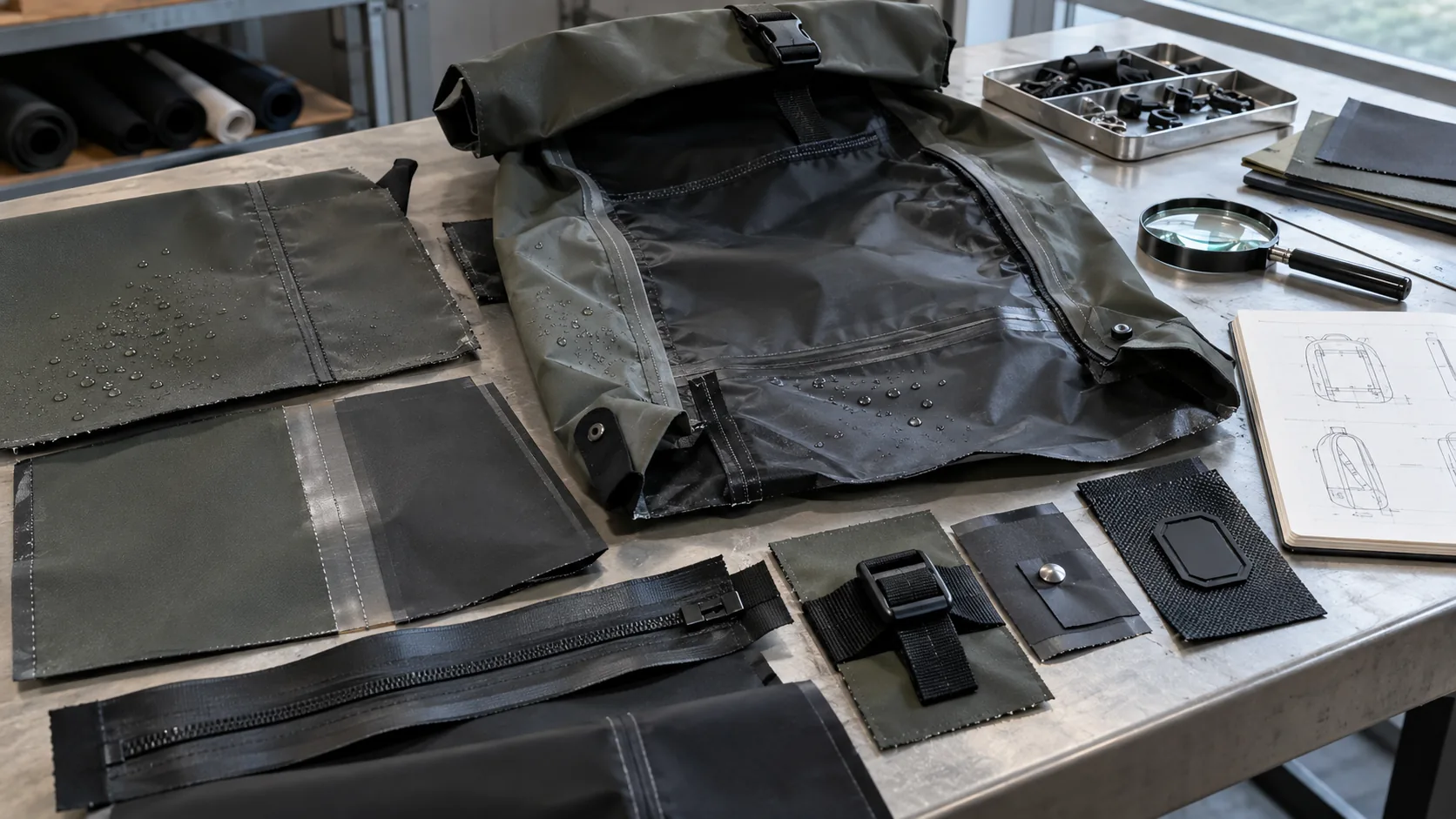
A finished bag is a network of panels, joins, closures, and attachments. The barrier can be continuous in a fabric swatch and interrupted during assembly.
Map every likely ingress path before the first sample:
- stitched seams and needle holes;
- seam ends, intersections, bartacks, and binding;
- zipper tape, teeth or coil, slider, ends, garages, and installation seams;
- flaps, drawcord collars, roll-top folds, and other openings;
- webbing anchors, rivets, grommets, logo attachments, and hardware penetrations; and
- mesh, drainage points, or unprotected pockets connected to a protected zone.
Seam tape can cover a compatible stitched seam, while welding can join compatible layers without a conventional needle line. Neither feature is an automatic guarantee. Coverage, geometry, temperature, pressure, dwell, surface preparation, adhesion, and later flexing all influence the result. A treated main seam can still be bypassed by an untreated attachment beside it.
Closures also require their own evaluation. A water-resistant zipper, storm flap, or roll top changes the ingress path, but the result depends on installation and how the user closes the bag. A custom waterproof backpack therefore has to be reviewed as a system rather than as barrier fabric plus a list of “waterproof” components.
How Is Water Resistance Tested?
Different methods answer different questions, so start with the claim and specimen rather than selecting a familiar test name.
Surface wetting. The current AATCC Manual announcement lists TM22-2024, Water Repellency: Spray. This method family evaluates surface response to spray; it should not be presented as a hydrostatic or finished-bag result.
Fabric resistance to water penetration. AATCC TM127 and ISO 811:2018 address resistance of fabric to water penetration under hydrostatic pressure. ISO confirmed its 2018 edition as current in 2025. These methods qualify the tested fabric specimen under their stated procedures, not a completed bag.
Seams and closures. A seamed assembly or closure zone needs a method and fixture suited to that construction. Keep the specimen identity, orientation, conditioning, exposure, endpoint, and observations with the result.
Finished-bag exposure. No universal finished-bag protocol or grade covers every design and end use. Define a project-specific rain, spray, wet-contact, or immersion scenario only when it matches the intended claim. Record closure state, load, orientation, duration, water delivery or depth, inspection timing, and failure definition.
| Claim | Test object | Suitable evidence category | Boundary |
|---|---|---|---|
| Surface sheds water | Finished fabric face | Surface wetting or spray method | Does not prove pressure resistance |
| Fabric resists penetration | Exact coated or laminated fabric | Hydrostatic method | Does not include seams or closures |
| Seam manages water | Production-equivalent seam assembly | Defined seam exposure | Applies only to the tested construction |
| Closure limits ingress | Installed closure or bag zone | Directional exposure in service orientation | Depends on installation and closure state |
| Bag protects contents | Complete production-equivalent bag | Defined finished-product scenario | Supports only that scenario and acceptance rule |
Do not convert spray ratings, hydrostatic values, or finished-bag observations into one another. Retain the method edition, laboratory, sample identity, conditioning, result, and acceptance decision.
Is Polyester or Nylon Better in Wet Conditions?
Fiber names do not establish a universal winner. A coated polyester construction can outperform an uncoated nylon construction in one water test, while a different pair can reverse the result.
For a defensible comparison, align the intended use and then compare exact candidates on:
- yarn and fabric construction;
- finished mass and thickness;
- coating or laminate grade, side, and application;
- face finish and backing;
- seam and closure design;
- conditioning, aging, flexing, or abrasion before testing; and
- results from the same relevant method and endpoint.
Use the technical records for the specific polyester bag material and nylon bag material under consideration. Do not infer moisture uptake, drying, abrasion, ultraviolet durability, hand, or cost rankings across entire fiber families without matched evidence for the actual constructions.
Once a coating or laminate supplies the primary barrier, the layer system and its adhesion become central. The finished product still depends on seams, closures, openings, and workmanship regardless of the carrier fiber.
How Should Buyers Specify Water Protection for a Bag?
Begin with the service condition. “Waterproof” is not a complete request, so define the intended exposure before choosing materials or tests.
- Describe the use. Record product type, user, climate, carry duration, load, storage, care, and destination market.
- Name the water scenario. Distinguish surface shedding, limited rain, directional spray, wet-ground contact, and immersion. Do not treat them as a universal ladder unless the project defines one.
- Zone the bag. Mark the base, main compartment, lid, pockets, back panel, and external attachments according to the protection each area needs.
- Freeze the material system. Record base fabric, denier, weave, mass, finish, coating or laminate, side, supplier grade, color, and reference swatch.
- Map ingress paths. Identify every seam, zipper end, opening, binding, bartack, webbing anchor, rivet, grommet, logo, and drainage feature.
- Match evidence to the claim. State the specimen, method, edition, conditioning, endpoint, and acceptance criterion for fabric, assembly, closure, and finished product.
- Approve a production-equivalent sample. Retain its bill of materials, pattern, construction notes, test record, and physical reference.
- Define production controls. Check incoming material identity and screen workmanship on production units without treating lot checks as a replacement for design validation.
If water is found inside a sample, record the location, exposure condition, time, closure state, orientation, load, and reproducibility before naming the cause. Internal moisture is an observation; it is not proof that the fabric, seam, zipper, or workmanship alone caused the failure.
Resolve these fields during development with your custom bag manufacturer. Changing the protection target after patterns, tooling, and construction methods are approved can require a material and assembly redesign.
Frequently Asked Questions
Is uncoated polyester waterproof?
No. An uncoated woven polyester fabric is not automatically a continuous water barrier. Its surface wetting and resistance to penetration depend on the exact weave, finish, specimen condition, and test evidence.
Is 600D polyester waterproof?
Not from the denier label alone. Two 600D fabrics may use different weaves, masses, finishes, coatings, or laminates. Review the complete construction and relevant test result.
Does DWR make polyester waterproof, and will it remain after care?
DWR primarily changes surface wetting; it does not by itself prove a waterproof barrier. If retained performance matters, test the selected finish after the specified care, abrasion, folding, or contamination sequence.
Can seams let water through coated polyester?
Yes. Stitching and attachments can interrupt a coating or laminate. Evaluate the production-equivalent seam, any tape or welding, intersections, bartacks, binding, and adjacent penetrations.
Does a fabric water-column result prove that a finished bag is waterproof?
No. A hydrostatic result applies to the tested fabric specimen. A finished-bag claim also needs evidence for seams, closures, openings, assembly, and the defined product-use scenario.
Conclusion
Polyester is a fiber identity, not a waterproof rating. The usable water-protection specification combines the fabric construction, face finish, coating or laminate, seams, closures, openings, zone map, and matched evidence.
Separate surface wetting, fabric penetration, assembly leakage, and finished-bag exposure. Validate the design against the intended scenario, then use production checks to confirm that incoming material and workmanship continue to match the approved construction.
When the exposure and acceptance criteria are defined, review the available polyester bag material systems with the complete bag design rather than selecting by fiber name or denier alone.