
What is a neoprene bag, and what does that product name actually tell a buyer? It identifies a polychloroprene-based elastomer family, but it does not define the finished laminated sheet, seam construction, water protection, or service life of a bag.
In bag production, buyers usually encounter a flexible foam or rubber-like core laminated to one or two textile faces. The useful specification therefore has to describe both the material and the finished assembly. This guide separates those layers so a quote, sample, and production lot can be compared on the same basis.
What Is a Neoprene Bag?
Neoprene is a common commercial name associated with polychloroprene rubber. A historical technical bulletin archived by the US National Institute for Occupational Safety and Health describes neoprene as polychloroprene produced by polymerizing chloroprene. For bag sourcing, that chemistry is a starting point rather than a complete product specification.
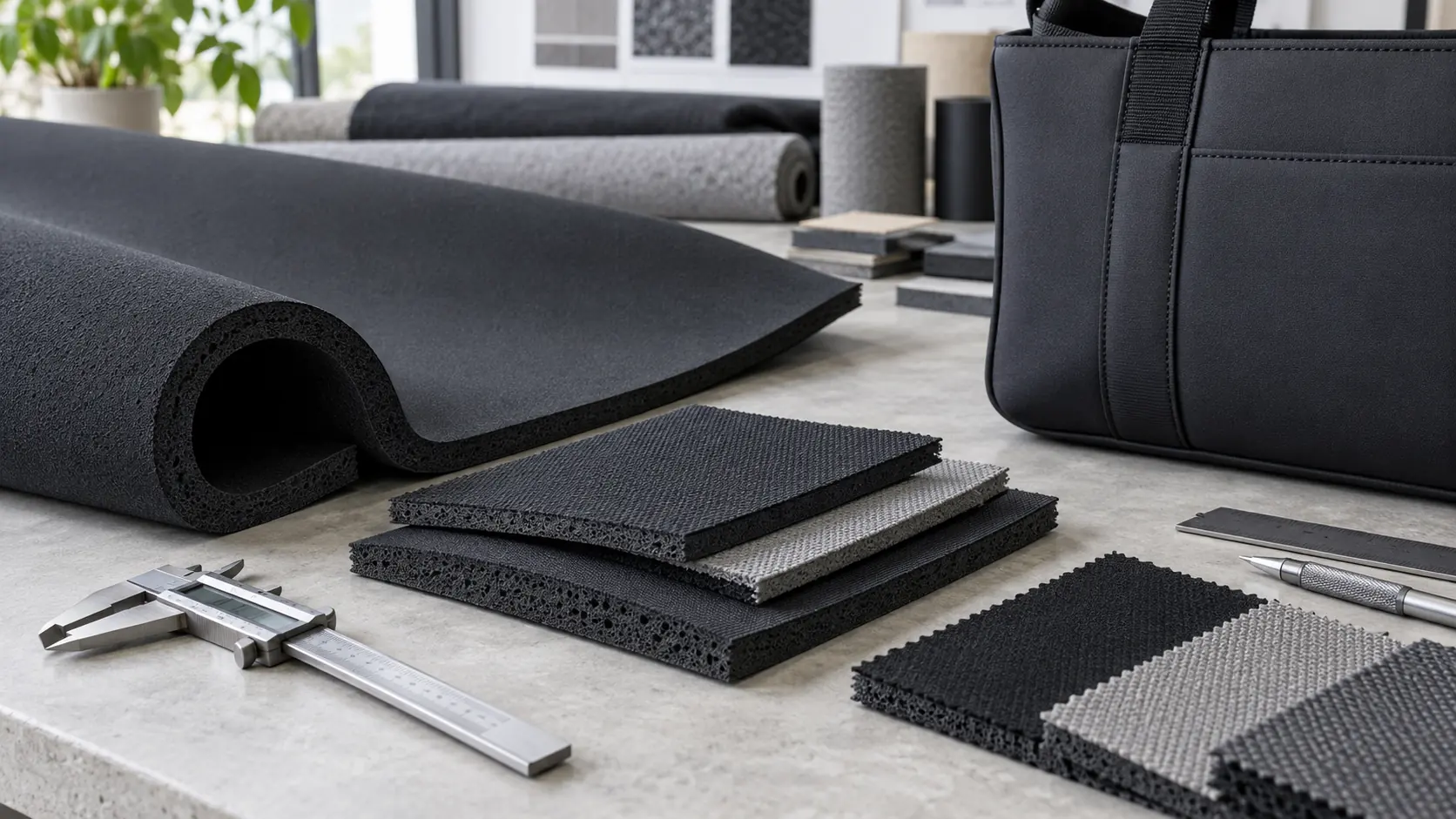
A supplier description should state what is actually being offered. Useful fields include the declared elastomer or supplier grade, foam type, color, finished thickness and tolerance, apparent density where relevant, textile face, backing, adhesive or lamination system, and intended bag component. If the quote uses the word “neoprene” without those fields, two suppliers may be pricing different constructions.
The material name also does not prove cushioning, insulation, odor, water protection, durability, or environmental performance. Those are claims about a defined test object under defined conditions. The evidence must match the exact sheet, composite panel, or finished bag being accepted.
What Is a Neoprene Bag Made Of?
Bag-grade neoprene is commonly supplied as a composite sheet. A foam or elastomer layer is bonded to a textile face, and some constructions use fabric on both sides. The face may support color, touch, printing, abrasion control, or sewing, while the core contributes flexibility and compression response.
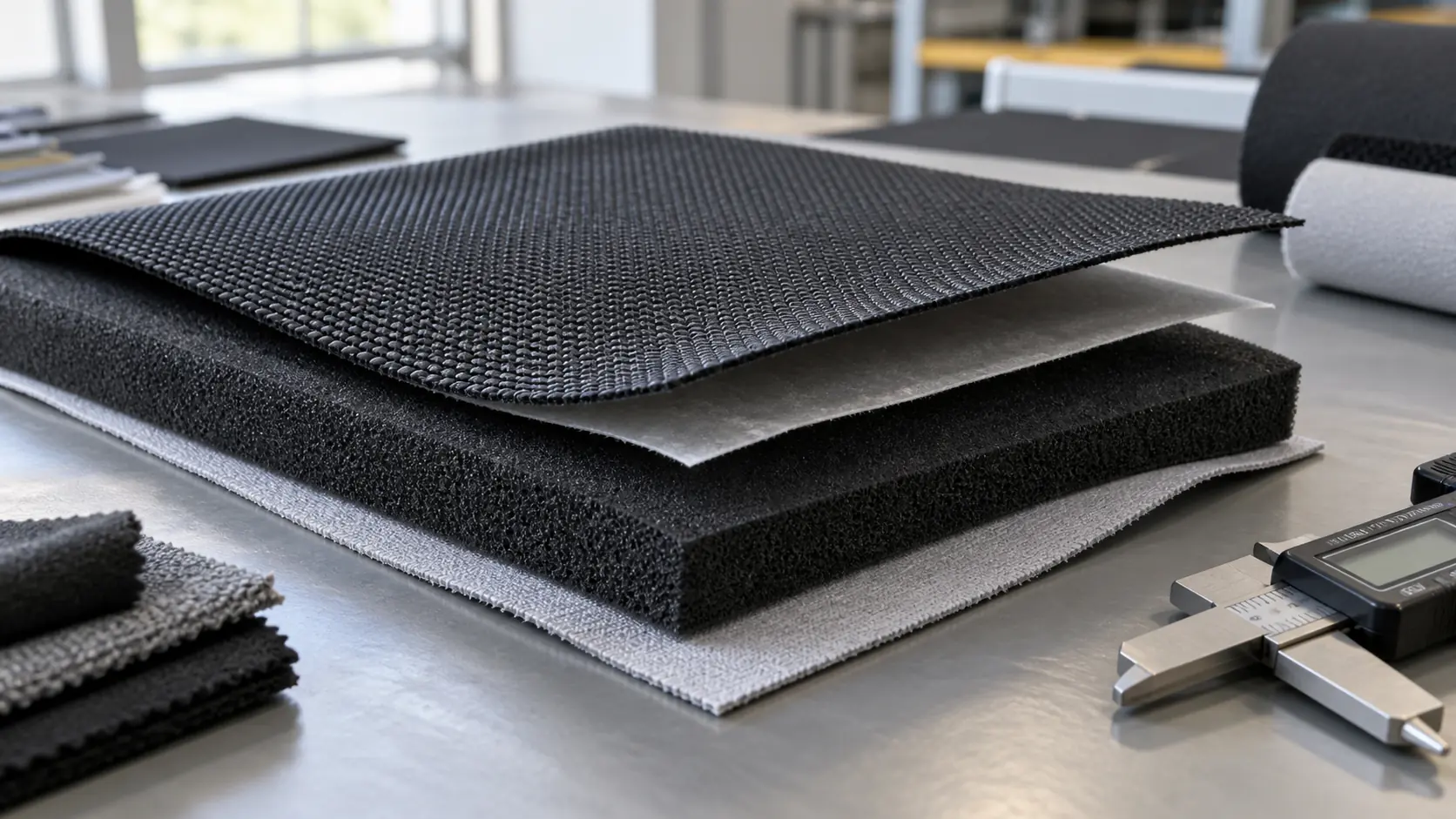
The complete interface recipe matters. Record both substrates, the surface or finish on each side, the adhesive code and form, layer order, edge construction, and the processing reference used for the approved sample. The same face-fabric name does not prove that a different backing, adhesive, or foam is interchangeable.
ISO currently lists ISO 2411:2024 as a method for determining coating adhesion strength in rubber- or plastics-coated fabrics. A relevant adhesion result can support one part of a material decision, but it does not validate sewing, handles, zippers, edge binding, or the complete bag.
When reviewing a neoprene bag manufacturer, ask for a traceable material reference and a finished sample. The broader guide to how a backpack is made also shows why cutting, feeding, stitching, reinforcement, and assembly have to be checked with the real composite rather than a loose swatch alone.
If a laminate starts to peel, first classify where the separation occurred: at an interface, inside an adhesive layer, inside a substrate, or as a mixed failure. That observation helps define the next investigation, but it is not a root-cause conclusion by itself.
Which Properties Matter in a Neoprene Bag?
Thickness is easy to see on a quotation, but it is only one property. Apparent density, hardness, compression response, compression set, tensile or tear behaviour, odor, and laminate adhesion describe different questions. Thicker, denser, or harder is not automatically better.
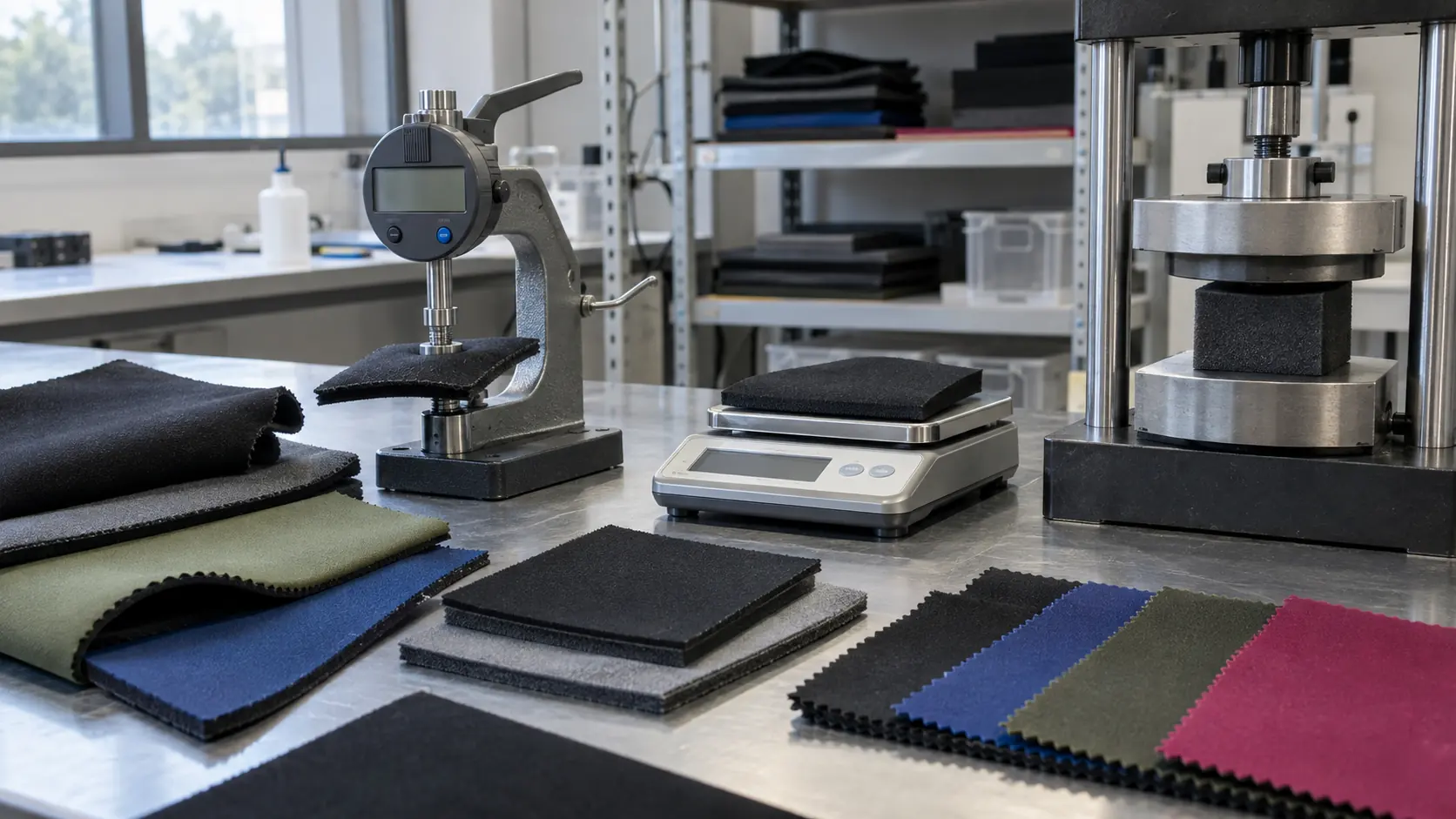
ASTM currently lists ASTM D1056-20 for flexible cellular sponge and expanded rubber. Its scope includes separate physical-property requirements and test methods, reinforcing the practical point that one nominal value cannot stand in for the entire material response.
Start with the bag’s use and failure mode:
| Design question | Field to control | Finished-sample check |
|---|---|---|
| Does the panel fit the pattern and seam stack? | Finished thickness and tolerance | Sewn dimensions, edge bulk, zipper alignment |
| Does the bag recover after packing? | Compression response and recovery | Shape after the agreed packing and recovery cycle |
| Does the panel feel too soft or too firm? | Hardness or defined compression measure | Handling of the approved bag sample |
| Does the laminate remain intact? | Interface recipe and adhesion evidence | Edges, bends, seams, and stressed zones |
| Does the product control light knocks? | Complete panel and construction | Use-case or impact check on the finished sample |
Insulation requires the same discipline. Foam structure can influence heat transfer, but the result also depends on thickness, lining, closure, seams, openings, contents, starting temperature, ambient conditions, and test duration. Do not promise a number of cooling or warming hours unless the exact finished product was tested under stated conditions.
Is Neoprene Waterproof?
The material name does not make a finished bag waterproof. A closed-cell or low-absorption sheet may resist water at the material level, while needle holes, seams, zipper ends, bindings, cut edges, logos, and the opening remain possible entry paths.
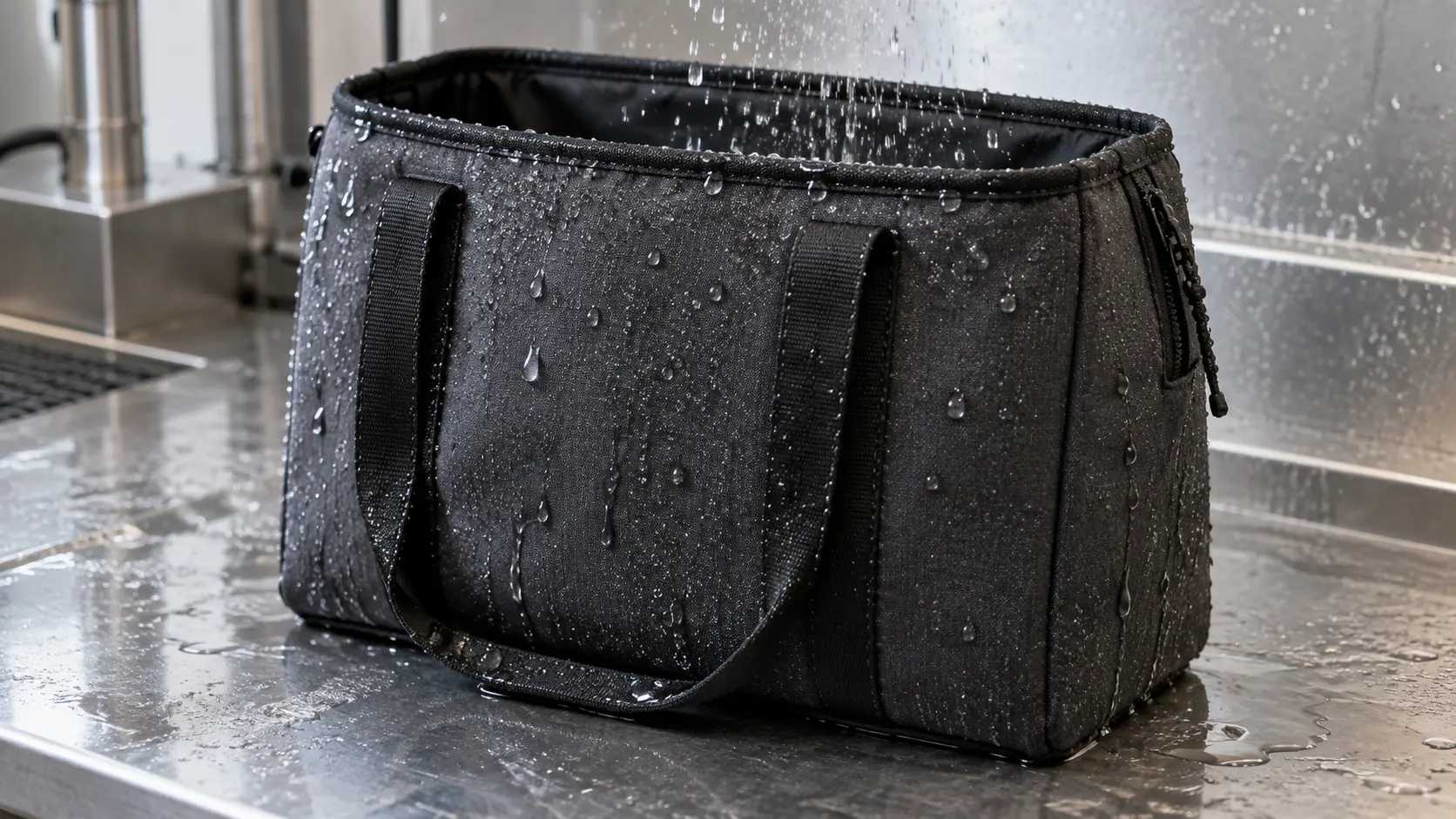
This is a test-object boundary. A result from a foam specimen or flat laminated panel cannot be transferred automatically to a seam, interface, or complete bag. Define the exposure first: incidental splashes, rain, standing water, water pressure, or submersion are different claims and need different constructions and evidence.
For a standard sewn bag, “water resistant” may be the more defensible description when evidence supports it. A stronger waterproof claim needs finished-product validation that includes the actual seams, closure, attachments, orientation, duration, and acceptance criteria. The same distinction is central to waterproof backpack construction.
What Is a Neoprene Bag Used For?
For buyers asking what is a neoprene bag used for, common examples include tote bags, lunch carriers, bottle sleeves, laptop sleeves, cosmetic pouches, sports accessories, and reusable presentation packaging. Neoprene composites can be considered when a design needs flexible structure, a soft surface, compact packing, or moderate cushioning.
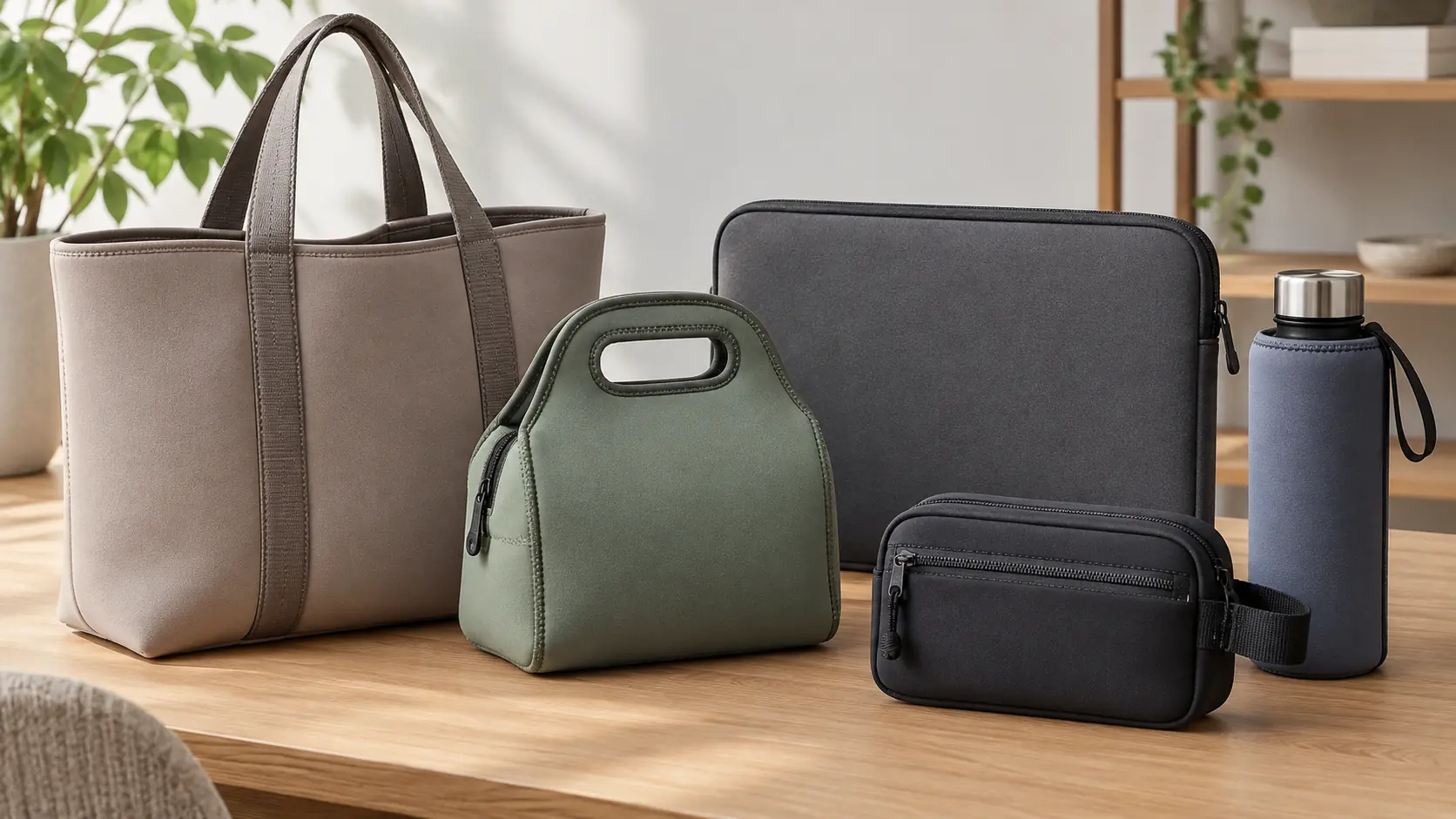
The product category does not determine one correct material. A laptop sleeve may prioritize fit, zipper clearance, lining, and corner construction. A lunch carrier may prioritize cleanability, closure, lining, and a product-specific insulation test. A sports pouch may need ventilation or drying guidance. A tote may place more stress on handle anchors and seam reinforcement.
For a new program, define the contents, load, carry method, exposure, cleaning method, retail position, packing method, and required evidence before selecting the sheet. A custom bag manufacturer can then translate those use conditions into a pattern, material stack, construction sample, and quotation rather than treating “neoprene bag” as one fixed specification.
How Does Neoprene Compare with Polyester, Nylon, and EVA?
Compare complete candidate constructions for the same component and use. Neoprene, polyester, nylon, and EVA name different material families or layers, but those names alone do not create a universal ranking for weight, cushioning, abrasion, water protection, breathability, price, or sustainability.
| Comparison field | Buyer question |
|---|---|
| Component | Are both candidates being compared as the same shell, lining, foam, or insert? |
| Construction | What are the face, core, backing, finish, and interface recipe? |
| Physical fields | Are thickness, finished mass, density, and tolerances aligned? |
| Processing | Do cutting, printing, sewing, bonding, and edge finishing suit the candidate? |
| Evidence | Do both results use the same test object, method, conditions, and endpoint? |
| Commercial basis | Are quantity, color, decoration, packaging, evidence, and delivery assumptions equivalent? |
A textile shell may be preferable when low bulk or airflow is important, while a laminated foam panel may be useful when flexible cushioning is part of the design. Those are design directions, not guaranteed outcomes. Use the same controlled comparison when evaluating nylon bag material or polyester bag material.
EVA is often considered for molded or more structured components, but its performance also depends on grade, density, thickness, geometry, lamination, and processing. Compare prototypes when shape retention, compression, or impact protection drives the decision.
What Should Buyers Check in a Neoprene Sample?
Approve the material record and the finished construction together. The sample should be traceable to the quoted material, color, finish, adhesive system, thickness tolerance, decoration method, trims, and packaging plan.
Use a checklist tied to the expected risks:
- measure the agreed dimensions and finished thickness at defined locations;
- compare color, surface, hand, odor, and visible defects with the approved reference;
- inspect lamination at edges, folds, printed zones, and stressed areas;
- check stitching, seam allowance, binding, zipper alignment, and handle anchors;
- evaluate shape recovery after the agreed packing simulation;
- test water or insulation claims on the finished product under stated conditions;
- confirm decoration appearance and adhesion on the production material;
- record care instructions that match the final combination of materials and trims.
When a defect appears, keep the investigation chain intact: observation, location, sample identity, time, exposure, competing hypotheses, verification method, result, and remaining uncertainty. That record prevents an early guess from becoming a false root cause. Reviewing comparable bag project case studies can help a sourcing team frame pilot checks, but acceptance criteria still belong to the current specification.
How Should Neoprene Bags Be Cleaned and Maintained?
Care instructions must belong to the finished product, not the generic material name. A bag may combine a textile-faced foam, print, adhesive, thread, binding, zipper, hardware, lining, reinforcement, and label. One cleaning method may suit the base sheet but damage another component.
Until the care method has been validated, use conservative language: follow the product label, remove loose debris, spot-test an inconspicuous area, avoid unapproved solvents and high heat, and dry the bag fully under the stated conditions. Do not promise that every neoprene bag can be machine washed or soaked.
Odor complaints also need investigation rather than a universal remedy. Record whether the odor is present at unpacking or develops after use, where it is strongest, how the bag was stored, whether moisture or contamination was involved, and whether the affected sample matches an approved reference. Ventilation may help some packaging-related odors, but persistent or unusual odor should be handled through the supplier’s quality process.
Frequently Asked Questions
Is neoprene a rubber?
Neoprene commonly refers to polychloroprene rubber. A bag-material specification still needs the declared supplier grade and the complete laminated construction.
Does a neoprene product contain natural rubber latex?
Do not answer from the product name alone. The main sheet may be polychloroprene-based, but adhesives, elastic, trims, coatings, or other components can differ. Request a supplier declaration and any market-specific evidence needed for the exact finished product.
Is a neoprene bag waterproof?
Not automatically. Material-level water resistance does not validate sewn seams, zippers, openings, edges, or attachments. Match the finished-bag claim to a defined exposure and test.
Does neoprene keep food or drinks cold?
It may contribute to an insulated construction, but cooling performance depends on the whole bag and the test conditions. Do not state a duration without product-specific evidence.
Can a neoprene bag be machine washed?
Only if the finished product’s validated care instruction allows it. Heat and agitation can affect laminates, prints, trims, hardware, or shape, so the product label should control the answer.
Conclusion
A complete answer to “what is a neoprene bag?” starts with the material family but does not end there. A sourcing-ready specification records the declared material, foam or sheet construction, textile faces, interfaces, thickness and tolerance, relevant physical fields, component, processing, and evidence required for the intended use.
Approve the traceable swatch and the finished sample, then keep changes under revision control. When the construction and acceptance plan are ready, contact us today to develop and quote the bag against those controlled fields.