
A broad backpack label can hide the access, carrying system, dimensions, or protection the intended user needs.
The main types of backpacks are grouped by use, carrying system, access, structure, capacity, and special function. One model may fit several groups, so choose from the user, contents, carry time, environment, and sales channel before specifying its features.
This approach turns category names into a backpack design that can be measured, sampled, and evaluated.
How Are Backpack Types Classified?
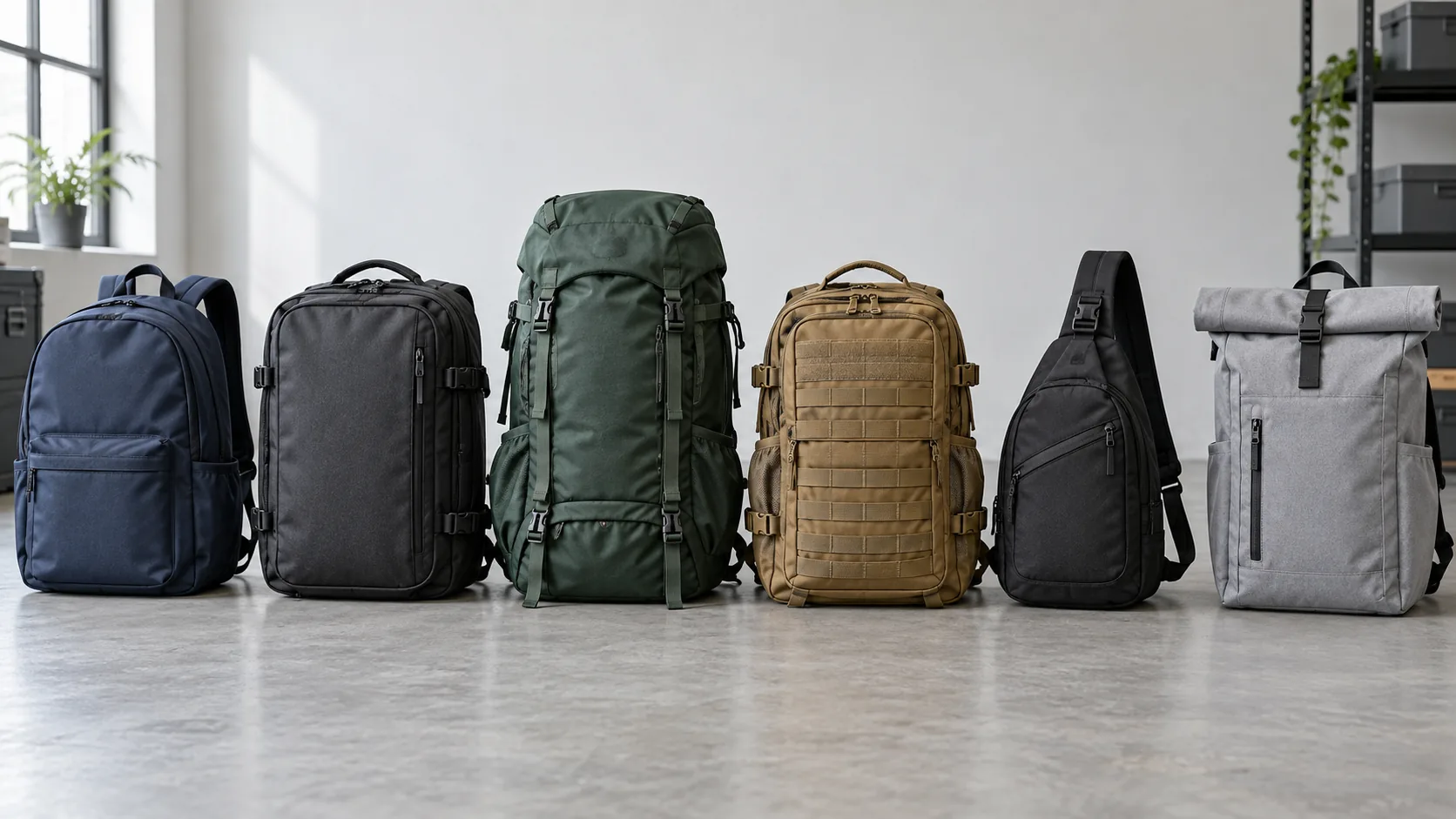
Merriam-Webster defines a backpack broadly as a pack usually carried on the back with two shoulder straps. The market then divides that broad family through overlapping layers rather than one universal taxonomy.
| Layer | Selection question | Examples of variation |
|---|---|---|
| Use | Who carries it, where, and for what? | School, commute, travel, trail, sport, work |
| Carrying system | How does the bag connect to the user? | Two straps, single sling, sternum strap, hip belt, frame |
| Access | How are contents reached? | Panel zip, clamshell, top load, roll top, side or rear access |
| Structure | What supports the bag and load? | Soft body, padded panel, frame sheet, internal frame |
| Capacity and dimensions | What must fit, and within which outside limit? | Item fit, usable volume, packed width, height, and depth |
| Special function | What extra task must the bag perform? | Device organization, hydration, modular attachment, weather protection |
A laptop travel backpack may also be a commuter, carry-on, smart, or anti-theft design. The category name helps position the product; the complete feature stack determines how it is built and evaluated.
Once the category is selected, terms such as frame sheet, sternum strap, compression strap, and hydration port still need to become explicit specification fields.
Which Everyday, School, Laptop, and Commuter Backpacks Fit Daily Use?
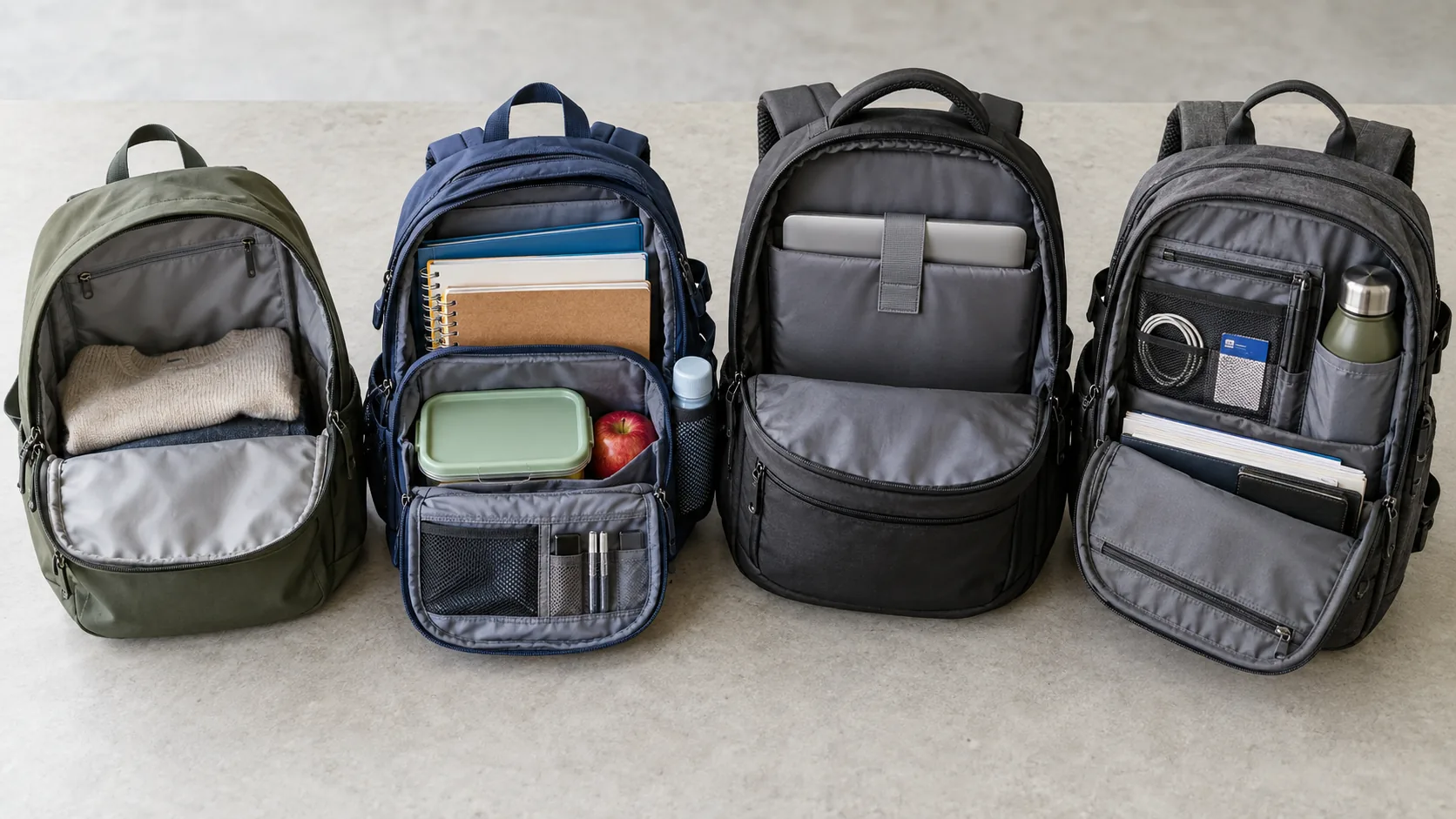
Daily-use backpacks overlap heavily. Their meaningful differences are the contents, access pattern, carry duration, visibility needs, and cleaning conditions.
- Everyday backpacks may use a simple main compartment with limited organization or a more structured pocket plan.
- School backpacks often need room for books, devices, stationery, food, and bottles, but those contents vary by age and market.
- Laptop backpacks add a sleeve or compartment sized to a stated device envelope. Padding, suspension from the base, closure, and movement control must be specified rather than inferred from the label.
- Commuter backpacks commonly prioritize quick access to work or transit items, device organization, and a carrying system suited to the planned trip.
Do not assign one standard capacity to this family. Start with the actual item list, including the largest device and thickest object. Then check the opening, pocket dimensions, base, packed shape, strap adjustment, and cleaning requirements against that load.
A reflective detail does not make a product visible in every condition, and a padded sleeve does not guarantee device protection. Each claim needs a defined use condition and an appropriate product check.
How Do Travel, Carry-On, and Convertible Backpacks Differ?
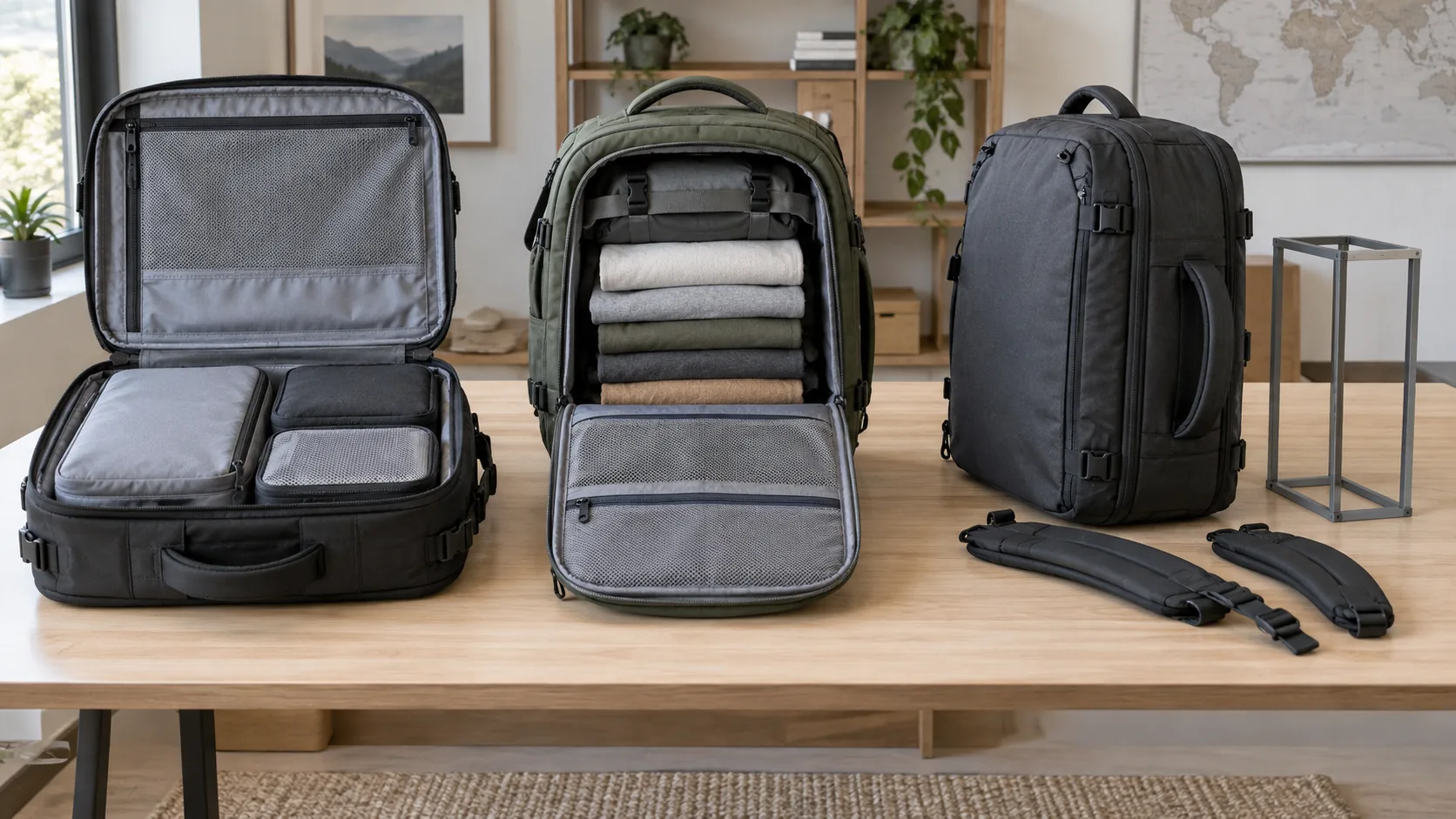
Travel backpacks are shaped by packing access, packed external dimensions, and the time spent carrying the load.
- Clamshell designs open around most of the perimeter for suitcase-like packing.
- Panel-opening designs give broad access without separating the bag into two full halves.
- Top-loading travel packs favor a vertical packing sequence but can make lower items harder to reach.
- Convertible backpacks add hand, shoulder, or duffel-style carry. The added handles, anchors, and stowage panels become part of the load path.
- Stowable carrying systems cover or contain straps and belts when they are not in use, but the closed arrangement still needs a packed-dimension check.
“Carry-on” is an intended use, not approval by every airline. Eligibility depends on the operating airline’s current allowance and the bag’s packed external dimensions, including bulges, handles, wheels, and attachments where applicable. The guide to measuring a backpack explains why measurement points and product state need to be recorded.
Capacity is a separate field. ASTM F2153 covers a standardized method for measuring capacity in backpacks and listed related bags. Outside length × width × depth describes a bounding box; it does not establish usable internal volume.
What Separates Daypacks, Hiking Packs, and Backpacking Packs?
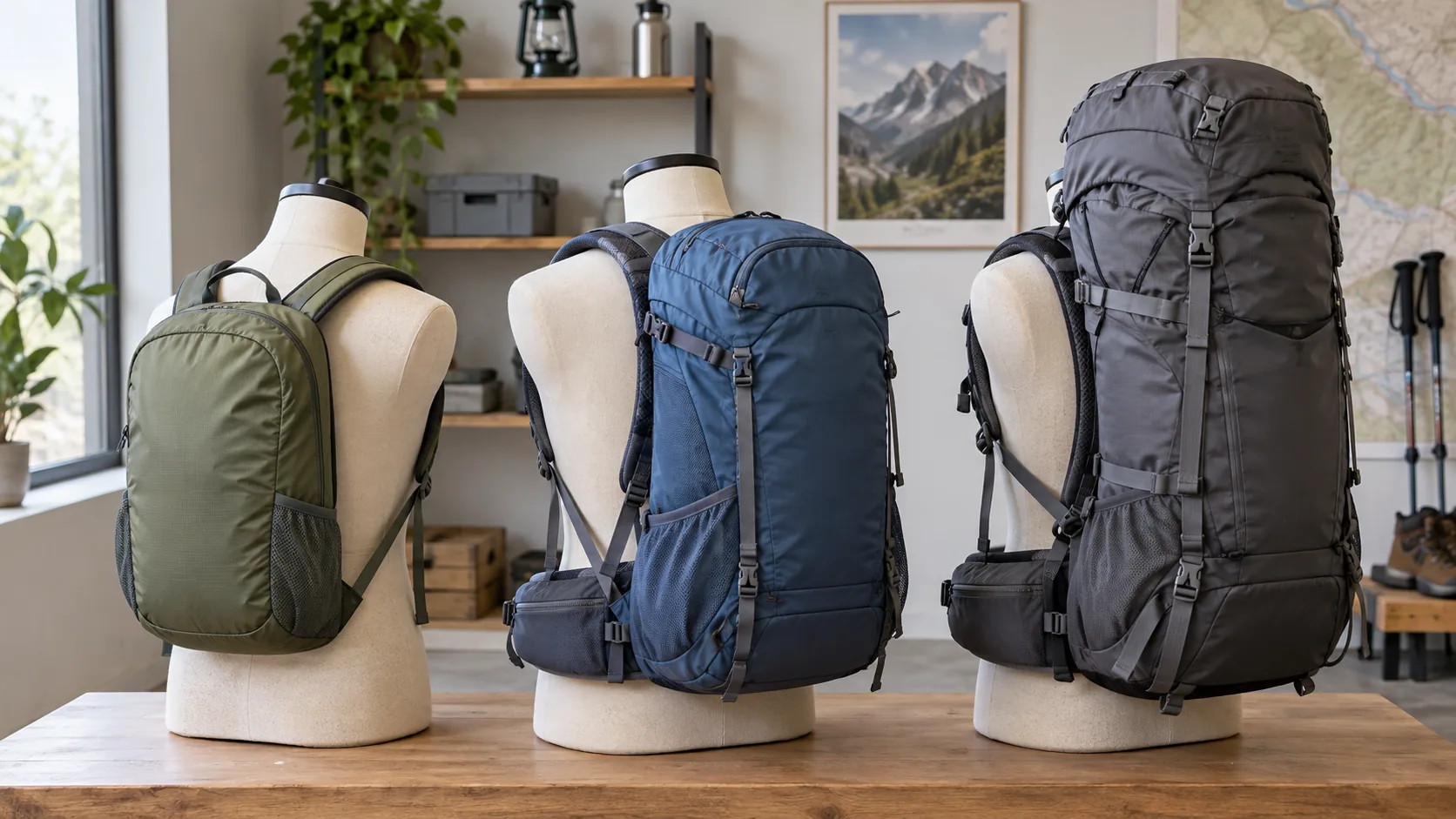
These types overlap in market language, so compare the intended load, carry duration, fit range, access, and weather plan.
- Daypacks are intended for shorter outings or smaller loads, though neither word establishes a capacity or carrying limit.
- Hiking packs may add a shaped hip belt, frame sheet, sternum strap, compression, hydration routing, and external attachment.
- Backpacking packs commonly use a more developed frame and adjustment system for longer-duration or larger-load use.
A hip belt can change how forces are distributed, but the result depends on bag structure, belt setup, load, user, activity, and measurement method. A PLOS ONE load-carriage study compared multiple configurations of one hip-belt backpack and measured separate endpoints, including pressure, strap forces, and pack movement. Its results do not transfer automatically to another design.
Evaluate the intended configuration and representative load. Shoulder load, strap tension, contact pressure, pack movement, perceived comfort, and component strength answer different questions. Avoid medical claims about posture, pain, or injury prevention.
For adjacent selection decisions, the guide to choosing a hiking backpack covers use, fit, access, and weather requirements in more depth.
What Do Tactical, PALS, and MOLLE Backpack Labels Mean?
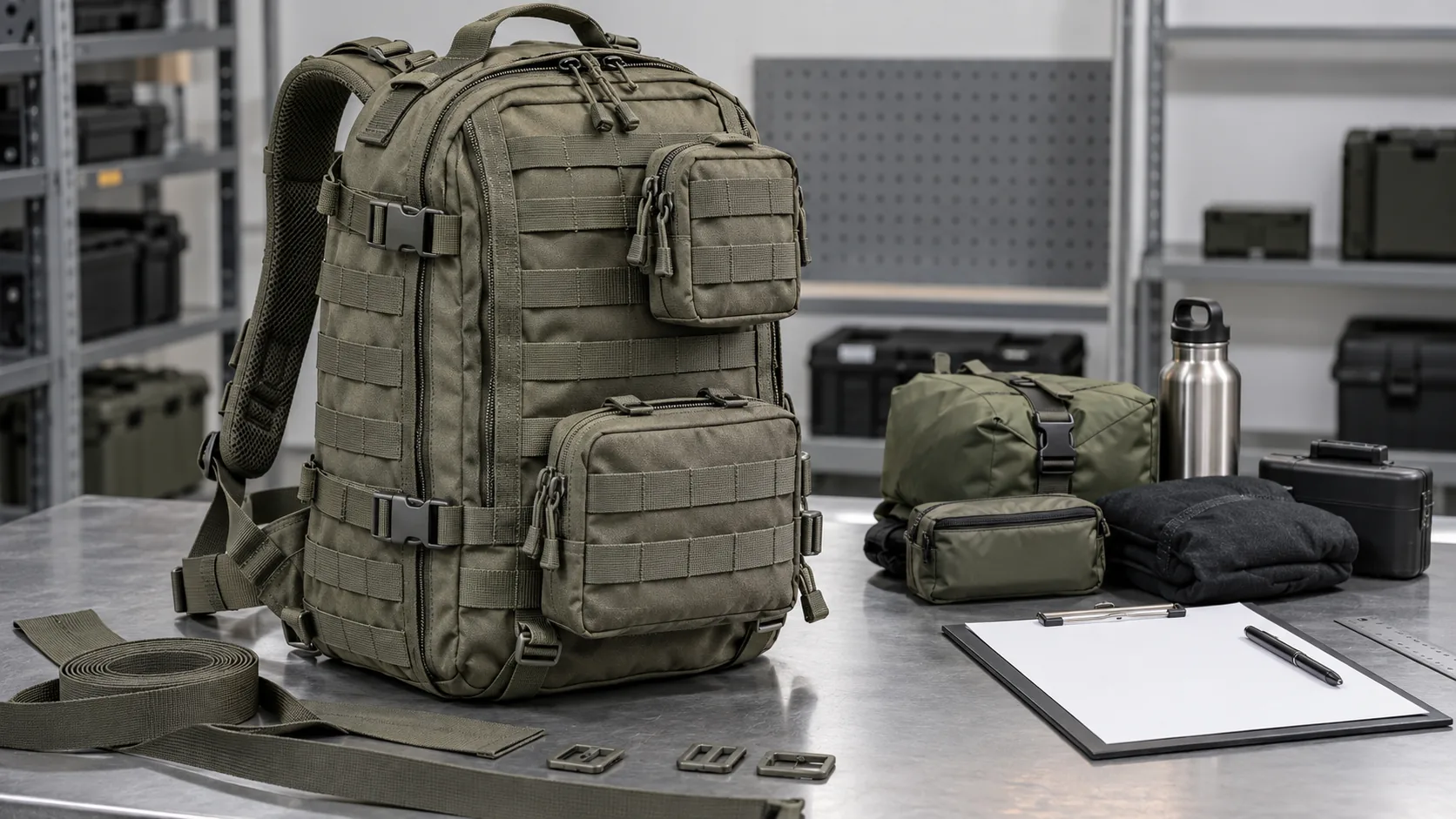
Tactical and load-carrying packs are usually positioned around modular attachment, organization, reinforcement, and field-oriented access. The labels do not prove military adoption, compatibility, or performance.
The US Army’s TM 10-8470-210-10 distinguishes the terms: PALS means Pouch Attachment Ladder System, while MOLLE means Modular Lightweight Load-Carrying Equipment. PALS is the attachment interface used within the broader equipment-system context.
For a commercial backpack described as “MOLLE compatible,” specify and verify:
- webbing layout, spacing, material, and stitching;
- the attachment and locking method;
- the actual pouch or accessory to be fitted;
- access and interference when adjacent rows are loaded;
- anchor construction and reinforcement; and
- the product configuration, payload, movement, and endpoint used for evaluation.
Cosmetic ladder webbing does not establish PALS geometry or safe load. “Military grade” and “heavy duty” are also product descriptions unless they point to a complete applicable specification and evidence.
Teams developing this category can use the tactical backpack construction page to move from market positioning into defined interfaces and components.
Which Flexible and Purpose-Built Backpack Formats Solve Specific Tasks?
Flexible formats change carrying or access; purpose-built backpacks organize around a specific payload.
| Format | Primary design decision | What the label does not prove |
|---|---|---|
| Sling backpack | Single-strap geometry, bag position, rotation, and target load | All-day comfort or a universal load limit |
| Roll-top backpack | Opening geometry, roll count or closure state, and secondary access | Waterproof finished-bag performance |
| Drawstring backpack | Cord path, opening, reinforcement, and intended light-load use | Security, weather protection, or durability |
| Packable backpack | Folded package, deployed shape, material, seams, and target contents | Capacity, strength, or long-term crease resistance |
| Camera backpack | Equipment fit, dividers, padding, access, and movement control | Impact protection for every camera system |
| Hydration backpack | Reservoir fit, suspension, hose routing, and separation from cargo | Compatibility with every reservoir or freedom from leakage |
| Sports backpack | Equipment fit, separation, ventilation, lining, and cleaning | Odor control, hygiene, or liquid containment |
A separate compartment proves only that items occupy different spaces. Sealing, ventilation, odor control, cleanability, and leakage containment are different requirements.
The payload should drive the pattern. A camera body and lenses need different access and movement control from a hydration reservoir, wet sports kit, helmet, or pair of shoes.
What Do Anti-Theft, Smart, and Waterproof Backpacks Really Mean?
These labels describe intended features or performance, so each needs a defined claim boundary.
- Anti-theft backpack: name the threat being addressed and the deterrence feature, such as concealed access, lockable zipper pulls, or a pocket placed against the body. Deterrence is not guaranteed theft prevention.
- Smart backpack: list the actual electronics-related components, power-source arrangement, connectors, cable routing, and device requirements. A pass-through port does not establish charging compatibility or device safety.
- Waterproof backpack: define the water-exposure scenario, product state, duration, orientation, and endpoint. Material, seams, closures, and attachment points form one finished system.
ISO 811:2018, confirmed current in 2025, specifies a hydrostatic-pressure method for fabric resistance to water penetration. Its test object is fabric, not a complete backpack. A material result cannot establish the performance of installed seams, zipper ends, openings, or carrying-system attachment points.
The same evidence boundary guides waterproof backpack construction: select the exposure and claim first, then use evidence that tests the correct object.
How Should Brands Choose a Backpack Type for Development?
Start with the user and payload, then complete the specification fields that affect the pattern, materials, and validation plan:
- User and channel: intended user, market, sales channel, and use setting.
- Representative payload: item list, largest object, total mass, distribution, and quick-access items.
- Carry duration and movement: walking time, activity, bag position, and adjustment needs.
- Access architecture: panel, clamshell, top load, roll top, side access, rear access, or a controlled combination.
- Capacity and packed dimensions: method, measurement points, product state, loading rule, and endpoint.
- Carrying system: shoulder straps, adjusters, sternum strap, hip belt, back panel, frame sheet, stays, and torso relationship where applicable.
- Organization: pocket dimensions, device or equipment fit, separation, and access sequence.
- Materials and load path: shell, lining, coating, zipper, hardware, webbing, seams, anchors, reinforcement, and base.
- Exposure and care: rain, splash, dirt, abrasion, cleaning method, and the exact performance wording sought.
- Branding and packaging: artwork, placement, color and finish references, packed shape, and shipping support.
- Sample validation: sample identity, configuration, payload, conditioning, activity or fixture, duration or cycles, inspection point, endpoint, and acceptance criterion.
Do not approve a backpack from appearance alone. A fabric report, buckle result, seam specimen, loaded carry evaluation, and finished-bag exposure test answer different questions. Keep each result attached to its test object, method, sample version, and conditions.
Existing project evidence can help teams frame checks without copying unrelated acceptance limits. For a new program, the custom backpack development page is the next step once the category and controlled fields are ready.
Frequently Asked Questions (FAQ)
What type of backpack works for everyday use?
Choose from the actual daily contents and carrying time. Confirm opening, organization, device fit, base, packed dimensions, strap adjustment, and cleaning needs instead of relying on the everyday label.
Are travel backpacks automatically accepted as carry-ons?
No. Compare the packed external dimensions and weight with the operating airline’s current allowance. A travel label or liter rating does not guarantee acceptance.
What should a laptop backpack specify?
Specify the device envelope, sleeve position, padding or structure, base relationship, closure, and movement control. Then evaluate the sample with a representative device or controlled equivalent.
What separates a daypack from a backpacking pack?
Market usage overlaps. Compare intended load, carry duration, frame and adjustment, access, organization, attachment, and weather plan rather than using one capacity cutoff.
Is a MOLLE backpack the same as military equipment?
No. MOLLE names a broader equipment-system context, while PALS identifies the attachment interface. A commercial compatibility claim still needs its geometry, attachment, accessory fit, and load conditions verified.
Conclusion
Backpack categories help narrow the search, but they do not complete a product brief. Define the user, payload, carry time, access, dimensions, carrying system, organization, materials, exposure, and validation conditions before approving the type.
Those controlled fields give a manufacturer enough information to quote and sample the intended backpack rather than interpret a market label.