
Most backpacks should not go in a tumble dryer unless the care label or the manufacturer explicitly permits it. Heat and drum movement can affect coatings, foam, adhesives, prints, plastic hardware, and the bag’s shape.
When the label is missing or unclear, empty the backpack, open every compartment, blot excess water, and air-dry it in shade with good airflow. Check padded areas before storage because the shell can feel dry while the back panel or straps still hold moisture.
Can You Put a Backpack in the Dryer?
Usually, no. Follow the care label for the exact backpack. If it says “do not tumble dry,” the dryer is not an option. If it permits tumble drying, use only the stated temperature and cycle.
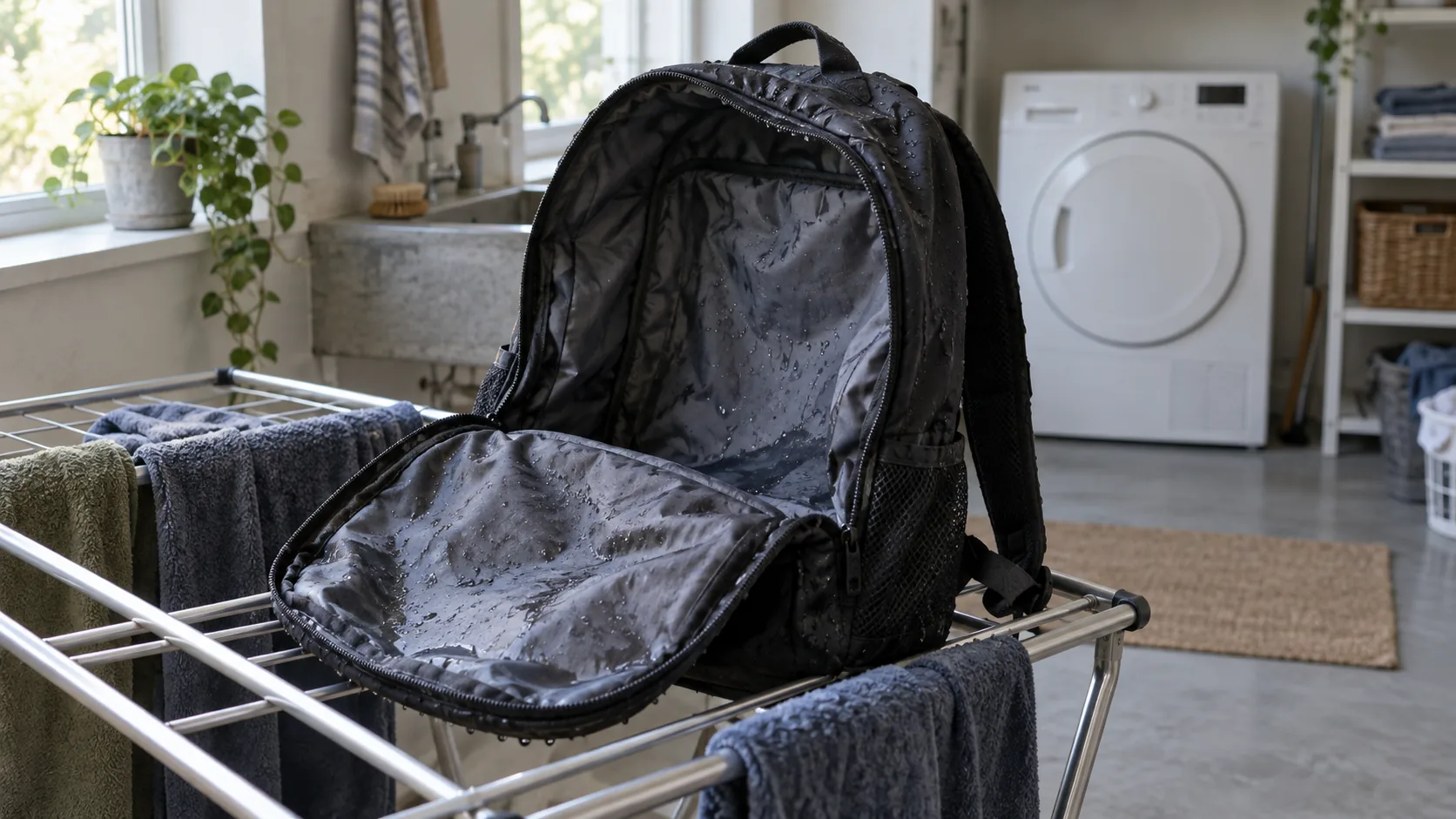
Major backpack brands commonly recommend air drying. JanSport’s backpack care guide says not to use a dryer because it can damage the backpack. The North Face advises spot cleaning its backpacks and letting them air dry. Deuter’s care instructions also say not to put a backpack in a dryer because the process can damage the PU coating.
Care symbols help when the sewn label is still readable. The GINETEX care-symbol guide uses a circle inside a square for tumble drying. Dots indicate the permitted heat level, while the crossed symbol means do not tumble dry.
A fabric description cannot replace the finished-product label. Two packs made from similar nylon can have different instructions because one may contain thick foam, a coated lining, a rigid frame sheet, printed graphics, or bonded components.
If the backpack needs cleaning before drying, use the manufacturer’s directions. The guide to cleaning a tactical backpack explains how to empty compartments, remove detachable parts, and clean coated or structured packs without treating every construction the same way.
Why Can Heat or Tumbling Damage a Backpack?
A dryer exposes the entire backpack to warm moving air and repeated impacts against the drum. The shell fabric is only one part of the product.
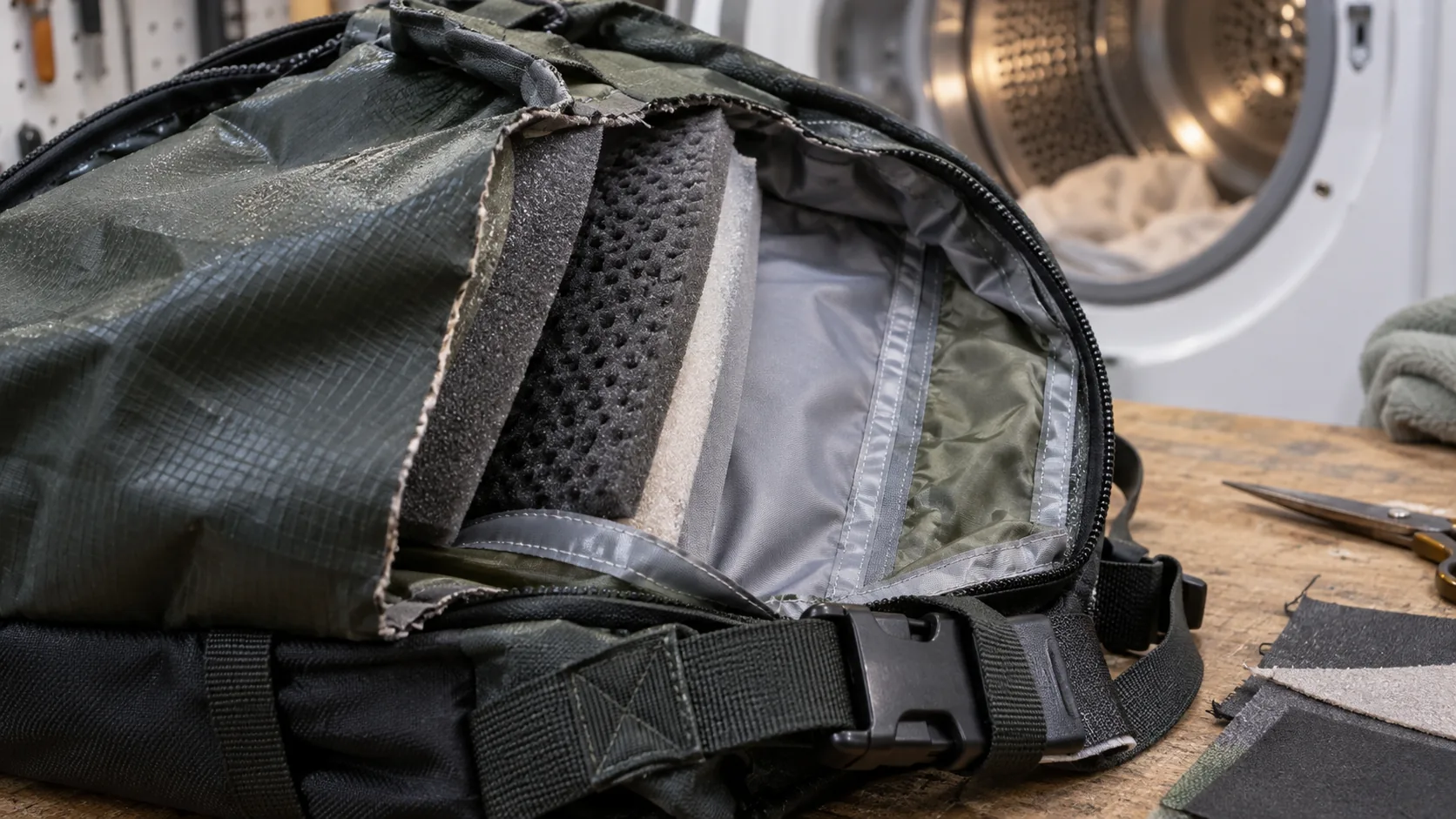
These components can respond differently:
- Coatings and laminates: PU coatings, seam treatments, and bonded layers can change in appearance, hand, adhesion, or water performance when exposed to unsuitable heat.
- Foam padding: shoulder straps and back panels contain thick layers that hold moisture and depend on their shape. Tumbling can shift, crease, or compress them.
- Adhesives and bonded parts: some labels, prints, reinforcements, and laminated panels depend on heat-sensitive bonding.
- Plastic hardware: buckles, adjusters, zipper components, and molded panels can strike the drum or change shape if the conditions exceed their design limits.
- Straps and loose webbing: long straps can snag, twist, or pull against attachment points.
- Frames and inserts: a rigid or semi-rigid part can stress the fabric, machine, or surrounding construction as the pack tumbles.
No-heat or air-only tumble settings remove the heating risk, but they still move the backpack through a drum. Do not assume that “no heat” is safe unless the product instructions allow that treatment.
Direct heat outside a dryer also creates risk. Deuter recommends drying a backpack away from electric heaters, open flames, and direct sunlight. Place the bag where air can circulate rather than against a radiator or under a hot hair dryer.
Industry insight: Approved care card `CARE-02` separates coated-fabric guidance from finished-backpack guidance. For PVC or PVC+PU coated fabric, the material supplier’s instructions may address cleaner choice, friction, rinsing, and complete drying around folds and seams. Those directions do not automatically cover foam laminates, prints, hardware, leather trim, or the assembled backpack. Confirm the coating system and follow the finished product’s care label first. The boundary is supported by Scantarp’s maintenance guidance for PVC and PVC+PU coated fabrics.
Which Backpack Features Require Extra Caution?
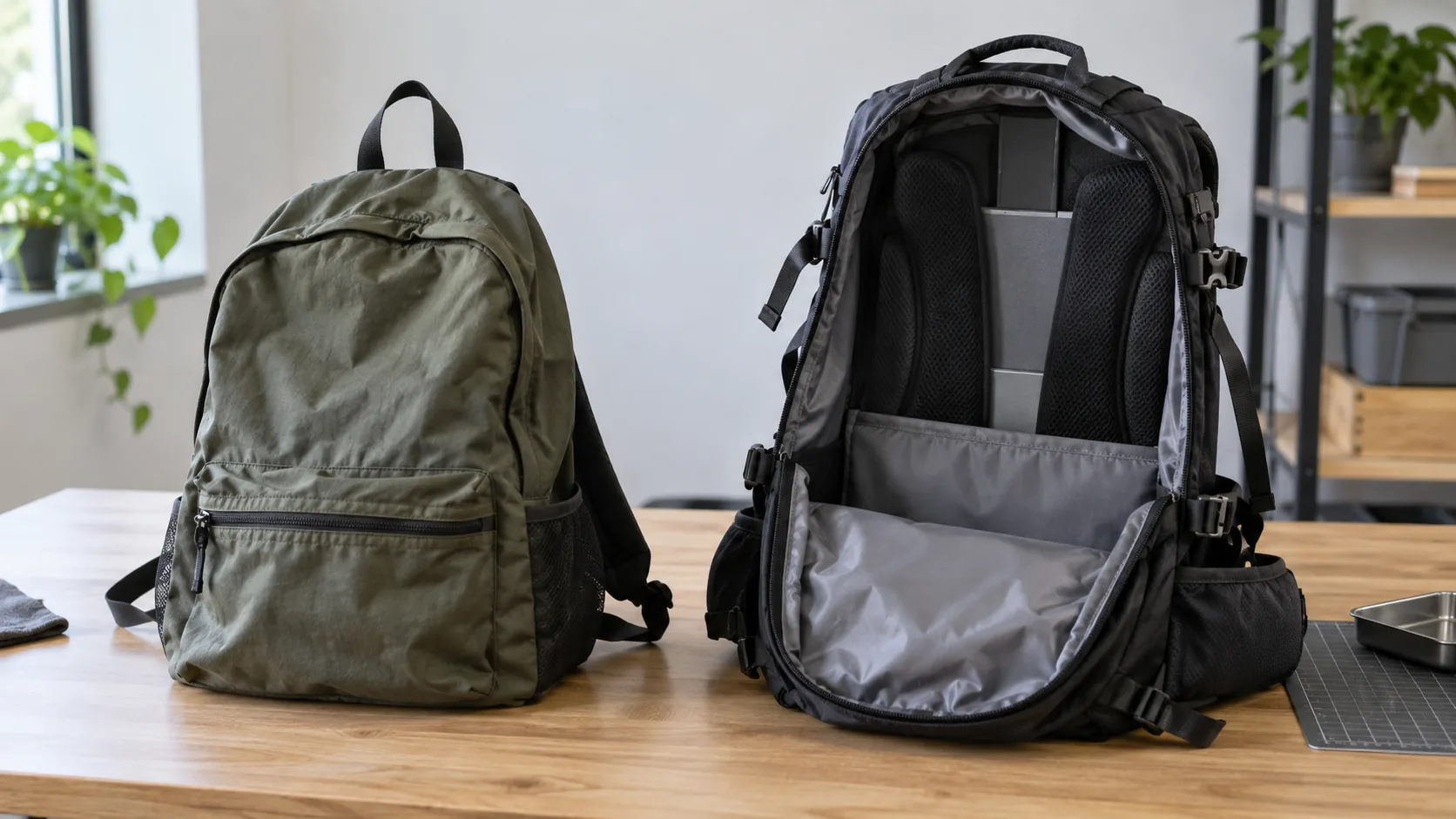
Padded, coated, structured, or electronic backpacks need more caution than a simple unlined fabric sack. The care label still controls the final decision.
| Backpack feature | Why it changes the drying decision | Safer default |
|---|---|---|
| PU-coated or laminated fabric | Heat may affect the coating or bond | Air dry and follow the material-specific label |
| Thick foam straps or back panel | Padding holds water and depends on its shape | Blot, support, ventilate, and check last |
| Internal frame, frame sheet, or stays | Drum movement can stress rigid parts and seams | Remove only if the manufacturer designed it to be removable; otherwise air dry the assembled pack |
| Leather or suede trim | Water and heat may change color, hand, or shape | Use the brand’s spot-care instructions |
| Printed or reflective details | Surface graphics and bonding can lift or distort | Air dry in shade |
| Molded panels or hard shells | Shape-dependent parts may not tolerate tumbling | Support the normal shape while drying |
| USB port, cable, light, or battery component | Electronics require separate care and may not be dryer-safe | Remove detachable electronics and never tumble dry the connected pack |
| Wheeled chassis | Bearings, frame parts, and molded housings complicate washing and drying | Wipe clean and follow the luggage manufacturer’s instructions |
| Simple unstructured washable bag | Fewer components reduce the number of risks | Follow the care label; do not infer permission from simplicity |
Do not dismantle a fixed back system simply to speed drying. Deuter warns that its fixed frames and rods are not designed for owner removal and may be damaged if reinstalled incorrectly. Remove only parts the product manual identifies as detachable.
How Should You Air-Dry a Backpack?
Air drying works best when water can drain, wet surfaces are separated, and room-temperature air reaches the padding and interior.
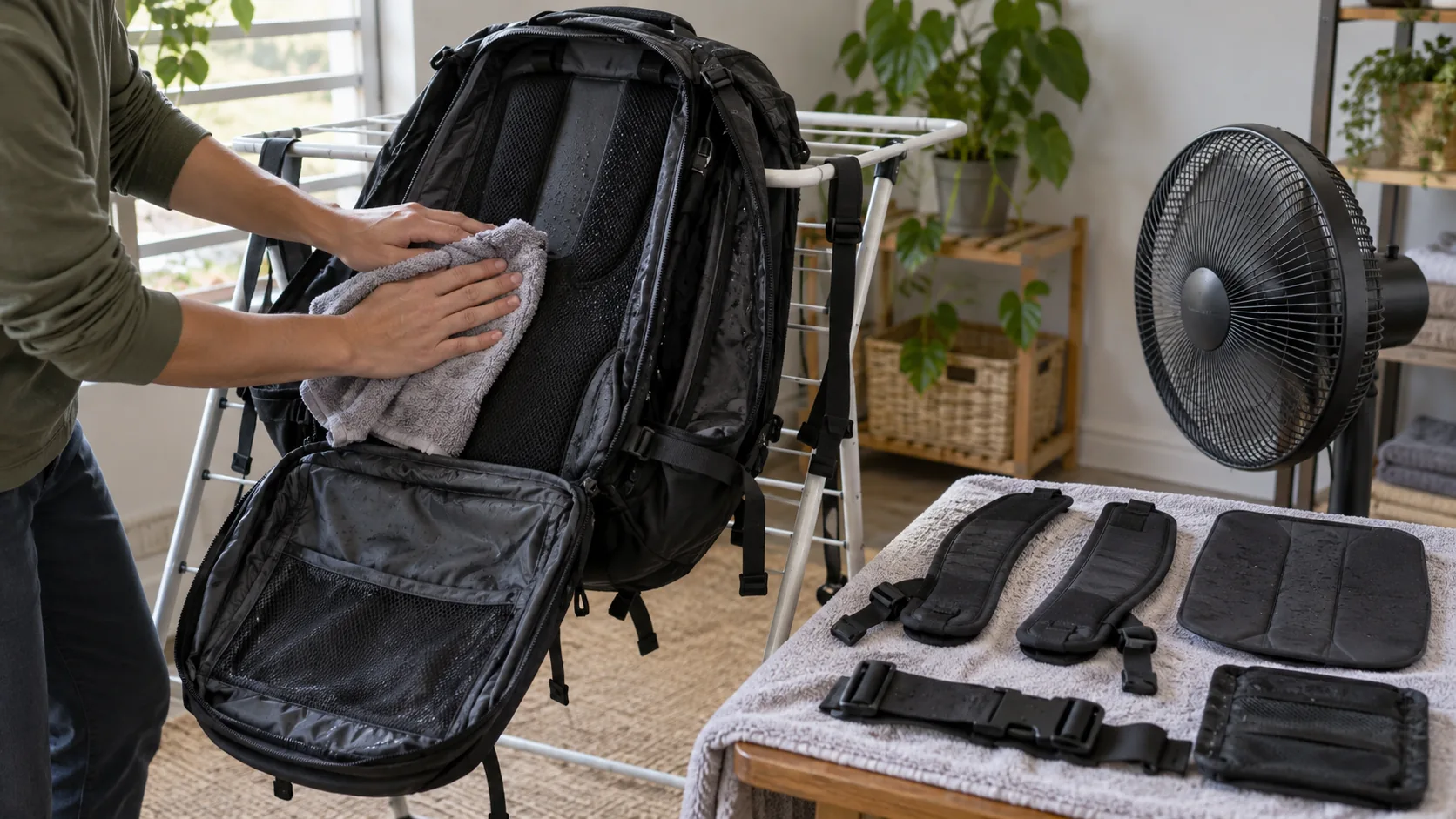
Use this sequence:
- Empty every compartment. Remove electronics, paper, food, and loose objects.
- Check the care label. Confirm whether the bag should be spot cleaned, hand washed, or handled another way before drying.
- Remove approved detachable parts. Separate rain covers, removable organizers, and inserts only when the design allows it.
- Drain excess water. Hold or place the pack so water leaves the pockets and base.
- Blot rather than wring. Press clean dry towels against the lining, shell, shoulder straps, and back panel.
- Open all zippers and flaps. Keep compartments spread apart so interior surfaces receive airflow.
- Support the pack. Lay it across a rack or hang it from a suitable point without loading one wet shoulder strap.
- Use shade and ventilation. An indoor ventilated room or shaded outdoor area protects the pack from concentrated heat and direct sun.
- Rotate it. Change the position so the base, back panel, and pocket corners do not remain against the same surface.
- Check thick areas before storage. Press the shoulder straps, back panel, base, and padded laptop sleeve. Leave the pack open if any area feels damp or unusually cool.
JanSport advises leaving the bag where it can air out until completely dry and warns that incomplete drying can lead to mold or fungi. REI’s backpack-cleaning guide also recommends air drying in the shade or indoors rather than using a dryer.
Once the pack is fully dry, inspect any water-repellent finish before applying another product. The guide to waterproofing a backpack explains why cleaning, drying, and compatible treatment should be handled as separate steps.
How Can You Dry a Backpack Faster Without Direct Heat?
Increase airflow, expose more wet surface area, and lower the room’s humidity. Do not solve slow drying by placing the pack against a hot appliance.
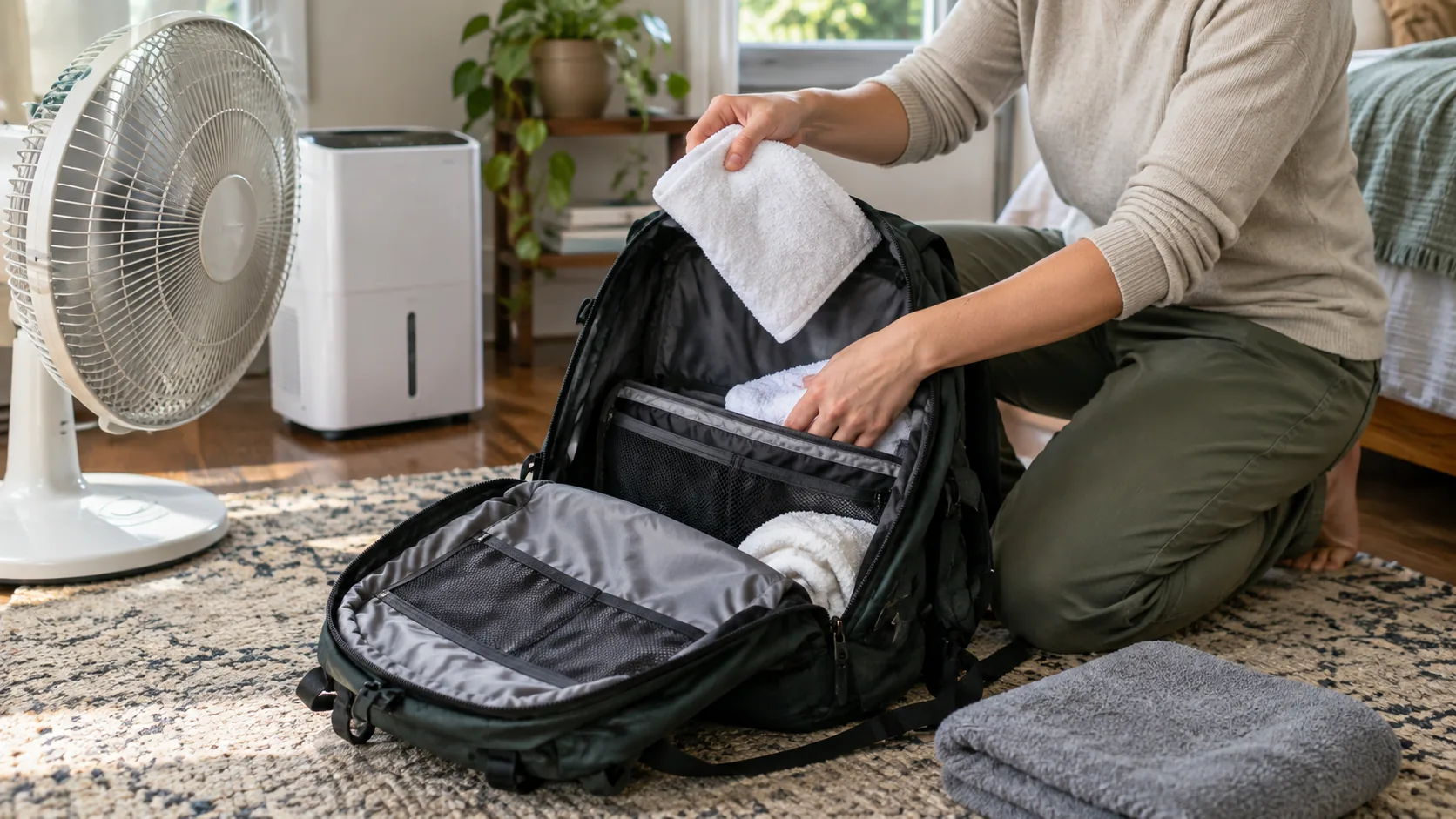
Practical ways to shorten the drying process include:
- aim a room-temperature fan across the open compartments;
- use a dehumidifier in a humid room;
- replace damp towels with dry ones after blotting;
- keep pockets, dividers, and laptop sleeves separated;
- reposition the bag so the base and back panel receive direct airflow;
- dry removable components separately.
Avoid stuffing the bag tightly with towels. A towel can absorb surface water, but leaving a wet towel packed inside blocks airflow and keeps moisture against the lining. Remove or exchange it once it becomes damp.
There is no reliable universal drying time. A thin daypack in a dry room and a padded hiking pack in humid weather will dry at different rates. Judge the pack by its thickest areas, not by the outer shell.
How Long Does a Backpack Take to Air-Dry?
Drying time depends on the construction, how much water remains after blotting, the room’s humidity, and the amount of airflow. A thin unlined bag may dry much sooner than a padded backpack with a laptop sleeve, foam straps, a coated lining, and several closed pocket corners. A fixed hour estimate would hide those differences.
Use condition checks instead of a timer. Reposition the backpack, press the base and padded areas, and compare the inside of deep pockets with the exposed shell. If a thick section still feels damp or noticeably cooler than the surrounding material, continue drying with the compartments open. Store the bag only when those slow-drying areas are dry.
What Should You Check After Accidental Dryer Use?
Stop the cycle, remove the backpack, and let it cool before inspecting it. Do not immediately run another cycle or apply more heat.
Check:
- the shape and symmetry of the back panel, shoulder straps, and base;
- foam for bunching, hard spots, flattening, or movement;
- internal coatings for bubbles, peeling, stickiness, cracking, or unusual stiffness;
- printed and reflective details for lifted edges or distortion;
- seams and binding for puckering or separation;
- zipper tape, teeth, coils, and sliders for misalignment or sticking;
- buckles and adjusters for warping, whitening, cracks, or incomplete closure;
- frame sheets, stays, and molded panels for changes in fit.
Operate every zipper and buckle after the backpack reaches room temperature. If a zipper now sticks, first identify whether the slider, teeth, coil, or surrounding fabric has changed. The guide to fixing a backpack zipper covers problems that can be handled without replacing the entire closure.
Contact the manufacturer if the coating separates, a structural panel deforms, hardware no longer closes correctly, or a load-bearing seam changes. Do not apply solvents, glue, ironing, or another dryer cycle without product-specific guidance.
What Should Brands Put in Backpack Care Instructions?
Care instructions should be based on the assembled product, not copied from the shell-fabric data sheet. The finished sample includes coatings, foam, thread, binding, prints, hardware, frames, and electronics that may set a stricter limit.
A useful care specification records:
- permitted cleaning method;
- permitted drying method;
- relevant care symbols and written instructions;
- whether any tumble cycle was actually validated;
- parts that must be removed before cleaning;
- parts that must not be removed;
- instructions for coated, printed, leather, suede, reflective, or electronic components;
- storage instructions requiring complete drying;
- after-sales steps for accidental machine washing or drying.
Validation should use a production-representative sample with the final materials and construction. If the finished pack has not been tested for tumble drying, do not infer permission from a washable fabric.
Brands comparing production partners can use the backpack manufacturers guide to review material documentation, sample approval, testing, and care-label controls before bulk production.
Frequently Asked Questions
Can I put a backpack in the dryer on low heat?
Only if the backpack’s care label or manufacturer explicitly permits low-heat tumble drying. Low heat is not a universal safe setting for coatings, foam, printed details, frames, or plastic hardware.
Can I use a no-heat tumble setting?
The setting removes heated air but still tumbles the backpack. Straps, frames, buckles, foam, and loose webbing may still be stressed. Use it only when the manufacturer allows it.
How do I dry a backpack quickly?
Open every compartment, drain and blot excess water, use a room-temperature fan, reduce room humidity, and reposition the bag. Keep it away from direct heat and inspect the padded areas before storage.
Is a backpack ruined if it went through the dryer?
Not necessarily. Let it cool and inspect the coating, foam, shape, seams, zippers, buckles, prints, and frame. Contact the manufacturer if a load-bearing, coated, or structural component changed.
How do I know the backpack is completely dry?
Press the shoulder straps, padded back panel, base, pocket corners, and laptop sleeve. The bag needs more time if any thick area feels damp or noticeably cooler than the surrounding material.
Final Answer
Do not put a backpack in the dryer unless its care label or manufacturer explicitly allows it. Air drying with open compartments, towel blotting, room-temperature airflow, and a final check of padded areas is the safer default for an unlabeled pack.